- Matching (Score) |
- Our verdict |
- Competing TVs |
- TV appearance |
- Where to buy |
- Contrast and black detail |
- HDR effect quality |
- Factory color reproduction |
- Color reproduction after calibration |
- Smoothness of tonal transitions |
- Image scaling and smoothness of tonal transitions |
- Blur and motion smoothness |
- Console compatibility and gaming features |
- Input lag |
- Compatibility with PC |
- Viewing angles |
- Daytime performance |
- TV features |
- Apps |
- Playing files from USB |
- Sound |
- Panel details
Philips PQS9011 / PQS9001 (The One 2026) Review
PQS9011 / PQS9001 / the one 2026

Available screen sizes:
Complete the survey to find out the result
Panel type: LCD VA Refresh rate: 144Hz Brand: PHILIPS Resolution: 3840x2160 System: Titan OS Model year: 2026
This review is an English translation of the Polish original. Read the original on Wybierz.tv.
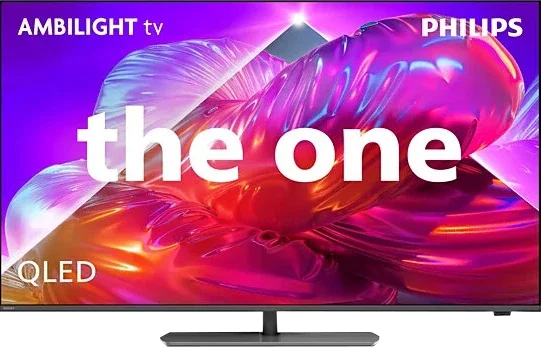
The One is one of Philips' most popular TV ranges. For years it has attracted buyers who want some of the capabilities of higher-end models at a reasonable price, while also enjoying Ambilight. This year's Philips PQS9011 / PQS9001 continues that approach, but the competition isn't standing still. In 2026, does that formula still make The One a worthwhile choice? We checked.
PHILIPS PQS9001 - Our verdict
6.8
Overall rating
The idea behind The One has hardly changed over the years and with the Philips PQS9001 this is both a strength and its biggest drawback. You still get a versatile mid-range television whose main distinguishing feature is Ambilight. The light that follows the picture can change the atmosphere of an evening viewing and for many people will be the main reason to buy it. It's easy to see why: once you like that effect, you often don't want to go back to watching without it. The picture quality itself is good, but a very similar level has been seen in this series in previous years. The VA panel delivers decent blacks, colours are nicely saturated and the brightness is sufficient for comfortable viewing in a typical living room. It's a pity, though, that Philips didn't take another step and at least implement some form of local dimming. In a dark room you can see a navy-black rather than true black, and HDR, though noticeable, is less impressive as a result. After so many years of The One on the market we'd expect more.
There is a clear step forward in Titan OS. Compared with last year, and especially the version from two years ago, the system has become much more pleasant to use. A few apps have been added, many small functions improved and the annoying bugs we complained about before have been fixed. Overall it runs respectably, although we're again bothered by a remote that has to be pointed at the television. Philips stubbornly sticks with infrared for basic control, even though voice control uses radio connectivity. That makes it harder to understand why radio wasn't also used for menu navigation. The One also has a lot to offer gamers. Four HDMI 2.1 ports and extensive features are one thing, but what impressed us most was the panel's response time. Our unit showed virtually no smearing, even on dark backgrounds, which is rare for LCD TVs with a VA panel. That deserves considerable praise. The ability to play in 4K at 144 Hz or in Full HD at 240 Hz further encourages connecting a PC. Unfortunately there's an unfinished element here too: Dolby Vision when gaming on Xbox incurs very high input lag.
The PQS9000 therefore leaves mixed impressions. It can surprise with excellent motion handling and shows that Philips has worked on the system, but the image quality lacks a similar step forward. This is a television we can recommend primarily to Ambilight fans. If that lighting is what convinces you to choose Philips, buying The One makes a lot of sense. It's worth checking, though, whether you can't find a Mini LED model with good local dimming at a similar price, which would offer deeper blacks and more striking HDR. Then you need to decide what matters more to you: the ambience created by Ambilight or better image quality itself.
Advantages

Ambilight, which gives evening viewing sessions a distinctive atmosphere and improves the perceived native contrast of the VA panel
Excellent panel response time: minimal motion blur of moving objects
Many gaming features: four HDMI 2.1 ports, VRR, ALLM, HGiG
144 Hz refresh at 4K and 240 Hz at Full HD from a PC
Good coverage of a wide colour gamut: PFS LED
Dolby Vision, which genuinely helps the TV with HDR content
Respectable brightness of around 500 nits, useful for daytime viewing
Swivelling base
Disadvantages

No local dimming: average blacks in the evening and limited HDR effect
Smaller app library than the competition
Poor viewing angles (can be mitigated with a swivel stand)
Very high input lag in games with Dolby Vision
Significant errors in HDR colour reproduction (no CMS adjustment available)
Infrared remote requiring direct aiming
 Movies and series in UHD quality
6.4
 Classic TV, YouTube
6.3
 Sports broadcasts (TV and apps)
6.8
 Gaming on console
7.4
 TV as a computer monitor
8.6
 Watching in bright light
6.1
 Utility functions
7.6
 Apps
Apps7.2
 Sound quality
6.9
Complete the survey to find out what fits your preferences
PHILIPS PQS9001 - Competing TVs in this price range
PHILIPS PQS9001 - TV appearance
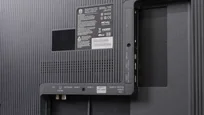
HDMI inputs: 0 x HDMI 2.0, 4 x HDMI 2.1 (48Gbps) Outputs: Toslink (Optical audio), eARC (HDMI), ARC (HDMI), Mini-Jack (Headphones) Network Interfaces: Wi-Fi 2.4GHz, Wi-Fi 5GHz, Ethernet (LAN) 100Mbps
Build quality: Good
Stand type: Central
Bezel color: Graphite
Stand: Fixed
Flat design: No
Accessories: Stand
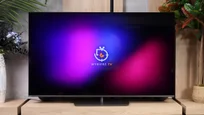
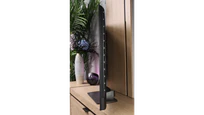
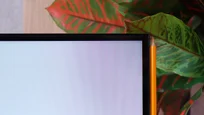
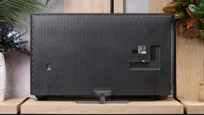
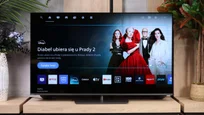
The look of the The One series has changed little over the years. The PQS9000 is simply a well-made LCD TV that sits nicely on a TV stand but doesn't try to pass for a top-of-the-range model. At the front there are fairly slim graphite bezels and a noticeably thicker bottom bezel. Most of its character, of course, comes from Ambilight: the light cast on the wall follows the colours on screen and can especially in the evening change the appearance of the whole room. An interesting addition is the central swivel stand. It lets you easily angle the screen towards the sofa or an armchair, a solution that is increasingly rare in TVs. The stand is plastic, so it doesn't feel particularly luxurious, but it does the job and doesn't require a wide TV stand. We do have one reservation about our sample. On that stand the screen sat slightly tilted to one side. Overall the build is fine, although the materials used and the finish of the stand make it clear this is a mid-range model.
Buy at the best price
Select size:

PHILIPS PQS9001 - Contrast and black detail
5.8/10
Local dimming function: No


Result
5,500:1

Result
3,950:1

Result
5,600:1

Result
5,750:1

Result
4,500:1

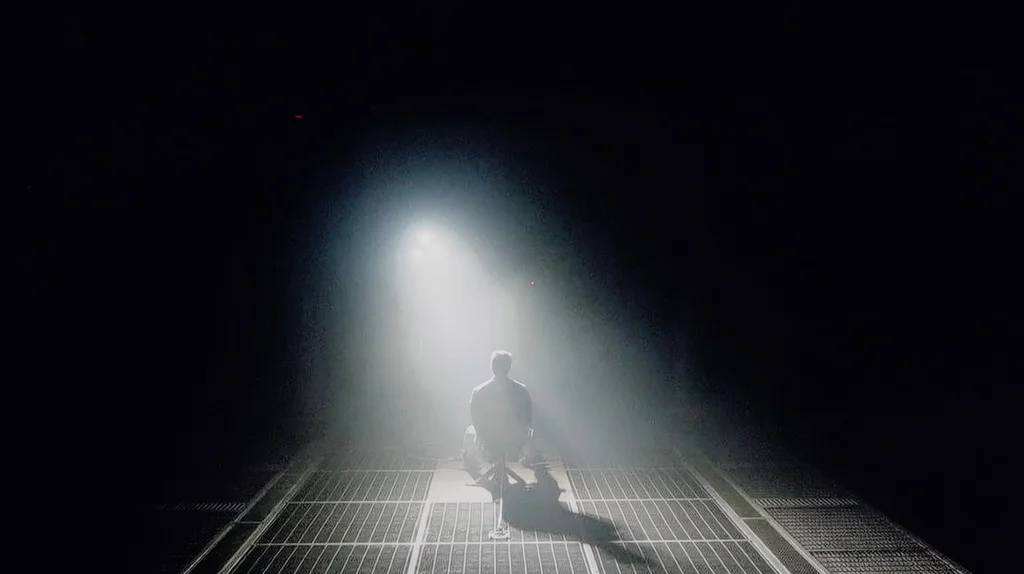
Black levels and contrast on the Philips PQS9000 are decent for an LCD TV without local dimming. That's mainly thanks to the VA panel; in our film scenes contrast often exceeded 5000:1, and in weaker results dropped to around 4000:1. That delivers an image with quite good depth and a clear advantage over typical IPS panels, where blacks are much more prone to looking grey. Unfortunately that's basically where the panel's strengths end. The TV has no local dimming, so it can't dim dark areas separately while retaining strong highlights elsewhere on the screen. All it has is global dimming, which brightens or dims the entire backlight at once. In a completely dark room these limitations become apparent: blacks take on a dark navy hue, and shadowy scenes lack the depth of a good screen with local dimming. Fortunately Ambilight helps here. The light on the wall makes the on-screen blacks appear deeper and slightly masks the panel's glow. That doesn't change the TV's actual contrast, but it affects how our eyes perceive it. In this case Ambilight is therefore not just decorative, as it can also make evening viewing more pleasant.
Halo effect and black detail visibility:
PHILIPS PQS9001 - HDR effect quality
5.5/10
Supported formats: HDR10, HDR10+, Dolby Vision, HLG
Luminance measurements in HDR:

Result
449 nit

Result
467 nit

Result
487 nit

Result
486 nit

Result
507 nit
Philips PQS9000 is a moderately bright TV. In our HDR scenes it reached roughly 450 to just over 500 nits. That's enough to notice a difference compared with SDR. Reflections of the sun, lamps or flares have a bit more sparkle than on basic TVs, whose brightness often tops out around 300 nits. However, it is not a level at which bright elements make a particularly strong impression. The biggest limitation remains contrast. Without local dimming, when the TV brightens a bright object it also raises the black level around it. There is therefore no clear separation of strong highlights from a dark background, and it is that contrast that can show what HDR can do. The PQS9000 offers more than the cheapest models, but despite decent brightness the effect remains fairly basic.
Colours
Philips deserves praise for the colours. Although the manufacturer calls this model QLED, in reality a PFS phosphor is used here instead of quantum dots. That choice does not prevent the TV from achieving good results. On both test patterns and in measurements of film scenes we recorded about 94% coverage of DCI-P3 and 75% of BT.2020. For this class of TV that is really good. In practice this means that the vast majority of colours used in HDR films and series will have appropriate saturation. Vibrant green or intense red are not much of an issue and add appeal to the picture. Limitations are easier to notice in some games and in rarer content that use the most saturated shades of the wide BT.2020 gamut. In such situations, displays with wider colour coverage, such as SQD or RGB LED, can show more. In its price bracket, however, the PQS9000 has nothing to be ashamed of.
BT.2020 color gamut coverage and primary color luminance
| Data set | BT.2020 | P3 | R | G | B |
|---|---|---|---|---|---|
| Synthetic patterns | 75.2% | 94.2% | 56% | 61% | 55% |
| Film measurements | 75.2% | 94.2% | 56% | 60% | 55% |
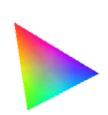 BT.2020
 BT.2020 and P3 – average color gamut coverage (percent of the target gamut).
R, G, B – average primary color luminance relative to target (percent).
Scene from the movie “Pan” (about 2800 nits)

Scene from the movie “Billy Lynn” (about 1100 nits)

In movie scenes the PQS9000 performs adequately, both with material around 1,100 nits and in more demanding shots reaching 2,800 nits. Compared with the reference monitor the overall image is preserved, though differences show up in the brightest areas. The sun in "Panie" or the fireworks in "Billy Lynn" sometimes merge into bright blobs, causing a loss of some detail and subtle transitions in the whites. This can give the impression those elements have been boosted, but it does not mean Philips is actually displaying them brighter than intended. At about 500 nits it has to fit much brighter material into the screen’s limited capabilities and does not always manage to retain all the detail. The elevated black level also robs scenes of depth, though it is not responsible for the loss of highlight detail. Overall it is pleasant to watch, but in such shots the difference to higher-end TVs is already noticeable.
HDR luminance chart:
We previously checked scenes from "Pan" and "Billy Lynn" in HDR10, so the good news is that the PQS9000 supports Dolby Vision. This format helps the TV distribute image brightness more effectively and preserve details that can be lost in blown-out highlights with HDR10. In the shot of the horses the difference is clear: in Dolby Vision you can see more texture in the snow, the blades of grass protruding from it and the trees in the distance. In HDR10 much of that background blends into a bright patch. Dolby Vision will not, of course, increase the panel's brightness or contrast, but it allows the panel's capabilities to be used better. On this Philips TV it is a useful addition that actually improves the appearance of demanding scenes.
Static HDR10

Dynamic: Dolby Vision

Factory color reproduction
5.1/10
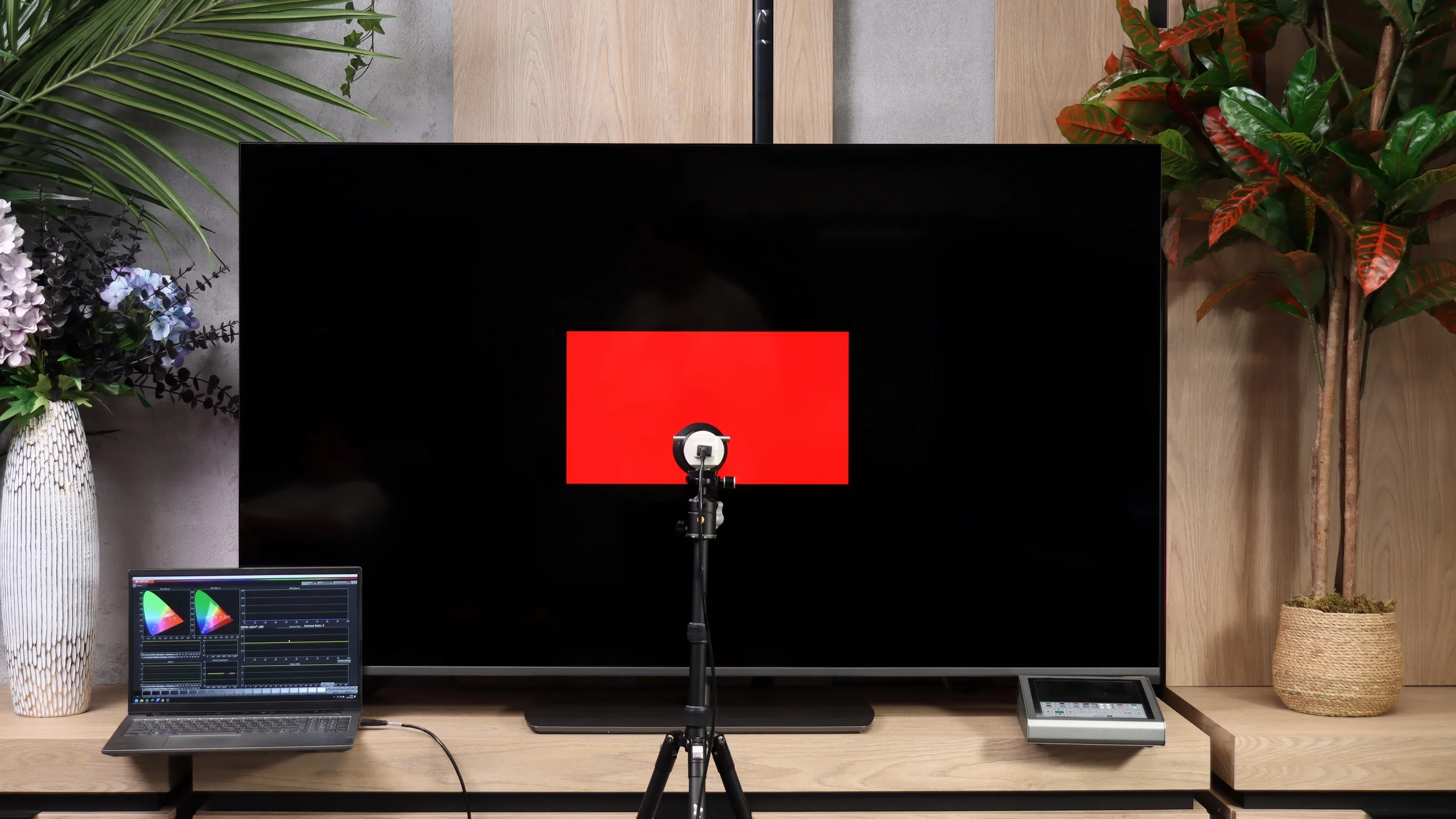
Unfortunately, the factory picture settings for Film mode on the PQS9000 need refinement. In SDR the most noticeable problem is an excess of red in the white balance, which makes whites, greys and skin tones too warm, sometimes even slightly pinkish. On top of that the gamma runs below the reference across most of the range. The TV therefore brightens midtones and highlights, making the overall image look flatter than it should.
In HDR the white balance itself is much better. Apart from minor deviations the RGB components track closely, so there is no pronounced colour cast as in SDR. However, the EOTF curve shows a slight brightening of parts of the image, and the biggest issue appears in measurements of the wide colour gamut. Many hues deviate significantly from the target, with errors reaching levels of 8–9. The good gamut coverage we praised earlier therefore does not mean the TV hits specific colours equally well. It can display a wide colour range, but out of the box it does not use it very precisely.


Color reproduction after calibration
7.7/10
Calibration brought a significant improvement, especially in SDR material. We managed to even out the white balance and remove the previous colour cast, and the Color Checker measurements now look really very good. Colours are much closer to what should be on screen, so with ordinary TV or SDR films we can be satisfied with the outcome. Unfortunately HDR somewhat spoils that result. On the one hand it is limited by the panel itself, because calibration won't improve contrast or replace local dimming. On the other hand there remain colour errors that we couldn't correct because the CMS settings, that is the colour management controls, were greyed out and inactive. That costs Philips points with us. The white balance can be fine‑tuned, but without access to wide‑gamut adjustments it's not possible to order HDR colours equally well. It's a shame, because the SDR results show the potential is there, but we weren't allowed to make full use of it everywhere.


PHILIPS PQS9001 - Smoothness of tonal transitions
8.6/10
The Philips PQS9000 handles tonal transitions very well. This is especially evident in dark scenes, where shades flow smoothly into one another without visible banding or distinct boundaries between colours. As a result, even on large, uniform areas the image looks smooth. Minor imperfections only appear in lighter tones, but you have to look closely to notice them. During normal viewing they are unlikely to distract from the film. In this category Philips performs really well.








Image scaling and smoothness of tonal transitions
7/10
 Smooth transition function
Image without overscan on the SD signal

Digital picture processing in the Philips PQS9000 performs well, though we have a few reservations. The "Distortion Reduction" function helps to smooth tonal transitions in lower-quality material, but it works rather unevenly. It can improve one part of the image, only to seem to lose its effect a moment later, still in the same scene, and show banding between shades again. A plus is that it doesn't remove film grain or fine noise, so the image retains its texture. We found the 'Medium' setting worked best and we recommend it. The upscaling to 4K itself is acceptable, although the image is very soft. Edges are heavily smoothed, which may leave some viewers feeling the picture lacks definition. In that case, it's worth slightly increasing the sharpness in the TV's menu, as this will make edges appear more defined. However, don't overdo the sharpening slider, otherwise artificial halos may appear instead of an improvement.
PHILIPS PQS9001 - Blur and motion smoothness
8.1/10
Maximum refresh rate of the panel: 144Hz
Film motion smoothing option: Yes
Blur reduction option: Yes
BFI function 60Hz: No
BFI function 120Hz: No
Brightness drop with BFI: 0%
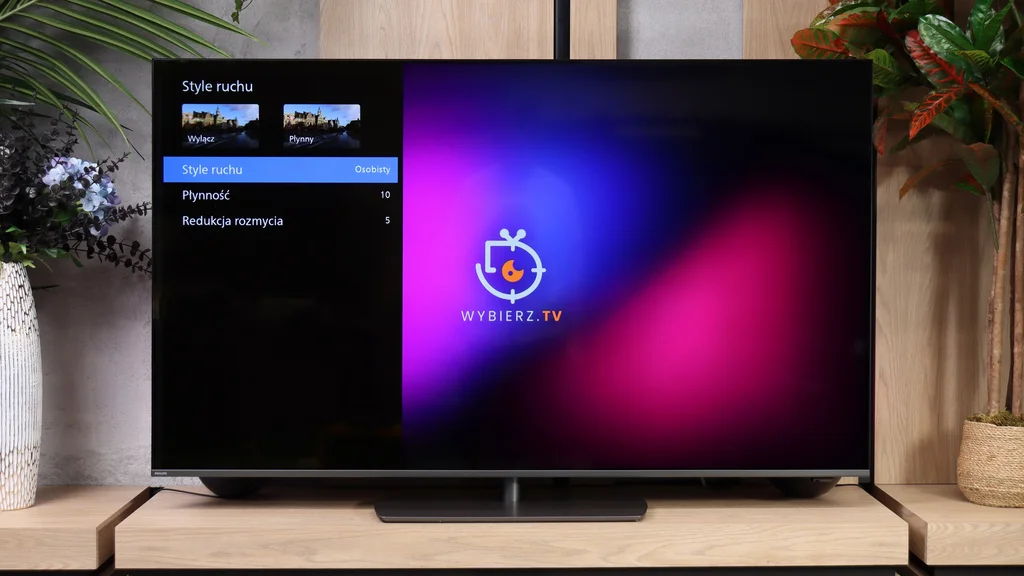
In terms of motion handling the Philips PQS9000 performs exceptionally well for an LCD TV. It's not just the 144 Hz refresh rate, but above all how quickly the panel itself responds. At 120 Hz there are virtually no typical trailing smears behind moving objects. What is particularly pleasing is that this also applies to darker scenes, where many VA panels clearly struggle. Here motion remains clear and, in this respect, Philips pleasantly surprised us.
The "Motion Styles" feature lets you adjust how motion is displayed. It includes two sliders: "Smoothness" and "Blur Reduction", allowing you to tailor the effect to the content you're watching and your own preferences. Our suggested settings are shown in the photo. Treat them as a starting point and try to find the level of smoothing that suits you best.
Blur (native resolution, maximum refresh rate):



Blur (1080p@240Hz):


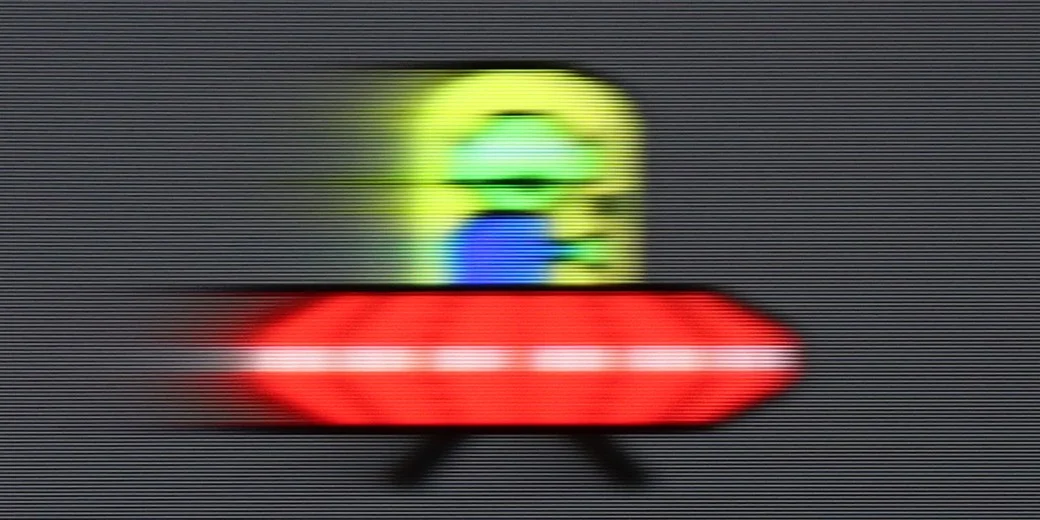
An extra surprise awaits when you connect a PC. By lowering the resolution to Full HD you can use the 240 Hz mode. Best of all, at such a high refresh rate motion blur does not increase dramatically, and with a sufficient frame rate movement becomes even smoother. You can already see some limitations of the LCD panel, but for this price bracket the result is excellent. For fast-paced games it's a really interesting option, provided you're willing to trade 4K detail for a higher refresh rate.
PHILIPS PQS9001 - Console compatibility and gaming features
9.5/10
- ALLM:
Yes
- VRR:
Yes
- VRR range:
48 - 240Hz
 Dolby Vision Game Mode:
Yes, high input lag
Dolby Vision Game Mode:
Yes, high input lag - Correct implementation of HGIG:
Yes
- 1080p@120Hz:
Yes
- 1440p@120Hz:
Yes
- 4K@120Hz:
Yes
- Game bar:
Yes
Gaming features
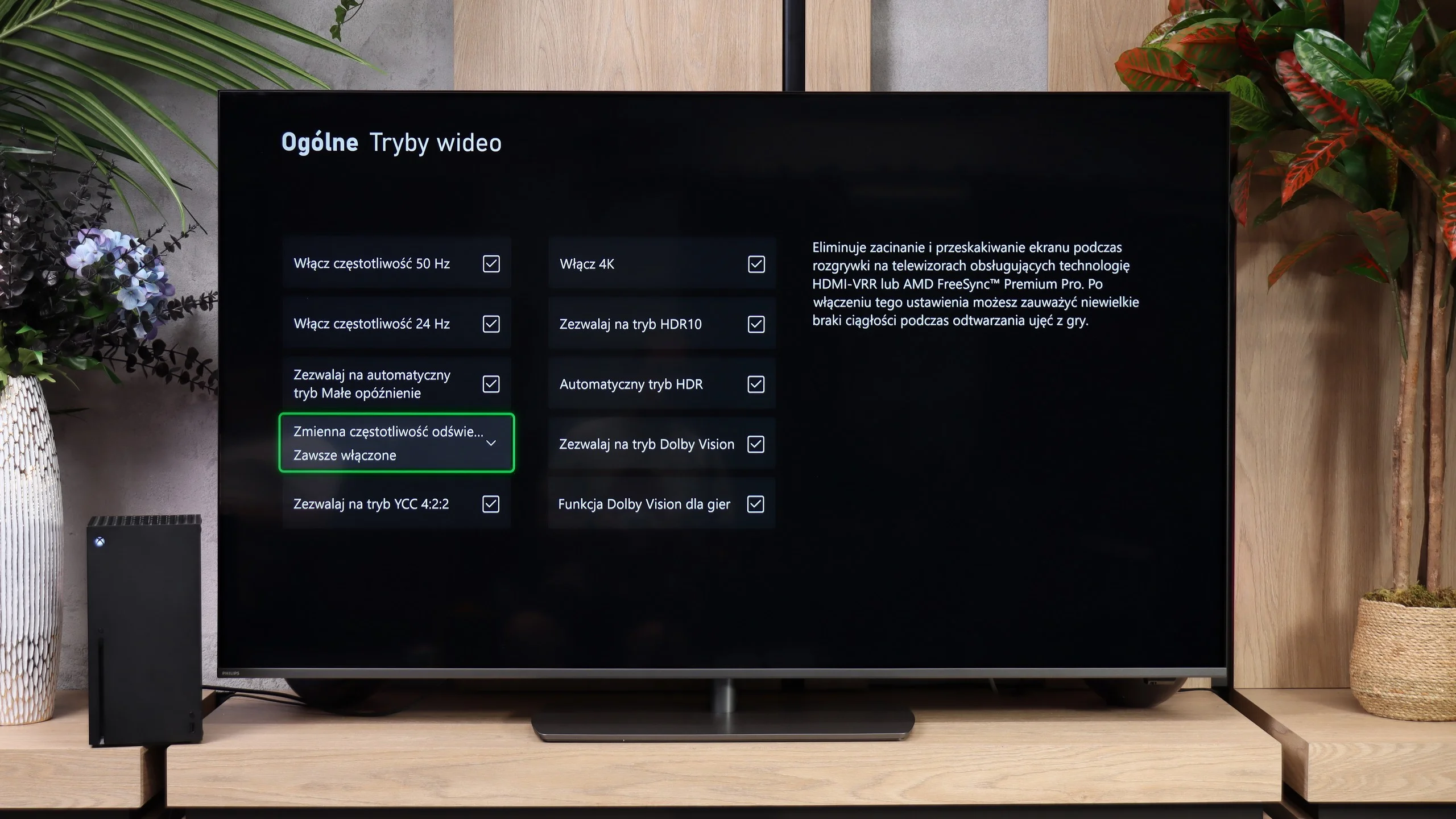
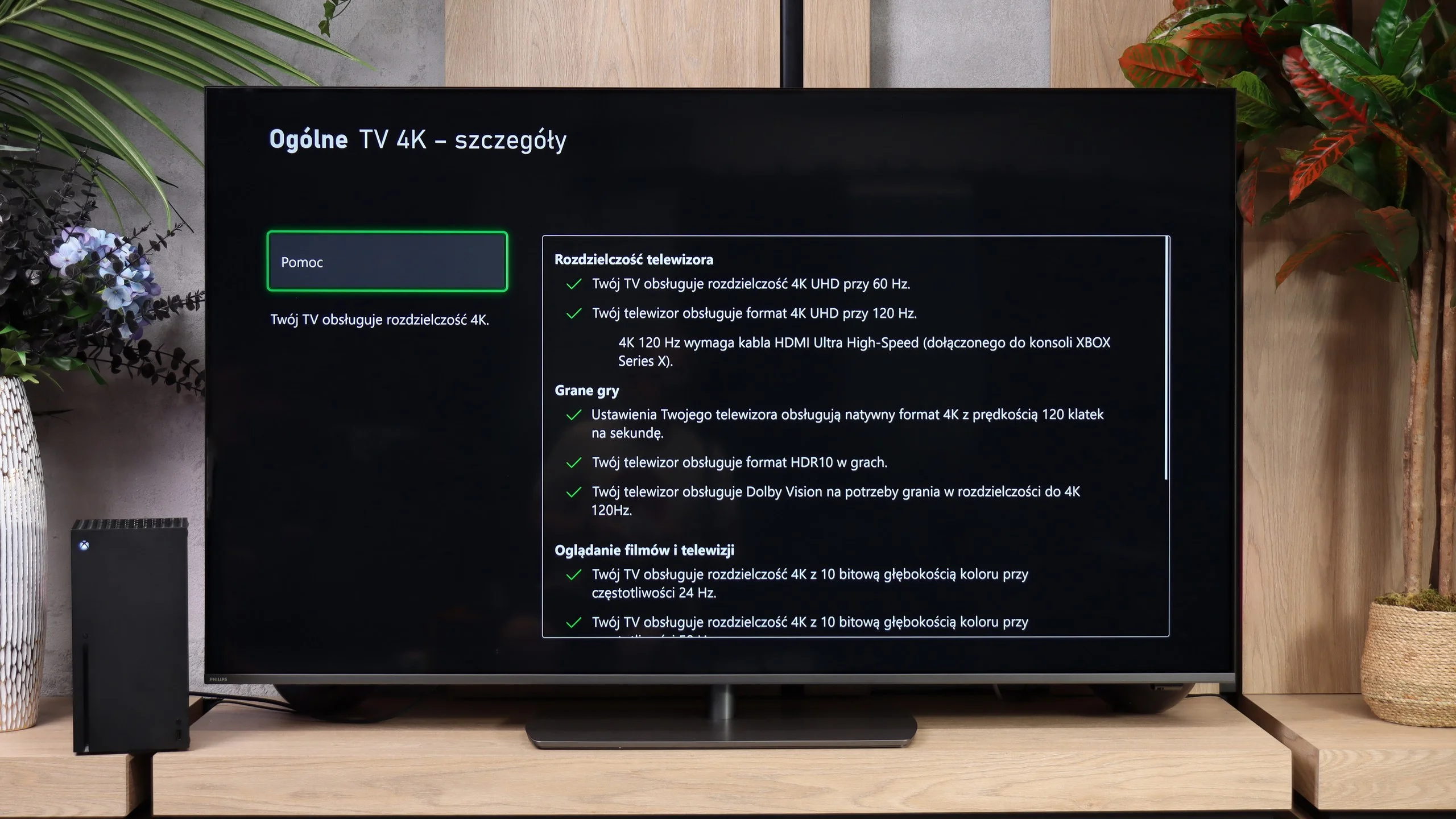
In terms of gaming features, the Philips PQS9000 has a lot to offer. Four HDMI 2.1 ports let you connect several devices without having to choose which one gets the full-capability port. Consoles can use 120 Hz at Full HD, 1440p and 4K, while a PC can also make use of 144 Hz at 4K or 240 Hz if you drop to Full HD. There's also VRR, which matches the refresh rate to the frame rate and prevents screen tearing. Its range is 48 to 240 Hz, with the upper limit applying in Full HD mode.
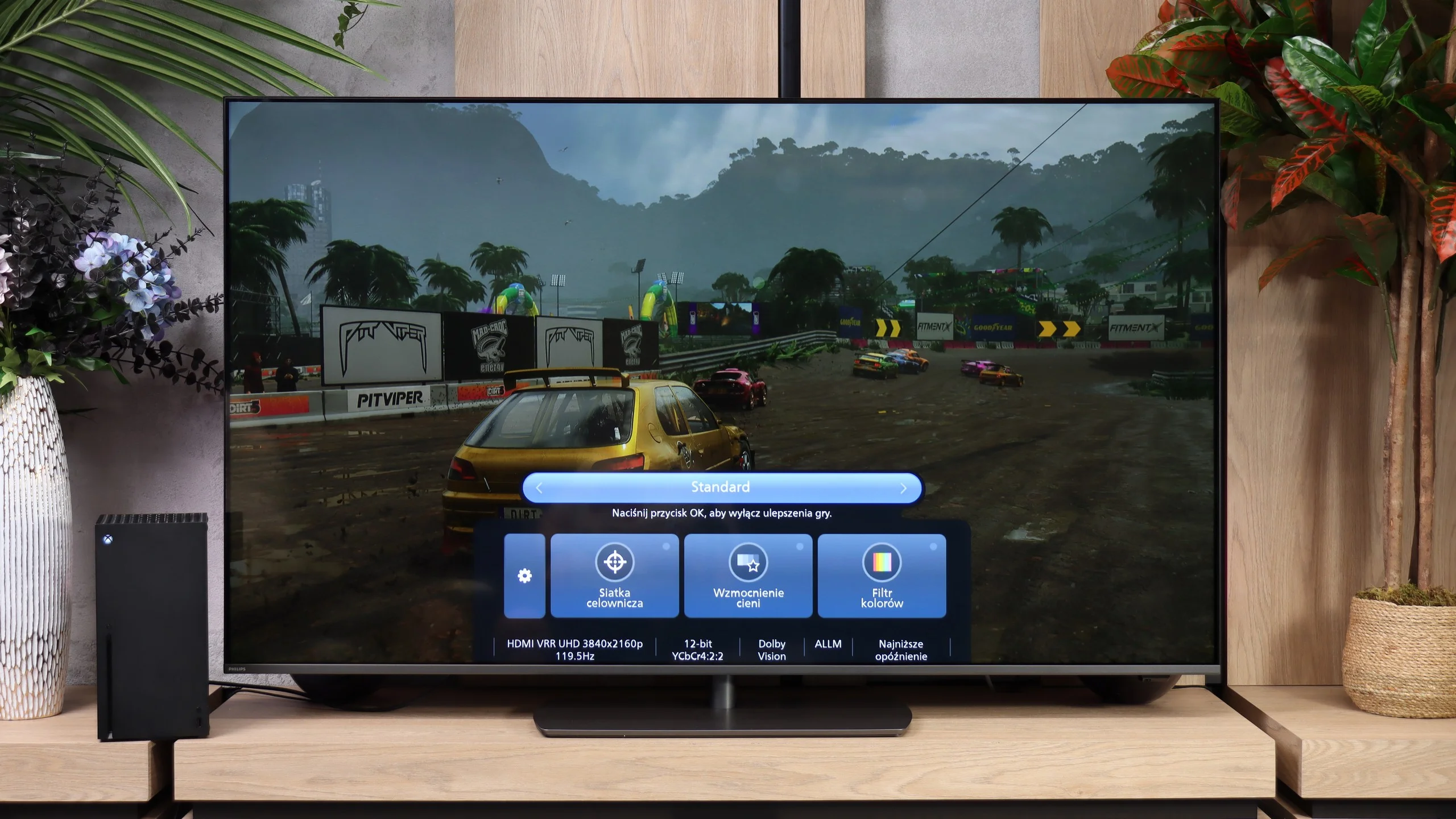
ALLM is present, so the TV automatically switches to game mode, and HGiG works properly, which is useful when setting HDR on a console. There's also a Game Bar for quick access to settings and signal information. The list even includes Dolby Vision gaming, but it's hard to enjoy this option because of very high input lag. Aside from that caveat, the feature set is really solid.

PHILIPS PQS9001 - Input lag
7.2/10
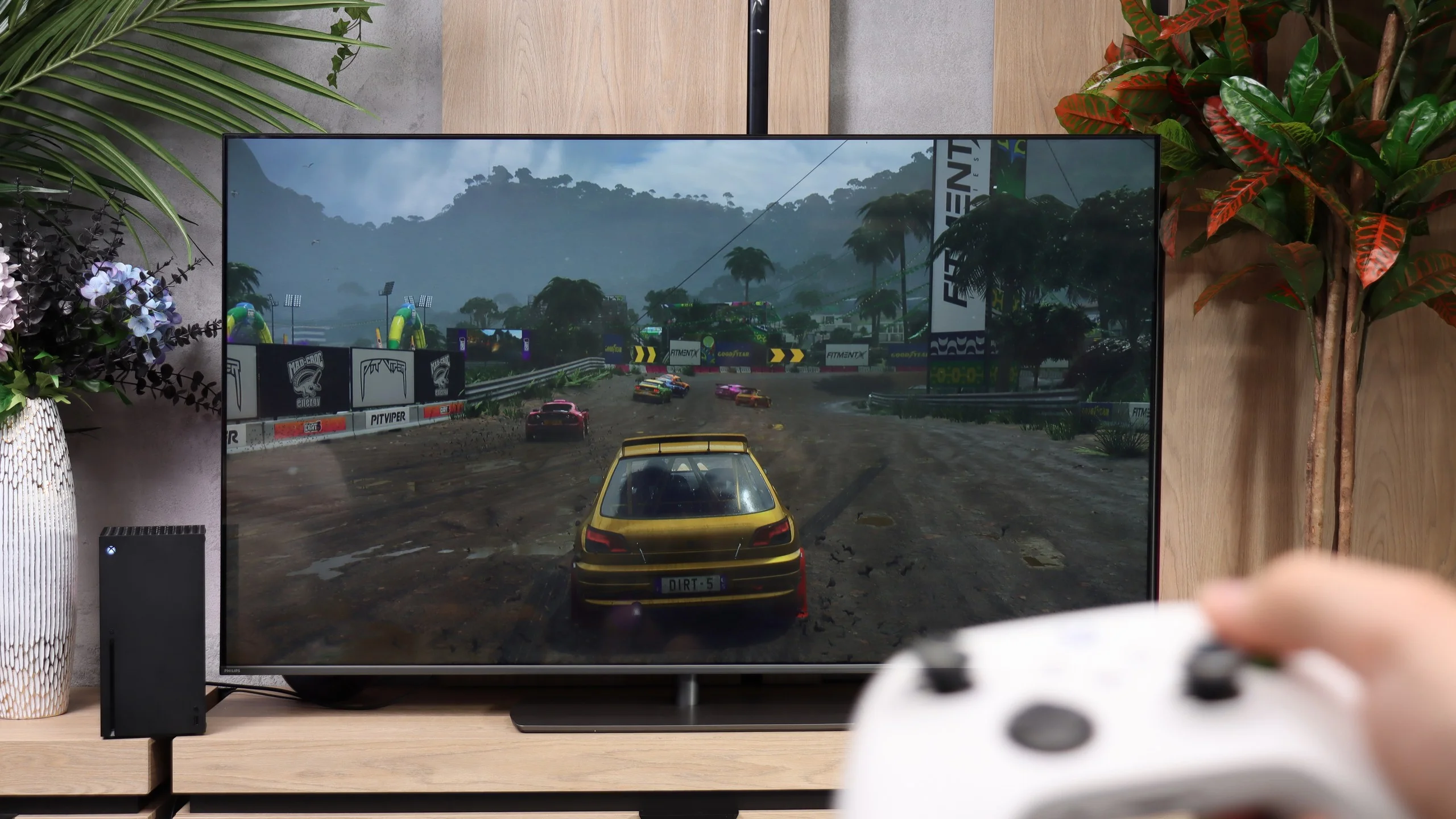
Input lag is already less impressive than the gaming features themselves. At 60 Hz we measured 32 ms, both in SDR and HDR. That result is fine for more relaxed games, but in fast-paced shooters you can feel a slight lag. At 120 Hz the delay drops to 16 ms and gaming is noticeably more enjoyable, though the competition can respond even faster.
The biggest problem appears when Dolby Vision is enabled. At 60 Hz the delay is as much as 213 ms, and at 120 Hz it reaches 106 ms. The response to controller input is then clearly delayed, which seriously disrupts gameplay. Therefore, on the PQS9000 it is definitely better to stick with HDR10. Dolby Vision is supported for games, but its practical usefulness remains limited.
| SDR | HDR | Dolby Vision |
|---|---|---|
| 1080p60: 32 ms | 2160p60: 32 ms | 2160p60 DV: 213 ms |
| 1080p120: 16 ms | 2160p120: 16 ms | 2160p120 DV: 106 ms |
| 2160p60: 32 ms | ||
| 2160p120: 16 ms |

PHILIPS PQS9001 - Compatibility with PC
8.6/10
Chroma 444 (max. resolution and refresh rate): Yes
Font clarity: Very Good
Readability of dark text and shapes: Average
Input lag in PC mode (4K, max. refresh rate): 16ms
Matrix subpixel arrangement: BGR
Max refresh rate: 144Hz
G-Sync: Yes
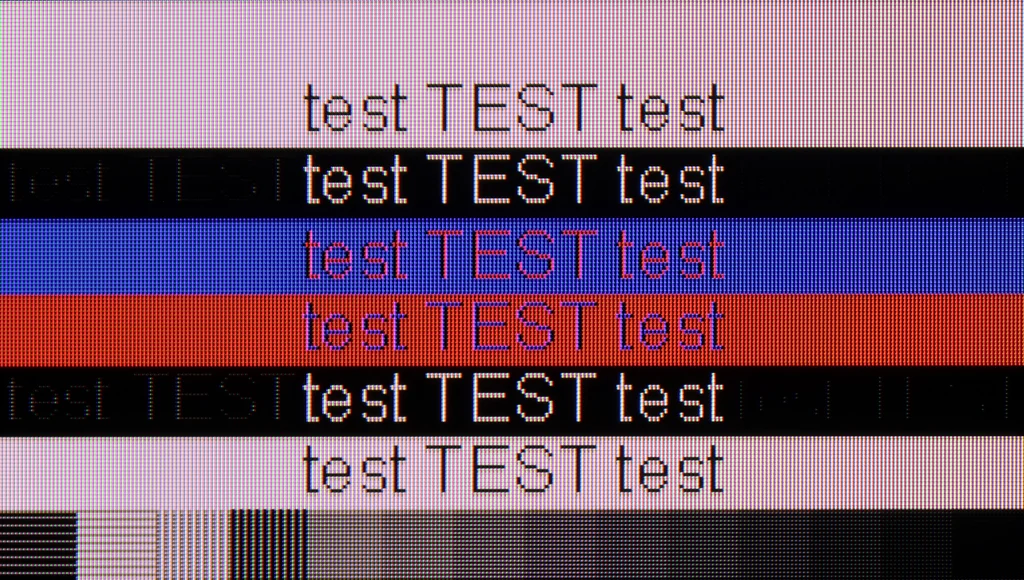
The PQS9000 scores highly for PC compatibility, mainly thanks to its gaming capabilities. A 144 Hz refresh rate at 4K and support for G-Sync Compatible and AMD FreeSync Premium Pro allow frame-rate synchronisation on compatible NVIDIA and AMD cards. Working with text is also good. Regular fonts are sharp and legible, and thanks to proper 4:4:4 chroma handling coloured letters, icons and small desktop elements retain their clarity. The main reservation concerns very small, dark text: the horizontal strokes of letters are noticeably darker than the verticals, which makes some characters look uneven. You probably won't notice this from the sofa, but if someone plans to put The One on a desk and work up close, this flaw may become annoying.
PHILIPS PQS9001 - Viewing angles
3.2/10
Brightness drop at an angle of 45 degrees: 68%
Viewing angles are one of the weakest points of the Philips PQS9001. Simply moving to the side is enough for the colours to lose saturation noticeably, and for the picture to look washed out and less contrasty. When watching with several people, seats directly in front of the screen will therefore be by far the best.
Unfortunately this is a typical characteristic of VA panels, where good contrast when viewed head-on comes at the cost of poorer off-axis performance. Most TVs with such a panel suffer the same problem and The One is no exception. The swivelling stand helps a little, allowing you to angle the screen towards the viewer, but it won't solve the issue when seats are widely spaced.
PHILIPS PQS9001 - Daytime performance
6.1/10
Panel finish: Satin
Reflection suppression: Decent
Black levels during daytime: Good
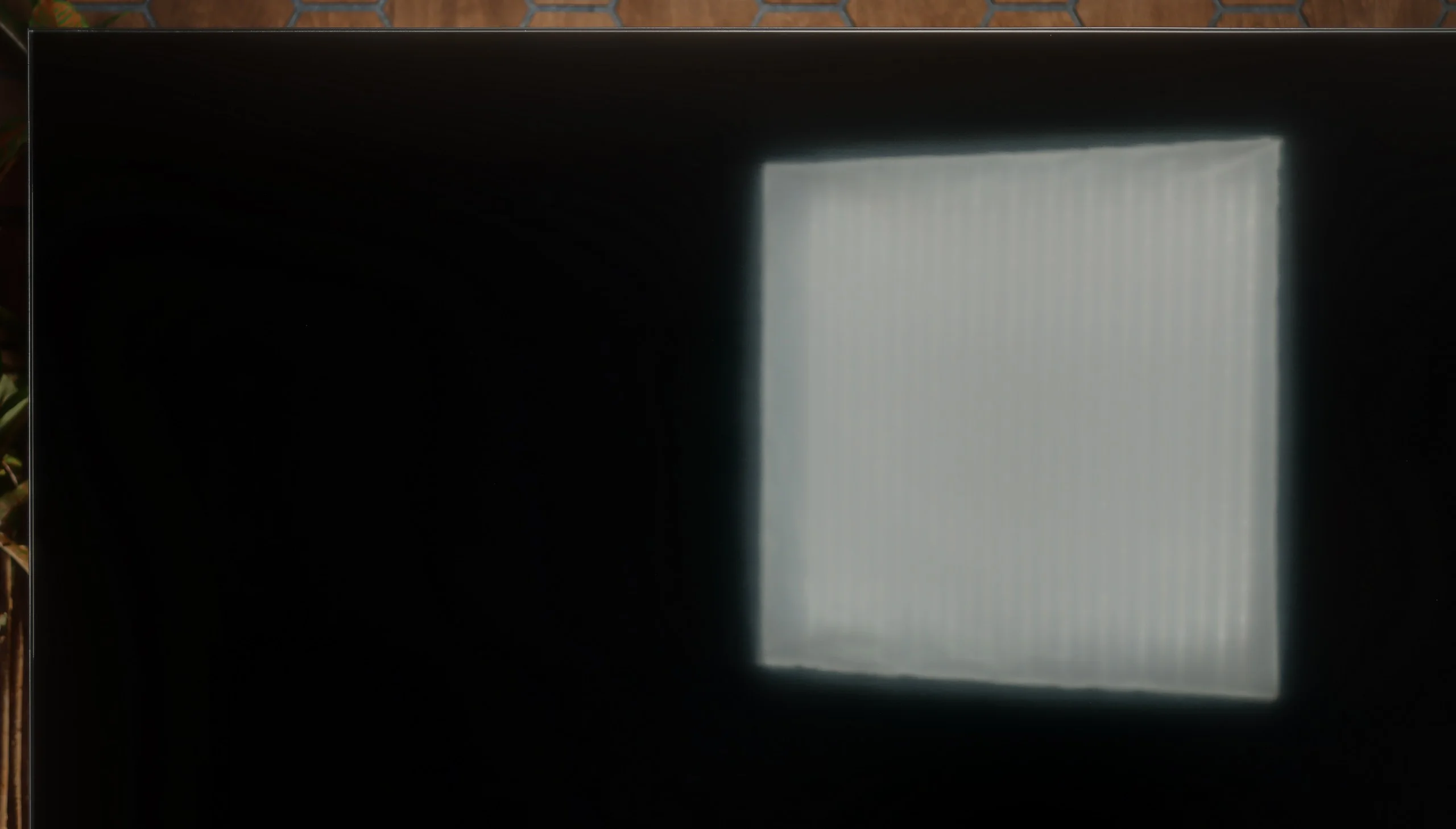
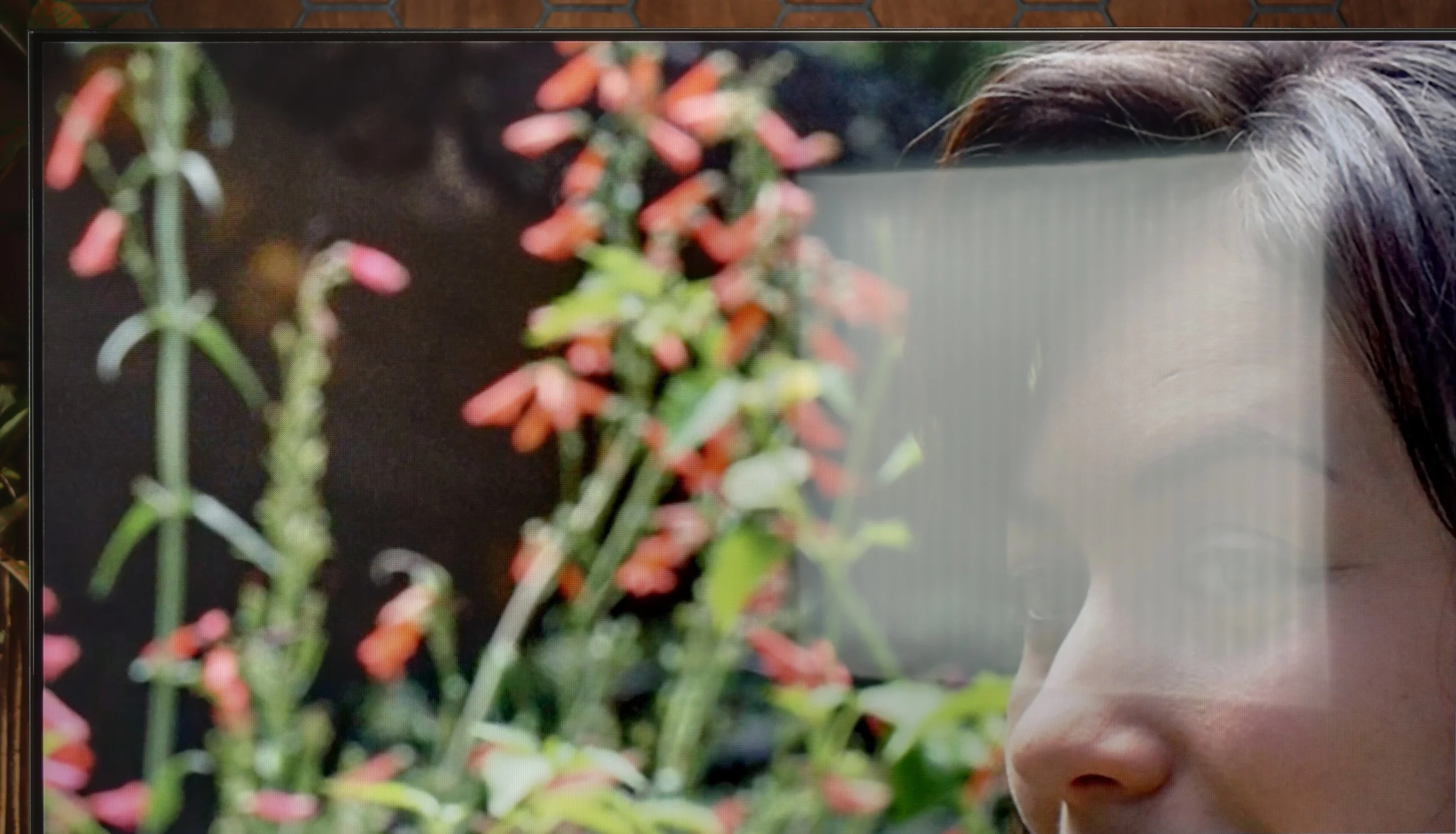
The Philips PQS9001 performs quite well for daytime viewing. The main advantage is a stable brightness of around 500 nits, regardless of how many bright elements appear on the screen. Even when watching winter sports or a scene full of white, the image does not dim. In a typical living room that level is more than enough to watch television comfortably without having to draw the curtains.
The satin finish does a decent job of suppressing reflections, though it does not eliminate them completely. A window opposite the screen will be visible and can be distracting, especially in darker scenes. Black holds up well in daylight, so the picture does not become overly washed out. For everyday viewing, it's therefore quite good, as long as the sun is not shining directly on the screen.
Panel brightness
Philips PQS9011 / PQS9001 (The One 2026): 502 cd/m2
PHILIPS PQS9001 - TV features
7.6/10
System: Titan OS
System performance: Decent
- HDMI inputs: 0 x HDMI 2.0, 4 x HDMI 2.1 48Gbps
- Outputs: Toslink (Optical audio), eARC (HDMI), ARC (HDMI), Mini-Jack (Headphones)
- Network Interfaces: Wi-Fi 2.4GHz, Wi-Fi 5GHz, Ethernet (LAN) 100Mbps
- TV reception: DVB-T, DVB-T2, DVB-S, DVB-S2, DVB-C
Classic features:
 Recording to USB (terrestrial TV): No
 - Recording programming: No
- Picture in Picture (PiP): No
- RF remote control (no need to aim): Infrared
- Backlit remote control: Yes
- Teletext: Yes
- Audio only mode: Yes
- Bluetooth headphones support: Yes
- Simultaneous Bluetooth headphones & TV audio: Yes
Smart features:
- AirPlay: Yes
- Screen mirroring (Windows Miracast): Yes
- Voice search: Yes
- Voice search in native language: Yes
- Ability to connect a keyboard and mouse: Yes
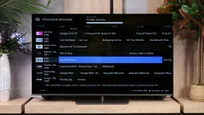
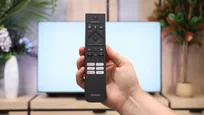
Titan OS in this year’s The One shows that Philips has worked on its system. Compared with last year’s version many small details and functions that previously did not behave as they should have been fixed. Now you can use AirPlay without problems, stream the picture from a computer via Miracast or search for something by voice in Polish. The system itself runs decently, though it is certainly not among the fastest. The app library has also grown, with Netflix, Prime Video, Disney+, CANAL+, Apple TV and YouTube available. The selection is still smaller than on Google TV, but when using popular services Titan gives fewer reasons to complain. Everyday convenience has improved in the basic features as well. You can connect Bluetooth headphones and listen through them at the same time as the TV’s speakers, and there is a mode that lets you switch the screen off and leave only the audio playing. USB recording and picture-in-picture (PiP) are missing. What’s most disappointing is the remote — despite its backlit buttons it still controls the TV via infrared, so you have to point it at the screen. The system has gained many useful tweaks, but that part of the operation has stayed the same and can be irritating in daily use.
Sound connection options
HDMI audio:
Other audio outputs:
- Toslink: Yes
- Stereo (Mini-Jack): Yes
Wireless audio:
- Bluetooth: Yes
Supported audio formats (external HDMI eARC audio):
- Dolby Digital Plus 7.1: Yes
- Dolby True HD 7.1: Yes
- Dolby Atmos in Dolby Digital Plus (JOC): Yes
- Dolby Atmos in Dolby True HD: Yes
- DTS:X in DTS-HD MA: Yes
- DTS-HD Master Audio: Yes
Senior accessibility
- Numeric keyboard on TV: Yes
- Font size adjustment: Yes
- Audio description: Yes
PHILIPS PQS9001 - Apps
7.2/10






















PHILIPS PQS9001 - Playing files from USB
8.6/10
| Maximum photo resolution: | Supported photo formats: |
|---|---|
| 4 Mpix | JPEG |
| 6 Mpix | HEIC |
| 8 Mpix | PNG |
| 10 Mpix | GIF |
| 12 Mpix | WebP |
| 16 Mpix | TIFF |
| 20 Mpix | BMP |
| 24 Mpix | SVG |
| 28 Mpix | |
| 32 Mpix |
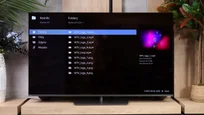
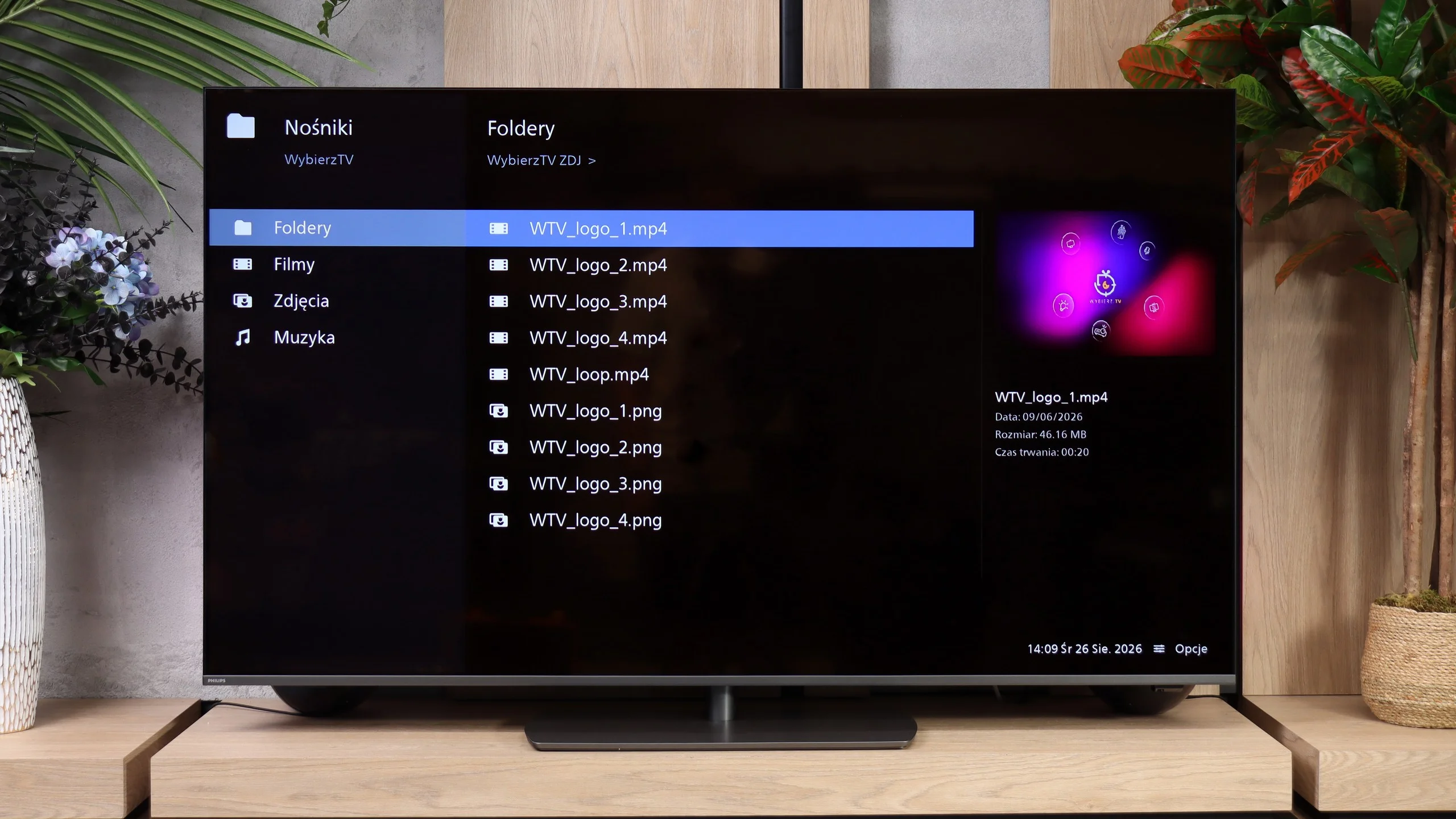
The built-in USB player works quickly and smoothly and handles most of the files we tested without a problem. Music playback is good, from popular MP3s to FLAC files, including 96 kHz/24-bit. It's perfectly adequate for everyday playback of media from a USB stick. However, our main reservations again concern photo handling. The player is rather selective about image resolution: it opened our 8, 16 and 32 MP files, but failed with, among others, 4, 12 and 24 MP files. It's hard to see the logic in that when a larger photo works but a smaller one doesn't. That can be irritating when browsing holiday photos.
PHILIPS PQS9001 - Sound
6.9/10
96dB
Maximum volume

Supported codecs (TV speakers)
Dolby Digital Plus 7.1
Dolby True HD 7.1
Dolby Atmos in Dolby Digital Plus (JOC)
Dolby Atmos in Dolby True HD
DTS:X in DTS-HD MA
DTS-HD Master Audio
The Philips PQS9001 has a 2.0 audio system with a total power output of 40 W, which is two 10 W drivers on each side. It performs quite well and noticeably better than most budget TVs. There's plenty of volume, but the sound itself lacks depth. The biggest issue is the lack of low bass, so explosions in films and the heavier parts of music don't have the proper weight.
Higher frequencies aren't reproduced evenly either. Measurements show a clear dip around 2 kHz, a boost at 6-7 kHz and a drop above roughly 8 kHz. This can emphasise sibilant consonants and give the sound an edge, despite the roll-off of the highest treble. It's adequate for everyday viewing, but for films and music it's worth considering additional audio equipment, all the more so given that the TV supports surround sound formats, including Dolby Atmos and DTS. A compatible soundbar or AV receiver will make better use of those formats than the built-in speakers.
Sound Quality Test:
Acoustic Measurements
96dBC (Max)
75dBC
PHILIPS PQS9001 - Panel details
Software version during testing: TPM267E_V167.002.054.151
Panel uniformity and thermal imaging:

Backlight Type: PFS LED

Founder and originator of the "ChooseTV" portal

Journalist, reviewer, and columnist for the "ChooseTV" portal

michal-woloszyn-title
Reader comments
Comments are provided by the external service Disqus (Zeta Global). Once loaded, Disqus may set cookies and process data about your activity.
We will remember your choice on this device. Provider's privacy policy
See articles related to Philips PQS9011 / PQS9001 (The One 2026):
Shopping Reviews
The best Philips TVs of 2024 – these models are worth buying... 5/22/2025
Shopping Reviews
Ranking of the best affordable televisions 2024 / 2025. Whic... 4/29/2025
Shopping Reviews
The first Philips TVs of 2025 are already in stores! We know... 6/20/2025
10/21/2025
7/17/2025