 Michał Wołoszyn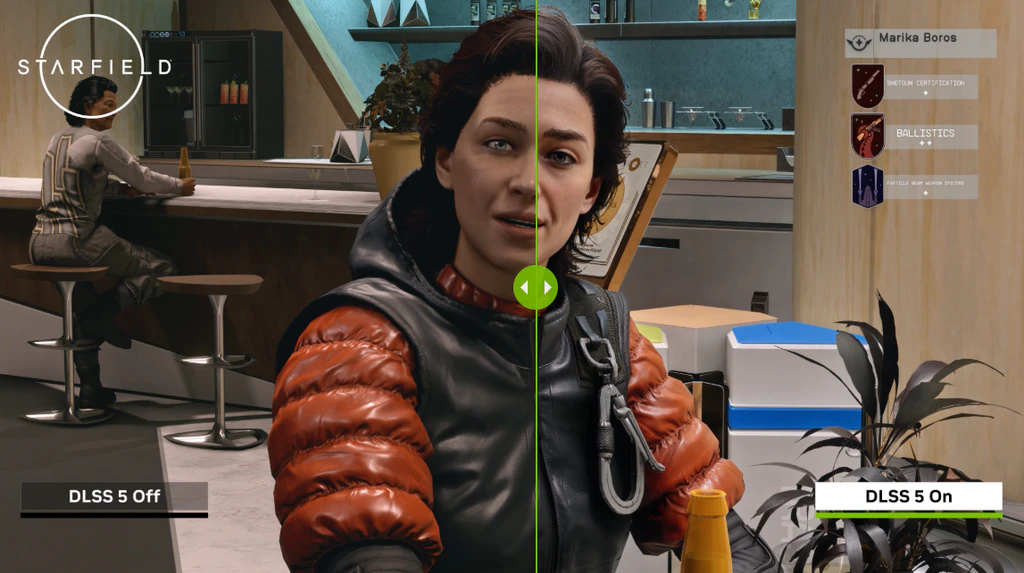
NVIDIA, during the GTC 2026 conference, presented DLSS 5, calling it the “GPT moment for computer graphics.” This is the biggest change in the “green” technology since the debut of ray tracing in 2018. Unlike previous versions, which focused on scaling resolution and generating frames, DLSS 5 goes a step further – it uses a neural network to generate photorealistic lighting and material textures directly on the screen. The technology is set to launch in the fall of 2026.
End of "brute force" in favor of artificial intelligence
For the past 25 years, the development of graphics has relied on increasing the computational power needed to calculate each ray of light. However, NVIDIA claims that traditional methods have reached their limits. The time budget for a frame in a game is a fraction of what Hollywood allocates for a single frame of special effects. The solution is DLSS 5, which instead of calculating every reflection, uses an AI model to "infuse" the scene with light and the physical properties of materials.
In practice, the system collects data on color and motion vectors, and then generates an image that takes into account complex phenomena such as subsurface scattering on human skin, the natural sheen of fabrics, or the way light penetrates through strands of hair. Although during demonstrations the technology operated on systems equipped with two RTX 5090 units, the manufacturer assures that ultimately DLSS 5 will be optimized for single cards from the Blackwell family (RTX 50 series).
“AI Slop”?
Despite impressive presentations, the announcement of such a deep AI intervention in images has caused a huge stir online. Skeptics quickly dubbed the new technology “AI slop,” suggesting that generative pixels will be unstable, start to “float,” or create an unnatural image that will blur the artistic vision of game creators. The internet is already flooded with memes showing artificial intelligence hallucinations integrated into screenshots from popular titles.
It Should Be Stable
Jacob Freeman, known in the community as a Technical Evangelist on the GeForce team, spoke out on this matter. Responding to concerns about image instability, Freeman put the speculation to rest with one specific statement: DLSS 5 "stays consistent every time." According to Nvidia, the key is combining game structural data (which is predictable) with an AI probabilistic model designed to prevent flickering or changes in details between frames.
When will we play and what will we play with DLSS 5?
Although there are still a few months until the release, the list of developers declaring support for DLSS 5 is already long. Among the partners are Ubisoft, Bethesda, Capcom, and Warner Bros. Games. Todd Howard from Bethesda admitted that the implementation of this technology in Starfield breathed new life into the game, especially in terms of planetary lighting.
Titles that will receive support for DLSS 5:
Resident Evil Requiem
Starfield
Hogwarts Legacy
Assassin's Creed Shadows
Delta Force
Naraka: Bladepoint
Sea of Remnants
The Elder Scrolls IV: Oblivion Remastered
Black State
Where Winds Meet
CINDER CITY
NTE: Neverness to Everness
Justice
The DLSS 5 technology is said to debut in the fall of 2026. Only then will we find out whether the claims of "stability every time" will hold true in reality, or if the creators of the memes (by the way, quite funny ones 😉) were right.