 Redakcja Choose TV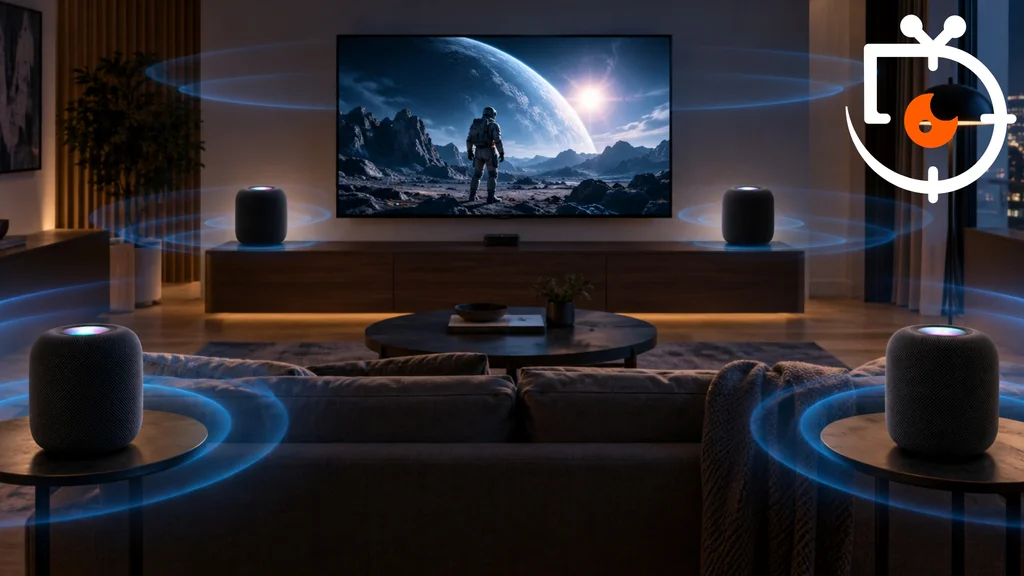
Apple may be preparing a major change in how HomePods are used as TV speakers. In the code of the test version of audioOS 27, references were found to a configuration that would use as many as four HomePods. The setup would provide true surround sound with separate front and rear channels. Currently Apple allows you to wirelessly connect up to two HomePods to an Apple TV 4K. The new feature is still being tested and it’s unclear whether or when it will reach users.
Four HomePods will create a surround system
Information about the planned feature was found in the code of the eighth beta of audioOS 27. One reference points to a mode intended for multichannel movie audio and surround configurations. According to the findings, the system would support four speakers simultaneously. Individual units could serve as the left and right front speakers and the left and right rear speakers. That would be a much more elaborate system than the current configuration of two HomePods. Today, the Apple TV 4K can wirelessly work with a maximum of two HomePods when playing movies and music. Even if the source contains a 5.1 track or Dolby Atmos, the audio is virtualized and played through two physical speakers. Four devices, however, would allow a much more traditional surround layout. The software is said to include automatic room calibration and determination of individual speaker positions. The code also contains references to time synchronization, bass management, and audio correction. The system would also offer different processing modes intended for movies and music. However, the new feature would not be available for every Apple speaker. According to the findings, the four-speaker setup would be intended exclusively for second-generation HomePods. The first-generation HomePod and the smaller HomePod mini would not be supported.
Apple has been working on a solution like this for years
The idea of using multiple HomePods to create a surround sound system is not new. As early as 2019 there were reports about an Apple patent covering spatial audio technology for those speakers. The patent itself was filed back in 2017. That means the company may have been developing a similar solution for at least nine years. At the same time, the HomePod never gained the same popularity as some other Apple products. Limitations related to supported music services, Siri and the way devices are paired may have hindered its wider adoption. Apple, however, apparently has no intention of abandoning the smart speaker and home device category. The audioOS 27 code is also said to contain references to a new HomePod model. According to earlier reports, the company is working on a third-generation HomePod with AI-powered Siri features. The new generation is not expected anytime soon. Apple is also said to be preparing a new version of the Apple TV 4K. Even more interesting information appeared in the macOS 26.7 code, where references were found to two game controllers designed by Apple. The devices are said to include haptic vibrations, a D-pad, analog sticks and shoulder buttons. They are also expected to use an accelerometer and a gyroscope. Rumors of an Apple game controller have been circulating for years, but the company has never officially confirmed such a product.
Apple is testing a four-HomePod configuration that could deliver significantly more advanced spatial audio when using Apple TV 4K. The feature is expected to include automatic room calibration, speaker position mapping, and separate audio processing for movies and music. For now, it appears to be in the testing stage, and support will be limited to the 2nd-generation HomePod. Apple may also be working on a new HomePod, a new Apple TV 4K, and its own game controllers.
source: flatpanelshd