- Matching (Score) |
- Our verdict |
- Competing TVs |
- TV appearance |
- Where to buy |
- Contrast and black detail |
- HDR effect quality |
- Factory color reproduction |
- Color reproduction after calibration |
- Smoothness of tonal transitions |
- Image scaling and smoothness of tonal transitions |
- Blur and motion smoothness |
- Console compatibility and gaming features |
- Input lag |
- Compatibility with PC |
- Viewing angles |
- Daytime performance |
- TV features |
- Apps |
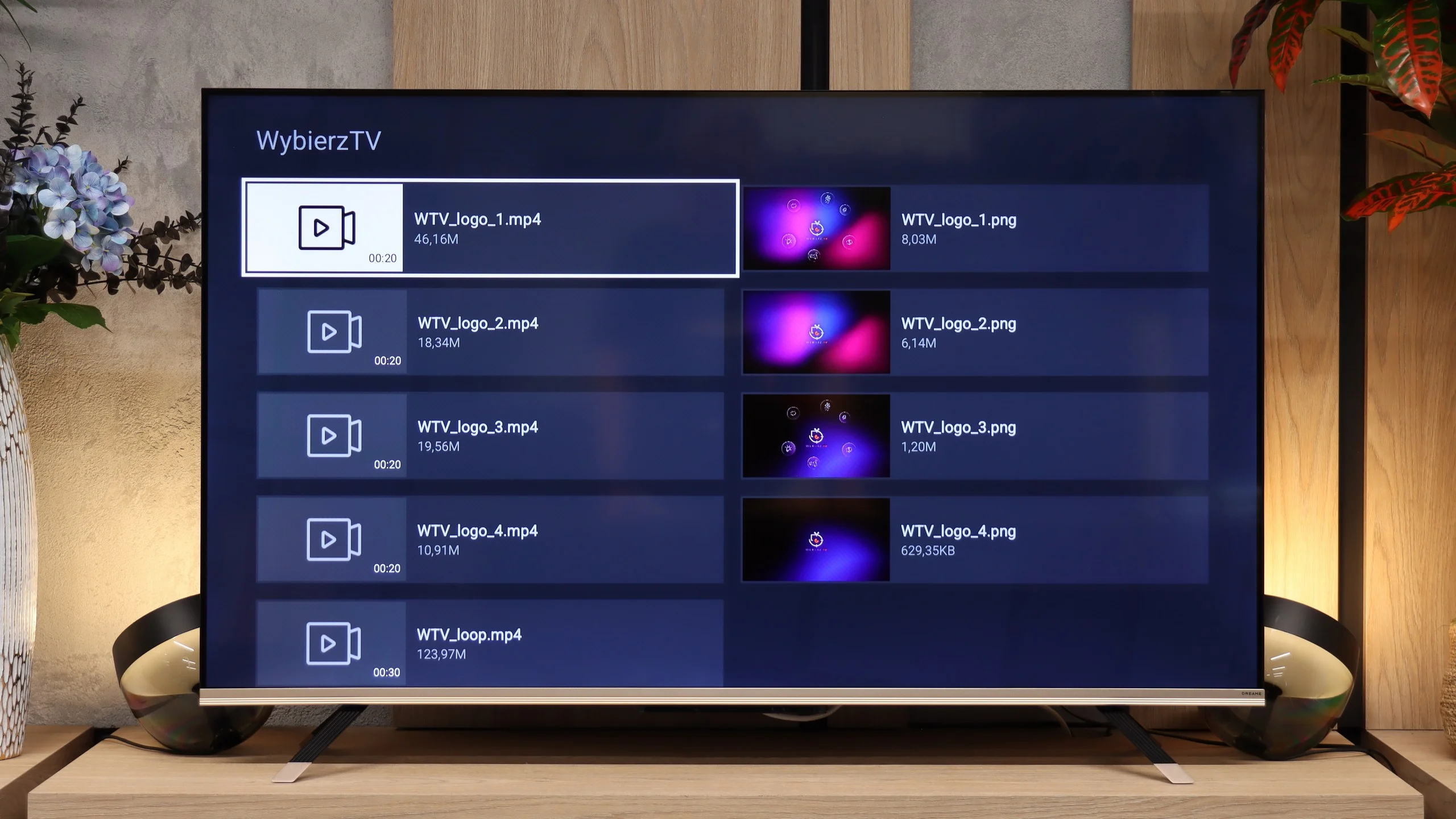
- Playing files from USB |
- Sound |
- Panel details
Dreame Q100 Review
Available screen sizes:
Complete the survey to find out the result
Panel type: LCD VA Refresh rate: 60Hz Brand: DREAME Resolution: 3840x2160 System: Google TV Model year: 2026
This review is an English translation of the Polish original. Read the original on Wybierz.tv.
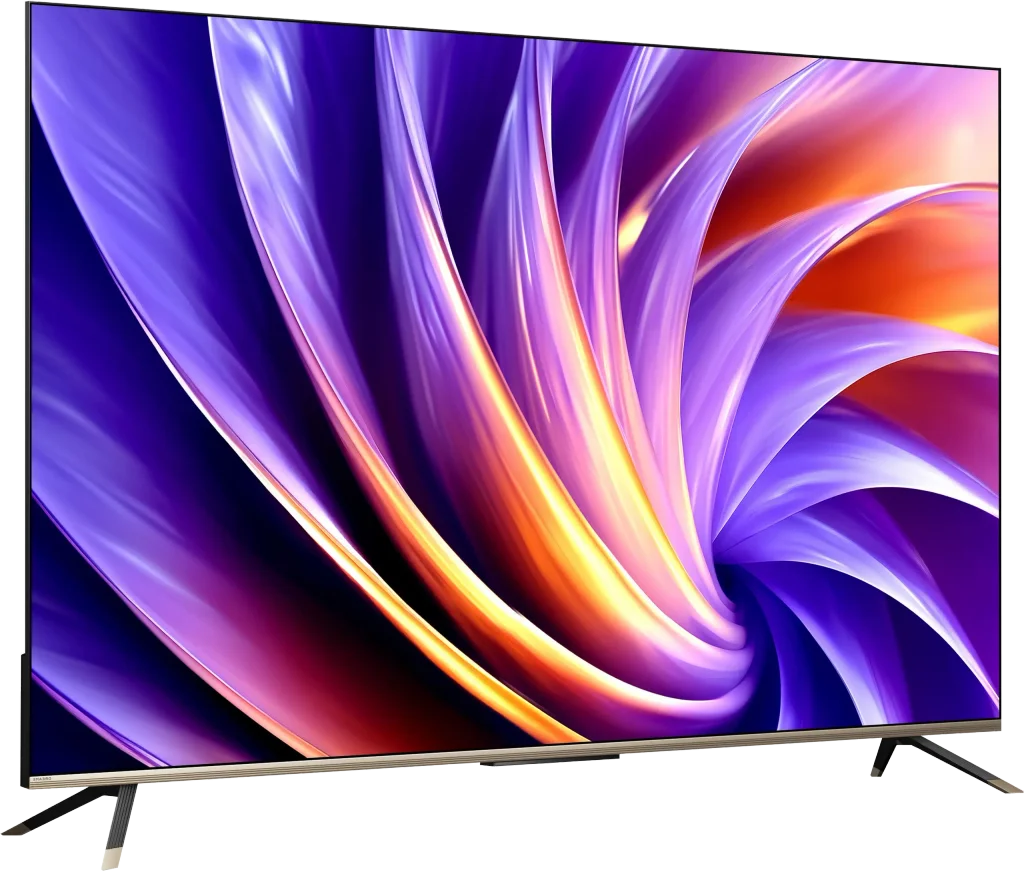
Dreame is a brand we had mainly associated with vacuum cleaners, robot vacuums and other household appliances. So it was all the more surprising when the manufacturer entered the TV market, led by the Mini LED S100. Alongside it, the company released the much simpler and cheaper Dreame Q100, aimed at people who don't want to spend a fortune on a new screen. We tested whether it's just a budget novelty from a well-known brand or a TV that actually has something to offer.
DREAME Q100 - Our verdict
5.6
Overall rating
The Dreame Q100 is the entry-level model in the manufacturer's line-up, and its price alone hints at what to expect. It's not a TV that aims to win on picture quality. Its strengths lie elsewhere: it runs Google TV, offers a surprisingly large number of features for gamers, and is fairly inexpensive. In terms of picture, the Q100 performs similarly to many other TVs in this segment. The VA panel delivers decent contrast, colours are quite respectable thanks to the QLED filter (PFS), but its roughly 300 nits of brightness quickly becomes a limiting factor. Especially in HDR, where it simply lacks the punch. It's good Dreame didn't ditch Dolby Vision, because for a TV like this that format really helps. Films and series from streaming platforms are better matched to the screen's capabilities and can look quite good as a result. The Q100 therefore makes most sense if you're after an affordable TV for casual viewing, Netflix, YouTube or the occasional console connection. There are no big surprises in picture quality, but you can't expect them from one of the cheapest models in the range. For Dreame's first attempt at this part of the market, the Q100 is a pretty interesting start, all the more so since until recently the brand name was much more likely to be associated with a vacuum cleaner than a TV.
Advantages

Google TV with a wide selection of apps
Support for Dolby Vision
Wide colour gamut, QLED PFS filter
Decent VA panel contrast
Smooth tonal transitions
Gaming features: VRR and ALLM
120 Hz at Full HD
Game Bar
Low input lag
Disadvantages

Low brightness, around 300 nits
Weak HDR performance
Average image processing
No AirPlay
Average audio
 Movies and series in UHD quality
5.8
 Classic TV, YouTube
5.4
 Sports broadcasts (TV and apps)
4.6
 Gaming on console
7.0
 TV as a computer monitor
4.0
 Watching in bright light
4.4
 Utility functions
5.2
 Apps
Apps9.6
 Sound quality
5.0
Complete the survey to find out what fits your preferences
DREAME Q100 - Competing TVs in this price range
DREAME Q100 - TV appearance
HDMI inputs: 3 x HDMI 2.0, 0 x HDMI 2.1 Other inputs: RCA (Chinch) Outputs: SPDIF (Coaxial audio), eARC (HDMI), ARC (HDMI), Mini-Jack (Headphones) Network Interfaces: Wi-Fi 2.4GHz, Wi-Fi 5GHz, Ethernet (LAN) 100Mbps
Build quality: Good
Stand type: Legs
Bezel color: Graphite

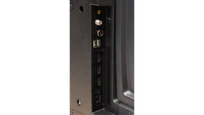
Stand: Fixed
Flat design: No
Accessories: Stand
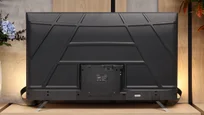
For its price, the Dreame Q100 is actually quite interestingly designed and, more importantly, feels well made. You can't deny it's a budget model, but the manufacturer at least tried to give it a bit of character. It's most noticeable from the front. The bottom bezel has a distinctive, slightly golden finish, and the same accent appears on the tips of the feet. It's a small detail, but it stops the Q100 from looking like just another anonymous, cheap TV. The back is much simpler. The rear is made from a single moulded piece, and the lower part of the casing thickens noticeably to house the electronics. That's a solution familiar from cheaper designs and also means that, when wall-mounted, the TV will sit fairly far off the wall. From the front, though, it looks a lot better than its price might suggest.
Buy at the best price
Select size:

DREAME Q100 - Contrast and black detail
5.3/10
Local dimming function: No


Result
4,350:1

Result
3,850:1

Result
4,100:1

Result
4,450:1

Result
3,400:1

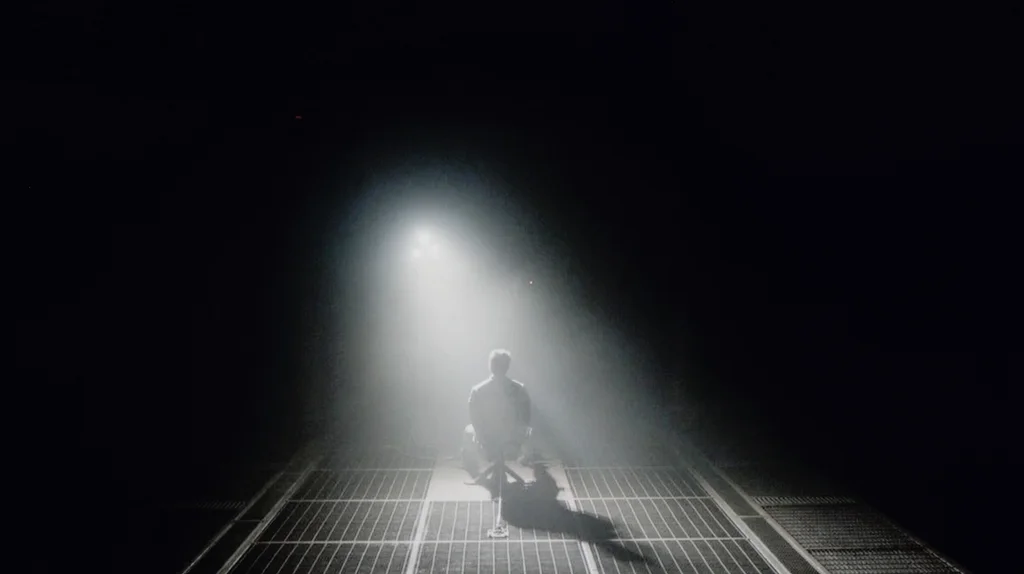
The Dreame Q100 is a basic LCD TV, so its black level and contrast performance depend mainly on the panel itself. It uses a VA panel that achieves a native contrast of around 4500:1. For this class of device that's a pretty good result. In practice this mainly means noticeably deeper blacks than in similarly priced TVs with IPS or ADS panels. You can see the difference especially in the evening, when dark scenes have more depth and don't look so grey.
Bear in mind, however, that the Q100 has no local dimming. The backlight therefore stays on constantly, with no way to dim specific parts of the image. In a very dark room the blacks can therefore take on a navy tint and are a long way from what better Mini LEDs, and even more so OLEDs, can do in this respect. That said, this is not surprising, as the same limitation affects most basic LCD TVs in this price range.
Halo effect and black detail visibility:
DREAME Q100 - HDR effect quality
4.2/10
Supported formats: HDR10, HDR10+, Dolby Vision
Luminance measurements in HDR:

Result
230 nit

Result
252 nit

Result
285 nit

Result
298 nit

Result
298 nit
The Dreame Q100 is unfortunately too simple, and above all too dim, to really deliver a true HDR effect. Our measured peak brightness reaches at most around 300 nits, which is definitely too low for bright parts of the image to really "hit" you with light. In fact, this is a level we more often associate with SDR material than with HDR. It therefore lacks the brightness headroom offered by more expensive TVs, which makes highlights, reflections and the sun look noticeably more impressive.
HDR colours
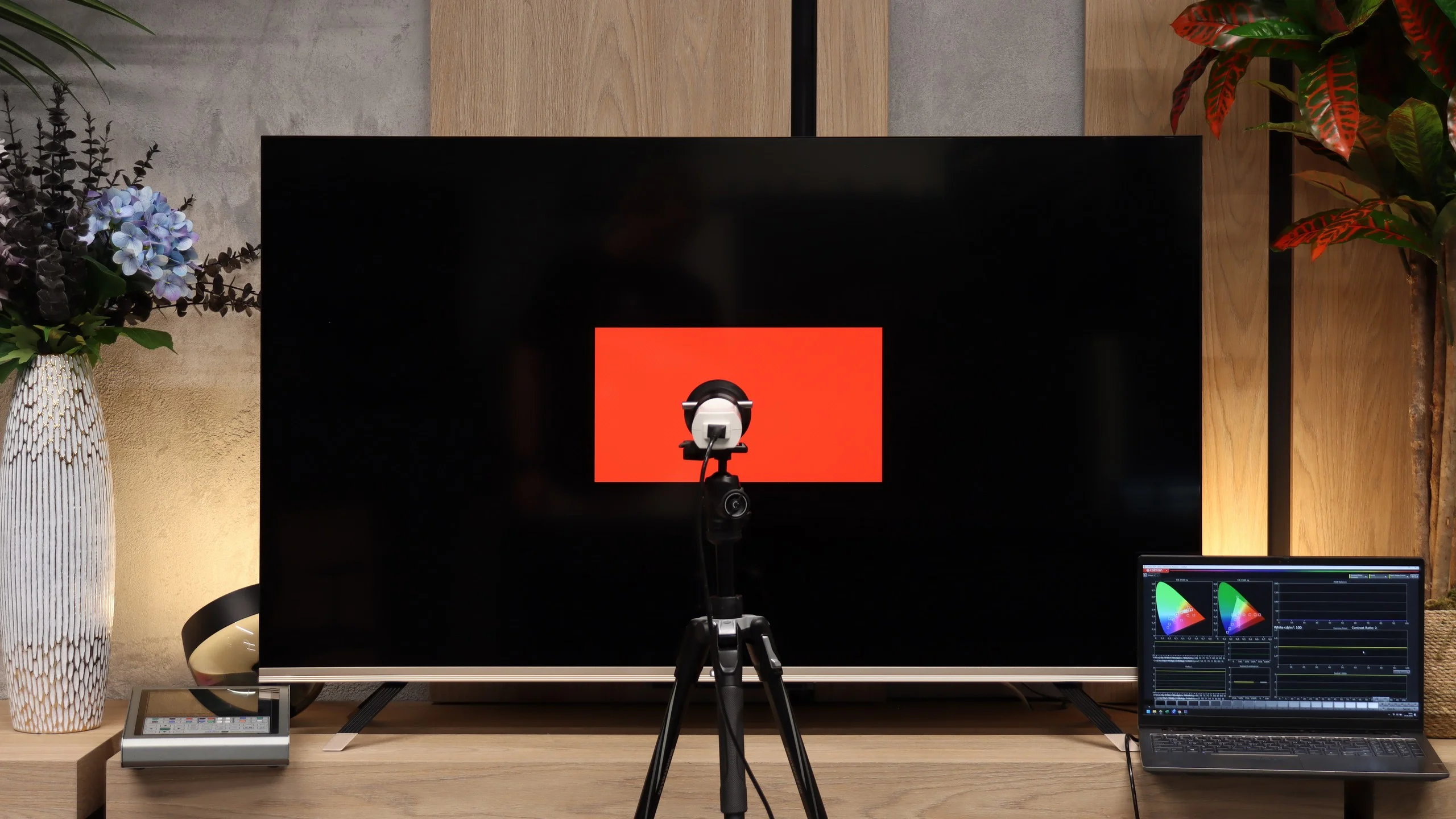
Fortunately the Q100 makes up for some of that elsewhere. The manufacturer markets it as a QLED TV, although in practice a PFS filter is responsible for widening the colour palette. Our measurements show coverage of about 92% of DCI-P3 and around 67% of BT.2020. These are not top-tier numbers, but still clearly better than basic LCD TVs without an extra layer to expand the gamut. That means HDR material can at least offer more saturated and varied colours, even if the brightness alone does not yet allow you to speak of a fully convincing HDR effect.
BT.2020 color gamut coverage and primary color luminance
| Data set | BT.2020 | P3 | R | G | B |
|---|---|---|---|---|---|
| Synthetic patterns | 67.4% | 92.1% | 49% | 53% | 64% |
| Film measurements | 67.1% | 91.7% | 49% | 53% | 64% |
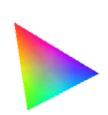 BT.2020
 BT.2020 and P3 – average color gamut coverage (percent of the target gamut).
R, G, B – average primary color luminance relative to target (percent).
Scene from the movie “Pan” (about 2800 nits)

Scene from the movie “Billy Lynn” (about 1100 nits)

When we started our comparison clips it was immediately clear the Dreame Q100 was starting from a fairly difficult position. Its low brightness heavily limits its capabilities and means the picture lacks the impact and showiness of more expensive televisions. Even so, the Q100 handled detail reproduction quite well. In most scenes the tonal transitions looked correct and the picture retained an appropriate level of detail. It only started to struggle in the brightest passages, such as the explosions in Billy Lynn, the sun in Pan or other strong highlights. In those spots the TV couldn't always adjust brightness properly and sometimes lost some detail. That said, given the class and capabilities of this model it doesn't look bad. The limitations are visible, but outside the most demanding sequences the Q100 performs pretty well.
HDR luminance chart:
As we mentioned earlier, the Dreame Q100 doesn't always handle automatic tone mapping in static HDR10 very well. With its low brightness it has limited headroom and in the brightest parts of the image it can lose some detail. That's why Dolby Vision support is a big plus. Dynamic metadata helps the TV better match the brightness of individual scenes to the panel's actual capabilities. In practice the difference can be noticeable. The same scene played back in Dolby Vision preserves more highlight detail, and the picture simply looks more natural and more readable. For the Q100, Dolby Vision doesn't suddenly turn it into a bright HDR TV. It's still limited to around 300 nits, but the format lets it make much better use of what the screen actually has.
Static HDR10

Dynamic: Dolby Vision

Factory color reproduction
6.5/10
For testing we chose the "Film" mode and we think it’s by far the best of the available presets. There are none of the heavily boosted, unnatural colours you see in Vivid/Dynamic mode. The picture looks quite reasonable straight away, although it falls short of perfect. In SDR material the most noticeable issue was a slight warming of the image. The white balance had too much red, which made whites lean towards a warmer tint, and a similar cast was visible in the greys. In HDR the situation was a little different. Here blue had a slight advantage, making the image a touch cooler. These are not major faults. For such an inexpensive TV the factory settings on our unit were pretty decent, and the "Film" mode already delivers a relatively natural picture without much fiddling with the settings.


Color reproduction after calibration
7/10
Contrary to appearances, the Dreame Q100 is actually quite well prepared for picture calibration. The menu contains plenty of advanced picture settings that allow fairly precise adjustment of its characteristics. In our case the white balance required the most work, both in SDR and HDR. After correction SDR material looked very good. We managed to achieve an almost neutral white balance and natural colours, with the main limitation remaining the black level itself, stemming from the panel design and the lack of local dimming.
In HDR we were also able to improve white balance and colour reproduction, but here the TV’s electronics reveal their limitations more quickly. Even after very precise EOTF curve adjustment, the Q100 doesn't always stick to it properly during real-world scenes. In some content it can also brighten the image, making some parts look brighter than they should, and some detail in bright areas can be lost as a result.


DREAME Q100 - Smoothness of tonal transitions
9/10
The Dreame Q100 handles the smoothness of tonal transitions very well. In most scenes the gradients are smooth, and transitions between lighter and darker tones look natural, without obvious banding or posterization. Minor imperfections may only appear in very demanding scenes, but these are situations that much more expensive TVs can struggle with too. Overall, the Q100 performs really well in this regard.


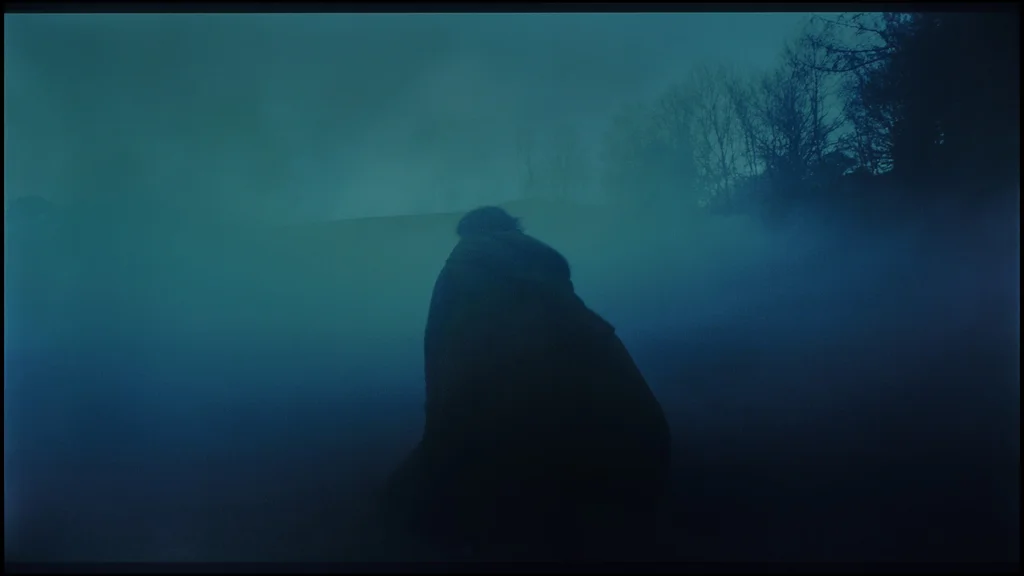

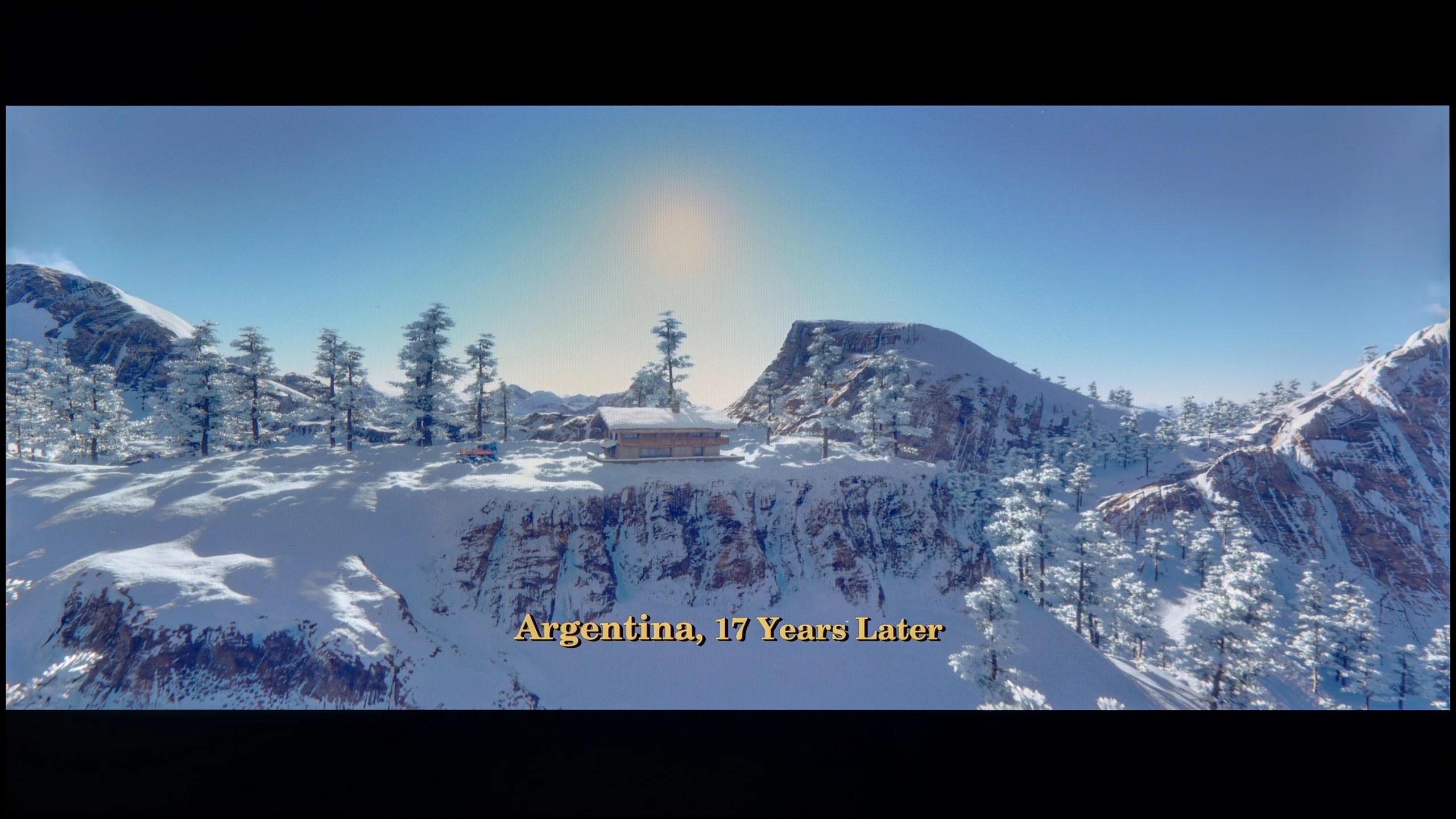

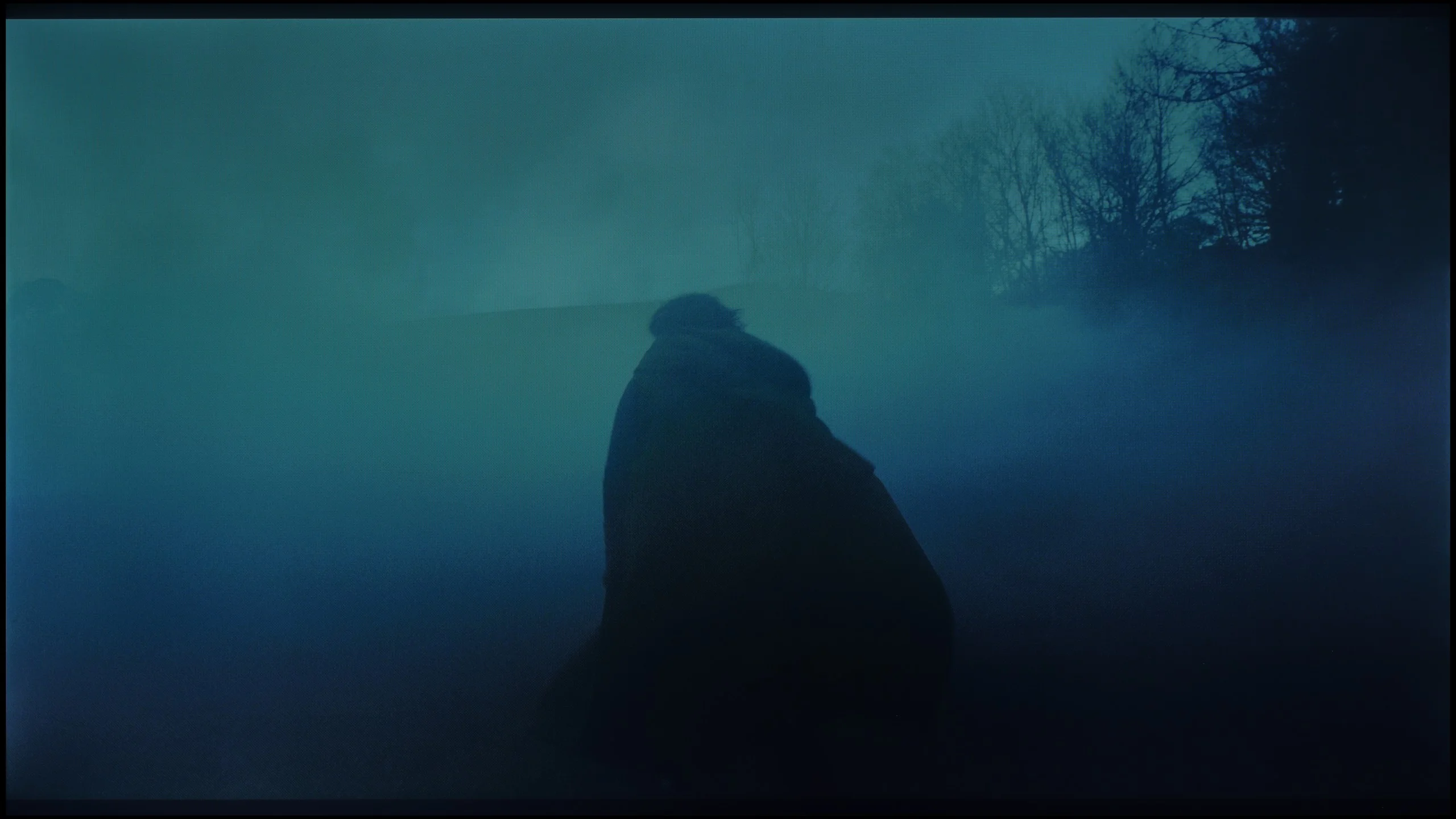

Image scaling and smoothness of tonal transitions
3/10
 Smooth transition function
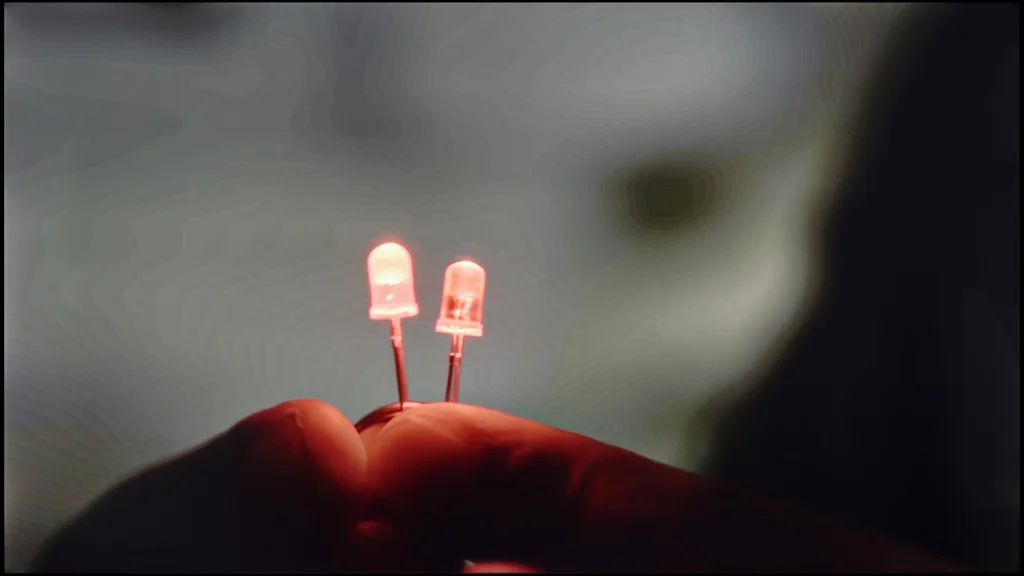
Image without overscan on the SD signal

The weakest point of the Dreame Q100 is its digital image processing. The processor used does a fairly average job of improving weaker material, and the menu offers no function that effectively smooths ugly tonal transitions or reduces visible posterisation. The upscaling itself is also unimpressive. With low-resolution material the image is rather soft and lacks better reproduction of fine detail. Additionally, the Q100 tends to overscan, meaning it slightly crops the edges of the image with very poor sources, for example 480p material. In everyday viewing of HD or 4K content this won’t be a major issue, but with older recordings the processor’s limitations are clearly visible.
DREAME Q100 - Blur and motion smoothness
4.6/10
Maximum refresh rate of the panel: 60Hz
Film motion smoothing option: Yes
Blur reduction option: No
BFI function 60Hz: No
BFI function 120Hz: No
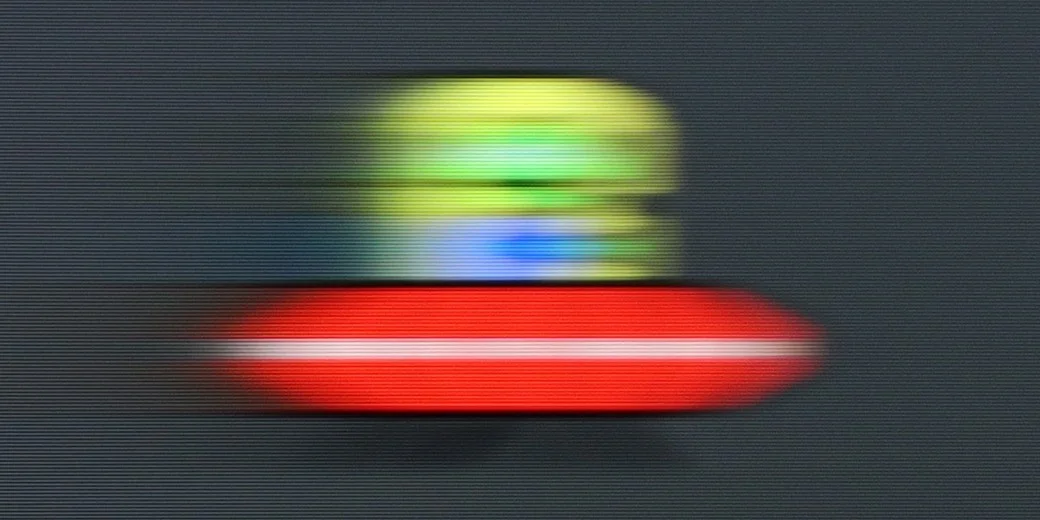
The VA panel in the Dreame Q100 has a native refresh rate of 60 Hz, so right from the start it's not a television built for the most demanding sports fans or gamers. The manufacturer does note the option to run at 120 Hz and that mode is indeed available, but it's primarily intended for a gaming mode. In everyday use the Q100 should therefore be treated as a standard 60 Hz TV. That means less smooth motion during fast sports broadcasts or quick gameplay than in models with 120 Hz or higher panels. One positive is the panel's response time. The VA panel doesn't smear excessively, so motion stays fairly clear and doesn't leave strong, blurred trails behind objects. For films we can also use a simple motion smoothing system. The manufacturer has prepared several presets that help reduce the characteristic judder in material shot at 24 frames per second.
Blur (native resolution, maximum refresh rate):



Blur (1080p@120Hz):


DREAME Q100 - Console compatibility and gaming features
6.3/10
 ALLM:
Yes
ALLM:
Yes - VRR:
Yes
- VRR range:
48 - 120Hz
- Dolby Vision Game Mode:
Yes
- Correct implementation of HGIG:
No
- 1080p@120Hz:
Yes
- 1440p@120Hz:
No
- 4K@120Hz:
No
- Game bar:
Yes
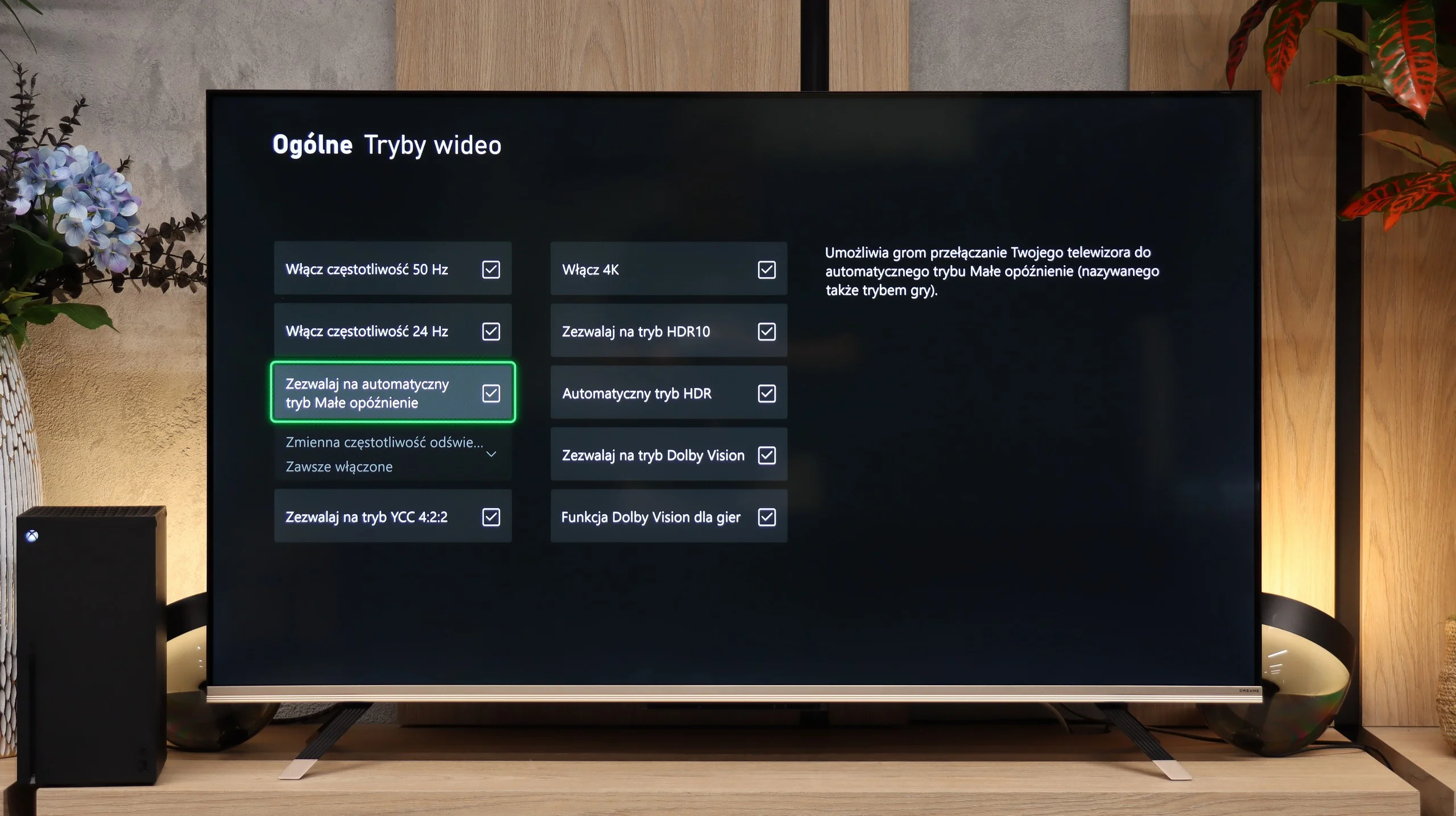
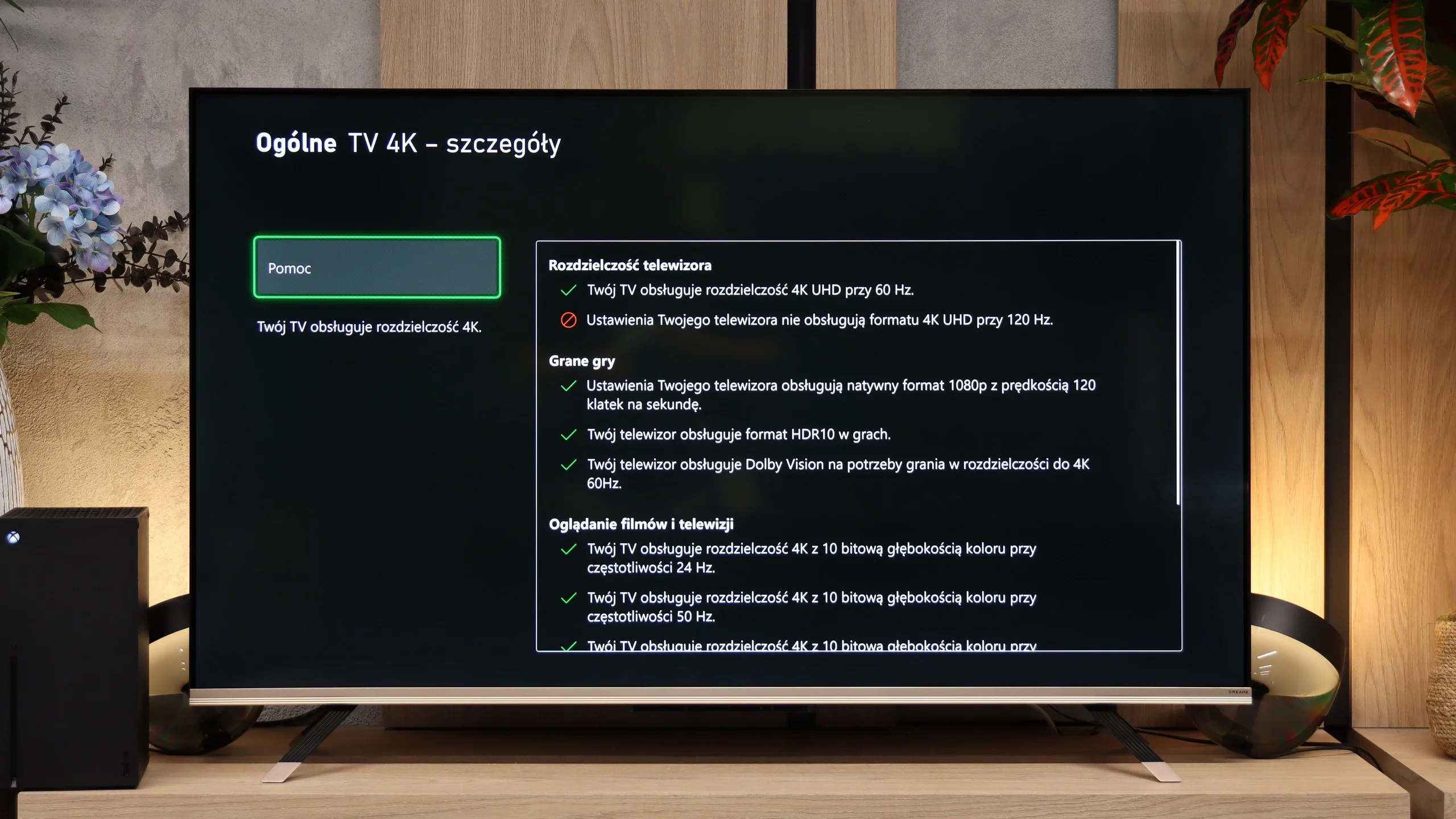
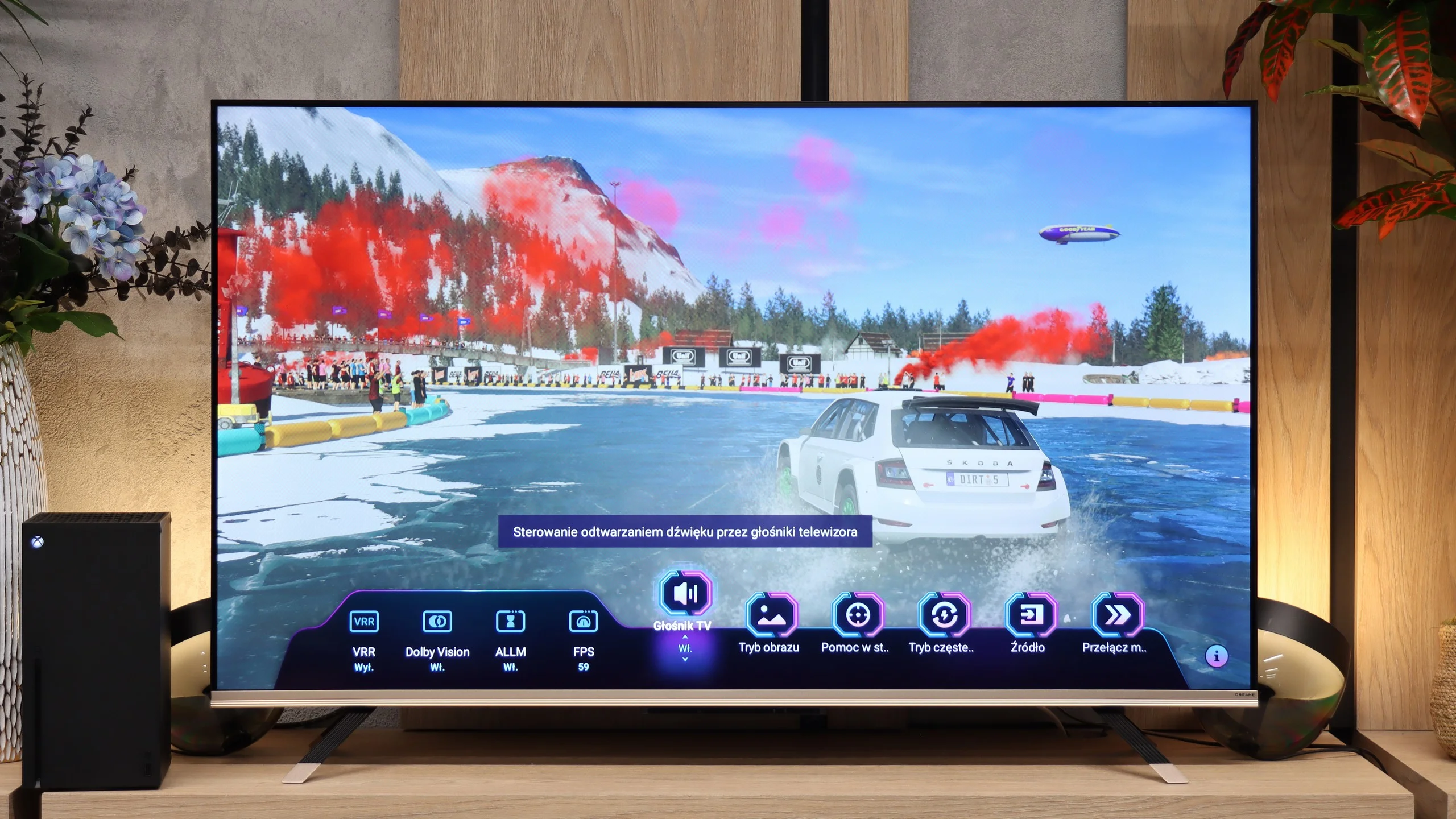
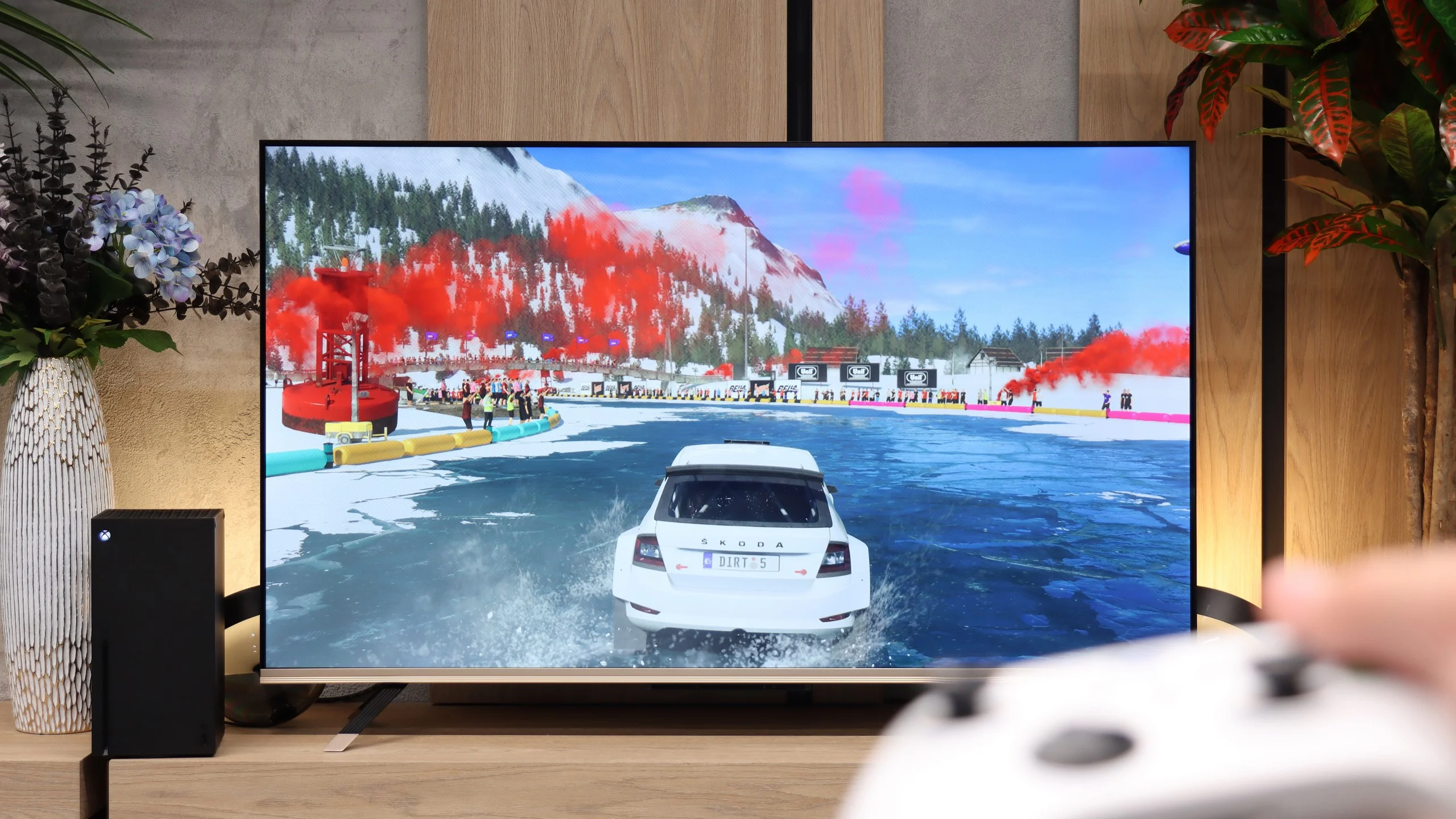
Dreame Q100 is not strictly a gaming device, but for console use it offers a pretty sensible package. You get VRR to eliminate screen tearing and ALLM, which automatically switches the TV to a low-latency mode when it detects a console signal. An interesting compromise is support for 120 Hz. The panel won't reach that refresh rate in 4K, but drop to 1080p and you can play at 120 frames per second. If a title prioritises smoothness over resolution (and the game offers such a mode), it's worth using. It also includes a handy Game Bar that lets you quickly change screen settings, switch the refresh mode or add a virtual crosshair. The HGiG implementation is a bit weak, but credit is due for Dolby Vision Gaming support on Xbox Series X and S. This isn't a panel for tech purists, but for casual console gaming, especially when trading 4K for smoother Full HD, it performs very well.

DREAME Q100 - Input lag
10/10
The measured input lag is low enough that it shouldn’t be an issue while gaming. In 60 Hz mode the delay stays under 15 ms, and when switched to 120 Hz it falls below 10 ms. These very low values provide highly responsive gameplay.
| SDR | HDR | Dolby Vision |
|---|---|---|
| 1080p60: 13 ms | 2160p60: 13 ms | 2160p60 DV: 13 ms |
| 1080p120: 9 ms | ||
| 2160p60: 13 ms |

DREAME Q100 - Compatibility with PC
4/10
Chroma 444 (max. resolution and refresh rate): No
Font clarity: Good
Readability of dark text and shapes: Poor
Input lag in PC mode (4K, max. refresh rate): 13ms
Matrix subpixel arrangement: BGR
Max refresh rate: 60Hz
G-Sync: Yes
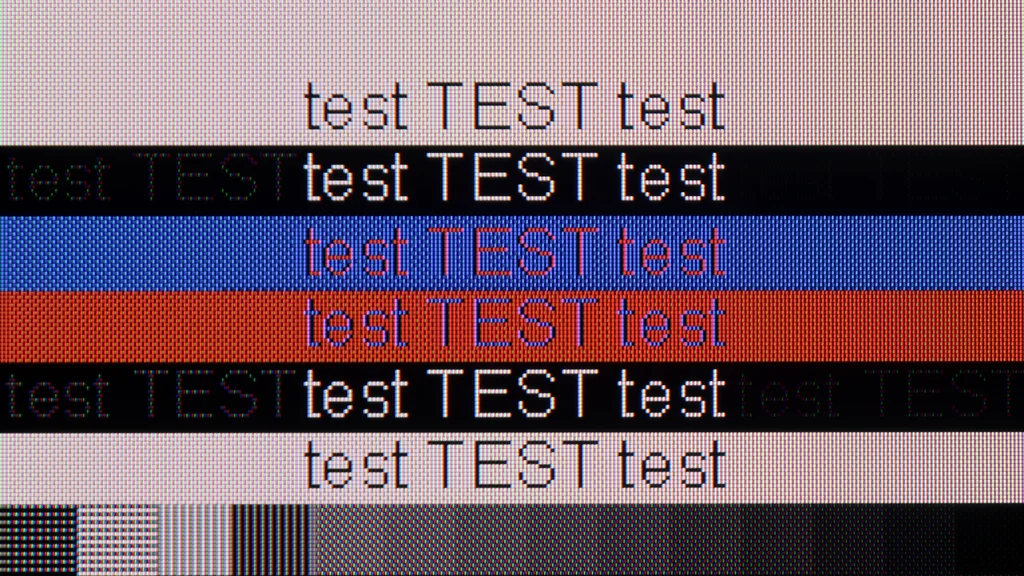
The Dreame Q100 can serve as a large screen connected to a computer from time to time, but it performs much worse in the role of a monitor. Above all, the TV does not correctly support 4:4:4 chroma subsampling, so coloured text and fine interface elements are not as sharp and legible as they should be. Black text on a light background looks much better, but during normal computer use this limitation quickly becomes apparent. There's also the matter of refresh rate. The Q100 can run at 120 Hz, but only after dropping the resolution to Full HD. At native 4K we remain at 60 Hz. It's fine for the occasional connection of a laptop or PC, but we wouldn't recommend it as a permanent monitor.
DREAME Q100 - Viewing angles
2.9/10
Brightness drop at an angle of 45 degrees: 70%
One of the typical limitations of VA panels is viewing angles, and the Dreame Q100 is no exception. Sit noticeably to the side and the picture begins to lose saturation and the colours become paler. In this respect IPS or ADS panels perform considerably better. However, it's a compromise: the VA panel offers much better contrast and deeper blacks when watching the TV head-on.
DREAME Q100 - Daytime performance
4.4/10
Panel finish: Satin
Reflection suppression: Decent
Black levels during daytime: Good
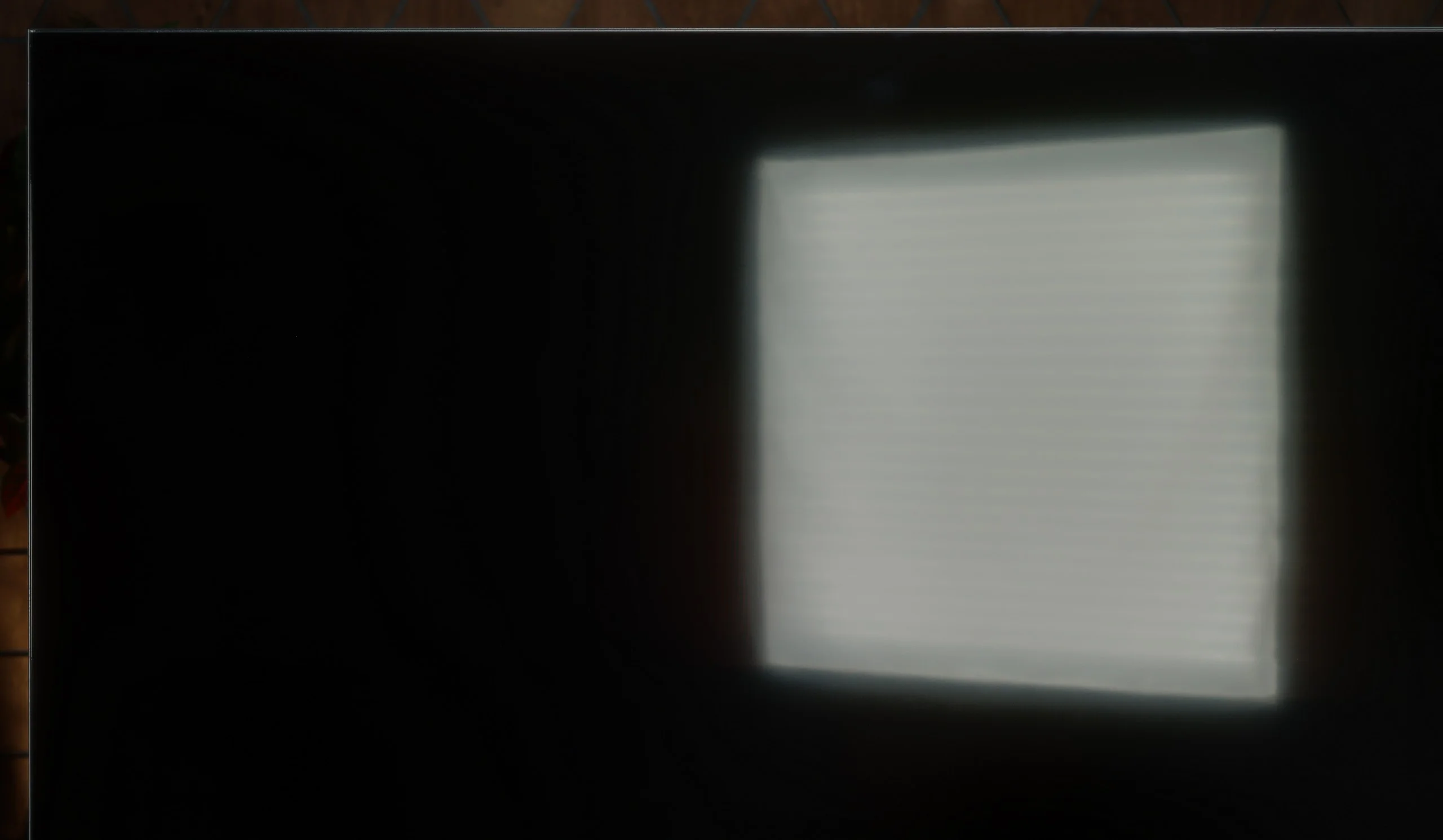
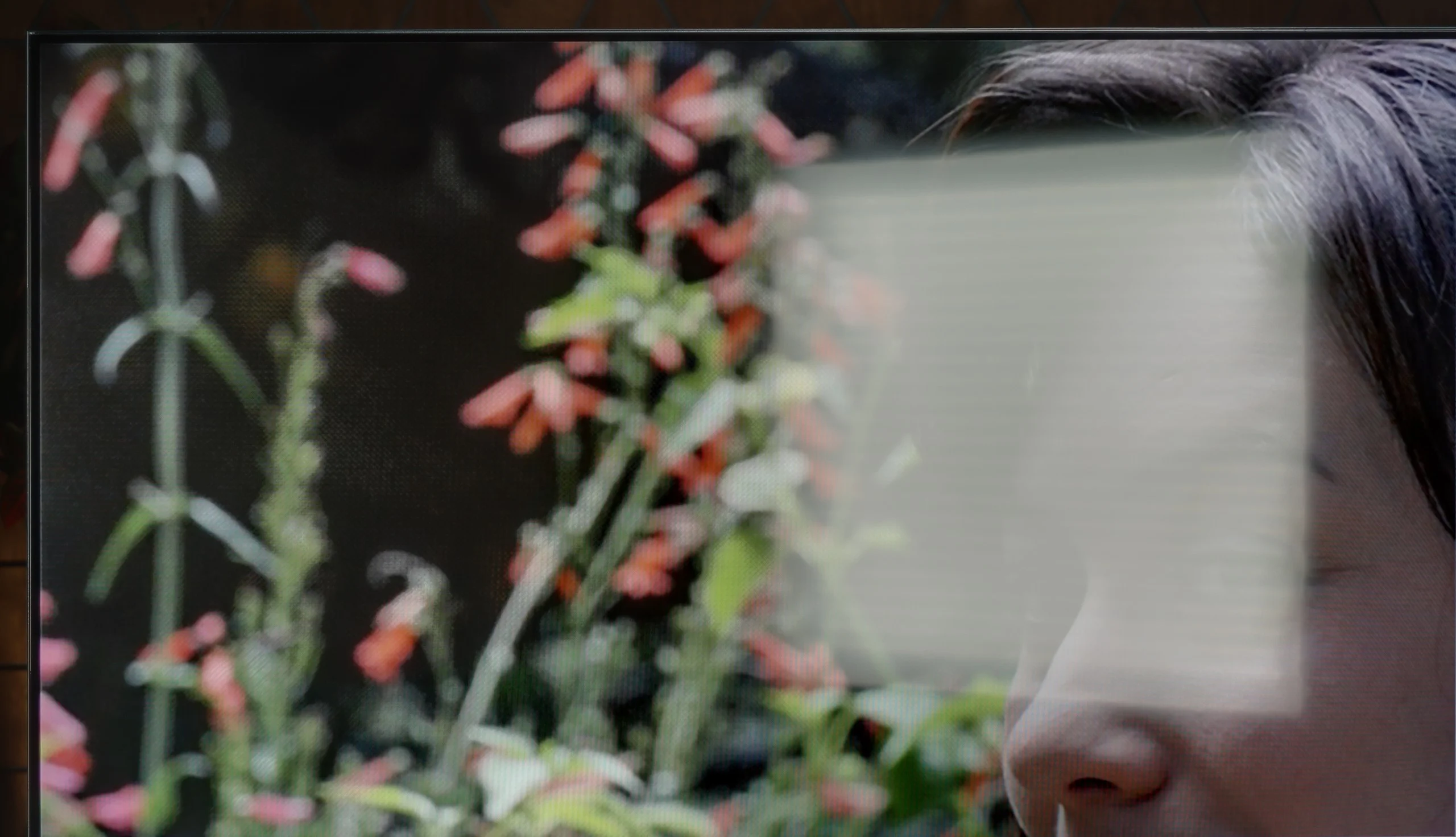
The Dreame Q100 isn't designed for very bright rooms. Around 300 nits of brightness is too little for the image to remain clearly readable in a strongly sunlit living room, especially during the day. The satin screen coating doesn't help either, coping only moderately well with direct reflections. With a lamp or window opposite the TV, reflections can be quite noticeable. In a typical, moderately lit room the Q100 will cope adequately, but for a really bright living room it's worth looking for something with higher brightness and a better anti-reflective coating.
Panel brightness
Dreame Q100: 282 cd/m2
DREAME Q100 - TV features
5.2/10
System: Google TV
System performance: Average
- HDMI inputs: 3 x HDMI 2.0, 0 x HDMI 2.1
- Other inputs: RCA (Chinch)
- Outputs: SPDIF (Coaxial audio), eARC (HDMI), ARC (HDMI), Mini-Jack (Headphones)
- Network Interfaces: Wi-Fi 2.4GHz, Wi-Fi 5GHz, Ethernet (LAN) 100Mbps
- TV reception: DVB-T, DVB-T2, DVB-S, DVB-S2, DVB-C
Classic features:
- Recording to USB (terrestrial TV): No
- Recording programming: No
- Picture in Picture (PiP): No
- RF remote control (no need to aim): RF
- Backlit remote control: No
- Teletext: Yes
- Audio only mode: Yes
- Bluetooth headphones support: Yes
- Simultaneous Bluetooth headphones & TV audio: No
Smart features:
- AirPlay: No
- Screen mirroring (Windows Miracast): Yes
- Voice search: Yes
- Voice search in native language: Yes
- Ability to connect a keyboard and mouse: Yes
Google TV
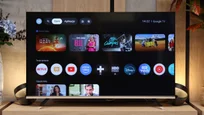
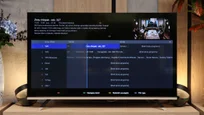
The Dreame Q100 runs Google TV, so it’s hard to fault when it comes to app access. You get all the most popular streaming services, the ability to install additional apps from the Google Play store and support for a Google account. The system therefore offers much the same capabilities as many far more expensive TVs. During our tests we couldn’t connect to the TV from an iPhone, so AirPlay is not available on this model.
Classic features
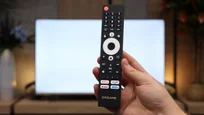
For regular TV watching the Q100 will do the job without major problems, but it’s fairly basic in terms of extra features. There’s no option to record programmes to USB or to schedule recordings. More advanced functions found on pricier models are also missing, such as viewing from two tuners at once or PiP mode. The supplied remote is rather modestly built, but thankfully the manufacturer has kept a full numeric keypad on it, which is still very handy for traditional TV. On the plus side, it includes analogue connectors. The Q100 even has a classic 3.5mm headphone jack, which you see less and less on new TVs these days.
Sound connection options
HDMI audio:
Other audio outputs:
- Coaxial: Yes
- Stereo (Mini-Jack): Yes
Wireless audio:
- Bluetooth: Yes
Supported audio formats (external HDMI eARC audio):
- Dolby Digital Plus 7.1: Yes
- Dolby True HD 7.1: No
- Dolby Atmos in Dolby Digital Plus (JOC): Yes
- Dolby Atmos in Dolby True HD: No
- DTS:X in DTS-HD MA: No
- DTS-HD Master Audio: No
Senior accessibility
- Numeric keyboard on TV: Yes
- Font size adjustment: Yes
- Audio description: Yes
DREAME Q100 - Apps
9.6/10






















DREAME Q100 - Playing files from USB
8.9/10
| Maximum photo resolution: | Supported photo formats: |
|---|---|
| 4 Mpix | JPEG |
| 6 Mpix | HEIC |
| 8 Mpix | PNG |
| 10 Mpix | GIF |
| 12 Mpix | WebP |
| 16 Mpix | TIFF |
| 20 Mpix | BMP |
| 24 Mpix | SVG |
| 28 Mpix | |
| 32 Mpix |
Dreame Q100 handles playback of files from a USB drive very well. During tests it played most common video and audio formats without major problems. The only limitations were with subtitles; the TV wouldn't play some formats, such as .SUB or .TXT.
DREAME Q100 - Sound
5/10
87dB
Maximum volume

Supported codecs (TV speakers)
Dolby Digital Plus 7.1
Dolby True HD 7.1
Dolby Atmos in Dolby Digital Plus (JOC)
Dolby Atmos in Dolby True HD
DTS:X in DTS-HD MA
DTS-HD Master Audio
The sound in the Dreame Q100 is simply average. It noticeably lacks bass, which makes the overall sound fairly flat and doesn’t give much of a sense of space. Fortunately, even at higher volumes there are no unpleasant crackles, squeaks or resonance from the plastic parts of the casing. A plus is Dolby Atmos support, although the TV’s speakers themselves can’t really show what the format is capable of. If you want better spatial sound, you’ll probably need a soundbar or a home theatre system.
Sound Quality Test:
Acoustic Measurements
87dBC (Max)
75dBC
DREAME Q100 - Panel details
Software version during testing: UKN5.251016.064
Image processor: mt5896 2GB
Panel uniformity and thermal imaging:

Backlight Type: PFS LED

Founder and originator of the "ChooseTV" portal

Journalist, reviewer, and columnist for the "ChooseTV" portal

michal-woloszyn-title
Reader comments
Comments are provided by the external service Disqus (Zeta Global). Once loaded, Disqus may set cookies and process data about your activity.
We will remember your choice on this device. Provider's privacy policy