 Redakcja Choose TV
Clearance sales of 2025 models are the best time to buy an OLED TV. Prices have already dropped to a reasonable level, and the TVs themselves still rank among the very best in picture quality. Among 55-inch models, these four sets are particularly worth a look.
Samsung S85F: the most affordable QD-OLED
The Samsung S85F is currently the most affordable TV with a QD-OLED panel. Thanks to quantum dot technology it offers more saturated colors than traditional WOLED panels, especially when watching HDR content. On board it has four HDMI 2.1 ports and support for VRR, ALLM, and HGiG, so it's also a very good choice for gamers. The biggest compromises are brightness, which is a bit lower than on the S90F or LG C5, and the processor, which doesn't handle lower-quality source material as well as more expensive models. It also still lacks Dolby Vision (though that's not a major drawback).
LG C5: the most versatile OLED
The LG C5 has long remained one of the safest choices in the OLED segment. Its higher-end WOLED panel (marketed as EVO) delivers high brightness, excellent black levels, and great picture quality in both movies and games. The biggest strengths are support for Dolby Vision, a 144 Hz panel, and a refined webOS system with the Magic Remote. It's a TV that's hard to definitively call weaker than the competition.
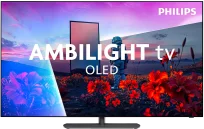
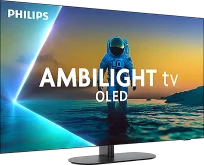
Philips OLED820: OLED with Ambilight
The Philips OLED820 stands out primarily for its Ambilight system. This combination is especially appreciated by viewers who watch movies and series in the evenings. The TV supports Dolby Vision, HDR10+, 144 Hz, and HDMI 2.1. The P5 processor does a very good job enhancing sharpness and motion clarity, and Ambilight remains a feature no competitor offers. The panel used in the OLED820 is very similar to the one used in the C5 and S90F models.

Samsung S90F: a strong competitor to the LG C5
In the 55-inch version the Samsung S90F uses a WOLED panel similar to the one in the LG C5. The differences stem mainly from the image processor and the software. The NQ4 AI Gen3 processor upscales lower-quality content very well, and the 144 Hz panel, four HDMI 2.1 ports and the Game Motion PLUS feature make it an excellent gaming TV. Compared with the LG C5 it still lacks Dolby Vision support, but Samsung supports HDR10+. Since both models are based on a very similar panel, the choice mainly comes down to preferences regarding the Smart TV system.