 Redakcja Choose TV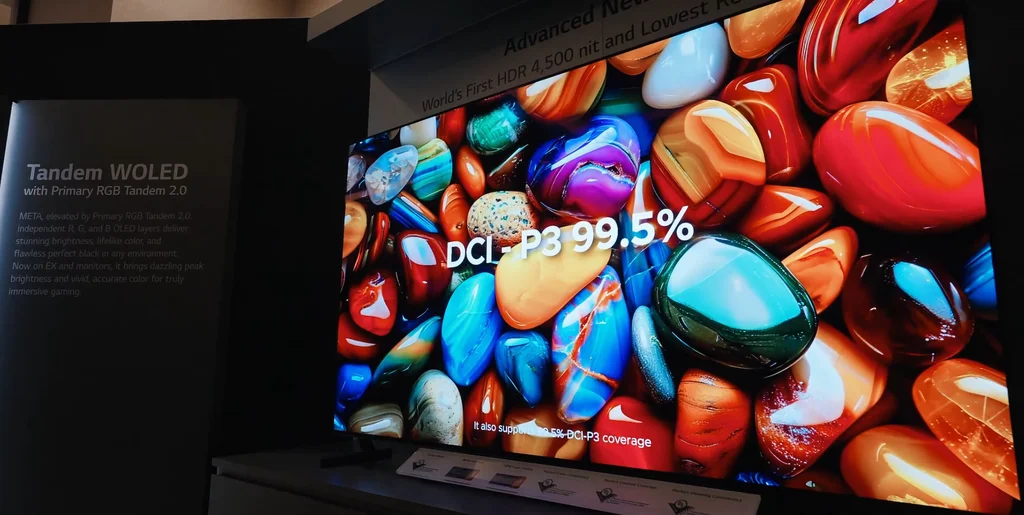
RGB LED, also known as micro RGB or RGB miniLED, is one of the most talked-about innovations at CES 2026 in Las Vegas. The technology, touted as the next big step in the evolution of LCD, is being introduced this year in televisions from Hisense, Samsung, and LG Electronics, and soon also Sony. Is this the moment when OLED loses its position as the undisputed leader in picture quality?
OLED vs. RGB LED – what really changes?
At first glance, RGB LED makes an impression. The use of red, green, and blue diodes in LCD backlighting allows for achieving very high brightness and an exceptionally wide color palette. In this area, RGB LED can realistically outperform OLED – especially when it comes to color saturation at extreme brightness. The problem is that RGB LED remains an LCD technology. Regardless of the type of backlighting, the key element is still the liquid crystal matrix, which:
has a significantly slower response time than OLED,
offers much lower native contrast,
loses image quality at an angle,
requires aggressive local dimming to improve blacks.
RGB LED manufacturers are eager to talk about brightness and colors, but in the presentations from CES 2026, they strikingly often overlook the number of dimming zones. This is not a coincidence.
Problem of Dimming Zones in RGB LED
In RGB LED, each dimming zone contains three independently controlled diodes: red, green, and blue. This poses a significant challenge for the controlling electronics and image processing algorithms. In practice, this may mean that:
the number of dimming zones in 2026 models will be lower than in the best miniLEDs from 2025,
it will be harder to limit halos,
contrast improvement will remain a compromise.
Meanwhile, OLED performs local dimming at the level of individual pixels – simultaneously for brightness and color. For a 4K TV, this means over 8.3 million "zones," whereas even the most advanced LCDs operate in the thousands. RGB LED does not solve the fundamental problems of LCD. It can only partially mask them.
How does LG Display plan to respond?
LG Display is not ignoring the RGB LED offensive. On the contrary – in 2026, the company significantly expands its OLED offerings, both in the premium segment and in a more affordable price range. The most important new feature is the improved Tandem WOLED panel with Primary RGB Tandem 2.0 technology. According to LG Display:
peak brightness reaches up to 4500 nits,
the panel's reflectivity has been reduced,
energy efficiency has been improved.
This technology is no longer reserved solely for top models. In 2026, it will be available:
for OLED EX panels,
for all gaming OLED monitors from LG Display.
RGB stripe in OLED monitors
The second important direction of development is RGB stripe pixels in OLED monitors, which improve:
the sharpness of text,
color accuracy,
saturation of colors.
It is worth emphasizing that LG Display OLED TVs in 2026 still use the RGBW arrangement. The term "Tandem WOLED" refers to the construction of the white OLED diode, not the presence of a white subpixel as such.
Cheaper OLEDs – a key change
The most interesting novelty revealed by LG Display in an interview with FlatpanelsHD is the introduction of the OLED SE (Special Edition) line. These are panels designed for the mid-range segment:
sizes: 83, 77, 65, 55, and 48 inches,
pixel-level dimming preserved,
lower power consumption,
more balanced specifications.
OLED SE is set to reach television manufacturers in 2026 and could realistically change the balance of power in the mid-price segment, where LCD currently dominates.
What about large diagonals and 8K?
LG Display admits that LCD TVs over 80 inches are still cheaper to produce. However, the company is counting on:
further improvement in OLED production yields,
increased costs of advanced LCD (miniLED, RGB LED),
gradual narrowing of the price gap.
When it comes to 8K OLED, the technology has been ready for years, but the market and content have not kept up. LG Display declares full readiness to return when real demand appears.
Comfort for the Eyes – the Silent Argument for OLED
In the context of increasingly bright LCDs, LG Display highlights an often-overlooked aspect: visual comfort. OLED:
does not use continuous backlighting,
emits light only where it is needed,
reduces exposure to harmful components of blue light.
In 2025, LG Display became the first company to obtain the Eyesafe 3.0 certification, taking into account the impact of the display on the circadian rhythm.
Will RGB LED Threaten OLED?
RGB LED is undoubtedly the most advanced form of LCD that has reached consumers. It offers impressive brightness and colors but does not change the fundamental limitations of liquid crystal technology. OLED, instead of defending the status quo, enters 2026 with:
higher brightness,
better efficiency,
new pixel structures,
and finally – cheaper panels.
This does not seem like a technology on the defensive.