 Redakcja Choose TV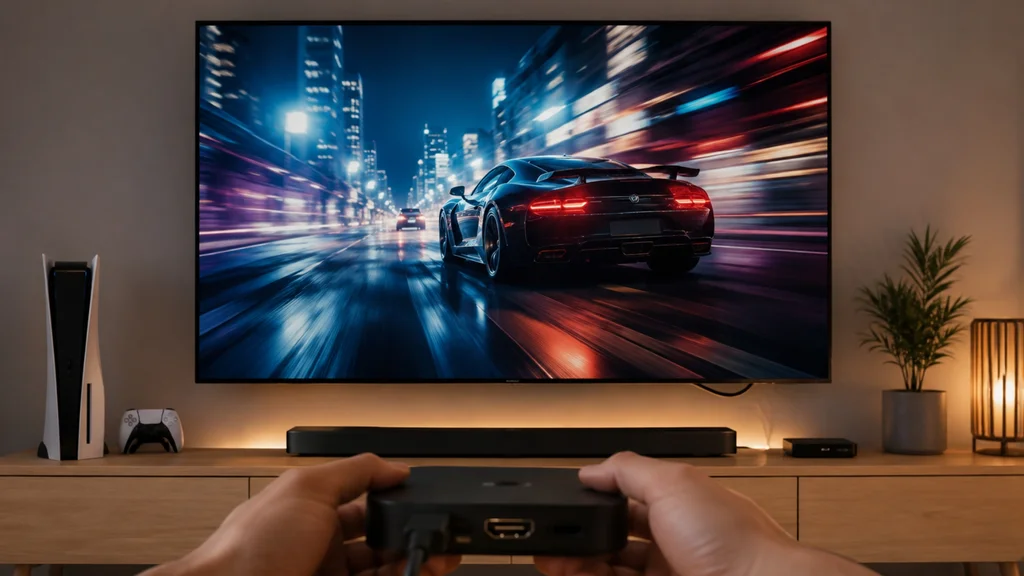
When using media players like the Apple TV 4K, many users notice a brief blackout of the picture when starting a movie or TV show. This is caused by the TV changing its refresh rate after adjusting the frame rate to match the content. The solution is HDMI 2.1 QMS, or Quick Media Switching, which lets the TV switch between different refresh rates without a momentary loss of the picture.
What is HDMI 2.1 QMS and how does this technology work?
Quick Media Switching (QMS) is an optional feature of the HDMI 2.1a standard designed to eliminate the brief black screen that appears when the frame rate changes. This occurs, for example, when a player automatically adjusts the refresh rate to match the content being watched. Movies are most often displayed at 24 frames per second, while television broadcasts may use 25, 30, 50, or 60 frames. The TV then has to change its refresh rate, which causes a short blackout. QMS uses the mechanism known from VRR but is a separate feature intended only for video playback, not for gaming. Using Video Timing Extended Metadata, the source device notifies the TV of an upcoming change before it happens. That allows the refresh rate to switch almost instantly and without the annoying black screen. The feature works with any HDMI cable and does not require purchasing special cables. However, to use it both the TV and the player must support QMS.
Which devices and TVs support HDMI 2.1 QMS?
The first player to support HDMI QMS was the Apple TV 4K from 2022. The feature makes the most sense on devices that offer automatic frame rate switching to match the content being played. On the TV side, LG was the first to announce support, and the technology later began appearing in models from other manufacturers. Today, the list of compatible devices is mainly made up of LG, Samsung, and TCL TVs from the 2023, 2024, 2025 and 2026 model years. Supported models include the LG C3, C4, C5 and C6 series, LG G3, G4, G5 and G6, Samsung S90C, S90D, S90F and S90H, Samsung S95C, S95D, S95F and S95H, and numerous TCL models from the C, QM and X series. Previously Sony stated it did not plan to implement QMS, while Philips said it would analyze the possibility of adding the feature in the future. Keep in mind that having HDMI 2.1 or VRR support does not automatically mean QMS compatibility. It is a separate feature whose implementation depends entirely on the TV manufacturer.
HDMI 2.1 QMS eliminates brief picture blackouts when switching refresh rates while playing movies and TV shows. To use it, both the TV and the playback device must support it, and the number of compatible models is steadily increasing.
source: flatpanelshd