 Maciej Koper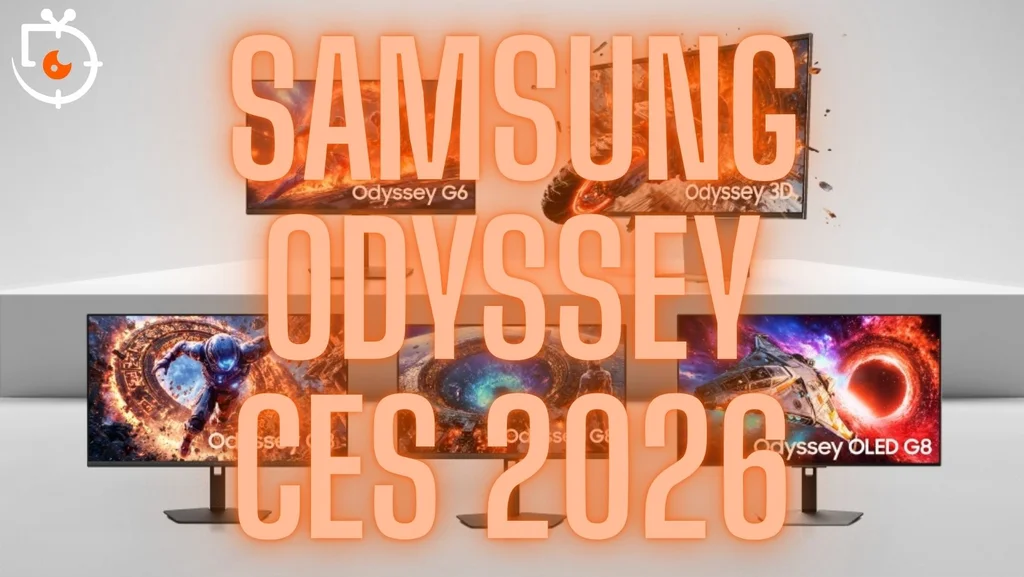
This year's CES in Las Vegas became a stage for Samsung to flex its muscles in two extremely different directions when it comes to monitors. On one hand, the manufacturer focused on extreme hertz racing and the revival of three-dimensional technology, while on the other hand, they aimed to push resolutions to 5K and 6K standards in more practical models. We had the opportunity to see the entire new Odyssey line for 2026 in person, and it must be admitted that it is an impressive display of technological capabilities, although not every presented novelty makes the same sense for the typical user.
Odyssey 3D G90X
The most controversial and eye-catching point at the booth was the Odyssey 3D (G90X) model. This is a 32-inch IPS monitor with a powerful 6K resolution that promises a depth effect without the need for uncomfortable glasses. We checked how it works in practice – a special coating on the screen combined with a real-time eye-tracking system ensures that each eye receives a slightly different image, creating natural stereoscopy. The sensation of objects on the screen seeming to literally fly in front of the panel is incredible and captivates the imagination. However, this technology has its limitations, as the best effect is achieved only by one person seated directly in front of the screen. In our opinion, it is a fascinating showcase of technology that will, for now, remain a niche curiosity for enthusiasts of specific titles designed for 3D.
Does anyone need 1040 Hz? Yes? Then welcome the Odyssey G60H
Equally loud was the premiere of the Odyssey G60H model, which Samsung decided to fight for the attention of the most demanding e-sport athletes. Marketing-wise, it sounds powerful, as the manufacturer boasts a refresh rate of up to 1040 Hz. However, it is worth noting that this astronomical value is achieved in "Dual Mode" when dropping to HD resolution (by default, the monitor offers 600 Hz in QHD). In our opinion, such high values are purely a race for numbers, which will only be appreciated by a fraction of professional players who have equipment capable of generating over a thousand frames per second. For most gamers, the barrier will still be the response time of the IPS panel itself, which is why we believe this equipment is strictly for competition, not for admiring graphics in AAA hits.
Two Faces of the G8 LCD Series: 5K and 6K Monitors for Work and Play
The new Odyssey G8 series presents itself much more sensibly and universally, as it has been divided into several variants this year. Samsung has shown that traditional IPS LCD technology still has a lot to offer, especially for those looking for a single screen for everything. The first option is the G80HS model, a 32-inch monster with a resolution of 6K and a refresh rate of 165 Hz. This solution targets those who need a vast workspace and impeccable text clarity during the day. With the Dual Mode feature, in the evening, you can switch the monitor to 3K mode with one click, which automatically boosts fluidity to e-sports levels of up to 330 Hz.
An alternative for those who prefer smaller screens is the G80HF model. This is a 27-inch display with a resolution of 5K, which, due to the smaller diagonal, provides an even greater pixel density. Here, the base refresh rate is 180 Hz, but once again we can take advantage of the dual mode. When lowering the resolution to QHD, the monitor ramps up to an impressive 360 Hz. Both of these models are great examples of hybrid monitors that are suitable for both work and gaming.
The most complete Samsung monitor? Odyssey OLED G8.
For most users looking for top-notch experiences, the most interesting highlight of the program was the new Odyssey OLED G8 (G80 SH). It is a 32-inch 4K QD-OLED panel that, in our opinion, offers the most complete and sensible package in this year's lineup. This monitor not only provides excellent contrast and black levels with a refresh rate of 240 Hz, but it also features a new matte coating that reduces glare. Importantly, from a practical standpoint, it is equipped with modern DisplayPort 2.1 (UHBR20) and USB-C connections with laptop charging up to 98W.
At the closed showcase, we also saw something that might be the most significant change for OLED technology in general. Samsung Display presented a prototype of a next-generation matrix with a vertical subpixel arrangement (V-stripe). This is a direct response to one of the biggest issues with previous OLEDs, namely blurry fonts and colorful outlines around text during office work. We examined it up close, and the new structure indeed significantly improves readability, eliminating annoying artifacts. Although this particular panel (34 inches ultrawide, 360 Hz) will likely first be used in monitors from partner brands such as Asus or MSI, it heralds the beginning of the end of text issues on OLEDs.
Source: own study