 Redakcja Choose TV
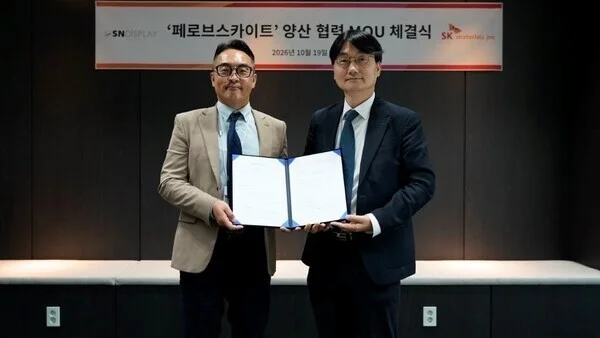
OLED technology and the popular QLED quantum-dot technology could gain a serious competitor in the future. South Korean firms SK Materials JNC and SN Display are collaborating to prepare mass production of perovskite materials. These materials could enable an even wider colour gamut in televisions and monitors.
Perovskites set to leave the labs
SK Materials JNC has signed a memorandum of understanding (MOU) with startup SN Display to develop a system for serial production of perovskite nanocrystals. The companies want to move the technology from the research stage to the manufacture of materials that can be used in commercial displays. SN Display, a startup founded by Professor Tae-Woo Lee of Seoul National University, will provide the nanocrystal synthesis technology. SK Materials JNC will contribute its experience in producing materials for OLED panels, quality control and organising industrial processes.
What can perovskites change in TVs?
The biggest advantage of perovskites is high colour purity and luminous efficiency. These materials can emit light in a very narrow range of wavelengths, which allows for more saturated colours. Because of this they are suitable for, among other things, colour conversion layers and future self-emissive displays.
SN Display has already received a CES Innovation Awards 2026 honour for a colour conversion film that uses perovskites. According to the company, the solution achieves over 95% coverage of the BT.2020 colour space, the standard defining a very wide colour gamut for Ultra HD content.
That does not mean, however, that TVs using the new material will appear in shops soon. The signed agreement only concerns preparing mass production, and the companies have not provided a commercialisation timeline. Ensuring sufficient material durability and stable operation remains a challenge. For now, then, this is another step in the technology's development rather than an announcement of specific TV models.
Source: The Elec