 Redakcja Choose TV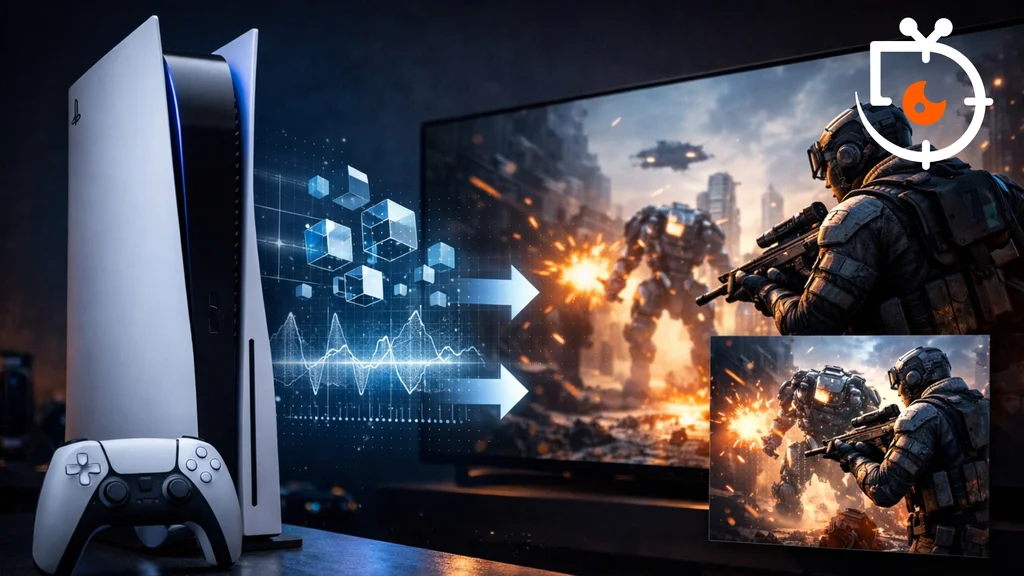
Sony is preparing another major change in graphics on PlayStation. This time it's about AI generating additional frames, which could significantly improve the smoothness of games without the need for more powerful hardware. The technology has already been confirmed, and it looks like the PS5 Pro will be the first candidate to utilise it.
AI takes things a step further than upscaling
So far, Sony has primarily used AI in the PSSR technology, which improves image sharpness. Now the company wants to go further. Frame generation works differently to traditional scaling. Instead of boosting the resolution, AI creates completely new frames between the rendered ones, which gives the impression of a significantly higher FPS. Similar solutions are already known in the PC realm, where technologies like DLSS and FSR operate. Sony wants to have its own version tailored for consoles.
Greater fluidity, but not without compromises
The biggest plus is obvious: games can appear to run at 60 or even 120 FPS, without the need to render each frame. For players, this means a smoother image, and for developers, greater freedom in enhancing graphics quality. More can be squeezed out of the same power. However, there is a downside. AI generating frames can introduce reaction delay, which can be noticeable in fast-paced games.
PS5 Pro as the Main Contender
Sony hasn't explicitly said that the feature will be available on the PS5 Pro, but everything points to it. The console is already utilising AI-based solutions and a stronger GPU, so it has the necessary backing. If the technology is implemented, it could extend the life of the console and bring it closer to high-end PC levels. For now, however, one must be patient. According to announcements, the feature may only appear sometime later, possibly even closer to the next generation.
Sony clearly shows the direction AI will become the foundation of graphics in games. Frame generation is the next step after upscaling and can really change the way we perceive smoothness. The PS5 Pro could gain a lot from this, but we'll see the true potential of this technology only in the coming years.
source: digitaltrends.com