 Direct comparison
TCL P755 stands out primarily due to its Google TV system, which simplifies daily use of the television. It is easy to operate, runs smoothly, and provides access to numerous applications, while personalised recommendations help quickly find something to watch. Support for AirPlay and Windows Miracast allows for easy casting from other devices. All of this makes the television a good option as a home entertainment centre. When it comes to picture quality, P755 offers solid performance for its price. Dolby Vision makes HDR content look better – colours are vibrant and contrast sharper. The wide colour gamut results in an image that is rich and natural, which is evident when watching films. Additionally, the television has a high native contrast, which distinguishes it in this price range. For gamers, the P755 could also be an interesting option. Low input lag enables smooth gameplay, and games run responsively. Of course, the 60 Hz panel does not provide ideal fluidity, and the HGiG function does not work perfectly, but for occasional gaming, this model is adequate. However, it does come with some drawbacks. Low brightness means that the image in bright rooms may be less readable, and the viewing angles are quite average. Dithering can also be an issue, causing artefacts in darker scenes, especially when using the television as a monitor – the fonts on the screen are less legible. TCL P755 is a good choice for those looking for an affordable television with features. Dolby Vision, a wide colour gamut, and low input lag are the strengths of this model. Although brightness and viewing angles could be better, it offers a lot at this price and works well for everyday viewing or occasional gaming.
- Matching (Score) |
- Our verdict |
- TV appearance |
- Where to buy |
- Contrast and black detail |
- HDR effect quality |
- Factory color reproduction |
- Color reproduction after calibration |
- Smoothness of tonal transitions |
- Image scaling and smoothness of tonal transitions |
- Blur and motion smoothness |
- Console compatibility and gaming features |
- Input lag |
- Compatibility with PC |
- Viewing angles |
- Daytime performance |
- Panel details |
- TV features |
- Apps |
- Playing files from USB |
- Sound
P755
S95H / S99H

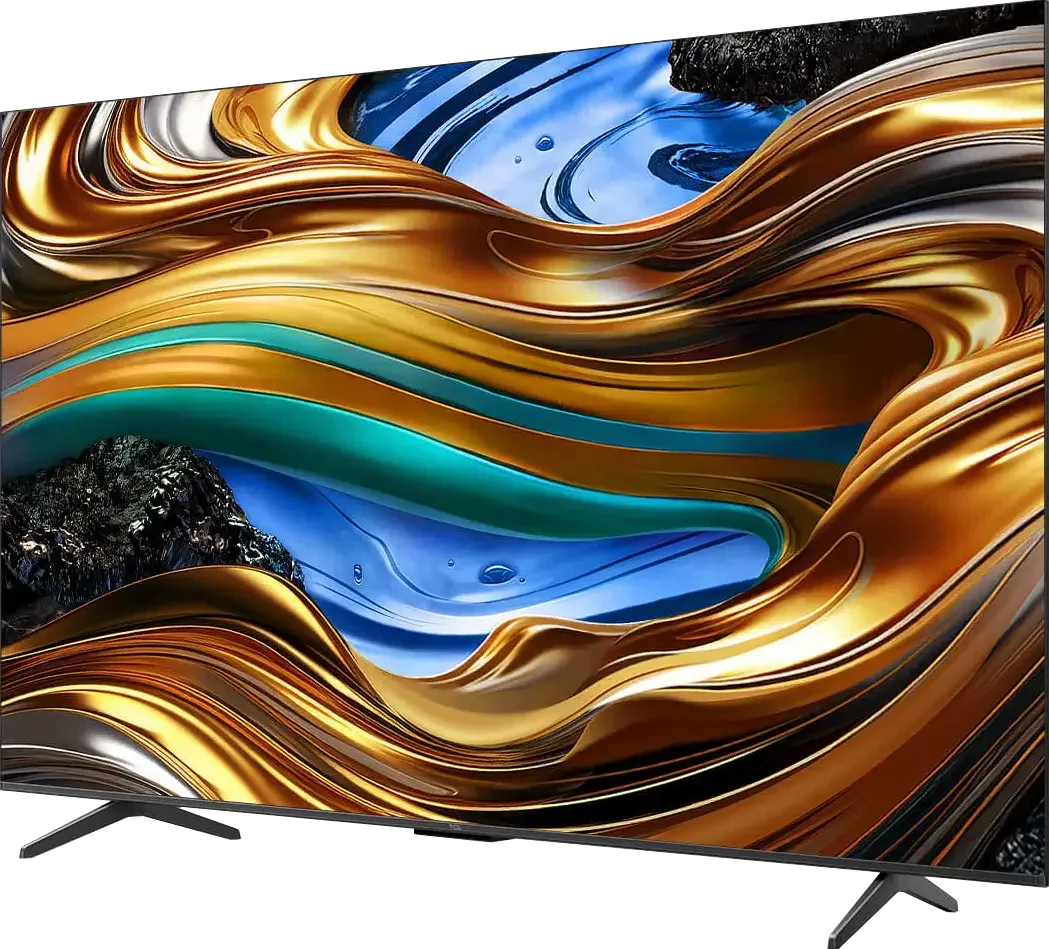
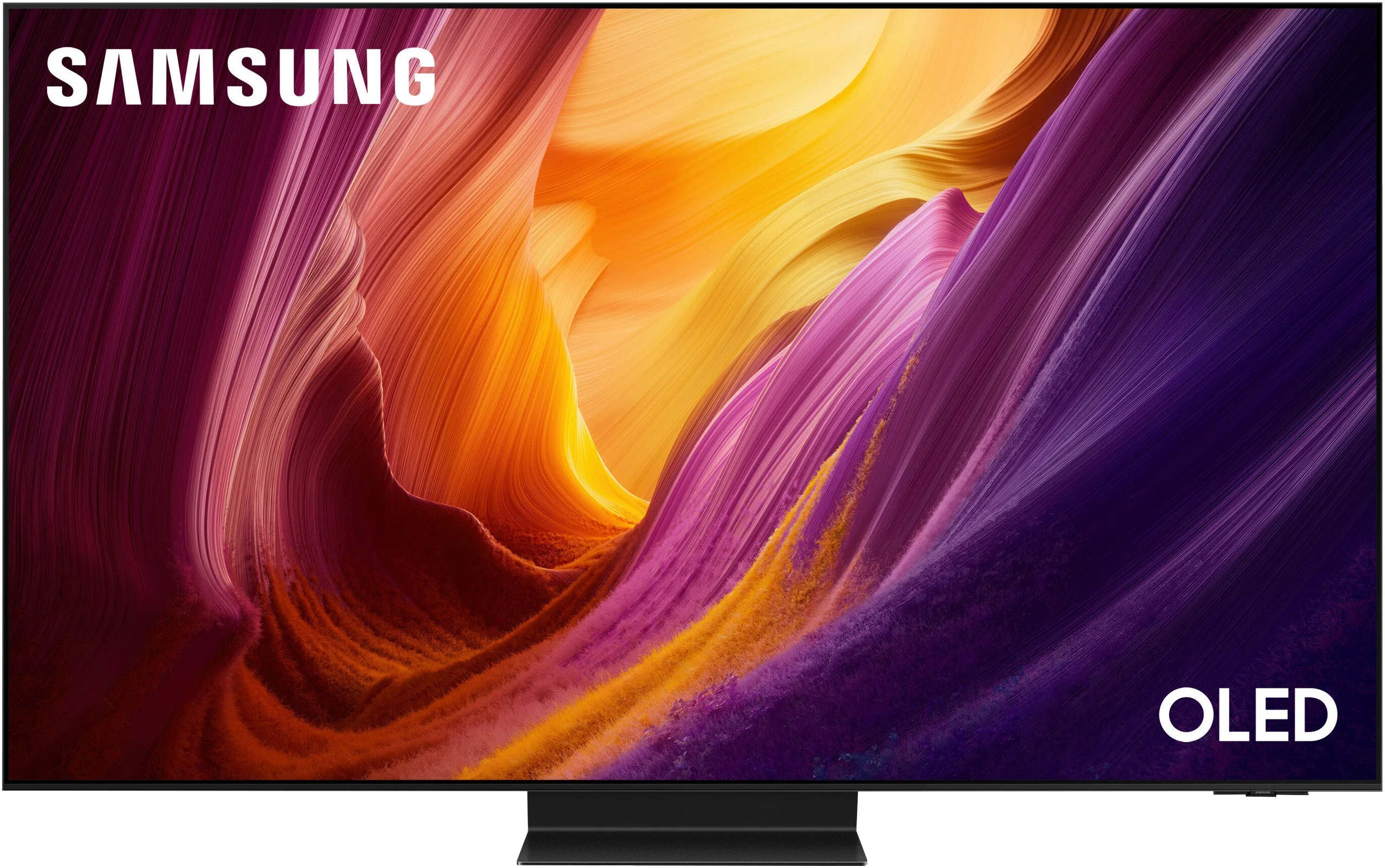
Panel type: LCD VA
Resolution: 3840x2160
System: Google TV
Model year: 2024
Complete the survey to find out the result
Panel type: QD-OLED
Resolution: 3840x2160
System: Tizen
Model year: 2026
Complete the survey to find out the result
Overall rating
5.8
8.8
 Movies and series in UHD quality
5.9
9.3
 Classic TV, YouTube
6.0
9.4
 Sports broadcasts (TV and apps)
5.1
9.0
 Gaming on console
6.8
9.9
 TV as a computer monitor
2.5
8.8
 Watching in bright light
3.8
7.3
 Utility functions
7.3
7.9
 Apps
9.6
9.3
 Sound quality
5.8
8.0
Complete the survey to find out what fits your preferences
Advantages

High native contrast
Support for advanced features for gamers
Advanced Google TV operating system
Low input lag
Support for all HDR formats
Support for all Dolby and DTS audio formats
Perfect blacks and OLED contrast
Very high brightness
Rich, highly saturated QD-OLED colours
Natural picture after calibration
Excellent tone mapping (lots of detail in bright scenes)
Matte finish that effectively reduces reflections
Market-leading viewing angles (QD-OLED)
165 Hz refresh rate and lightning-fast panel response
Very low input lag and extensive gaming features
SENSATIONAL LOOK
One Connect module included
Disadvantages

Low brightness
Average viewing angles
Incorrectly functioning HGiG mode
Poor font readability
Noticeable black level deterioration in bright light (a characteristic of QD-OLED panels)
Last year's version of Tizen
No DTS support (mainly relevant to Blu-ray fans)
Our verdict
The Samsung S95H is in almost every respect a continuation of the S95F. During testing we often felt like we were watching the same television. But... is that a bad thing? Not necessarily, because its predecessor set the bar very high. We still get a phenomenal picture and one of the best televisions we tested in 2026. HDR has enormous impact, and the colours and blacks mean a good film can really keep you glued to the screen. With a console or PC the S95H is just as enjoyable because it delivers what we expect from a flagship product.
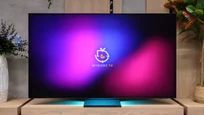
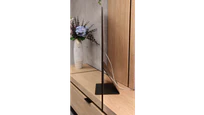
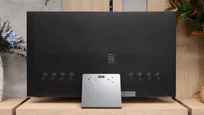
The strongest argument for this model may, however, be its appearance. It's aimed at people who want the slimmest, most minimalist television possible. Especially on the wall the S95H looks excellent, and One Connect helps organise the whole setup. If the distinctive bezel of the S99H isn't to your taste, here you'll find a more discreet design. Brightness is admittedly lower than in the higher series, but it's still high enough that it's hard to call it a serious compromise for viewing.
Not everything deserves praise, though. We were most disappointed by the inclusion of last year's version of Tizen. The system itself runs quickly, but that detail only underlines how little has changed compared with the S95F. Perhaps Samsung will release a suitable update soon.
Ultimately the S95H is a great choice for someone seeking top-tier picture quality in an exceptionally slim chassis. The Samsung S95H doesn't bring a revolution, but it's still a television that, despite giving us a small déjà vu, made a big impression.
TV appearance


Where to buy

Contrast and black detail
6.1/10
10/10
Local dimming function: No
Contrast:


Result
5,650:1

Result
6,750:1

Result
5,850:1

Result
6,550:1

Result
6,100:1
Result
∞:1
Result
∞:1
Result
∞:1
Result
∞:1
Result
∞:1
Halo effect and black detail visibility:
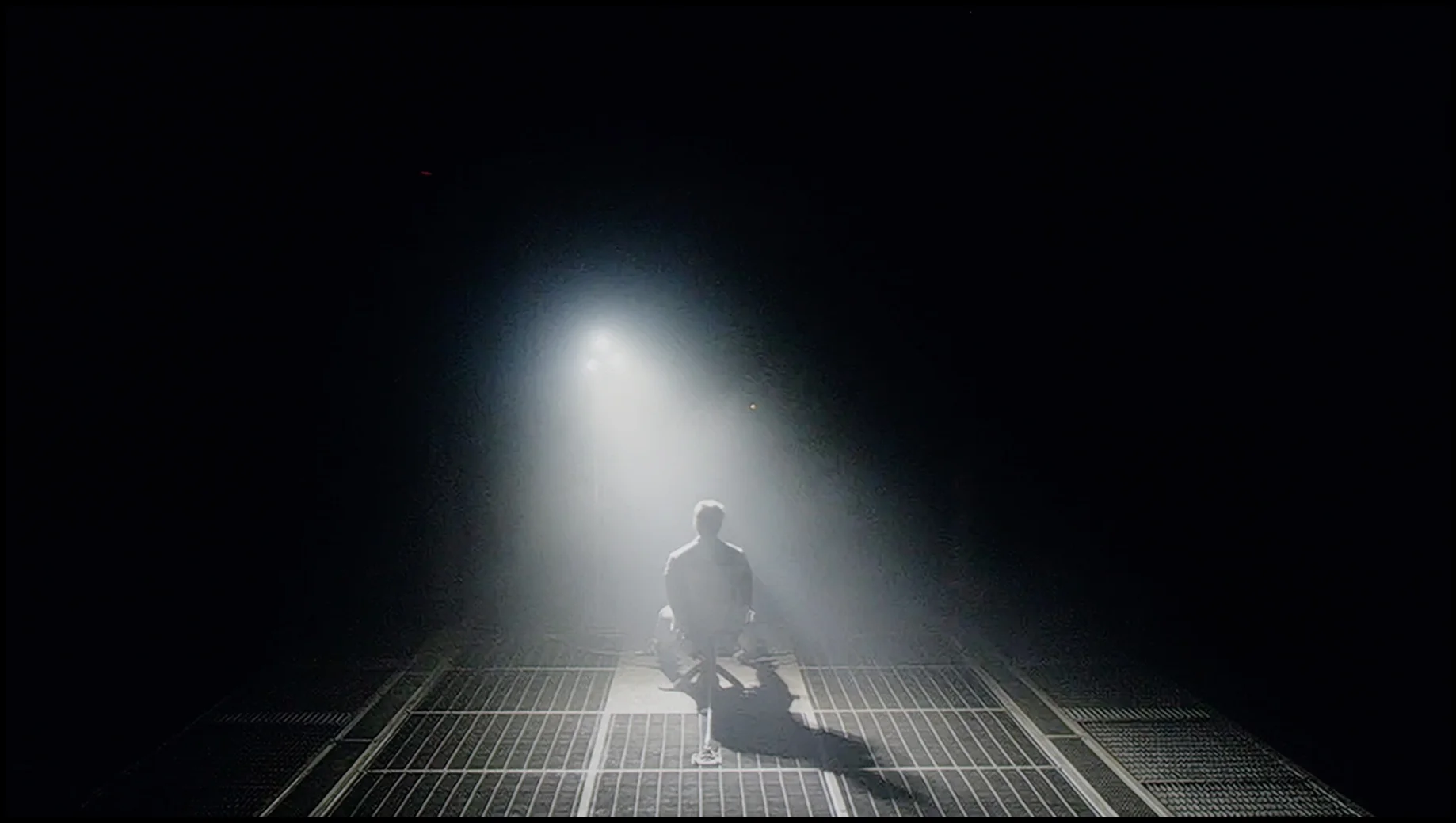
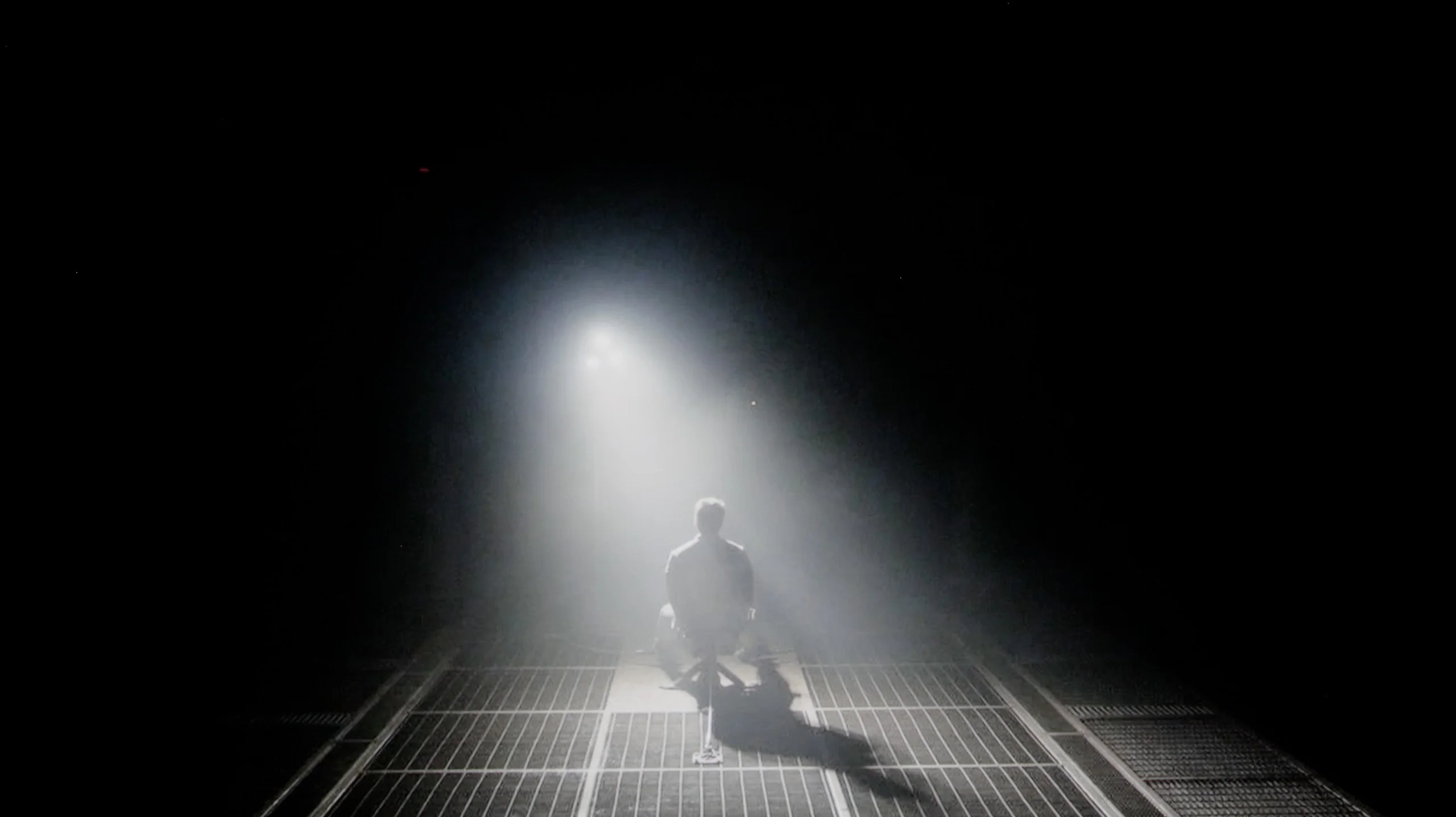
Check the visibility of bright lights on a dark background. Mini-LEDs often struggle with this. The photo does not compare black levels – that’s what the video below is for.
The video accurately shows differences in contrast and black levels between TVs, as well as potential issues: halo around bright objects or Mini-LED zone operation visible as brightness jumps.
TCL P755, equipped with a VA panel, offers very high contrast, which translates to deeper blacks and better detail representation in darker scenes than in the case of IPS/ADS panels. The panel in this model has an exceptionally high native contrast. In film mode, contrast is a strong point of the television, but the lack of local dimming technology means that blacks are not perfectly deep. They often take on shades of navy, which can be particularly noticeable in dark movie scenes. During the test with the film Sicario 2 , certain flaws were also noted in the form of uneven backlighting, which can distract from important details in the blacks, lowering the overall immersion in the scenes. However, it should be remembered that this comment refers to the sample we tested; nonetheless, it is worth bearing in mind that similar shortcomings may occur in other units.
The Samsung S95H we tested, with a 65-inch screen, uses a QD-OLED panel. The same type of panel is also found in the 55- and 77-inch models. A 48-inch size is new to the range, but note, it’s a completely different design. It does not have a QD-OLED panel or the One Connect module, so our review should not be applied directly to that variant. Returning to blacks, they are exactly what you would expect from any OLED. Each pixel lights independently and can switch off completely. As a result, black is truly inky, whether you are watching a broad shadow or a small dark area right next to a bright light. There are no bright banding artefacts or halos caused by local dimming zones. In our test scenes the S95H looked excellent in this regard. Bright elements stood out clearly from the dark background, and blacks retained their depth even in the most demanding shots. In the evening this creates a very pleasant effect, and it’s precisely this kind of picture we like OLEDs for. It is worth noting, however, that our unit had a minor issue with so-called black crush. The darkest greys sometimes merged into black, causing some shadow detail to disappear. The image then appeared even deeper and more contrasty, but that came at the cost of details that should have been visible. The black itself remained perfect, the TV simply did not always show what was just above it.
HDR effect quality
4.2/10
8.8/10
Luminance measurements in HDR:

Result
190 nit

Result
238 nit

Result
272 nit

Result
248 nit

Result
283 nit
Result
2246 nit
Result
2236 nit
Result
2113 nit
Result
2230 nit
Result
1571 nit
Scene from the movie “Pan” (about 2800 nits)


Scene from the movie “Billy Lynn” (about 1100 nits)


The photos show two HDR10 movies. 'Pan' is one of the brightest productions ever made, while 'Billy Lynn' (soldier) has brightness typical of streaming (Netflix, Prime, HBO MAX). Notice the intensity of effects and detail in whites.
Static HDR10


The photos present the visibility of white details in various HDR formats. They do not show brightness differences between TVs (these can be compared in the previous gallery).
Dynamic: Dolby Vision
Dynamic: HDR10+


The photos present the visibility of white details in various HDR formats. They do not show brightness differences between TVs (these can be compared in the previous gallery).
HDR luminance chart:
Samsung S95H
TCL P755
TCL P755 provides average HDR effect quality. The maximum brightness of the television is slightly below 300 nits. Such brightness limits the intensity of bright areas in HDR content. In practice, this means that bright elements may not be sufficiently pronounced, which affects the overall impression of contrast. However, the television offers a wide coverage of the DCI P3 colour gamut, reaching around 93%. As a result, colours are vibrant and saturated, significantly improving colour reproduction quality in HDR content. Despite the limited brightness, the wide colour range allows for richer and more realistic shades.
The Samsung S95H is an extraordinarily bright OLED TV. It does not quite reach the level of this year’s S99H, the one with a bezel, but a peak of around 2300 nits is still a phenomenal result. You can really feel it in films. Highlights, sun reflections or lights on a dark background have the punch we expect from a premium TV. Importantly, the S95H performs well across different scenes. It does not need a single small bright spot on a black screen to show what it can do. In the first four test shots we measured over 2100 nits, even though each of them places slightly different demands on the TV. That makes the HDR effect powerful both in night scenes and in more evenly lit frames.
Of course, the limitations typical of OLEDs remain. When a very bright image occupies a large part of the screen, ABL comes into play, the mechanism that limits panel brightness. With an almost white screen the drop can be much larger than with a short, point-like flare. That does not mean bright film scenes look weak. In a demanding shot from "The Meg" we recorded about 1600 nits. That is still a fantastic result, and the bright sky and reflections on the water retain very high intensity.
QD-OLED colours
Colours on the Samsung S95H are simply outstanding. It is one of the most 'colourful' OLEDs we have tested. Deeply saturated reds, greens and neons look great and complement the screen's high brightness. DCI-P3 coverage is as high as 99.9%, so the TV can reproduce practically the entire colour range used in that space for HDR films.
Interestingly, our measurements also show progress compared with the S95F. Coverage of the wider BT.2020 gamut rose from around 87% to 89.6%. That is a very similar result to what we obtained with this year’s S99H, which suggests very similar capabilities of both panels in terms of colour gamut. The difference from its predecessor is small but worth noting. The S95H remains at the very top among OLEDs in this regard and can confidently compete with new screens using SQD quantum dots.
Factory color reproduction
6.2/10
7.6/10


This gallery shows how colors change after professional TV calibration. If you notice the difference, we recommend ordering this service at SkalibrujTV.com.
Factory Mode
After calibration


This gallery shows how colors change after professional TV calibration. If you notice the difference, we recommend ordering this service at SkalibrujTV.com.
Factory Mode
After calibration
The colour reproduction in the P755 in "Movie" mode, although it is the best factory setting, leaves much to be desired. The biggest problem is the white balance, where the graph clearly shows a spike in red and a drop in green. This leads to a shift in colours towards red, making the colours on the screen less natural and potentially looking incorrect, especially in scenes with a white or neutral background. This is confirmed by the "Colour Checker" test, which reveals that the colours are indeed skewed towards red, affecting the realism of the image and reducing the perception of colour depth. In terms of contrast, the gamma chart analysis shows considerable fluctuations, particularly in dark areas of the image, where values drop below the optimal level of 2.4. This results in darker areas being displayed brighter than they should be. Additionally, the EOTF curve, responsible for brightness reproduction, is slightly above the reference curve. The graph shows a slight boost in brightness to around 50%, followed by only a minor decrease. This leads to excessive brightness enhancement in the mid-tones of the image and may result in loss of detail and distortion in brighter scenes.
Out of the box, the Samsung S95H performs quite well, although our sample had a few issues that needed correcting. In SDR material there is a red bias in the white balance. The image is therefore slightly warm, and whites and faces can take on a faint pinkish tint. It's not a large inaccuracy, but it can be noticed when compared with a reference image. More noticeable is the way dark scenes are shown. Gamma is above the target value of 2.4 across most of the scale, and the deviation is especially large at the darkest shades. The picture therefore looks darker and more contrasty than it should. This confirms the aforementioned issue with losing detail close to black. Dark clothing or background elements can blend into a single blot, even though they remain visible in the source material. In HDR, brightness control is significantly better. The EOTF curve tracks close to the reference, so the TV preserves the brightness of individual parts of the scene well. There remain, however, minor colour deviations. In the brighter areas the dominance of red and blue over green gives whites a slightly pinkish-violet tint. Overall the starting point is good, particularly in HDR, but calibration can still make some improvements.
Color reproduction after calibration
7.6/10
9.4/10

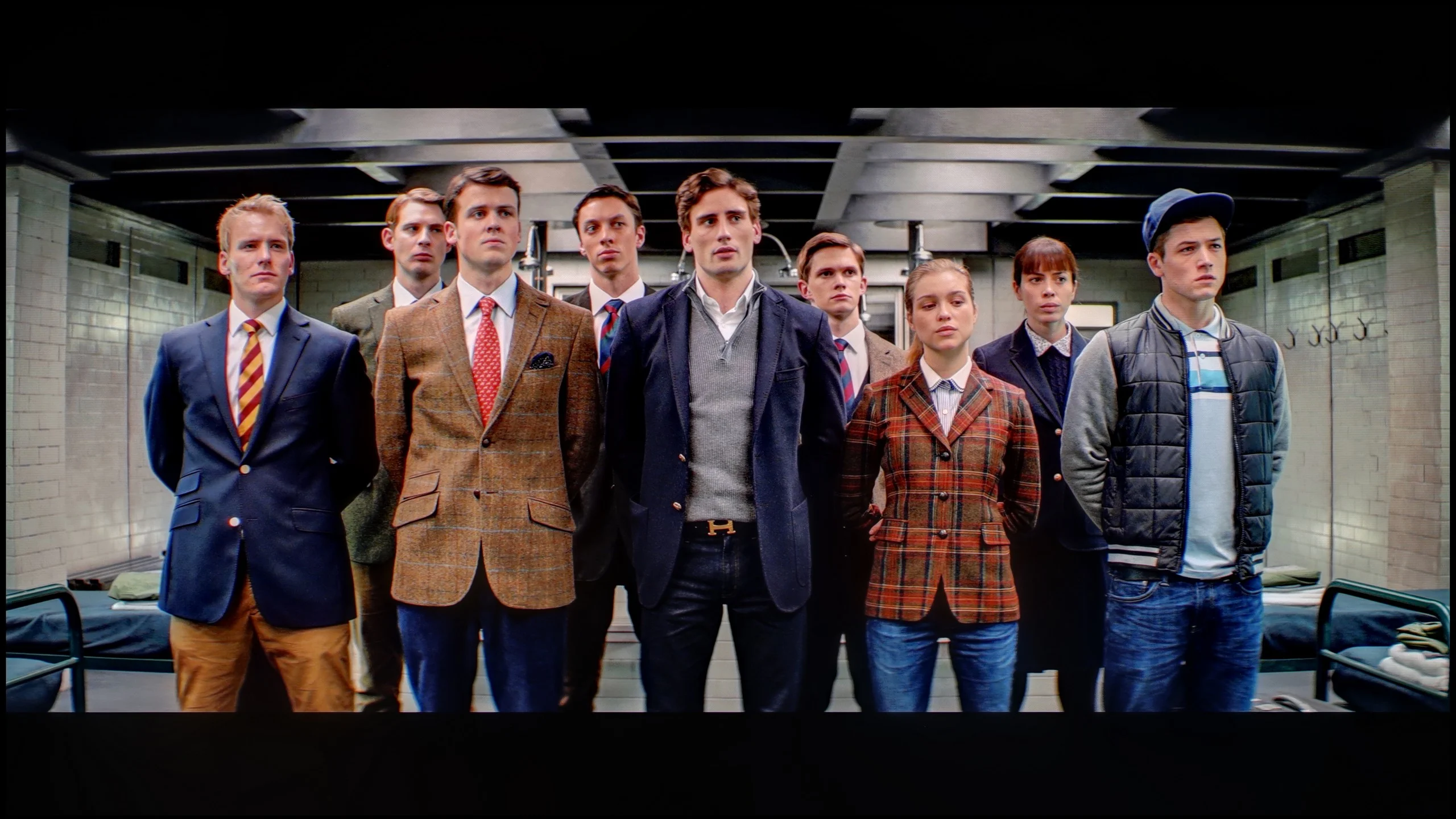
The photos show how movies look on the TV. Pay attention to black detail visibility, colors, and shadow tint.


The photos show how movies look on the TV. Pay attention to black detail visibility, colors, and shadow tint.
After calibration, the colour reproduction on the television improves significantly when it comes to SDR content. The colour curves are now close to the ideal value, and the gamma is more stable. Although the drop at the beginning of the graph to value is still present, the overall accuracy of colour reproduction is much better. The "Colour Checker" test shows that most colour samples have errors below level 2, indicating improved colour fidelity. A few deviations are present, but generally, the colours are now more realistic and consistent with reality.
Calibration also brings improvement in HDR content. The white balance has been improved, resulting in a more natural colour reproduction. The EOTF curve, although now closer to the reference curve, still shows a slight boost in brightness at the beginning of the graph. This leads to minor distortions in very bright scenes, but the overall tonal quality and detail have been enhanced. Dynamic tone mapping works more effectively, improving image quality in bright areas and retaining more detail.
Although the device's picture does not achieve complete perfection, calibration brings significant improvement. After adjusting the settings, the television presents itself much better, offering a more realistic and accurate colour reproduction in SDR and HDR content. While some shortcomings can still be noticed, calibration effectively eliminates many previous issues, ensuring better image quality and more natural colours.
After calibration the S95H looks truly excellent. The excess red was removed, so whites are neutral and faces have regained a natural tone. In SDR colour errors are now very small. The picture retains great saturation but no longer adds a colour cast that was previously visible in the factory settings. This is exactly how a properly set TV in this class should look. HDR also shows an improvement in white balance. In addition, the brightness in cinematic scenes adheres very well to the reference. Bright highlights have appropriate intensity, and the TV does not unnecessarily brighten the whole frame. Combining that level of control with the capabilities of the QD-OLED panel produces an image that is simply very pleasant to watch.
We are left with essentially two reservations. The first is the loss of the very darkest details. Our sample still tended to crush some shades near black, although this may be a trait of the particular unit under test. The second concerns the adjustment of the colour palette in HDR. The available settings do not allow perfect correction of every hue, so some minor inaccuracies remain. Nevertheless, this does not change the very good final result; after calibration the S95H delivers an image at a genuinely high level.
Smoothness of tonal transitions
7.5/10
9/10
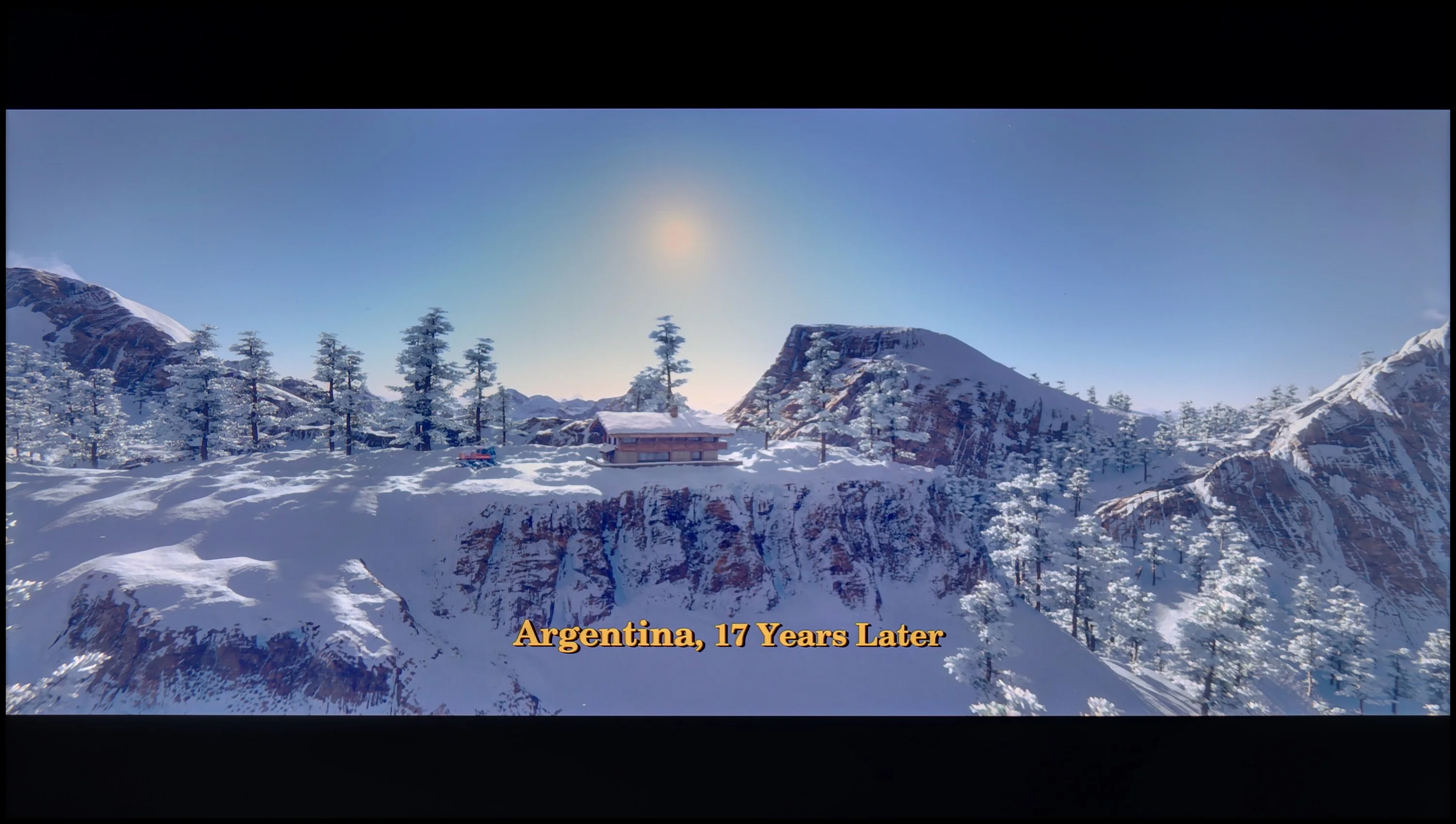

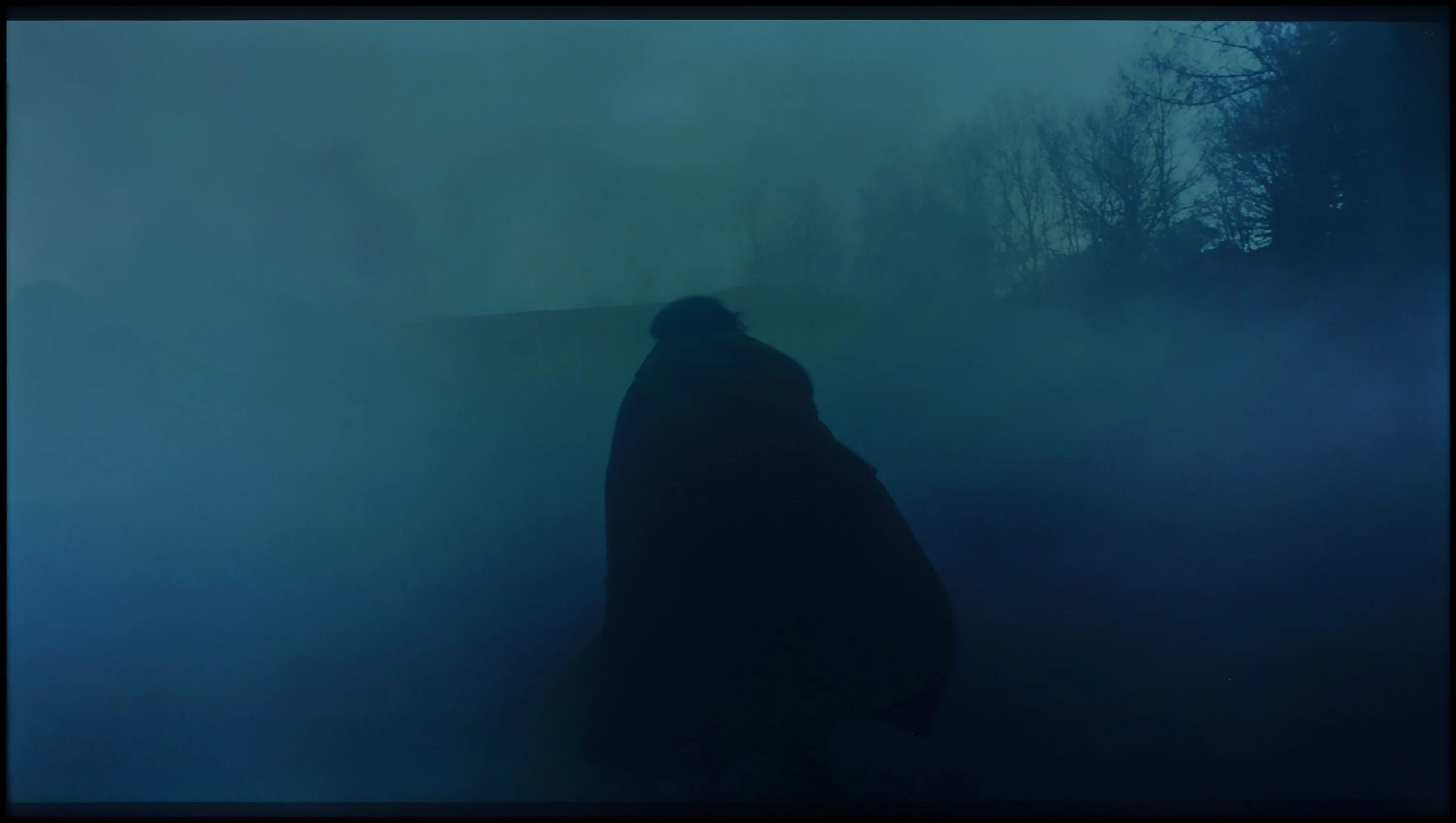

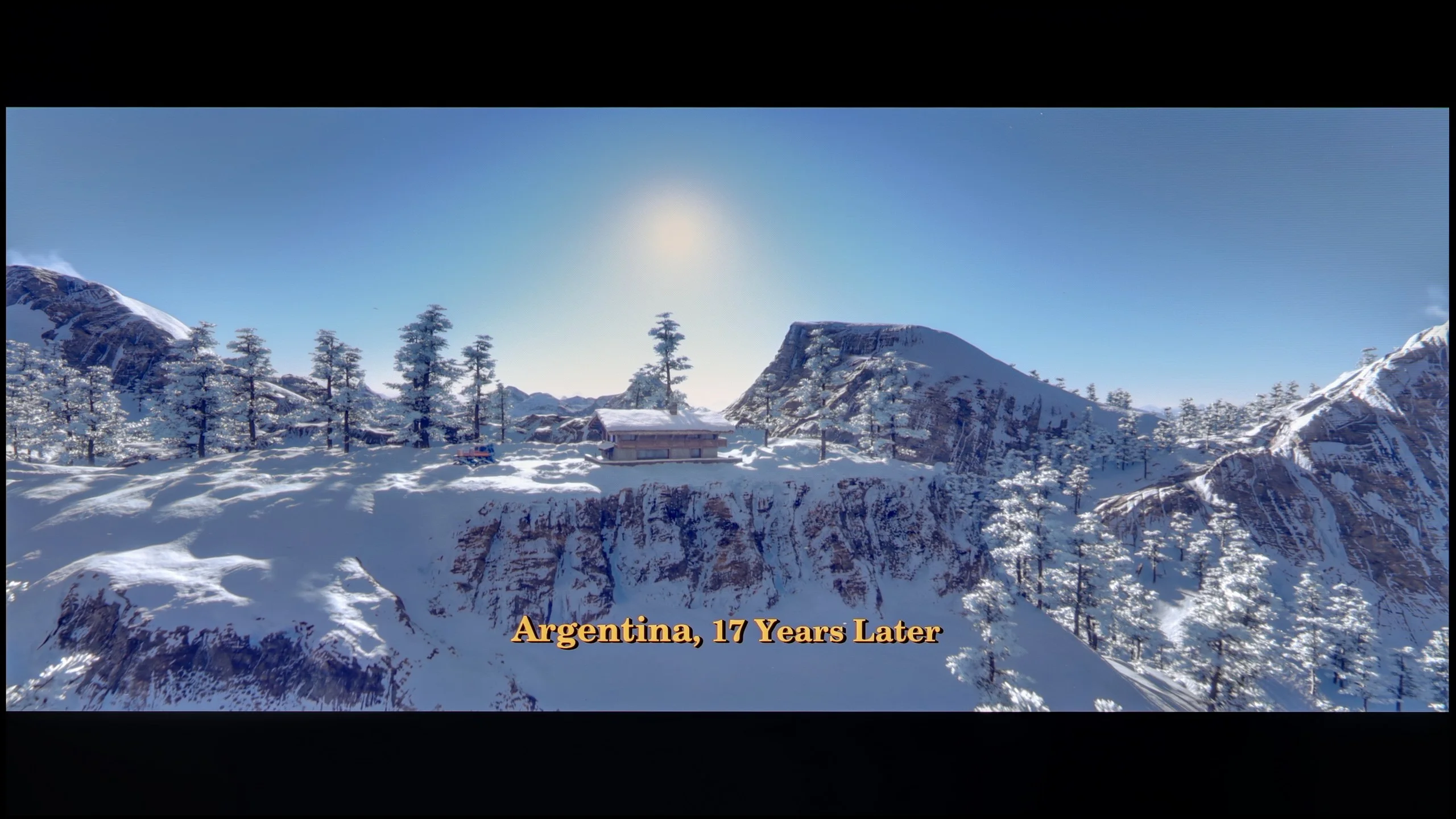
These are selected scenes that show smooth tonal transitions from one color to another. If you see distinct banding, it’s the TV panel’s fault.

These are selected scenes that show smooth tonal transitions from one color to another. If you see distinct banding, it’s the TV panel’s fault.
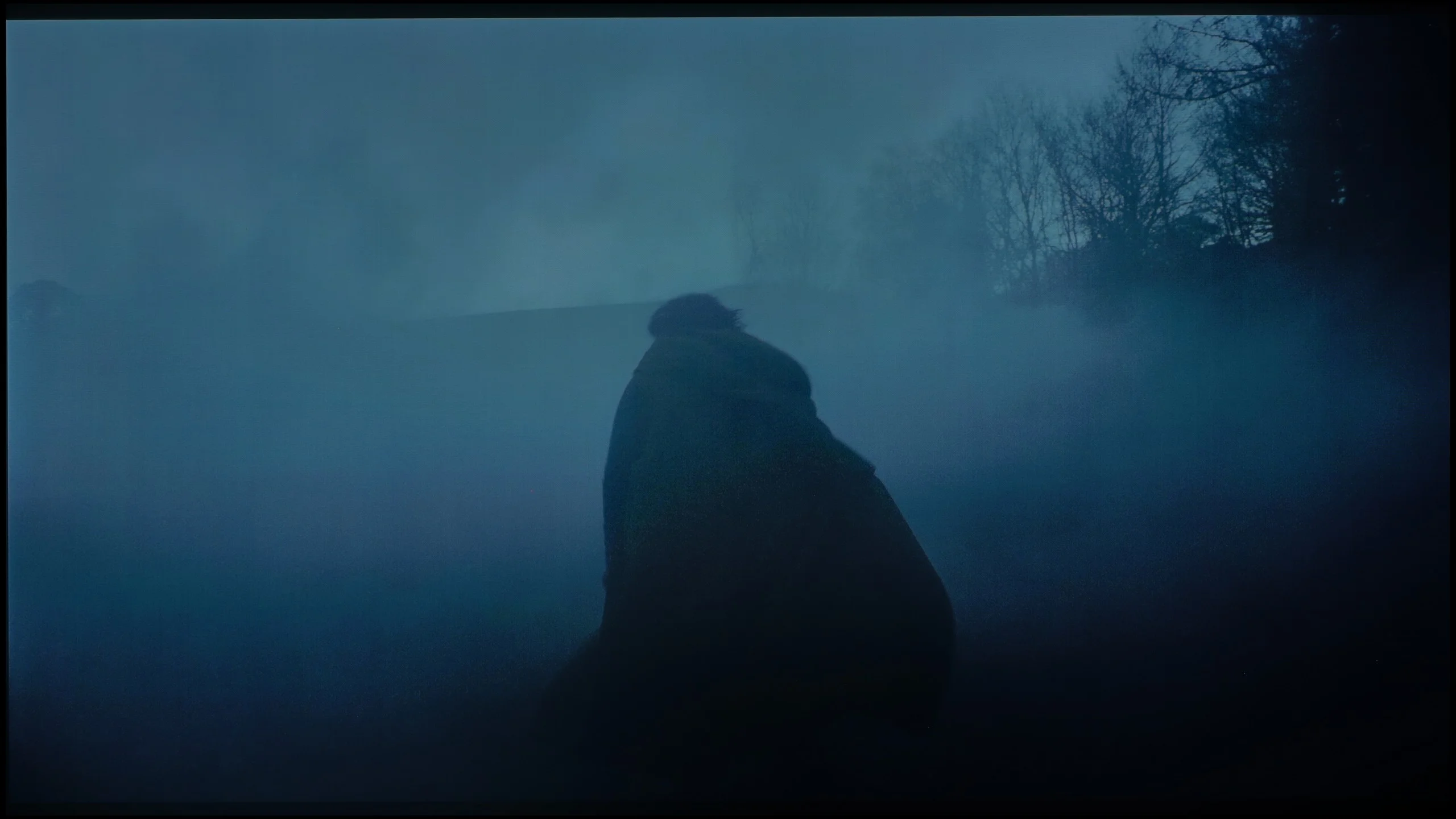
These are selected scenes that show smooth tonal transitions from one color to another. If you see distinct banding, it’s the TV panel’s fault.

These are selected scenes that show smooth tonal transitions from one color to another. If you see distinct banding, it’s the TV panel’s fault.
In the case of high-quality content, TCL P755 offers decent fluidity in tonal transitions. Although there are slight imperfections in colour blending, especially in more complex gradients, these are typical for televisions in this price range. During testing in filmic scenes, these issues were noticeable at certain moments, but in most cases, one really has to pay close attention to spot these flaws. For the average user, they should not pose a significant problem in everyday use.
The S95H handles tonal transitions very well. It's a strong suit of QD-OLED panels, which in our tests typically show visible banding between shades less often than WOLED panels with a white subpixel. In most scenes colours transition smoothly from one to another. This is especially apparent in dark scenes, where instead of the characteristic banding we see smooth transitions between shades of grey. It's not entirely perfect, though. In some brighter scenes you can notice slight irregularities, although you have to look closely to spot them. During normal viewing they are unlikely to distract from the film. Overall, the S95H performs very well in this category.
Image scaling and smoothness of tonal transitions
5.5/10
7.5/10


Smooth transition function
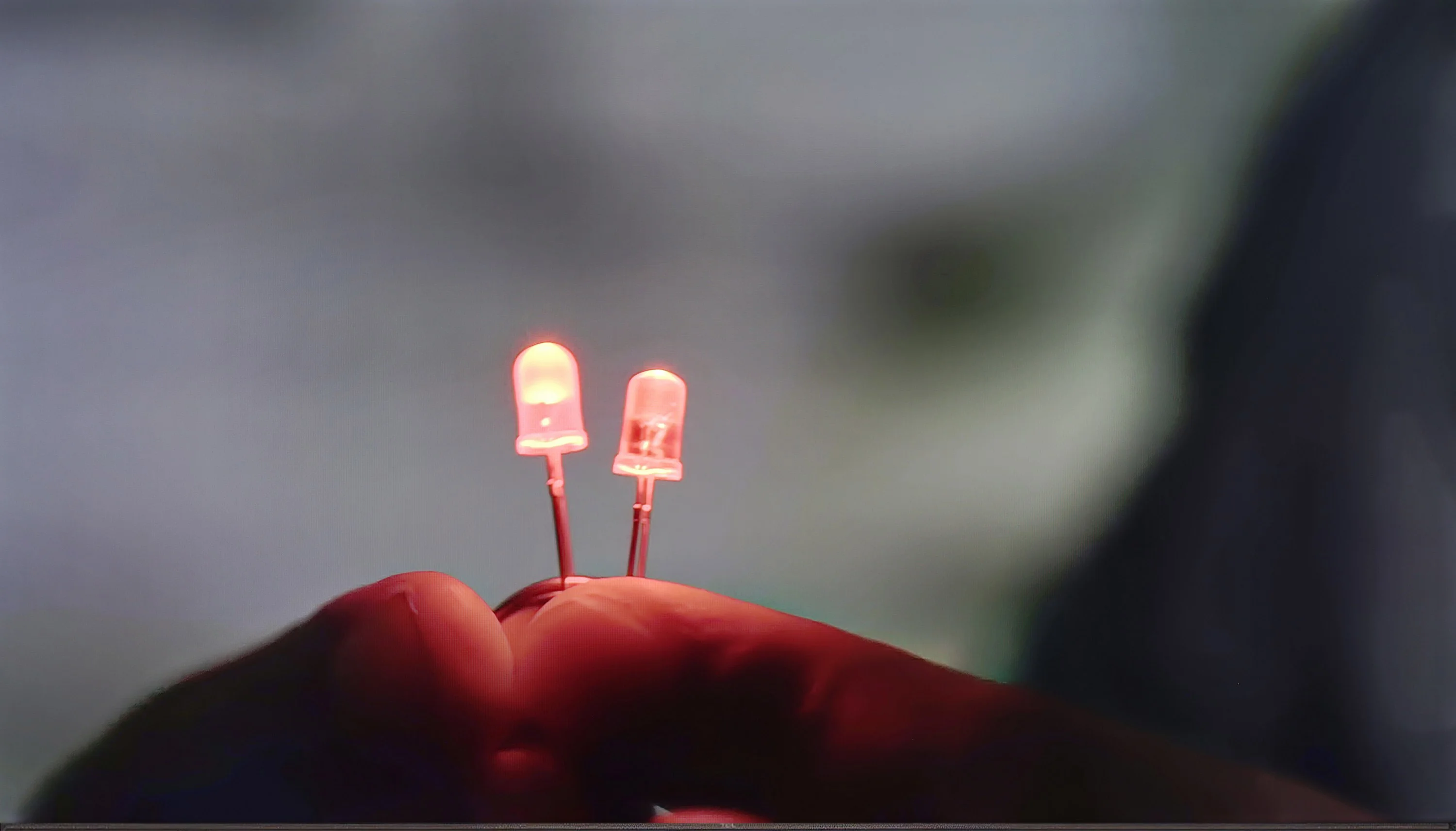
The match photo shows how the TV smooths weak tonal transitions in low-quality video.
Image scaling SD (576i)


The model photo shows how it handles upscaling of SD material.
The "Gradual Smoothing" function works quite well, effectively eliminating visible boundaries between different shades of the same colour. Thanks to it, tonal transitions are smoother. Unfortunately, this function is not available in HDR mode, which may affect the quality of tonal gradations in higher dynamic range materials.
When it comes to image scaling, the television does not perform at its best. There are noticeable edge cuts, particularly evident on the figure of the model and the branches of trees. The blurring of details in these areas affects the overall sharpness of the image. This may be noticeable when watching content in a lower resolution. Moreover, SD quality images are displayed with slight cropping at the top as well as the bottom.
The NQ4 Gen3 processor handles scaling and digital image processing, the same as in the S99H. Our test findings are very similar. Lower-resolution material looks really good when upscaled to 4K. The picture is clear but without artificial edge enhancement or excessive sharpness. A minor caveat applies to very old recordings at 480p or below. With such a signal the TV can slightly crop the edges of the frame.
The noise-reduction function is used to improve heavily compressed material. It smooths visible banding between tones and reduces other imperfections, such as in lower-quality recordings from YouTube. However, it does so quite aggressively. Along with the artefacts, fine detail and natural film grain can disappear. We left it turned off to preserve the original look of the material. If, however, someone is more bothered by artefacts than by the loss of some detail, it's worth trying it out.
Blur and motion smoothness
4.3/10
8.5/10
Blur (native resolution, maximum refresh rate):

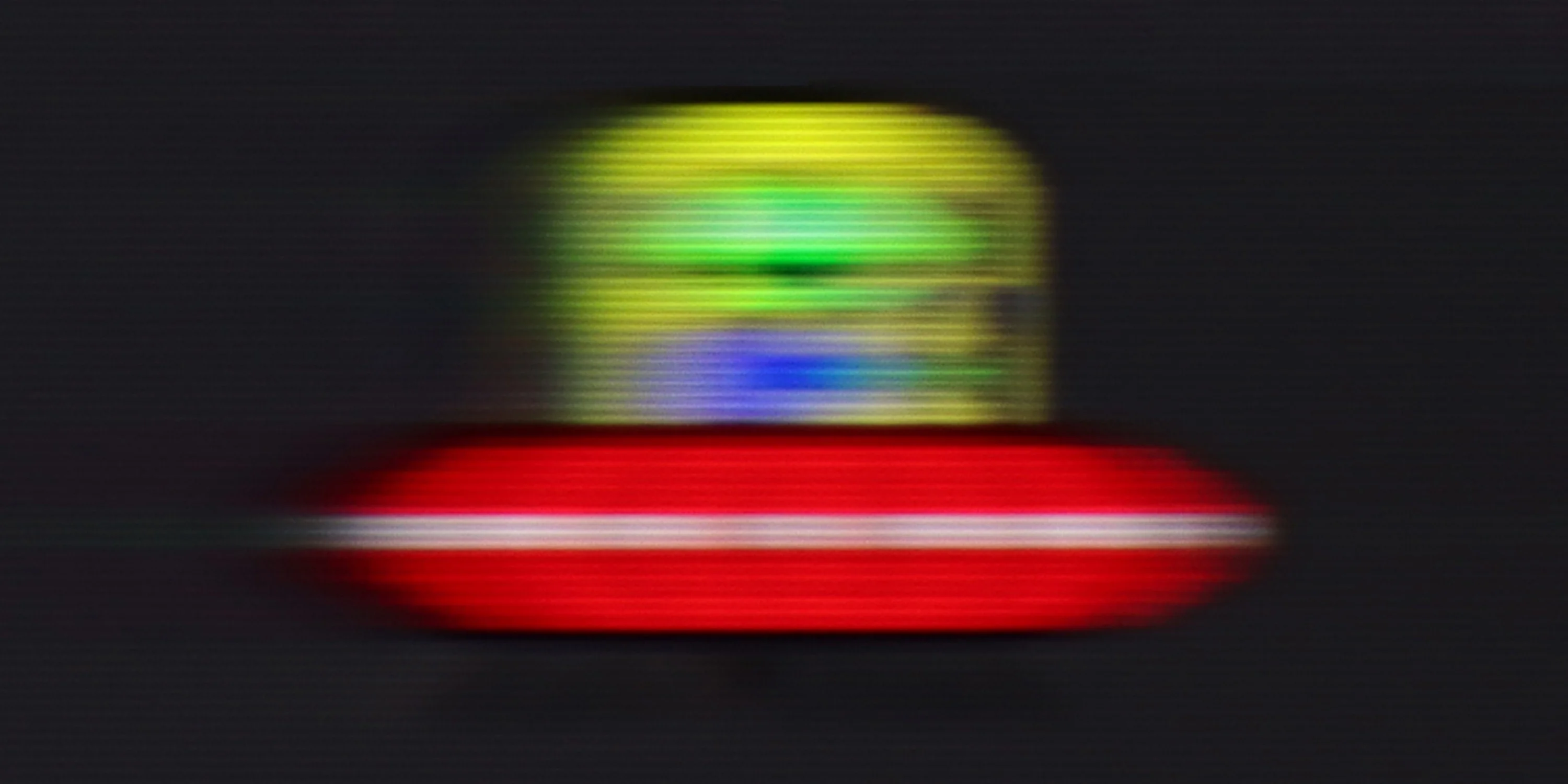



Blur (BFI function enabled):
Image flickers in this mode



Blur ():
Blur (4K@165Hz):



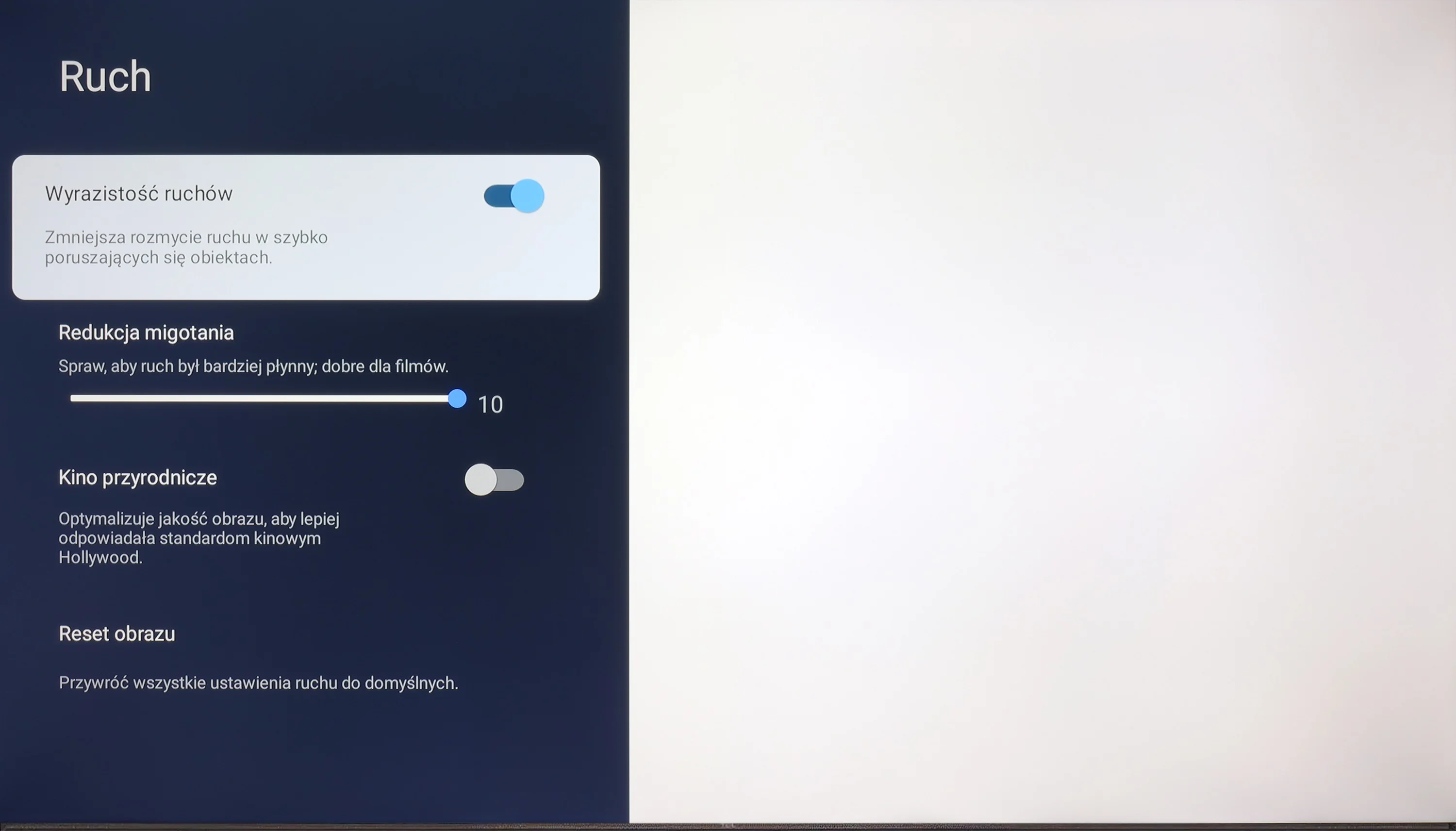
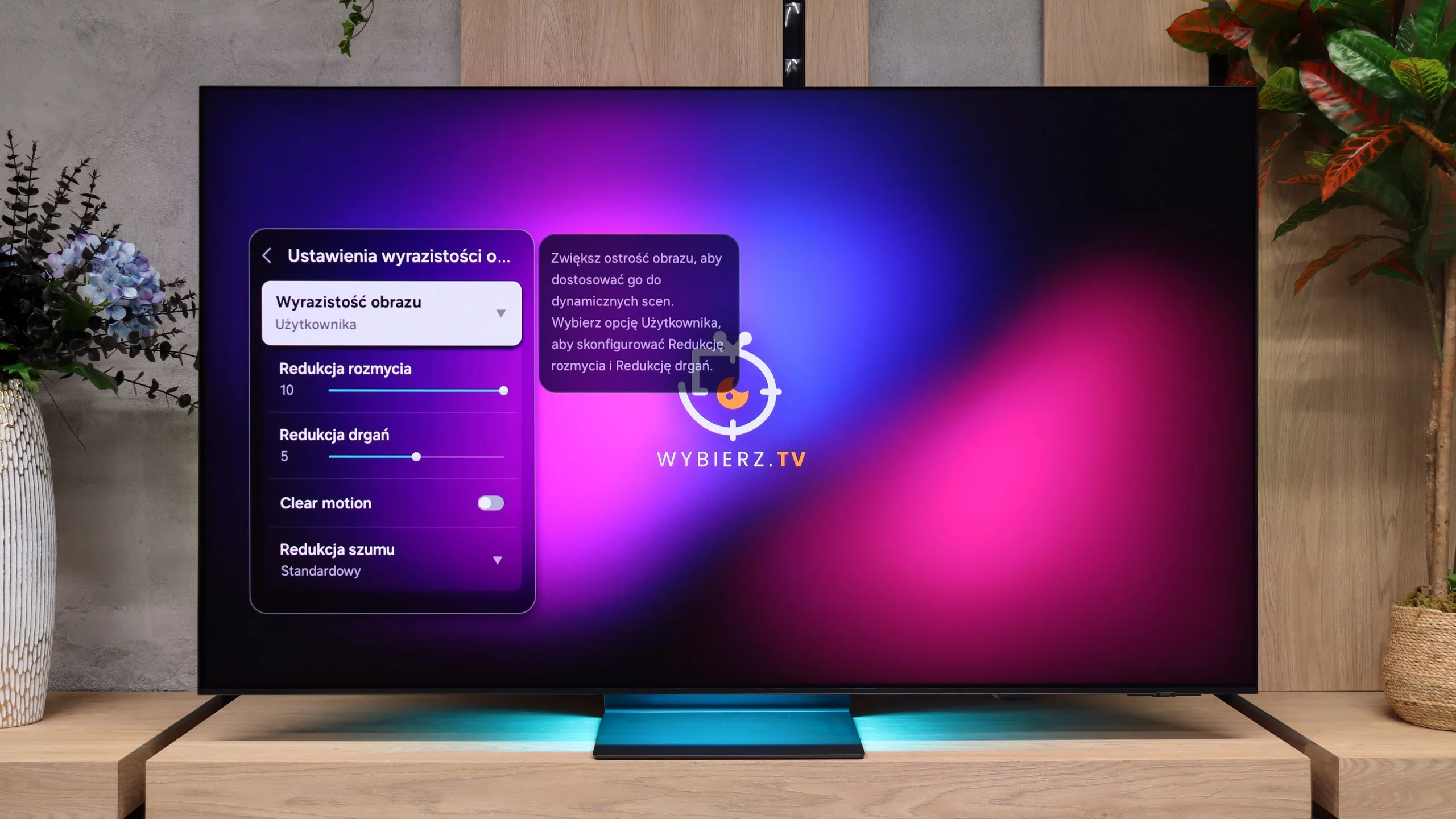
The television offers decent, although not perfect, results in terms of motion fluidity. For films, the television features a “Flicker Reduction” function that allows for motion fluidity adjustment on a scale from 1 to 10. With this option, we can customise the appearance of the image to a cinematic or more theatrical preference (with a slower or faster pace).
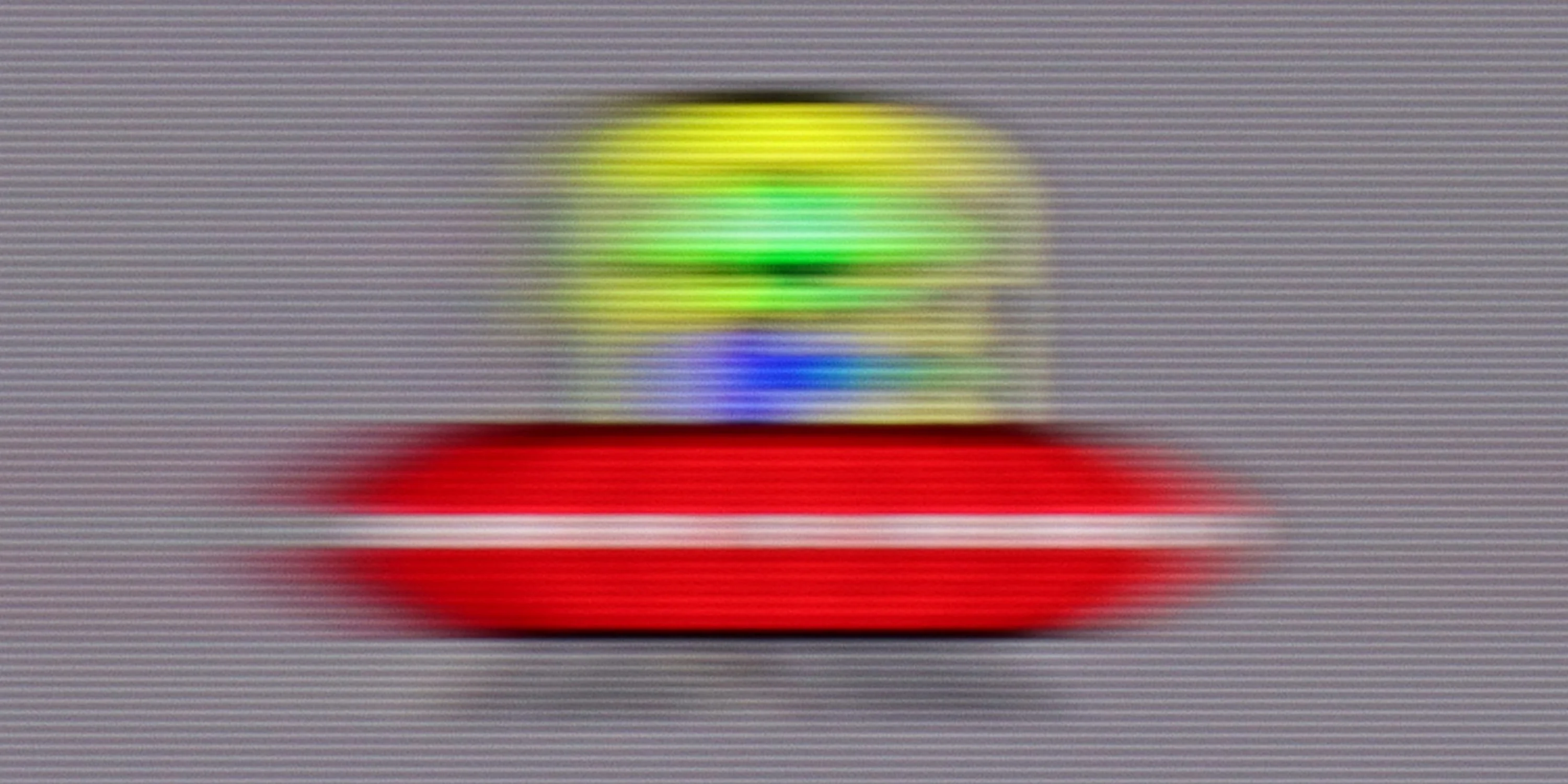
Samsung S95H handles motion very well, which is what we expect from an OLED. The panel supports a refresh rate of up to 165 Hz, though that figure will be mainly useful to PC gamers. When watching sport, the lightning-fast pixel response time is more important. A fast-moving ball or player does not leave the characteristic trailing blur. This keeps motion clear, without the artefacts typical of slower LCD panels.
There is also a motion smoothing feature that lets you tailor motion to your preferences. In films you can subtly reduce judder during camera pans or opt for a stronger smoothness effect. A separate setting for faster-paced content is useful when watching sport.
Console compatibility and gaming features
5.3/10
9.6/10
- ALLM
- VRR
- VRR range48 - 60Hz48 - 165Hz
- Dolby Vision Game Mode
- Correct implementation of HGIG
- 1080p@120Hz
- 1440p@120Hz
- 4K@120Hz
- Game bar
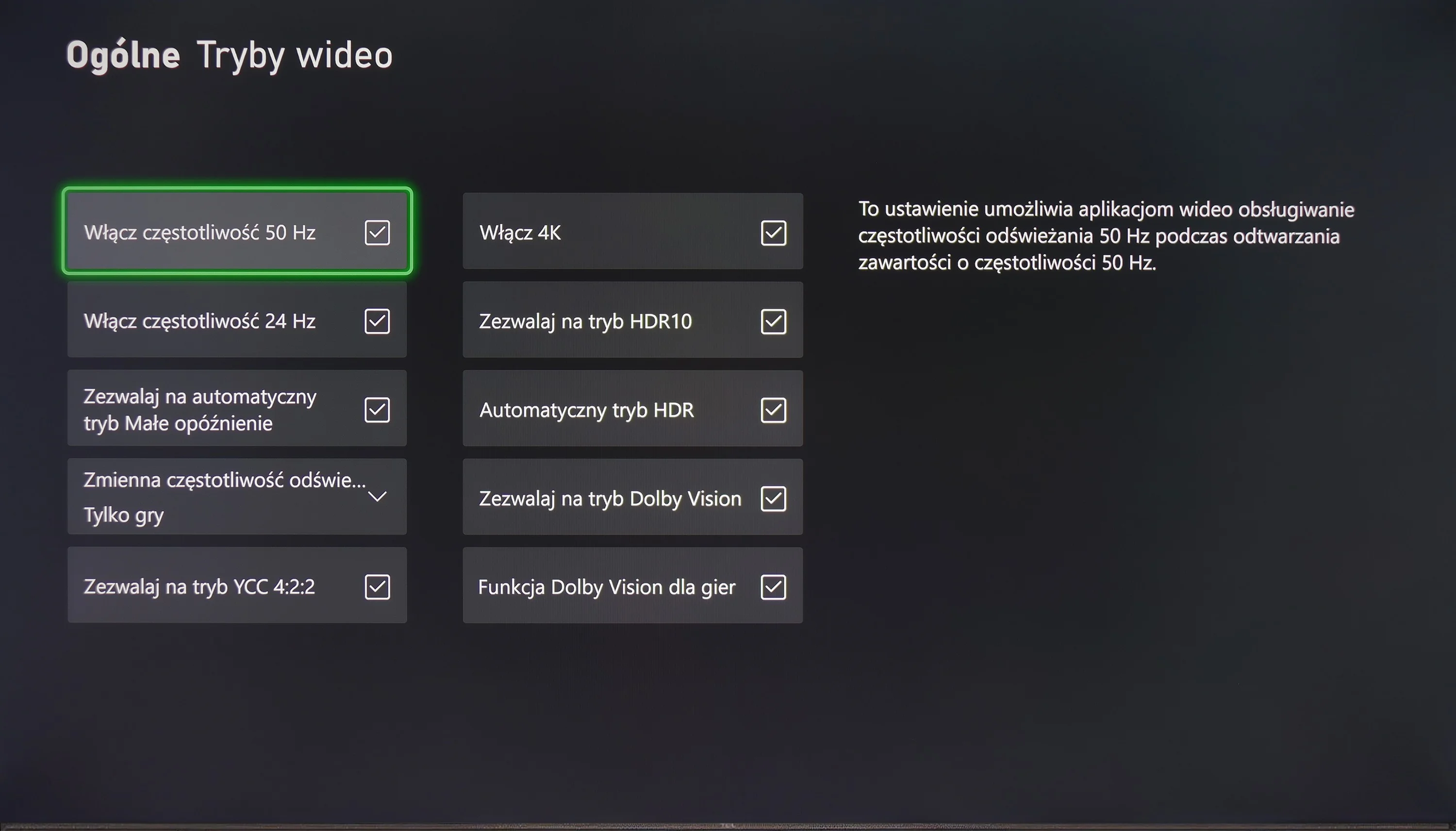
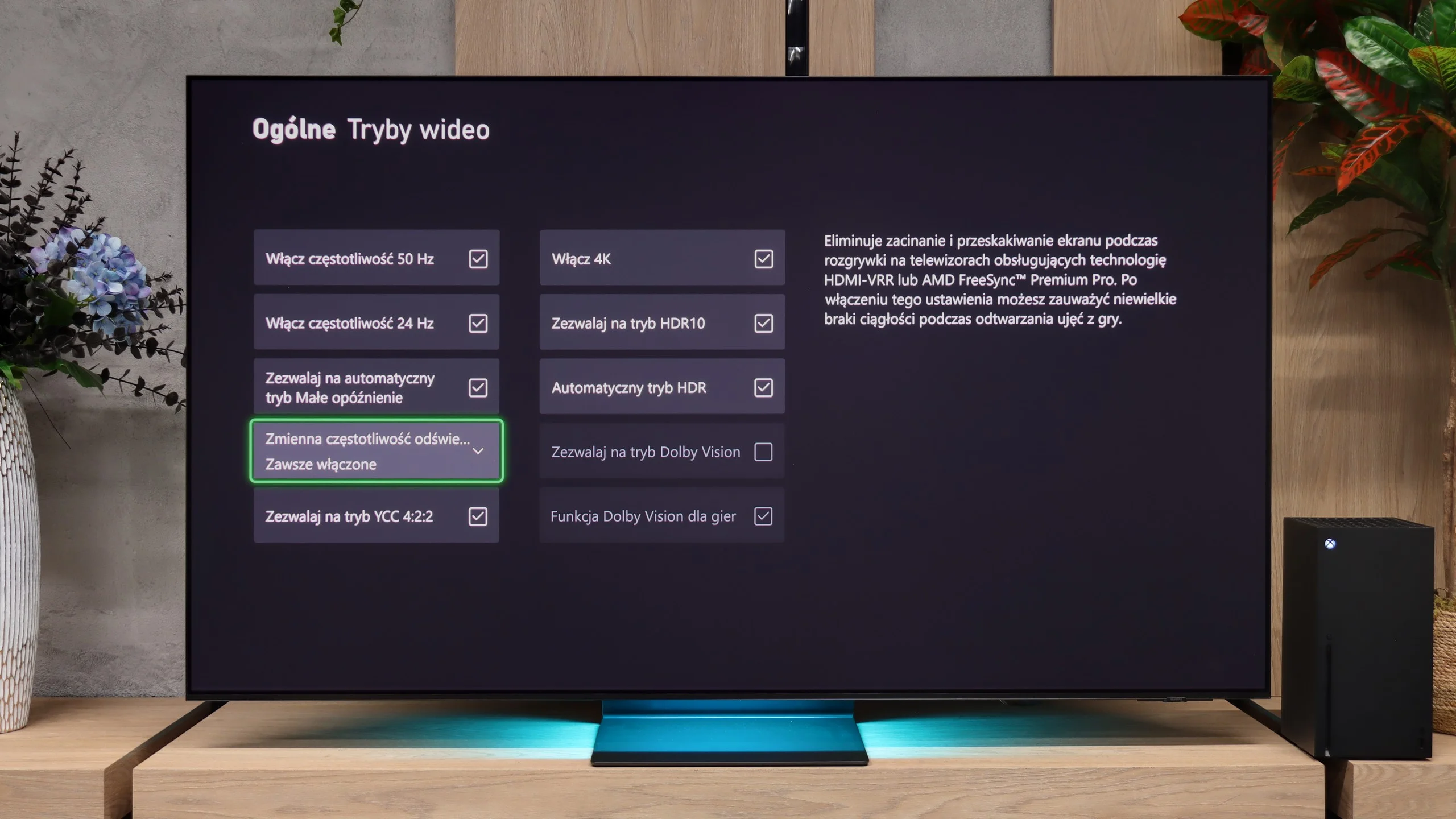
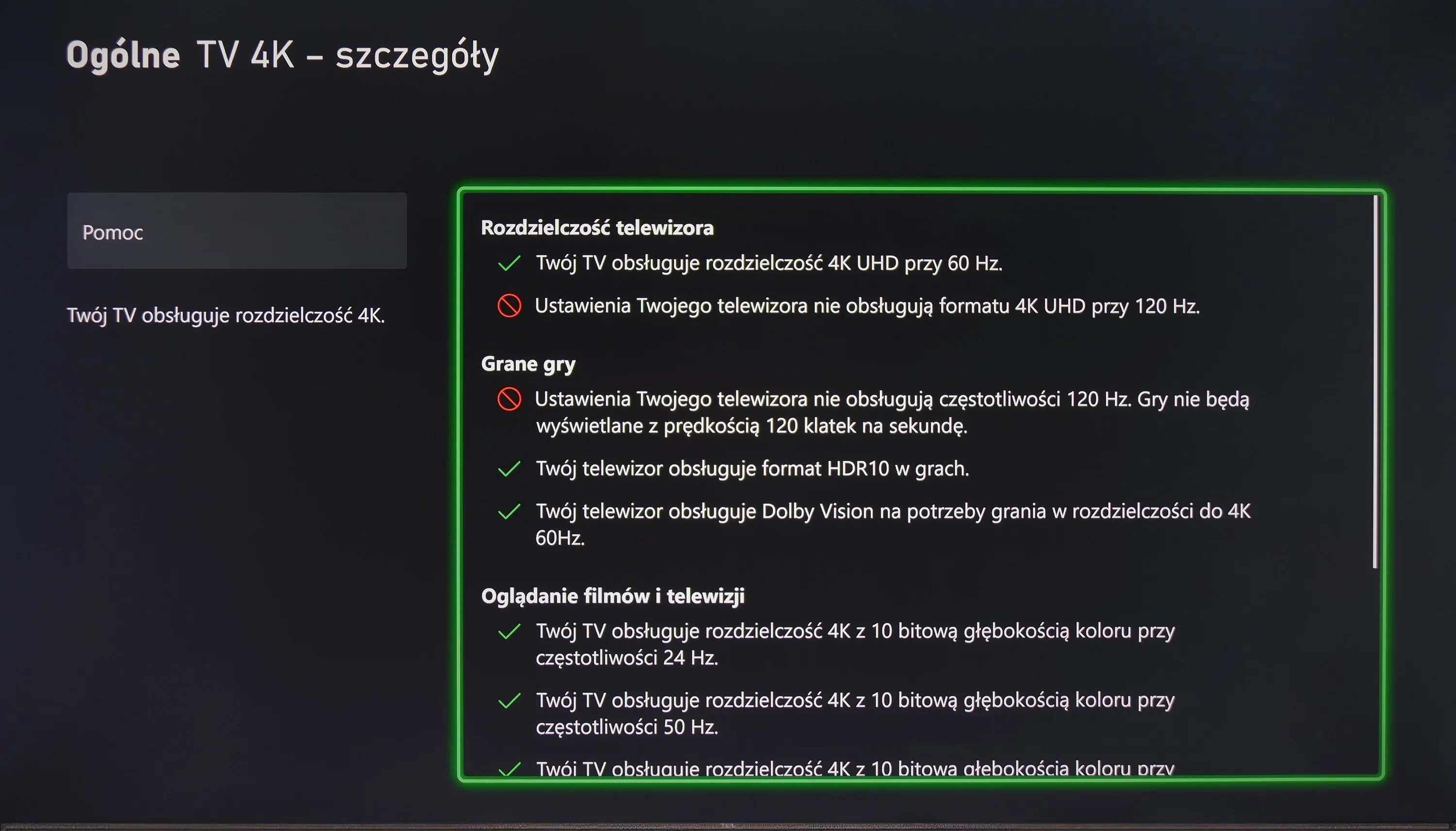
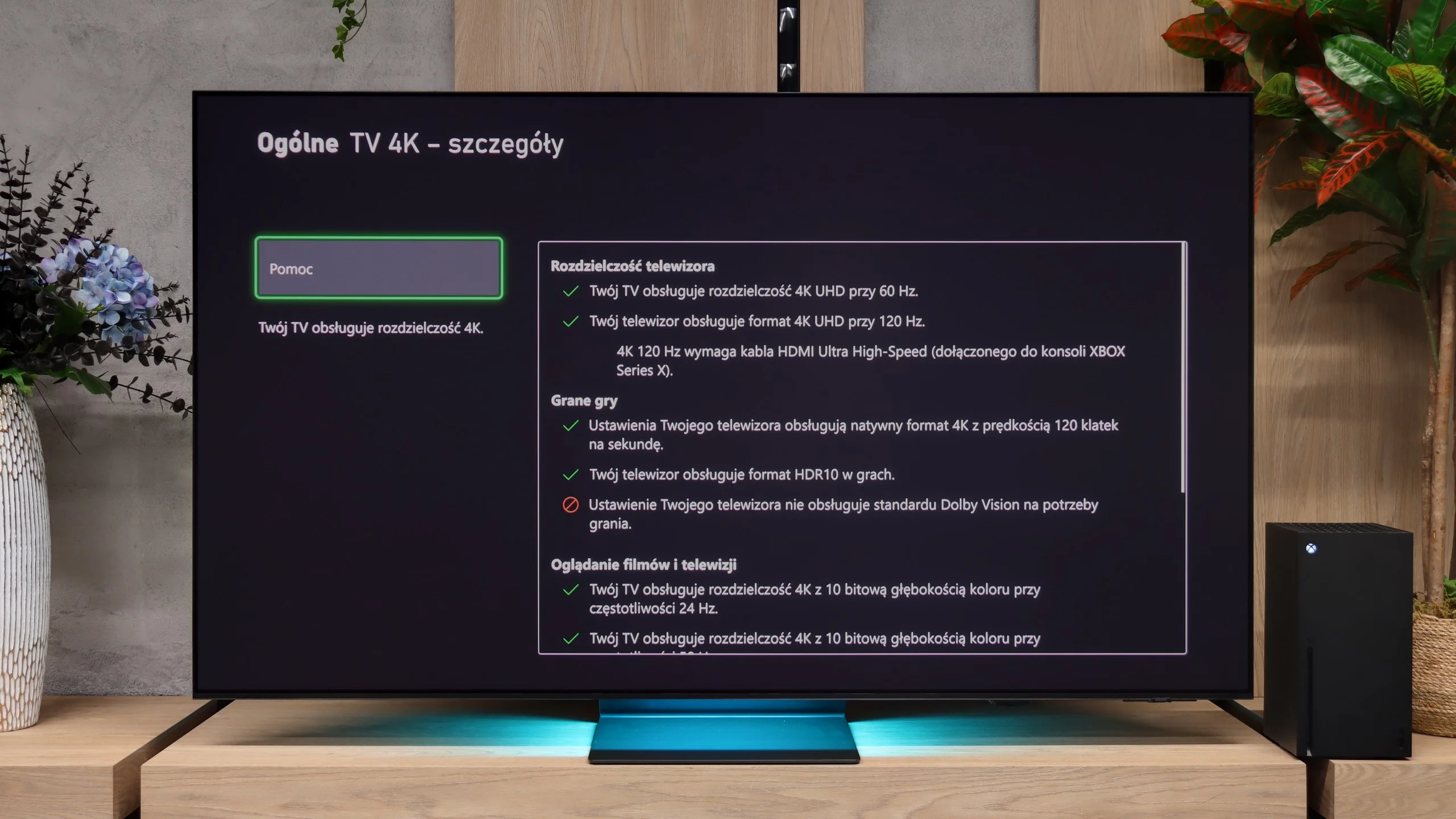
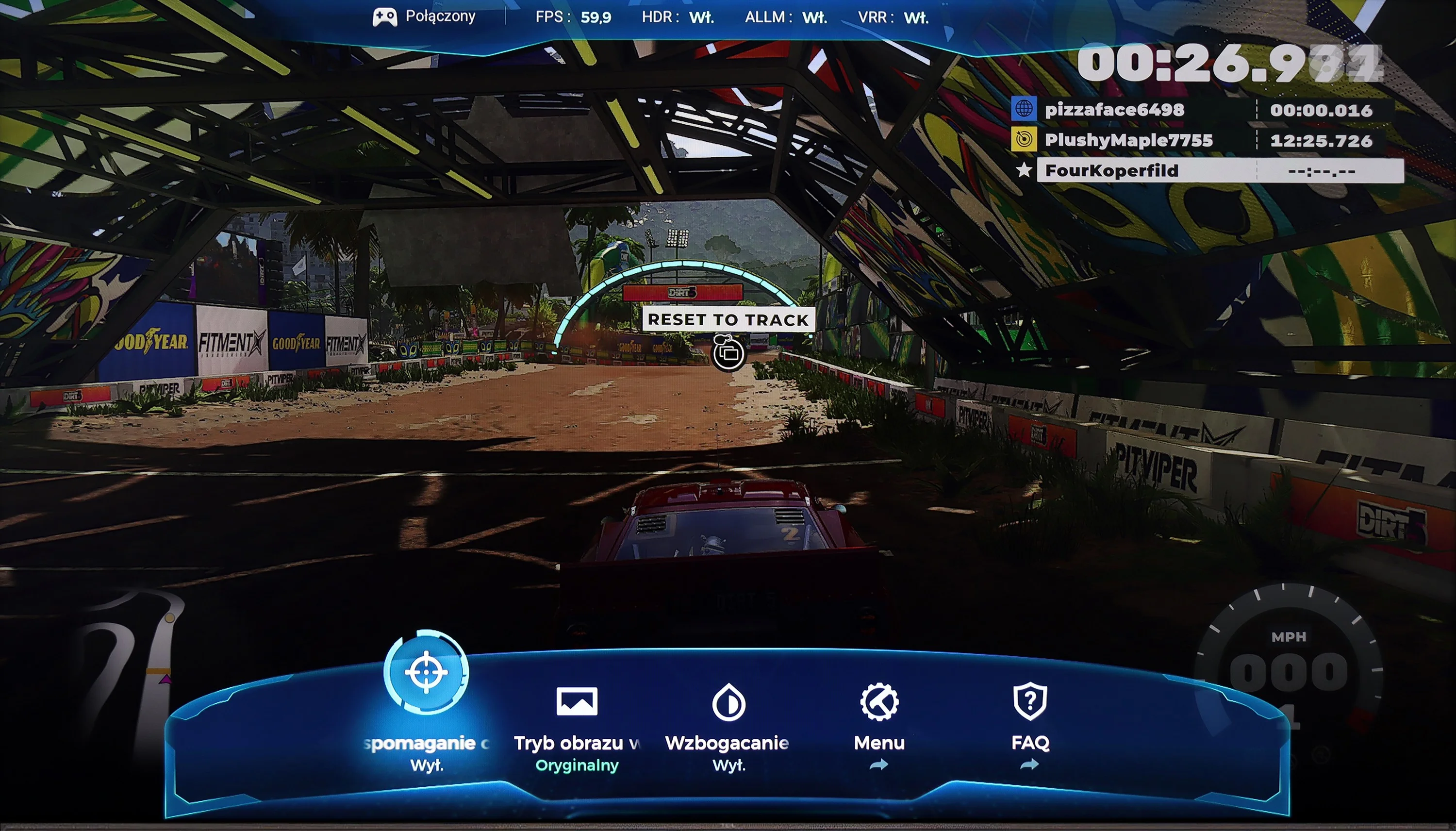
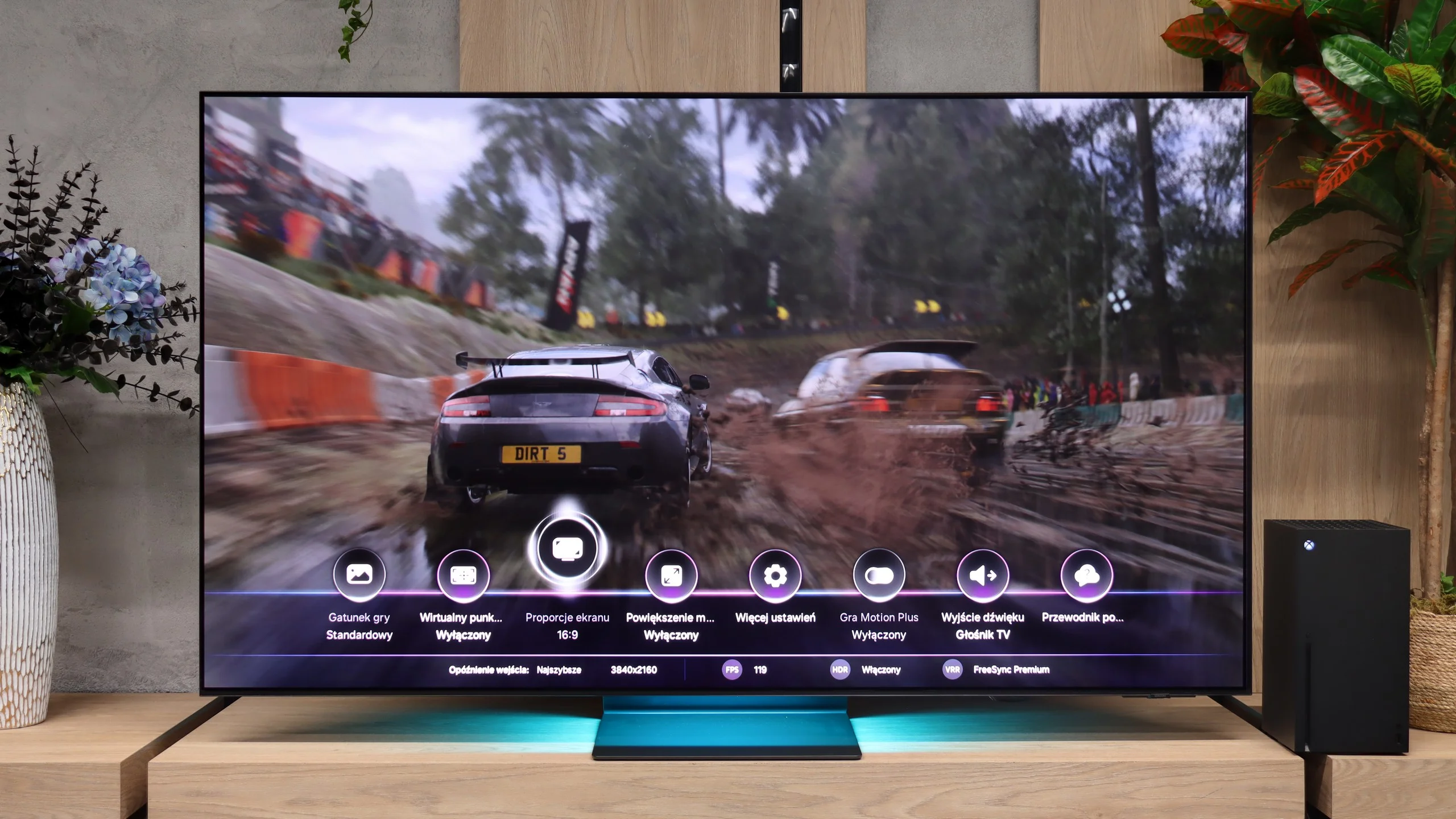

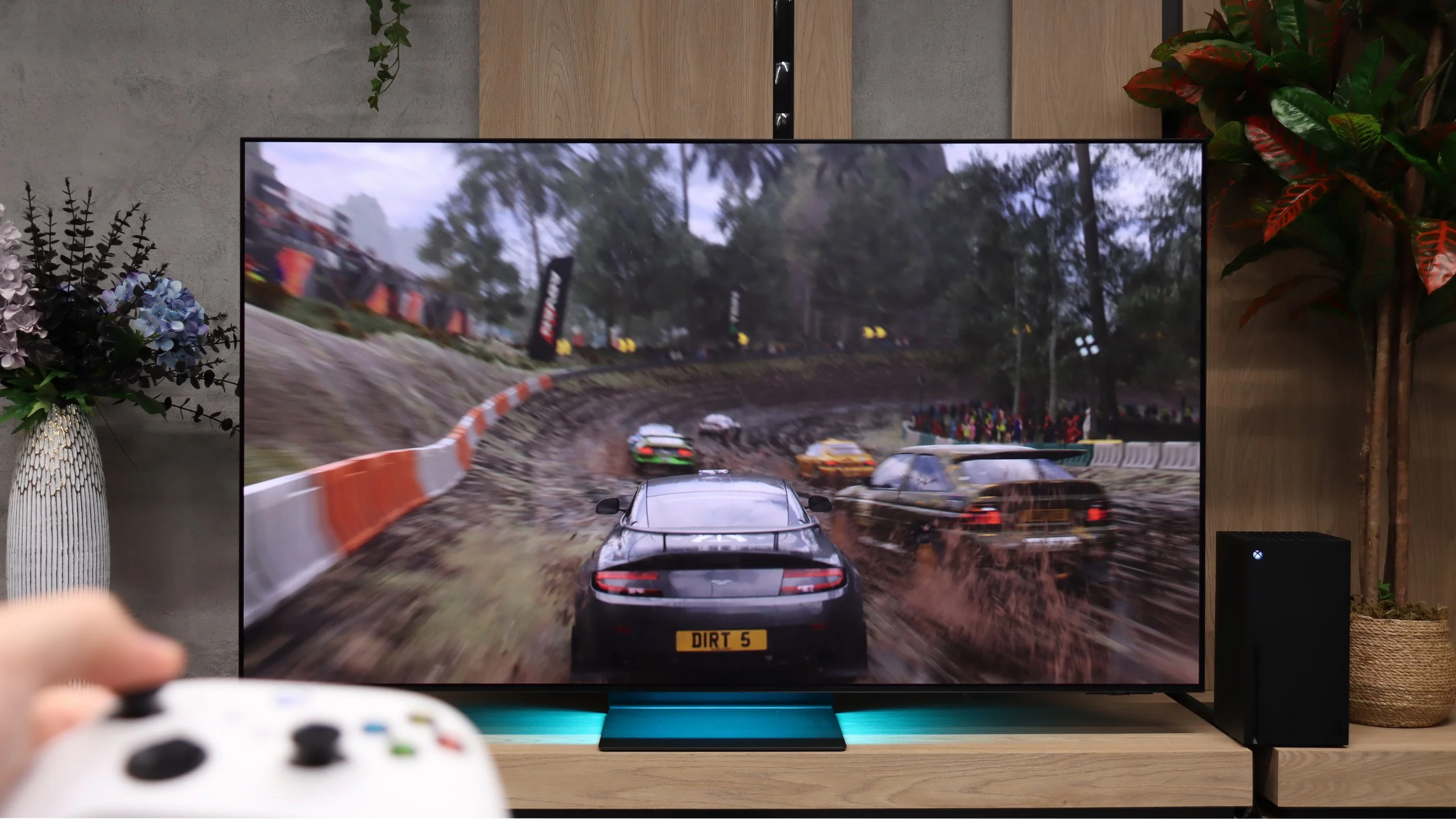
The device offers a range of features useful for gamers, such as ALLM (Auto Low Latency Mode), VRR (Variable Refresh Rate), Dolby Vision for gamers, and Game Bar. ALLM automatically switches the television to low latency mode, significantly improving response to commands from the controller and minimising input lag. VRR synchronises the screen refresh rate with the number of frames generated by the console, eliminating screen tearing and providing smoother gameplay. Dolby Vision for gamers enhances picture quality, offering better colour and contrast reproduction in games that support this format. The Game Bar feature allows quick access to game settings and monitoring of key parameters such as reaction time.
However, the television has certain limitations. The 60 Hz panel prevents the display of higher refresh rate signals at various resolutions, which may affect the smoothness of the image in dynamic games. Additionally, the lack of support for G-Sync technology for PC may impact gameplay quality on a computer. It is also worth noting that the HGiG mode, which aims to improve picture quality in HDR games, does not function correctly in this model, negatively affecting the visual experience in HDR-supported games.
Samsung S95H is a phenomenal TV for gaming. Beyond excellent picture quality it offers a whole set of useful gaming features. VRR works from 48 to 165 Hz and helps keep things smooth when frame rates vary. ALLM automatically switches to a low-latency mode, and a properly working HGiG makes setting up HDR on the console easier. There are no issues handling console 120 Hz in Full HD, 1440p and 4K. A handy addition is the Game Bar, which gathers signal information and the most important settings in one place. Game Motion Plus deserves special praise. This motion smoothing can improve the fluidity of lower-frame-rate games, and the input lag in our measurements was about 20 ms with it enabled. For additional motion processing that’s a very good result. In slower-paced games you can therefore get a smoother image without noticeably sluggish controls. Among the limitations, it’s worth noting the lack of Dolby Vision in games, which mainly affects Xbox users. The HDMI 2.1 ports also have a bandwidth of 40 instead of 48 Gb/s, probably due to the One Connect module. For typical console gaming at 4K, 120 Hz and 10-bit HDR this isn’t a problem and does not force a reduction in picture quality. For most players this will therefore be a specification difference they simply won’t notice while playing.
Input lag
10/10
10/10
SDR
HDR
Dolby Vision
P755 offers exceptionally low input lag, which is a significant advantage for gamers. In every mode, whether SDR, HDR, or Dolby Vision, the television achieves impressive performance. In every resolution, the input lag is only 11 ms, well done! Even in Dolby mode, the television maintains the same low level of latency. Thanks to these achievements, the television provides remarkable responsiveness and excellent gaming experiences, with no noticeable delays.
In terms of input lag, the S95H performs exceptionally well. At 60 Hz we measured just 9–11 ms, and at 120 Hz the delay falls to 5–6 ms. The controls are very responsive, so even in fast-paced shooters or racing games it's hard to find any faults. Importantly, enabling HDR does not increase the input lag. You can therefore enjoy the full picture capabilities without sacrificing quick response to controller inputs.
Compatibility with PC
2.5/10
8.8/10
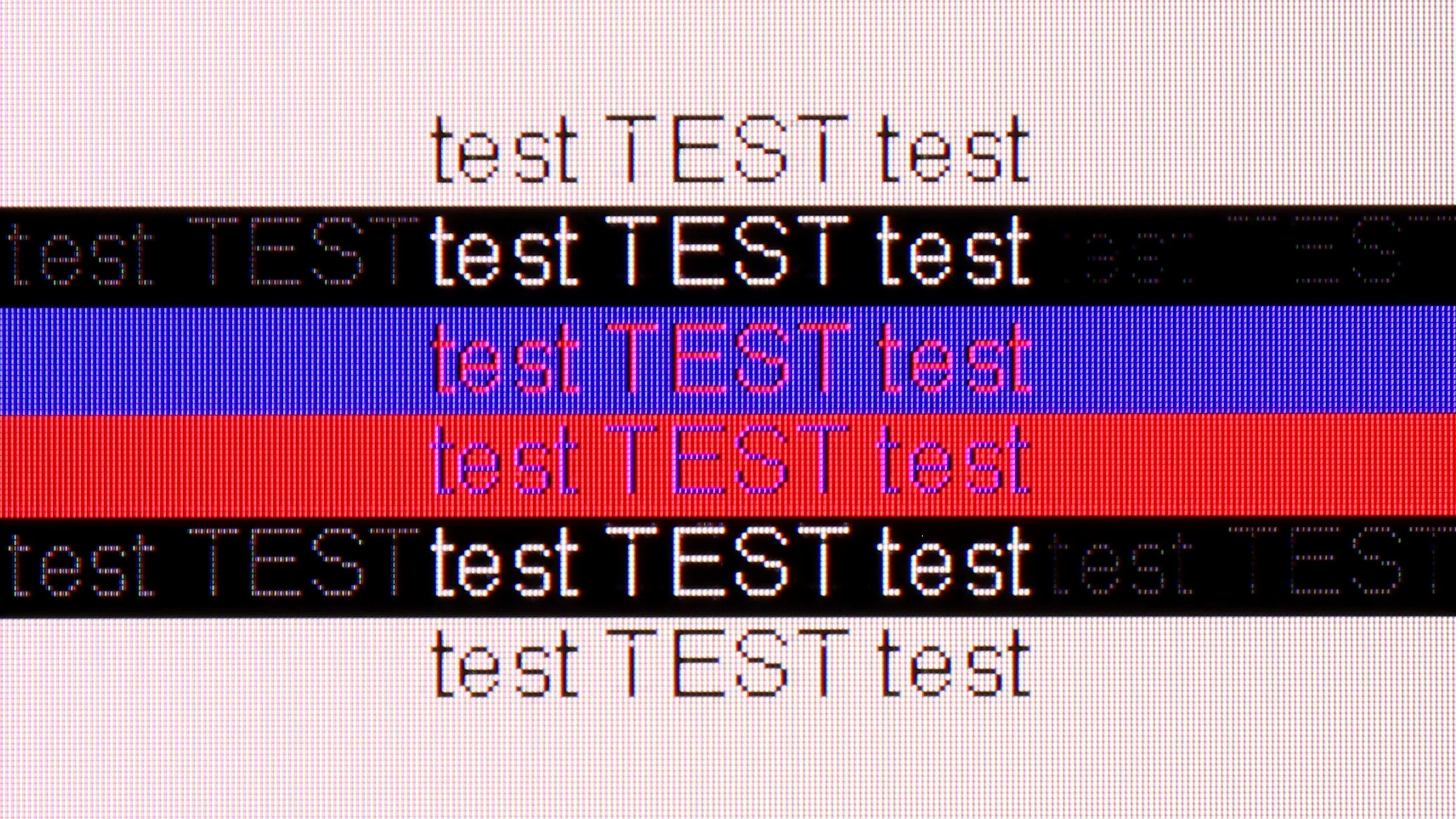
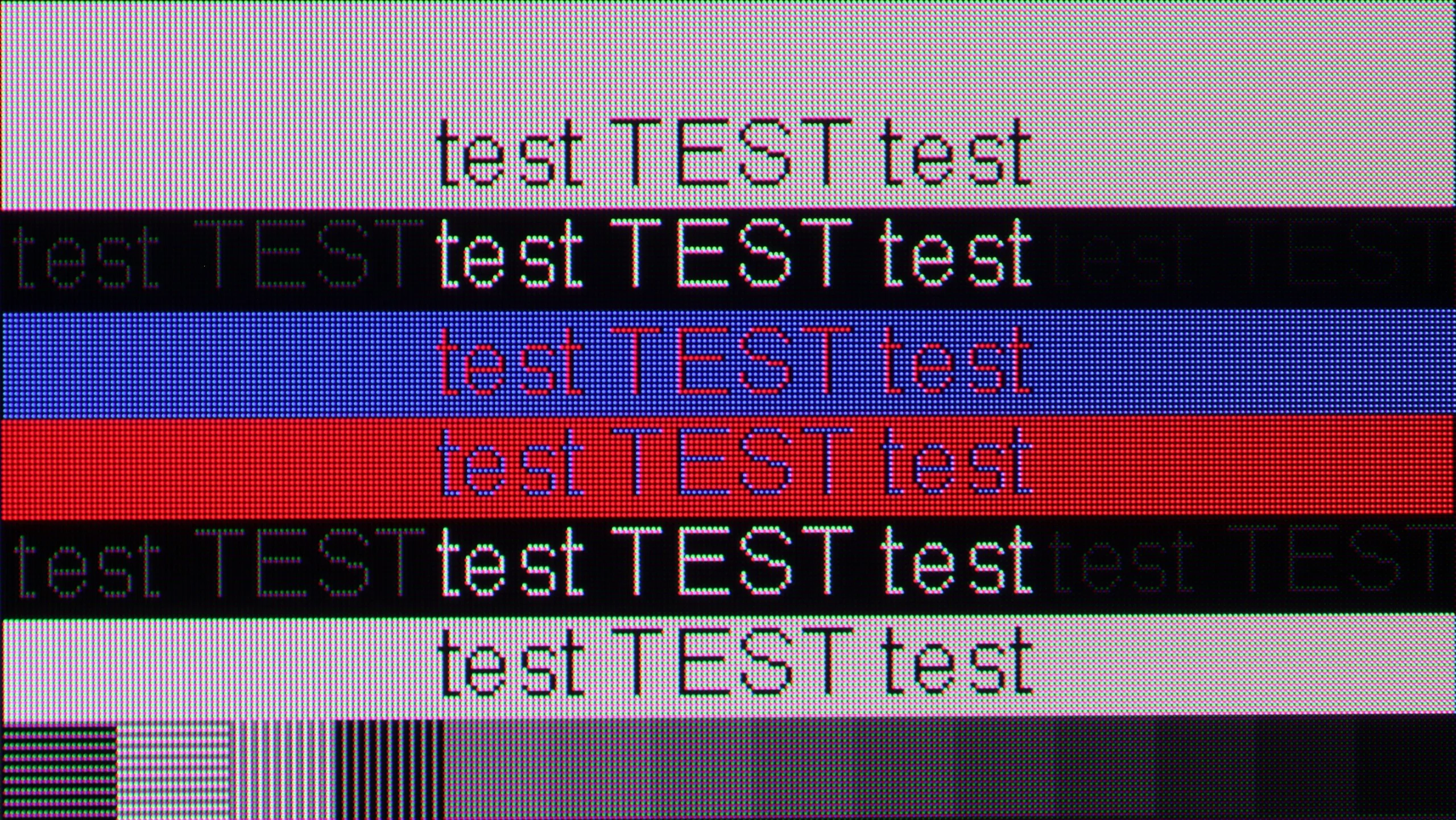
The photo shows the legibility of small fonts. Ideally, lines should be the same thickness on both light and dark text, with minimal pixel gaps.
When connecting the TCL P755 to a computer, the first thing you may notice is the support for chroma 4:4:4, which ensures correct colour reproduction in details, especially when working with text and graphics. Unfortunately, despite this support, the readability of fonts leaves much to be desired, particularly with dark text and shapes on a dark background. This issue arises from the limited resolution in darker shades, where the applied dithering makes the pixels resemble those known from Full HD. This is especially visible with small fonts, making comfortable office work on a large screen difficult. However, a positive aspect is the very low input lag of 12 ms, which means that the television performs well for occasional gaming on a computer, particularly in dynamic games. Ultimately, while the TCL P755 may be a decent choice for PC gaming, it may be disappointing for users expecting high text readability.
The Samsung S95H works great with a PC, especially when connected for gaming. You get 4K at 165 Hz, working G-Sync and an input lag of just 6 ms. Combined with the panel’s lightning-fast response this delivers a very smooth and responsive picture. The TV also correctly supports 4:4:4 chroma at the maximum refresh rate, so fine coloured elements remain legible.
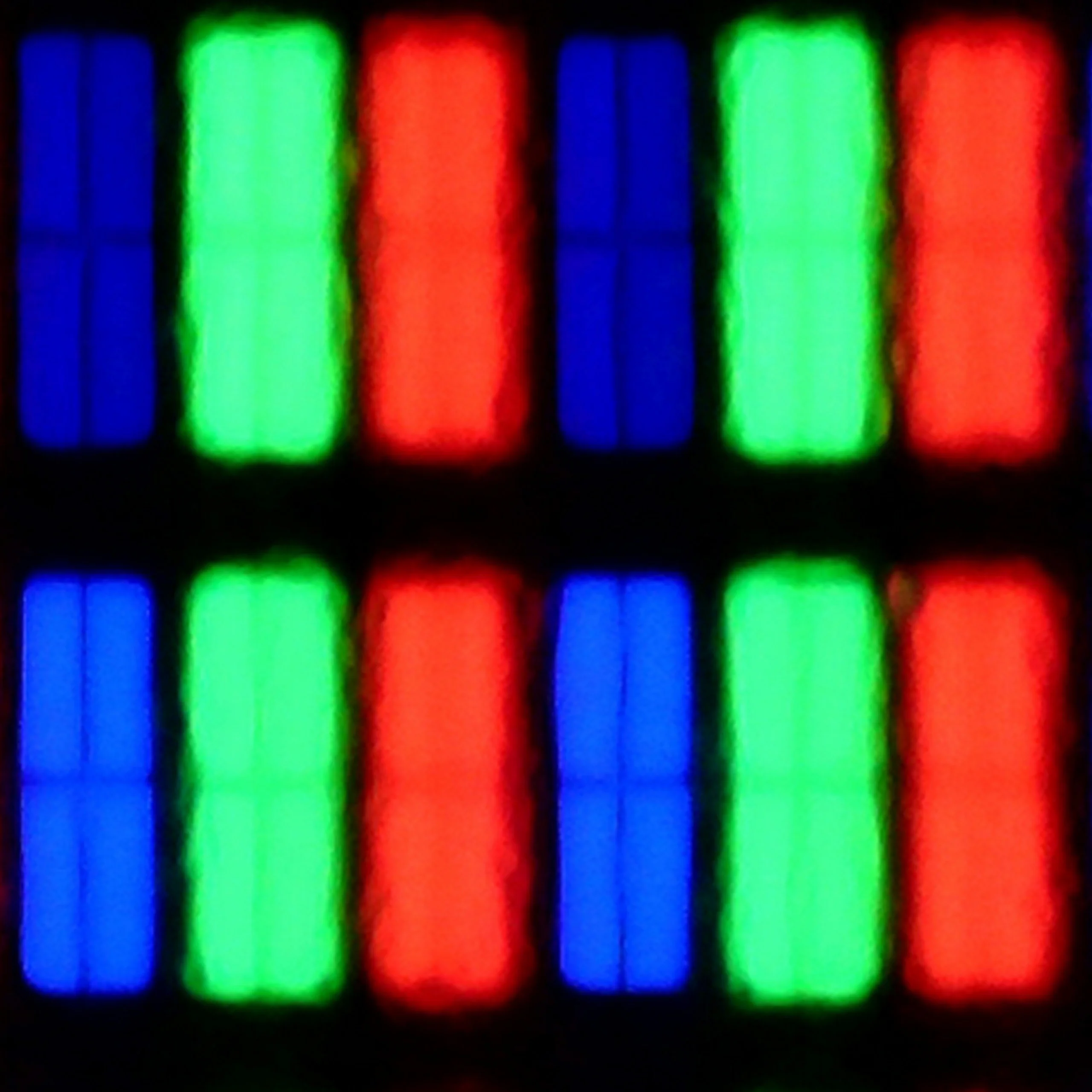
It also handles text well, although it wouldn't be our first choice for all-day document work. First, the QD-OLED models discussed here start at 55 inches, so you really need a sizeable desk to work on 😉. Second, the triangular arrangement of subpixels means that on the smallest letters you can notice slight coloured fringing. They're mainly visible up close. From a normal TV viewing distance they shouldn't be distracting, so occasional browsing of websites or working with text isn't a problem.
Viewing angles
3.2/10
9.9/10
P755, equipped with a VA panel, offers average viewing angles. In practice, this means that the brightness of the image significantly decreases when we view the screen at an angle. VA panels, although they provide better contrast and deeper blacks compared to IPS panels, have poorer properties in terms of viewing angles. IPS panels, known for their wider viewing angles, offer a more stable image from different angles, but usually at the cost of slightly lower contrast and black depth. Although the VA panel contributes to better contrast, the drop in brightness at an angle is noticeable and can affect viewing comfort in larger groups or from different positions in the room.
The viewing angles on the S95H are excellent. It's one of the biggest advantages of the QD-OLED panel and, in this respect, the S95H ranks among the best TVs we've tested. Even at a steep side angle the colours retain their saturation and the picture doesn't noticeably lose brightness. With a wide viewing angle or when watching a match with a larger group you don't have to fight for the middle spot on the sofa, as the picture still looks great from the side seats. 🙂
Daytime performance
3.8/10
7.3/10
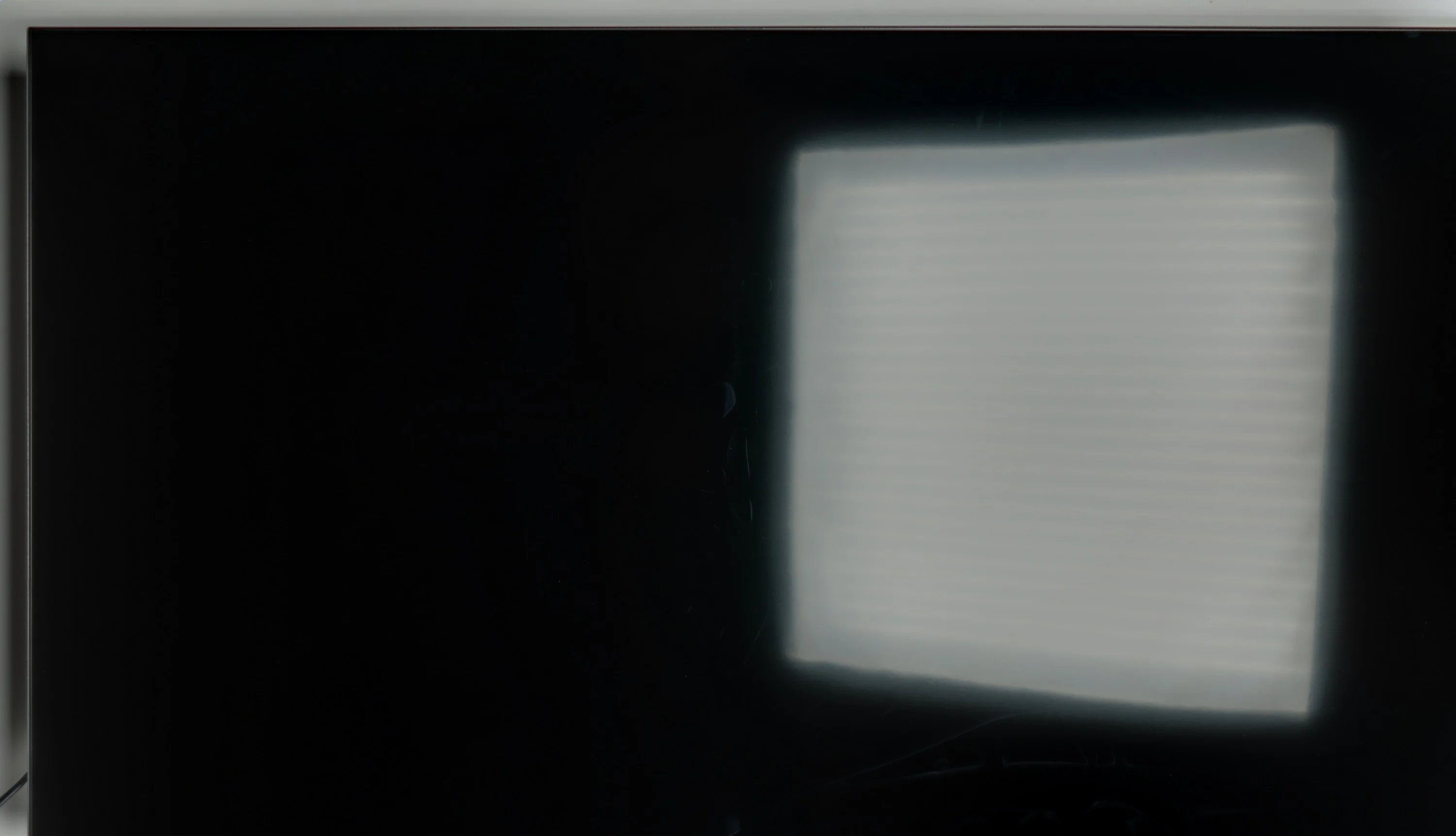
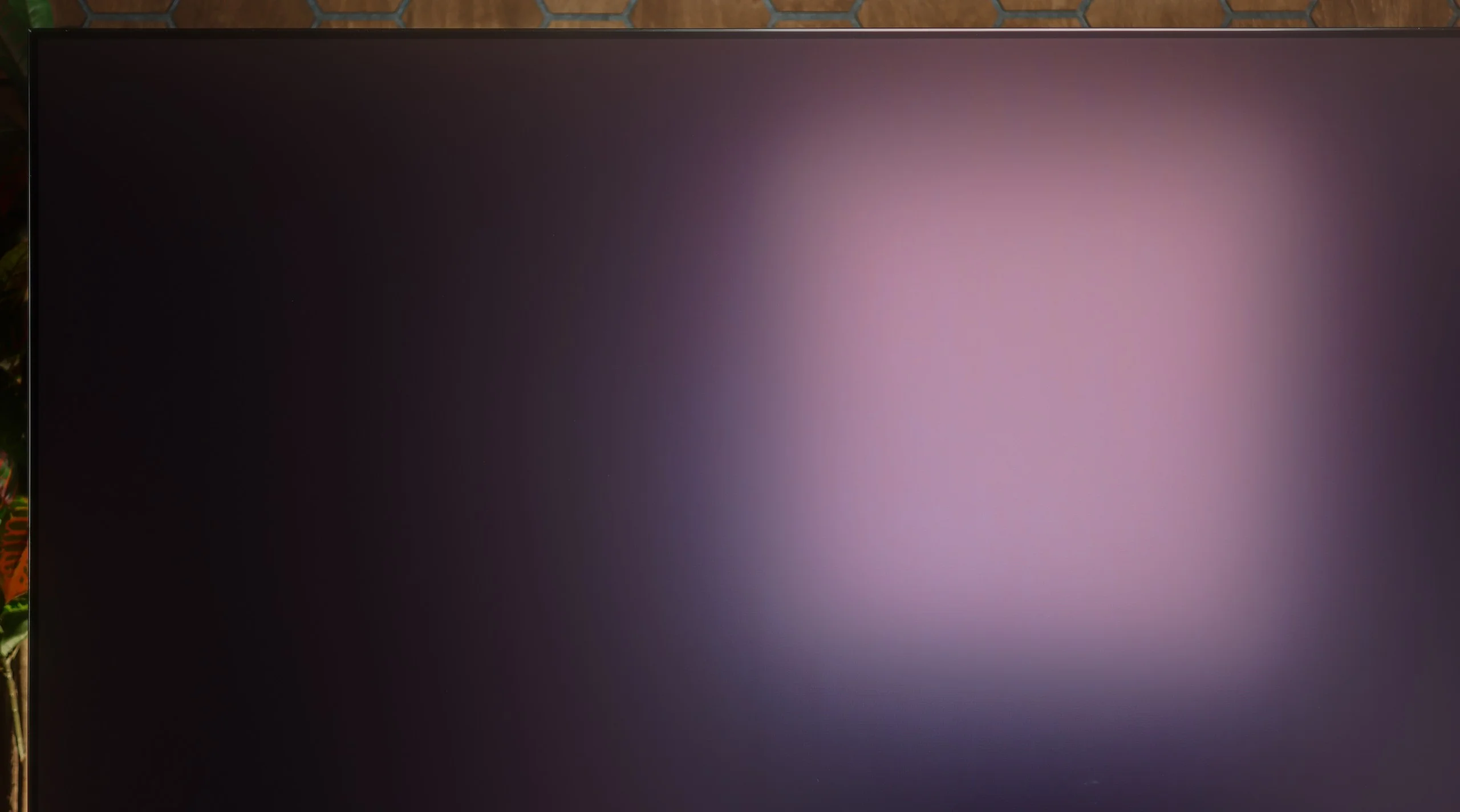
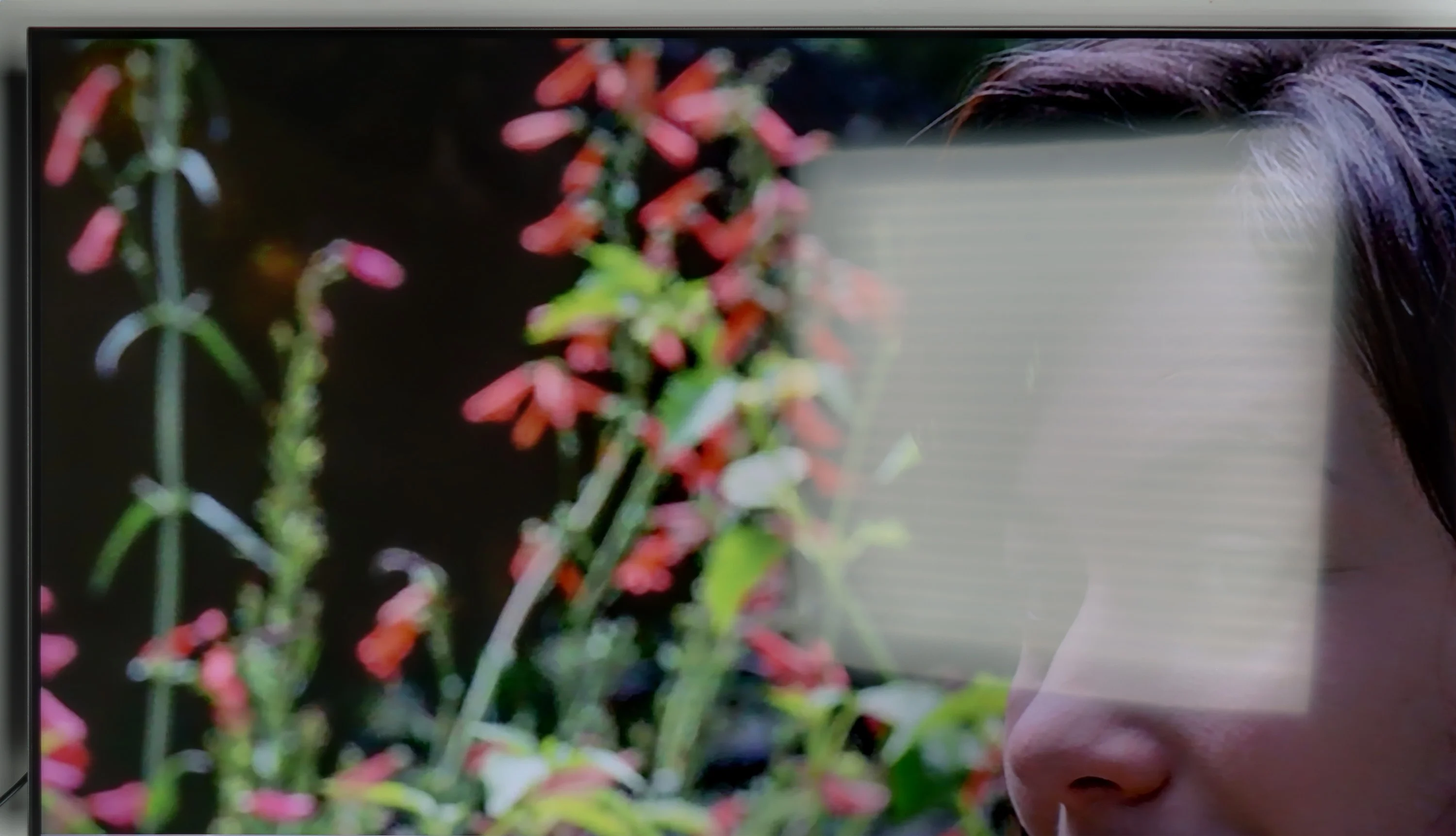
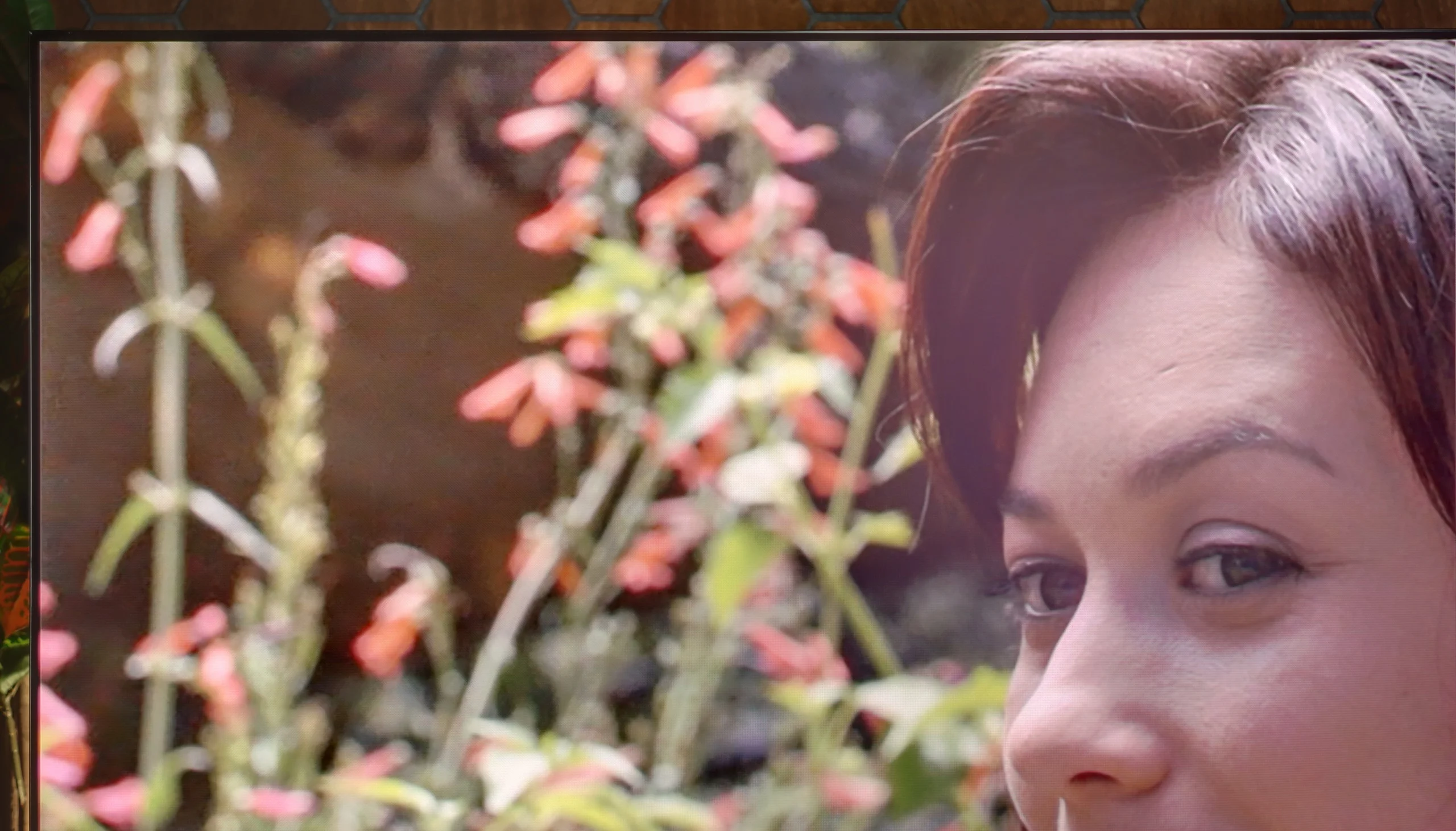
Panel brightness
Samsung S95H: 722 cd/m2
TCL P755: 290 cd/m2
The TV, equipped with a satin finish, performs well in moderately lit daytime conditions. Its brightness in SDR mode is around 290 nits, which is an average value. Unfortunately, the television has poor reflection handling, meaning that reflections of light can be noticeable, especially in bright surroundings. Nevertheless, the television offers good black levels during the day, due to the use of a VA panel, which handles contrast better compared to IPS panels. In practice, this means that despite issues with reflections, the television can deliver a satisfying picture in daytime conditions, maintaining a decent level of black and contrast.
The Samsung S95H performs very well for daytime viewing. Much of this is thanks to the matt finish, which effectively diffuses reflections. Instead of clearly seeing a window or lamp in the screen, you see a softer glow. Added to that is an average SDR brightness of around 750 nits. For an OLED that’s an excellent result, allowing comfortable viewing in a bright living room. You must remember, though, that brightness depends on what’s actually on the screen. With smaller bright areas the S95H tops 1000 nits, but with a full white screen it falls to about 400. So when watching winter sports or other very bright material, the image will not have the same impact as in mixed scenes.
The biggest limitation remains black level in a brightly lit room. First, light falling on the QD-OLED panel noticeably brightens it and shifts it toward a cherry tint, which robs it of its night-time depth and makes the picture look less contrasty. The matt finish deals well with reflections, but it also scatters that light more. The S95H is still a very comfortable TV for daytime viewing. You’ll see the full potential of its blacks only in dimmer lighting.
Panel details
Subpixel Structure:
Panel uniformity and thermal imaging:


TCL P755
Samsung S95H
TV features
7.3/10
7.9/10
- SystemGoogle TVTizen
- System performanceAverageVery good
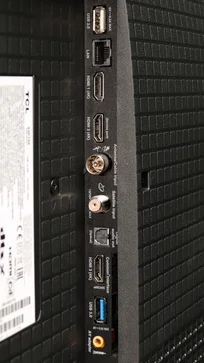
- HDMI inputs3 x HDMI 2.0, 0 x HDMI 2.10 x HDMI 2.0, 4 x HDMI 2.1 40Gbps
- Other inputsRCA (Chinch)USB-C
- OutputsToslink (Optical audio), eARC (HDMI), ARC (HDMI)Toslink (Optical audio), eARC (HDMI), ARC (HDMI)
- Network InterfacesWi-Fi 2.4GHz, Wi-Fi 5GHz, Ethernet (LAN) 100MbpsWi-Fi 2.4GHz, Wi-Fi 5GHz, Ethernet (LAN) 100Mbps
- TV receptionDVB-T, DVB-T2, DVB-S, DVB-S2, DVB-CDVB-T, DVB-T2, DVB-S, DVB-S2, DVB-C
Classic features:
- Recording to USB (terrestrial TV)
- Recording programming
- Picture in Picture (PiP)
- RF remote control (no need to aim)
- Backlit remote control
- Teletext
- Audio only mode
- Bluetooth headphones support
- Simultaneous Bluetooth headphones & TV audio
Smart features:
- AirPlay
- Screen mirroring (Windows Miracast)
- Voice search
- Voice search in native language
- Ability to connect a keyboard and mouse
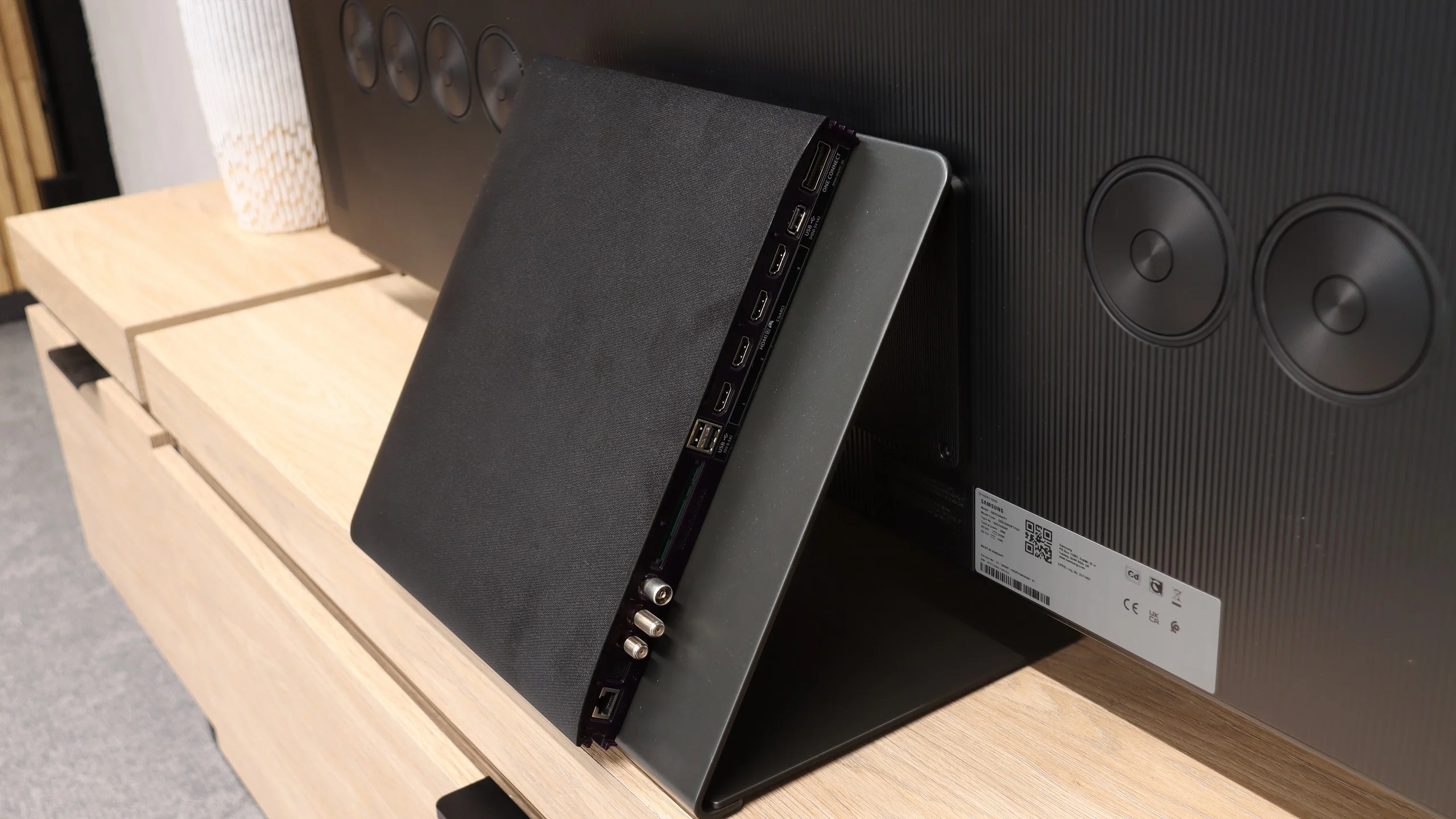
Sound connection options
- HDMI audioeARC (HDMI), ARC (HDMI)eARC (HDMI), ARC (HDMI)
- Other audio outputsToslink (Optical audio)Toslink (Optical audio)
- Wireless audioBluetoothBluetooth
Supported audio formats (external HDMI eARC audio):
- Dolby Digital Plus 7.1
- Dolby True HD 7.1
- Dolby Atmos in Dolby Digital Plus (JOC)
- Dolby Atmos in Dolby True HD
- DTS:X in DTS-HD MA
- DTS-HD Master Audio
Senior accessibility
- Numeric keyboard on TV
- Font size adjustment
- Audio description
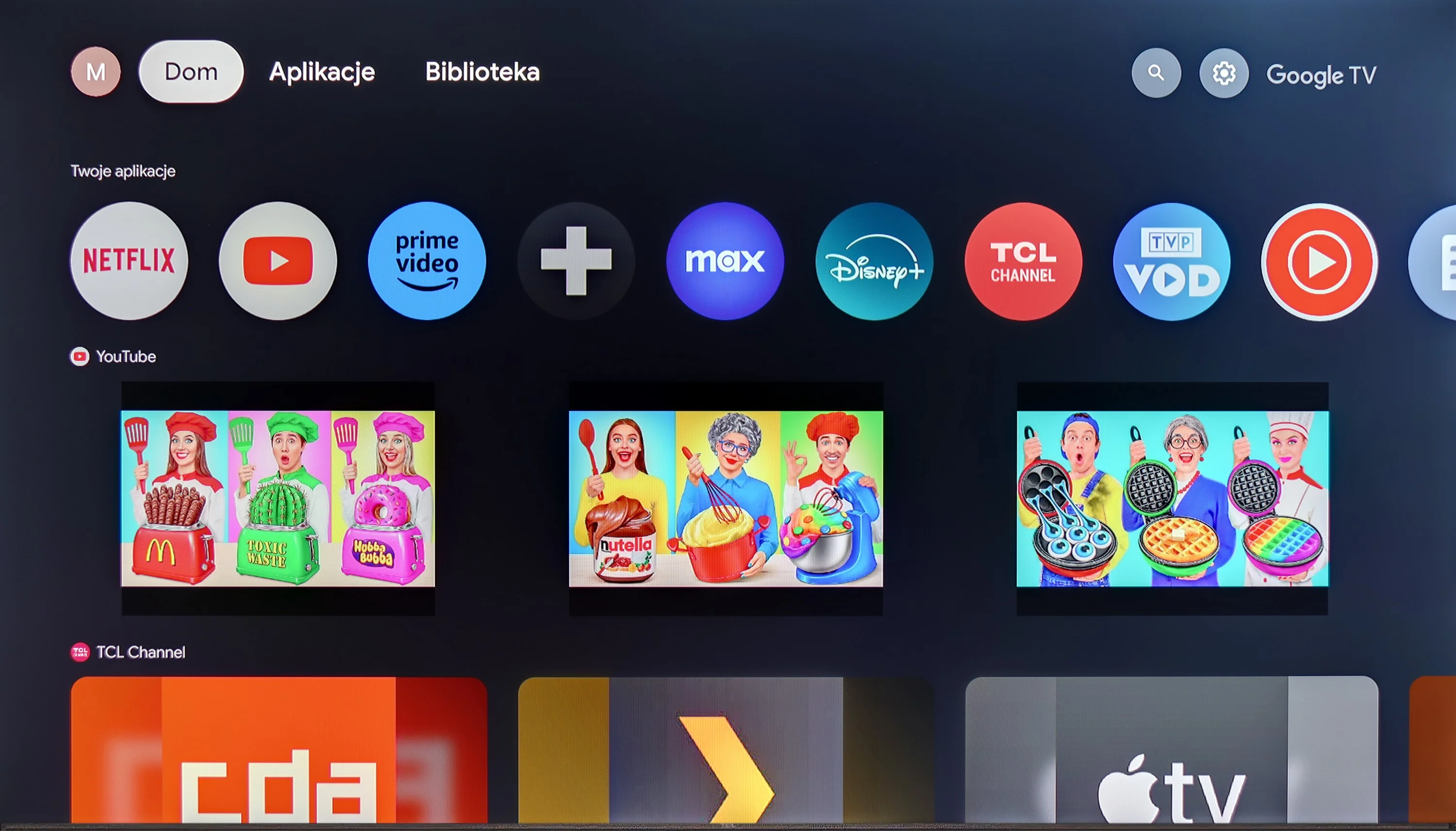
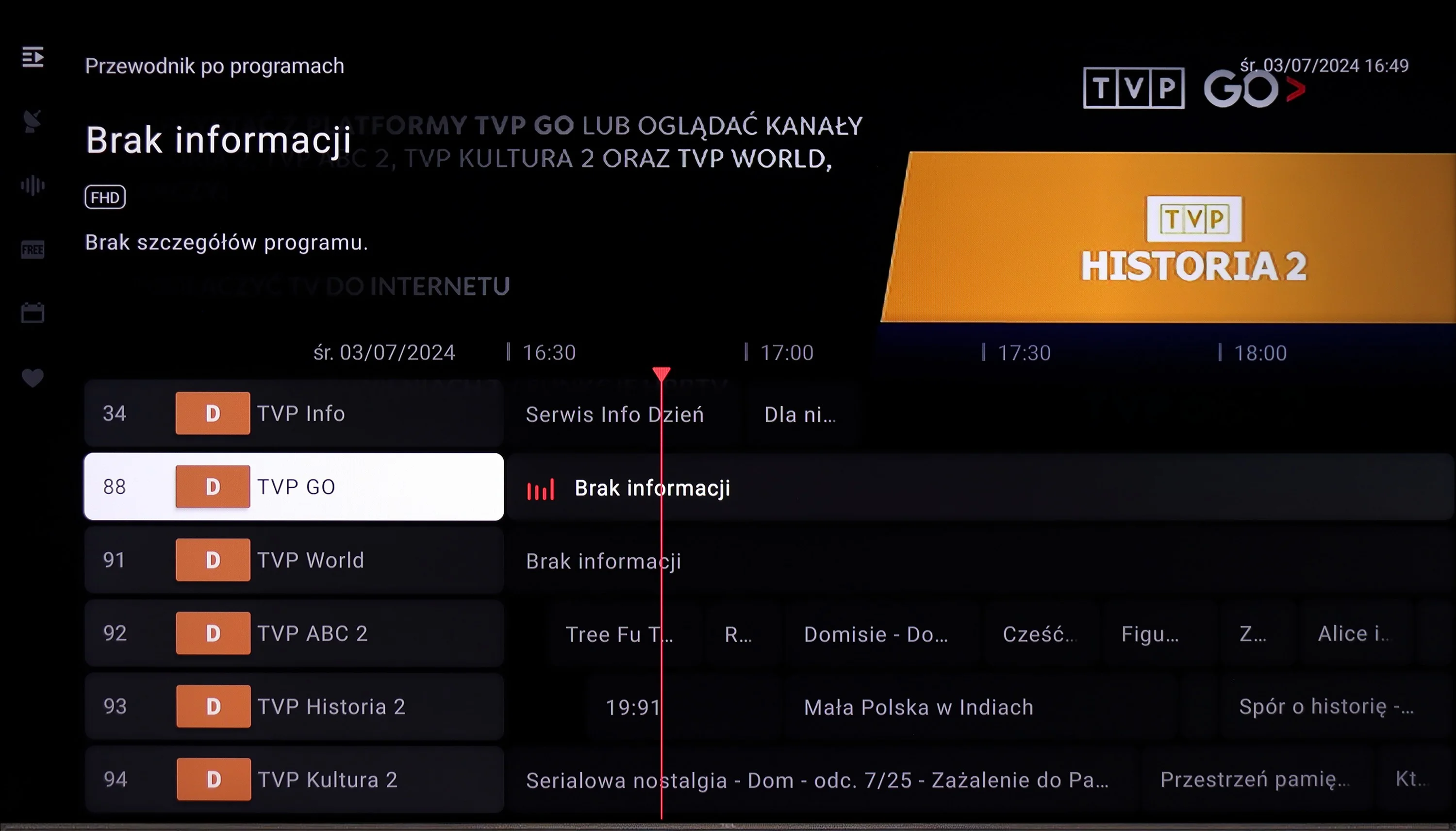
The device operates on the Google TV system, offering a wide range of features that enhance user comfort. Google TV, an extension of Android TV, provides personalised content recommendations based on watched programmes and user preferences. It allows easy access to popular streaming applications such as Netflix, YouTube, and Prime Video, as well as integration with the Google Play Store for additional apps. The system works with other Google devices, enabling control of the television using Google Assistant and integration with a smart home system.
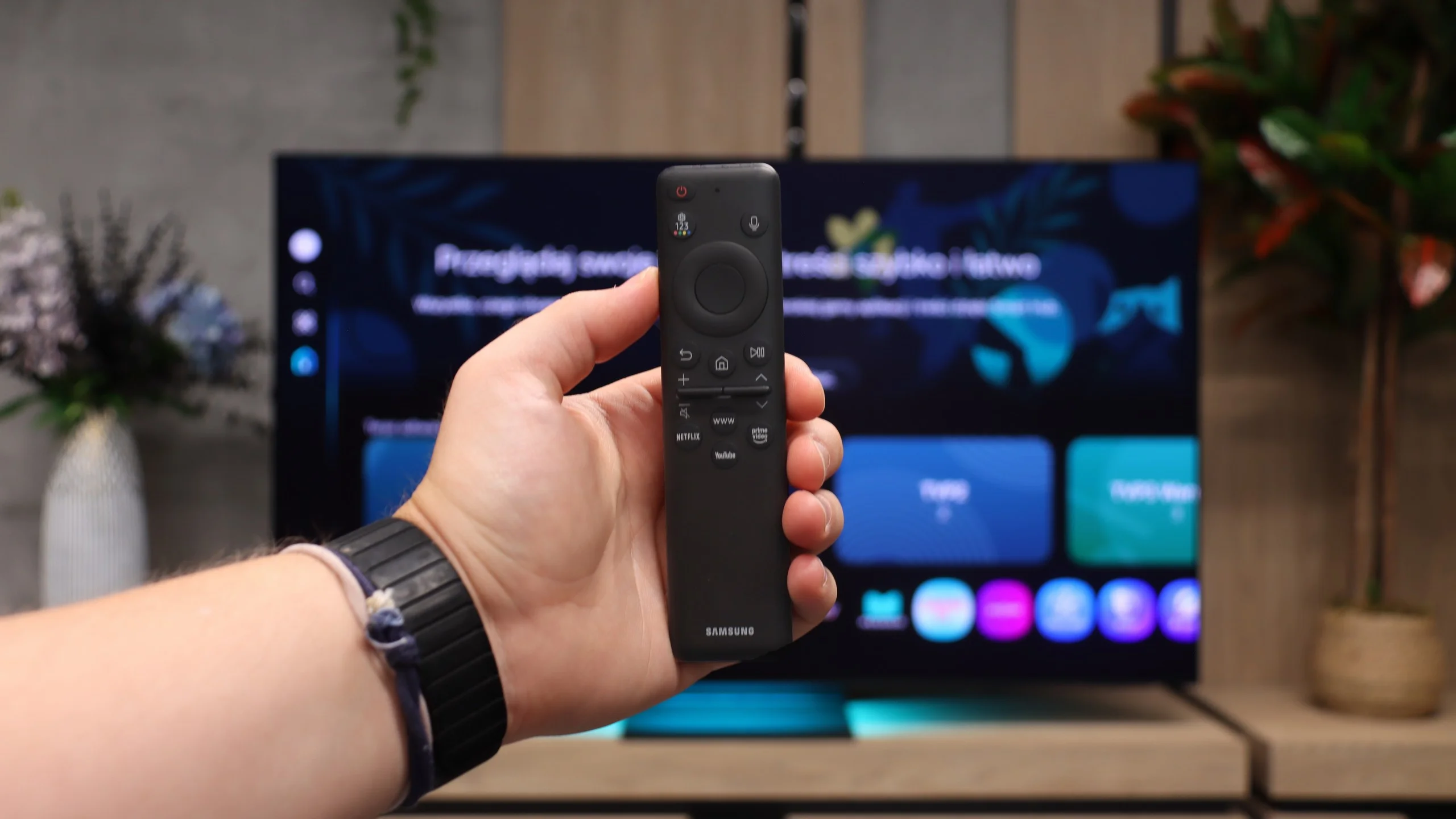
In terms of connectivity, the television supports screen mirroring via Windows Miracast and AirPlay, allowing easy transmission of images from other devices. It also allows connection of a keyboard, mouse, and Bluetooth headphones, while simultaneously using headphones and the built-in speaker with separate volume control for both audio sources. The television remote operates on an RF basis, so there is no need to aim at the screen, although it is not backlit. Additionally, the television supports audio-only mode and teletext, although it lacks picture-in-picture (PiP) functionality.
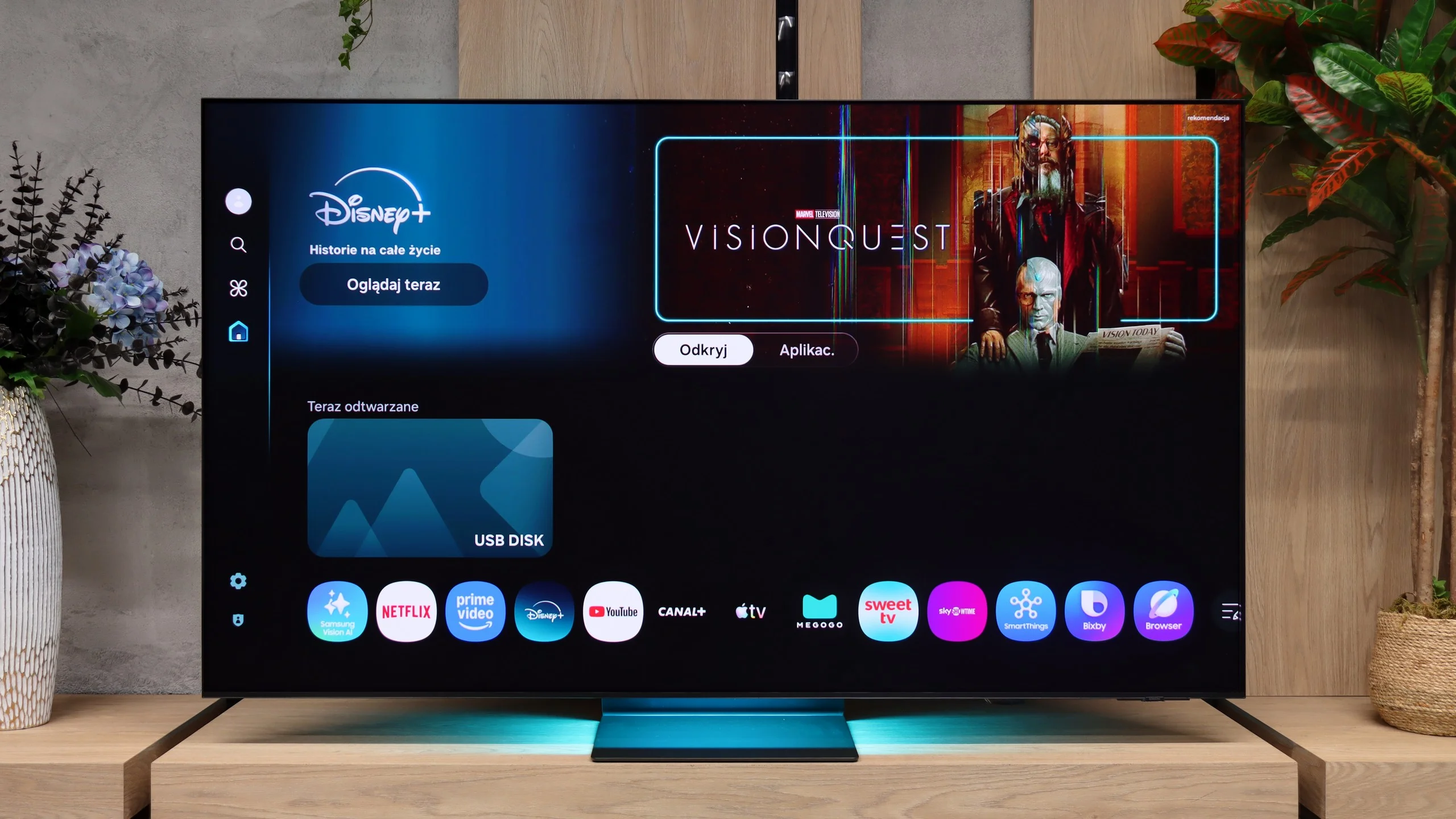
Tizen
The S95H uses the Tizen system, which runs very quickly here. Switching between apps and settings is smooth, so day-to-day use doesn’t require patience. There’s a wide selection of streaming apps, voice search and AirPlay for streaming content from Apple devices. You can also mirror a computer screen wirelessly. It’s a well-equipped Smart TV where it’s easy to find something for yourself.
We did notice one odd thing, though. Our review unit had a 2025 software version, even though the S95H is a 2026 model. At the time of testing we also couldn’t find an update to this year’s system on the manufacturer’s website. That’s surprising, as other Samsung models have already received it. Tizen itself runs smoothly, but for a new TV of this class we would expect the operating system to be up to date.
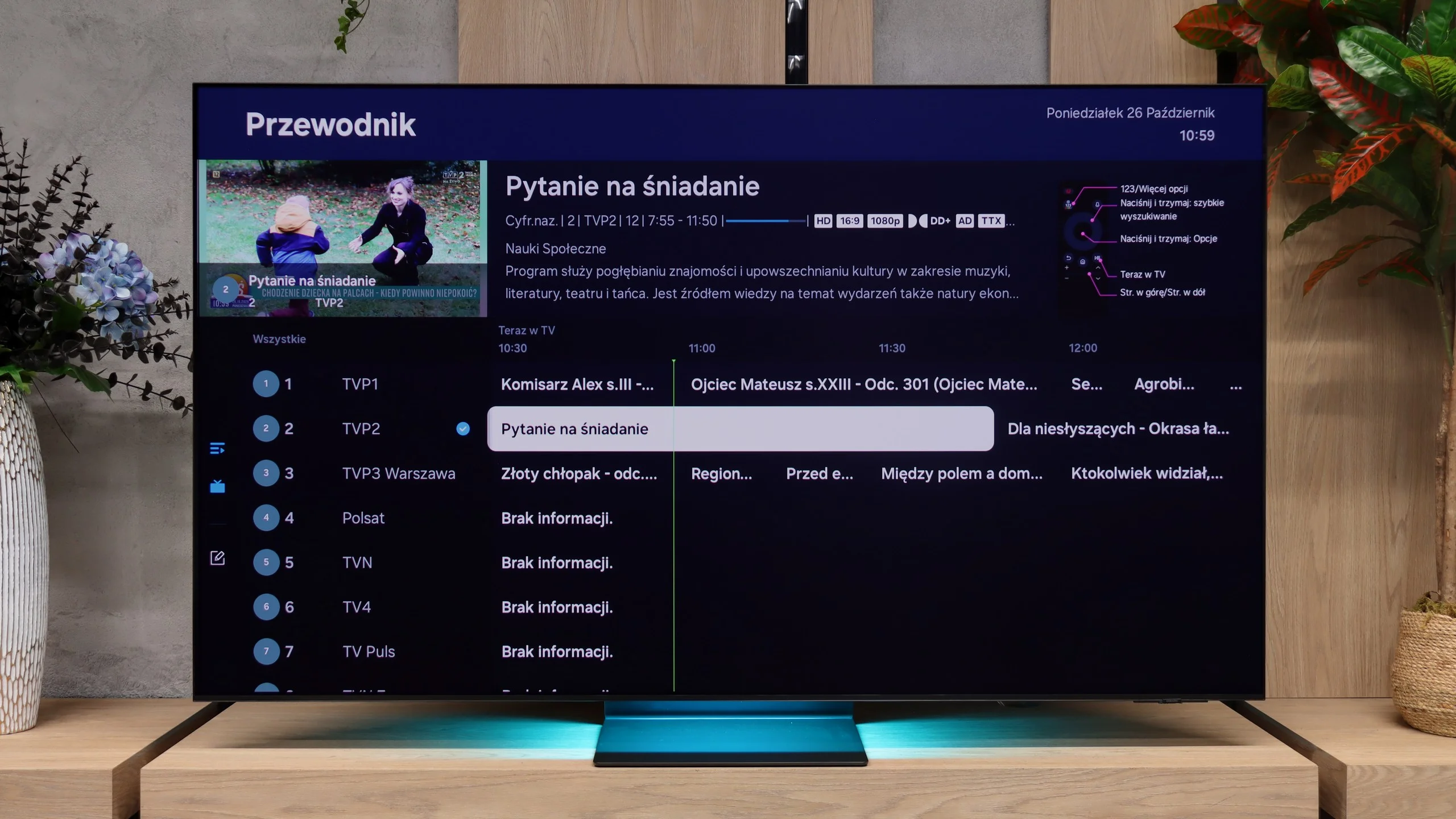
TV features and remote
Among the classic features are teletext and picture-in-picture, but the ability to record programmes to USB is missing. It can also be useful to play audio simultaneously through the TV speakers and Bluetooth headphones. The remote is very minimalist and works without needing to be pointed at the screen, although it’s a shame there are no backlit buttons. A definite plus is that it doesn’t require battery replacement and can be charged using solar power.
One Connect
The One Connect module remains an important addition, and Samsung TVs earn a small extra point from us for it. It contains four HDMI 2.1 inputs with 40 Gb/s bandwidth, and a soundbar can be connected via eARC or the optical output. The biggest advantage of this solution is simple: only a single cable runs to the screen. It’s easier to hide the cables and to connect another device without having to reach behind the TV. Those planning to wall-mount the S95H will especially appreciate it.
Apps
9.6/10
9.3/10






















Playing files from USB
9.1/10
9.1/10
Supported photo formats:
Maximum photo resolution:
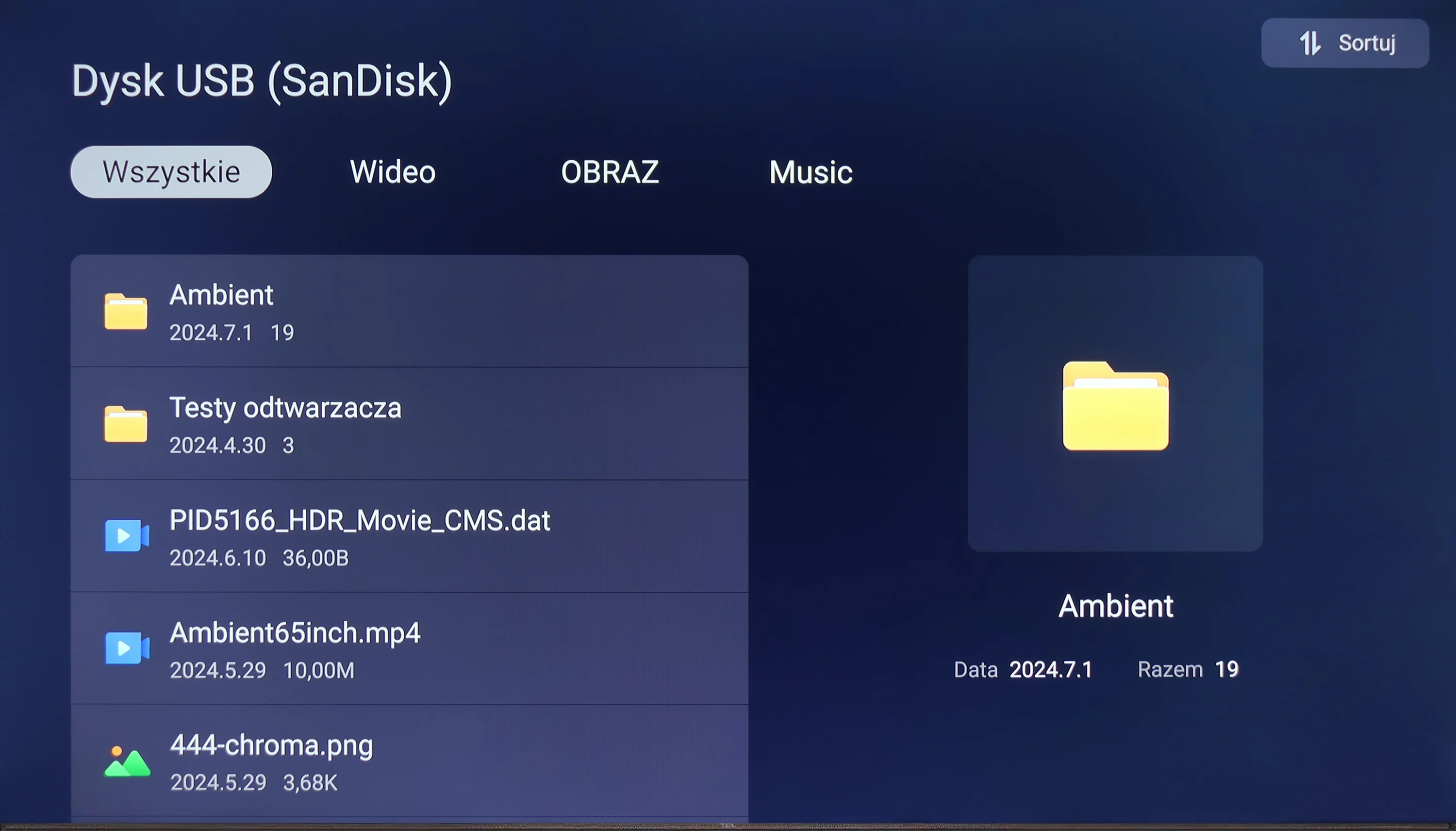
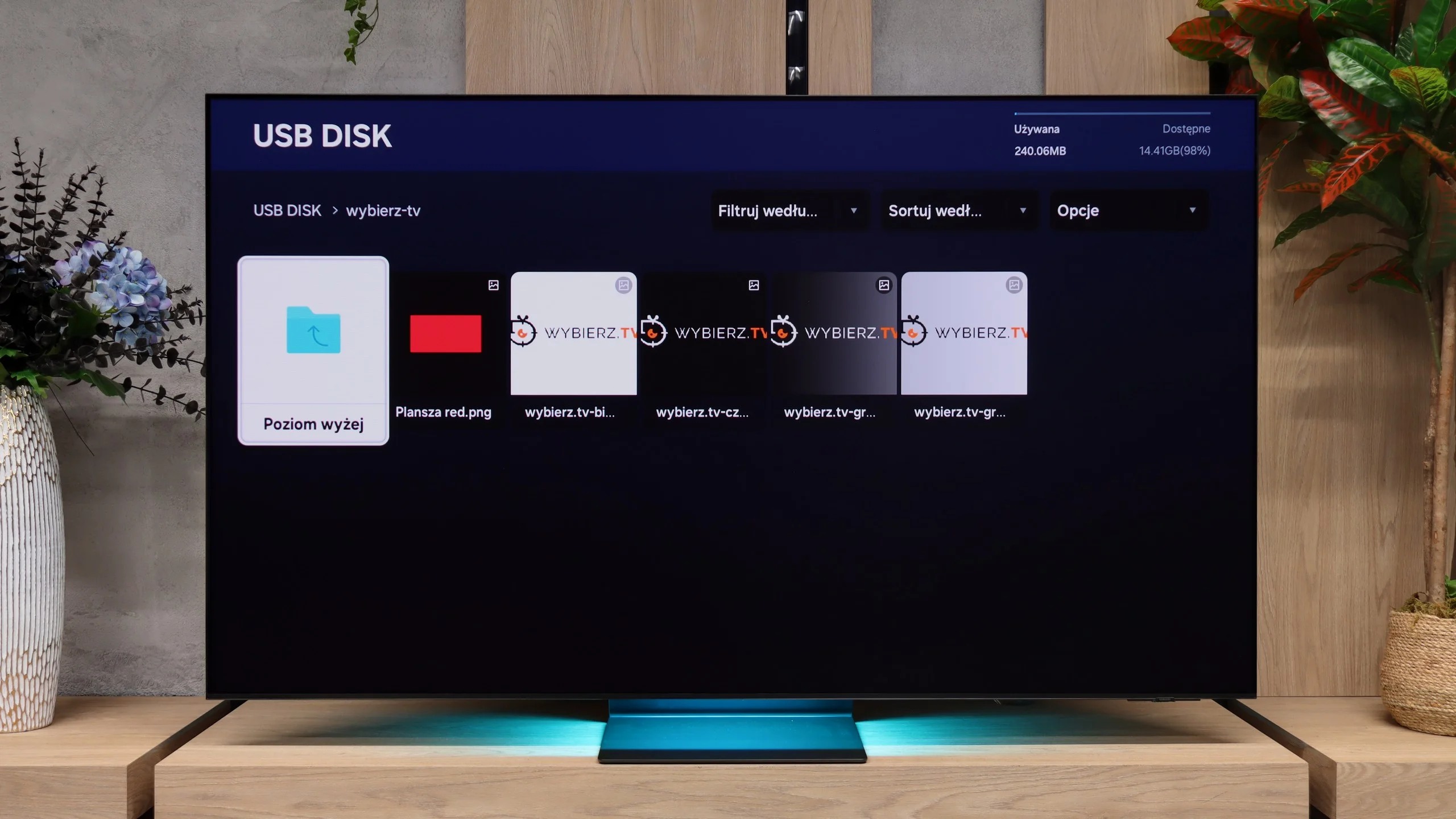
The television will play most files and video codecs, and with subtitles uploaded for the film, you can change the font size. The biggest downside here is the lack of support for less popular photo formats.
The built-in file player works quickly and smoothly. The S95H opened almost all of the audio and video files we prepared and expected it to support. You don't have to wait long for them to load, and browsing the contents of the storage device is convenient.
It's a pity, though, that there is no support for HEIC photos, the format used by default on many iPhones. So if you want to show photos from your phone directly from a USB stick, you need to convert them first, for example to JPEG.
Sound
5.8/10
8/10
- Maximum volume-86dB
- Dolby Digital Plus 7.1
- Dolby True HD 7.1
- Dolby Atmos in Dolby Digital Plus (JOC)
- Dolby Atmos in Dolby True HD
- DTS:X in DTS-HD MA
- DTS-HD Master Audio
The sound quality in the television is rather average. The high tones are slightly distorted and can sound unclear, while the bass is almost non-existent. The sound is dominated by the mid tones, which makes the overall audio experience balanced, but lacking in fullness. On the plus side, it supports advanced audio codecs such as Dolby and DTS, improving compatibility with various audio sources and formats.
In terms of sound the S95H is essentially a copy of last year’s model. Despite its very slim casing it delivers clean, pleasant audio, but the sound remains rather flat. It lacks depth and stronger bass, which, given such an impressive picture, leaves something to be desired. On the other hand, it is hard to expect large drivers in a TV about a centimetre thick. The beautiful appearance comes at a price.
It is therefore worth supplementing the S95H with a soundbar or a separate audio system so the audio better matches the picture. The TV supports Dolby Atmos, which makes it possible to expand the setup to surround sound. However, it lacks DTS support. This limitation may be an issue chiefly for viewers watching films from discs with soundtracks in that format.
Sound Quality Test
No sound test video
Acoustic Measurements
No acoustic data
86dBC (Max)
75dBC
Reader comments
Comments are provided by the external service Disqus (Zeta Global). Once loaded, Disqus may set cookies and process data about your activity.
We will remember your choice on this device. Provider's privacy policy