 Michał Wołoszyn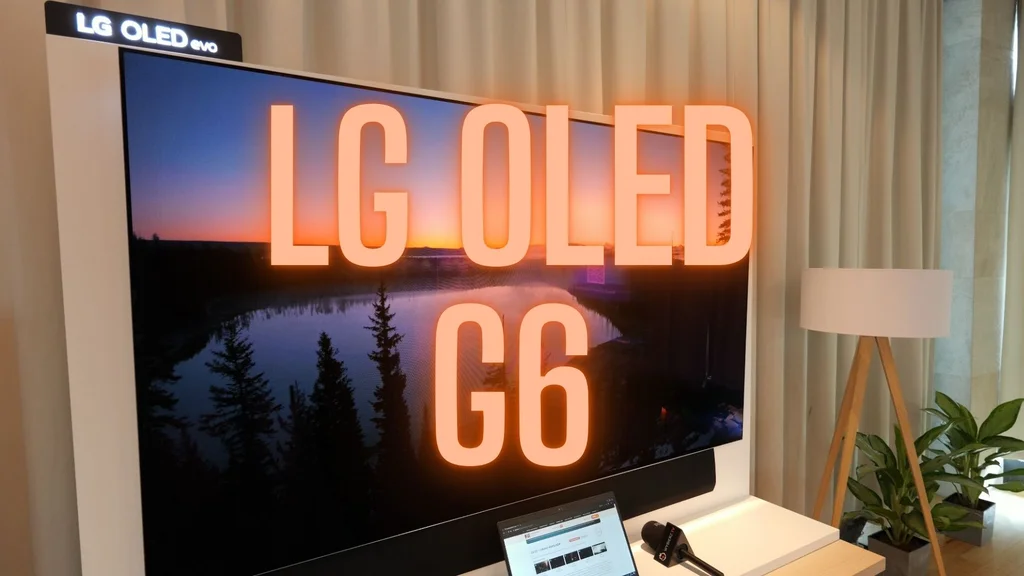
Every year, the premiere of the new "G" series from LG evokes the same emotions – on the one hand, we anticipate a technological earthquake, while on the other, we wonder if the engineers from Korea still have anything left to "squeeze" extra brightness from. As you'll soon see, they do. The G6 model for 2026 is a device that at first glance may seem like merely a safe continuation of the success of its predecessors. However, upon deeper analysis of what is happening "under the hood," it turns out that this time LG has focused on battling the biggest demons of WOLED technology. Let's take a look at the details.
LG G6: Design and warranty
Let's start with what is visible to the naked eye. If you are hoping for a visual revolution, I must disappoint you – not much has changed in the G6 model, and since the first series of G, the design of the device is almost the same. Of course, overlooking all the shades of grey of the casing.
A more important piece of information than the design of the frame is, however, the fact that LG's warranty policy remains unchanged. We still receive 5 years warranty on the OLED panel. With the increasing power of the matrix and record brightness levels, such protection is extremely reassuring and shows that the manufacturer is confident in the durability of its proprietary heat dissipation solutions.
LG OLED G6: Sizes and 2nd Generation Tandem OLED Matrix
LG G6 will be the model with the widest range of sizes in the flagship offerings. A key piece of information is the implementation of the 2nd Generation Tandem OLED matrix, which will be available in 55, 65, 77, and 83 inches.
The situation regarding the 48-inch model is quite intriguing. From our conversations with representatives from LG, it appears that the introduction of this size to the market depends on negotiations with retail chains. If you are looking for top-notch picture quality in a small format – let us know! The voice of the users holds real significance here. Meanwhile, for fans of cinematic grandeur, a 97-inch version has been prepared, although I must add an asterisk here: we probably won't find Tandem OLED technology there, but rather the standard WOLED panel known from the C series.
LG G6: HDR Brightness
Now that we know the sizes, let's get to the specifics, namely what excites the imagination the most: brightness. In the G6 model, we noted an improvement of about 10% compared to last year's G5. In the brightest points, in Filmmaker mode, the difference reached even 400 nits.
This is real progress that gives the image an amazing 'boost' in HDR. At peak moments, the brightness of the G6 could reach even 2800 nits in film scenes. Although it is not a revolutionary leap, it makes the image even more vivid and brings it closer year after year to what can be found in professional monitors, although we will probably have to wait a few more years for the real barrier (in filmmaker mode) of 4000 nits. Brightness in real content has ceased to be a mystery – the LG G6 is currently one of the brightest OLEDs on the market.
Important: If you are planning to purchase any model from the 2026 range, I would like to remind you of our promotion: we are offering free professional calibration in exchange for allowing us to test the television in our lab. You can find the details in the link under the article.
LG OLED G6: Colours – is there progress in this area too?
After all, a person does not live on black and white alone, and in marketing, brightness often overshadows other equally important aspects of the image. So how does the LG G6 perform in terms of colour reproduction? Here, the situation is straightforward: the revolution that was absent in brightness is also missing in colours.
When it comes to the DCI-P3 colour gamut, which is the standard in which the vast majority of today's films and series are mastered, we have not recorded any significant improvements. The result of 99.7% coverage falls within the margin of measurement error compared to last year (99.6%). It is safe to say that LG has already reached the technological ceiling for WOLED panels here.
Things get a bit more interesting when analysing the very wide BT.2020 colour gamut. Here we noted a subtle improvement of exactly 1.2 percentage points. This year's flagship achieved a result of 83.7% (compared to 82.5% in the G5 model).
Is this a change that you will notice with the naked eye during a viewing? Frankly – not really. It is more of a technical curiosity for purists, showing that engineers are still striving to optimise the matrix, squeezing out the absolute maximum from it, even if these are millimetre steps. However, it is good to see what benefits the competition between LG Display and Samsung Display has brought, as after years of stagnation, WOLED panels are finally making clear progress in colour reproduction.
Alpha 11 Processor – no more posterisation issues!
In our opinion, the most important new feature in the G6 is not brightness, but the new Alpha 11 processor with native, 13-bit brightness processing. Why is this so important? WOLED televisions with a white subpixel have always struggled with what is known as posterisation – ugly, jagged bands in the image, particularly noticeable in blue skies or dark scenes.
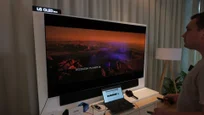
Thanks to the new processor, this issue has been significantly improved. The precise control of the panel around the blacks ensures that tonal transitions are smooth, as confirmed by our testers who have seen these screens at pre-release showcases. This is brilliant news – a clean image without artifacts is far more important for viewing comfort than additional features that most of us won’t fully utilise anyway.
Tone Mapping: AI at the Service of (Not Always) Perfection
According to the manufacturer, the new Alpha 11 processor (3rd generation) also brings significantly better tone mapping, analysing the image in as many as 48 separate zones in real-time. This is intended to help preserve details in the brightest areas of the image (e.g., clouds in the sky), when the material lacks dynamic Dolby Vision metadata.
However, we recommend caution here. Preliminary tests indicate that the dynamic tone mapping feature may artificially brighten the image at the expense of the accuracy of the message. We will provide a final evaluation after testing retail samples with the final software.
Anti-reflective coating – LG G6 versus "matte" Samsung S95H
What would the launch of a flagship be without a battle for the title of "best screen for bright rooms"? At this year's CES, there was much talk about the new anti-reflective coating on the LG G6. It was meant to be a little jab at Samsung, which in its top OLEDs (models S95F and S95H) opted for a completely matte display.
Can we therefore expect equally spectacular glare reduction in the LG G6? The answer is both yes and no. First of all – the display in the G6 is still glossy. However, it cannot be denied that even in this form it does a great job of minimising reflections, as can be seen in the attached photos. Even with the screen turned off, the "mirror effect" is significantly less bothersome than in cheaper models like the B6, or even the C6 series.
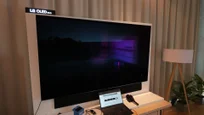
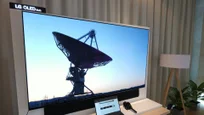
True magic happens, however, when vibrant, bright scenes appear on the screen (take a look at the picture next to it). At that moment, even on the shiny screen, reflections of the sun or the silhouettes of Paweł and Łukasz, who tested these televisions for you on site, become practically invisible.
So – is there progress? Definitely yes. Is the LG coating as effective at "killing" reflections as Samsung's matte? Here, the road is still long, because we cannot cheat physics – matte will always win against gloss in terms of light scattering. However, there is one powerful argument for the LG solution: colour saturation and depth of black. The shiny G6 screen maintains that characteristic, juicy "pop" that matte screens sometimes lose in very bright conditions. The choice thus comes down to a simple question: OLED without reflections or uncompromising colours?
Is the LG G6 an (almost) ideal OLED?
Looking at the overall changes in the G6 model, it is hard to shake the impression that LG has finally stopped chasing "empty" numbers in tables and has started to realistically address the problems that have irritated users for years. The combination of Tandem OLED 2nd generation display with the new Alpha 11 processor is a duo that promises not only a record brightness of 2800 nits but, above all, a picture quality that has been difficult to achieve in WOLED technology until now. Solving the problem of posterisation and the 13-bit brightness processing is a significantly more important piece of news than those additional 10% of power. Added to this is an effective (albeit still glossy) anti-reflective coating and a proven 5-year protection package for the panel, resulting in a product that looks complete on paper.
Of course, at this moment we are operating on pre-release data and what we have managed to squeeze out of the demonstration units. We can’t wait for the LG G6 to arrive at our lab for full testing, where we will rigorously examine it with professional equipment and assess the final software.
Now, the key question remains one: P R I C E. That will determine whether the G6 will be the undisputed king of value in the premium segment of 2026. LG has set the bar high, and the competition will have a tough nut to crack.