 Direct comparison
Philips PUS9010 (The One 2025) in the 75-inch version with an IPS panel is a TV that clearly shows the differences arising from the panel used. Compared to the VA panel variant, it offers significantly better viewing angles, very good compatibility with consoles, and excellent text readability, but at the same time, it loses out on black levels and maximum brightness. This model is best suited for everyday use, gaming, and in larger living rooms where not everyone is sitting perfectly in front of the screen. The TV performs very well in terms of responsiveness and features for gamers, offering 144 Hz, low input lag, and full support for variable refresh rates. An additional advantage remains Ambilight, which, especially in the evening, can enhance the viewing experience and partly mask the weaker black levels of the IPS panel. After calibration, the picture appears consistent and natural, and the differences compared to the VA version in color reproduction become hard to detect. On the other hand, it must be stated clearly that those focused on cinematic sessions in complete darkness may be disappointed. The poor black levels and boosted brightness due to the quality of our unit means that this variant of the PUS9060 performs worse than the same model with a VA panel. Philips PUS9010 IPS is generally a sensible choice for users looking for a large, modern TV for gaming, PC, and everyday watching with very good viewing angles. However, if deep blacks and better picture quality are a priority, it’s worth considering other variants or a higher class of equipment, as often for a small extra charge, you can get a TV equipped with mini-LED technology.
- Matching (Score) |
- Our verdict |
- TV appearance |
- Where to buy |
- Contrast and black detail |
- HDR effect quality |
- Factory color reproduction |
- Color reproduction after calibration |
- Smoothness of tonal transitions |
- Image scaling and smoothness of tonal transitions |
- Blur and motion smoothness |
- Console compatibility and gaming features |
- Input lag |
- Compatibility with PC |
- Viewing angles |
- Daytime performance |
- Panel details |
- TV features |
- Apps |
- Playing files from USB |
- Sound
The One 2025 / PUS9060 / PUS9010 / PUS9000

PQS9011 / PQS9001 / the one 2026
Available screen sizes: 75”
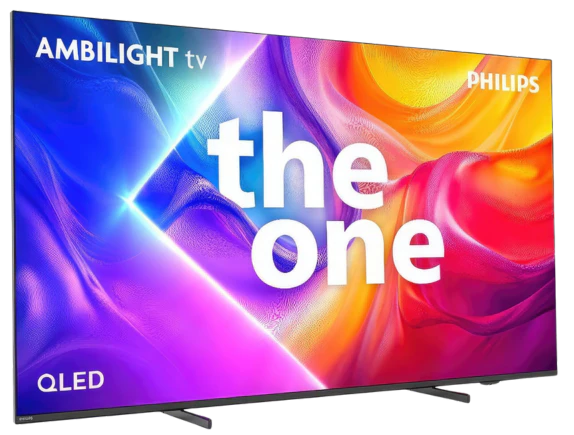
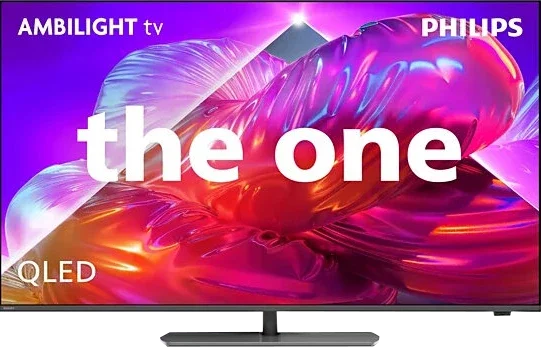
Panel type: LCD IPS
Resolution: 3840x2160
System: Titan OS
Model year: 2025
Complete the survey to find out the result
Panel type: LCD VA
Resolution: 3840x2160
System: Titan OS
Model year: 2026
Complete the survey to find out the result
Overall rating
6.5
6.8
 Movies and series in UHD quality
5.9
6.4
 Classic TV, YouTube
5.6
6.3
 Sports broadcasts (TV and apps)
6.7
6.8
 Gaming on console
8.1
7.4
 TV as a computer monitor
8.9
8.6
 Watching in bright light
5.4
6.1
 Utility functions
6.1
7.6
 Apps
6.7
7.2
 Sound quality
6.6
6.9
Complete the survey to find out what fits your preferences
Advantages

Very good viewing angles thanks to the IPS panel
Great PC compatibility, 144 Hz mode, proper support for G-Sync and FreeSync
Wide range of features for gamers, variable refresh rate, automatic gaming mode, HGiG
Support for multiple HDR formats including HDR10+ and Dolby Vision
Support for Dolby Atmos
Low input lag
Effective P5 image processor for lower quality content
Ambilight system
Backlit remote
Ambilight, which gives evening viewing sessions a unique ambience and improves the perceived native contrast of the VA panel
Excellent panel response time: minimal motion blur of moving objects
Many features for gamers: four HDMI 2.1 ports, VRR, ALLM, HGiG
144 Hz refresh at 4K and 240 Hz at Full HD from a PC
Good coverage of a wide colour gamut: PFS LED
Dolby Vision, which genuinely helps the TV with HDR content
Decent brightness of around 500 nits, useful for daytime viewing
Rotating stand
Disadvantages

Poor blacks and contrast (typical for IPS panels)
Clearly lower brightness than in the VA panel variant
Visible backlight bleed at the edges of the screen in the tested unit
Limited number of applications in the Titan OS system
The remote is still infrared, requiring aiming at the screen
No local dimming: average blacks in the evening and a limited HDR effect
Smaller app library than the competition
Poor viewing angles (can be mitigated with a swivel stand)
Very high input lag in games with Dolby Vision
Significant errors in HDR colour reproduction (no CMS adjustment available)
IR remote that requires aiming
Our verdict
The idea behind The One series has remained practically unchanged for years, and with the Philips PQS9001 this is both an advantage and its biggest weakness. Once again, we get a versatile mid-range TV whose main distinguishing feature is Ambilight. The lighting that follows what is happening on the screen can completely change the atmosphere of an evening movie session, and for many people it will be the main reason to choose this TV. That is hardly surprising, because once you get used to the effect, it can be difficult to go back to watching without it. The picture quality itself is good, but we have already seen a very similar level from this series in previous years. The VA panel provides decent blacks, colours are nicely saturated, and the brightness is sufficient for comfortable viewing in a typical living room. It is a shame, however, that Philips did not take another step forward and introduce at least basic local dimming. In a dark room, blacks can look noticeably bluish, and HDR, while clearly visible, does not make as strong an impression as it could. After so many years of The One being on the market, we would have expected a little more progress here.
There has, however, been a noticeable improvement in Titan OS. Compared with last year, and especially with the version from two years ago, the system has become much more pleasant to use. There are more apps, many smaller functions have been improved, and a number of irritating bugs we previously complained about have been fixed. Overall, it works reasonably well, although we are once again frustrated by the remote control, which still requires you to point it directly at the TV. Philips continues to rely on infrared for regular navigation, even though voice control uses a wireless connection. That makes it even harder to understand why the same connection was not used for navigating the menus. The One also has quite a lot to offer gamers. Four HDMI 2.1 ports and a broad set of gaming features are one thing, but what impressed us most was the panel’s response time. Our unit showed practically no visible smearing, even on dark backgrounds, which is quite rare for an LCD TV with a VA panel. Philips deserves a lot of credit for that. The ability to play at 4K 144 Hz or Full HD 240 Hz also makes the TV an interesting option for PC users. Unfortunately, there is still one unfinished element: using Dolby Vision in games on Xbox results in very high input lag.
The PQS9000 therefore leaves us with mixed feelings. It can surprise with excellent motion handling and shows that Philips has clearly worked on its operating system, but we do not see a similar step forward in picture quality. This is a TV we can recommend primarily to fans of Ambilight. If that lighting system is the main reason you are considering a Philips, then buying The One makes a lot of sense. It is still worth checking, however, whether you can find a Mini LED model with good local dimming at a similar price. Such a TV may offer deeper blacks and more impressive HDR performance. In the end, the choice comes down to what matters more to you: the atmosphere created by Ambilight or better picture quality itself.
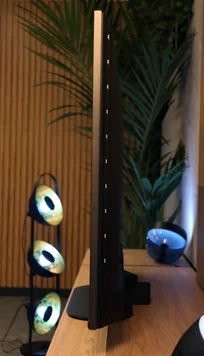
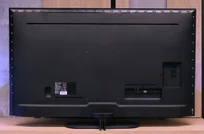
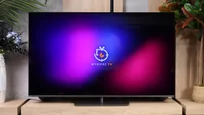
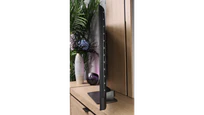
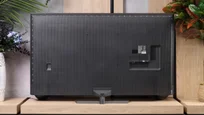
TV appearance



Contrast and black detail
2.9/10
5.8/10
Local dimming function: No
Local dimming function: No
Contrast:


Result
1,300:1

Result
1,400:1

Result
1,450:1

Result
1,500:1

Result
1,350:1
Result
5,500:1
Result
3,950:1
Result
5,600:1
Result
5,750:1
Result
4,500:1
Halo effect and black detail visibility:
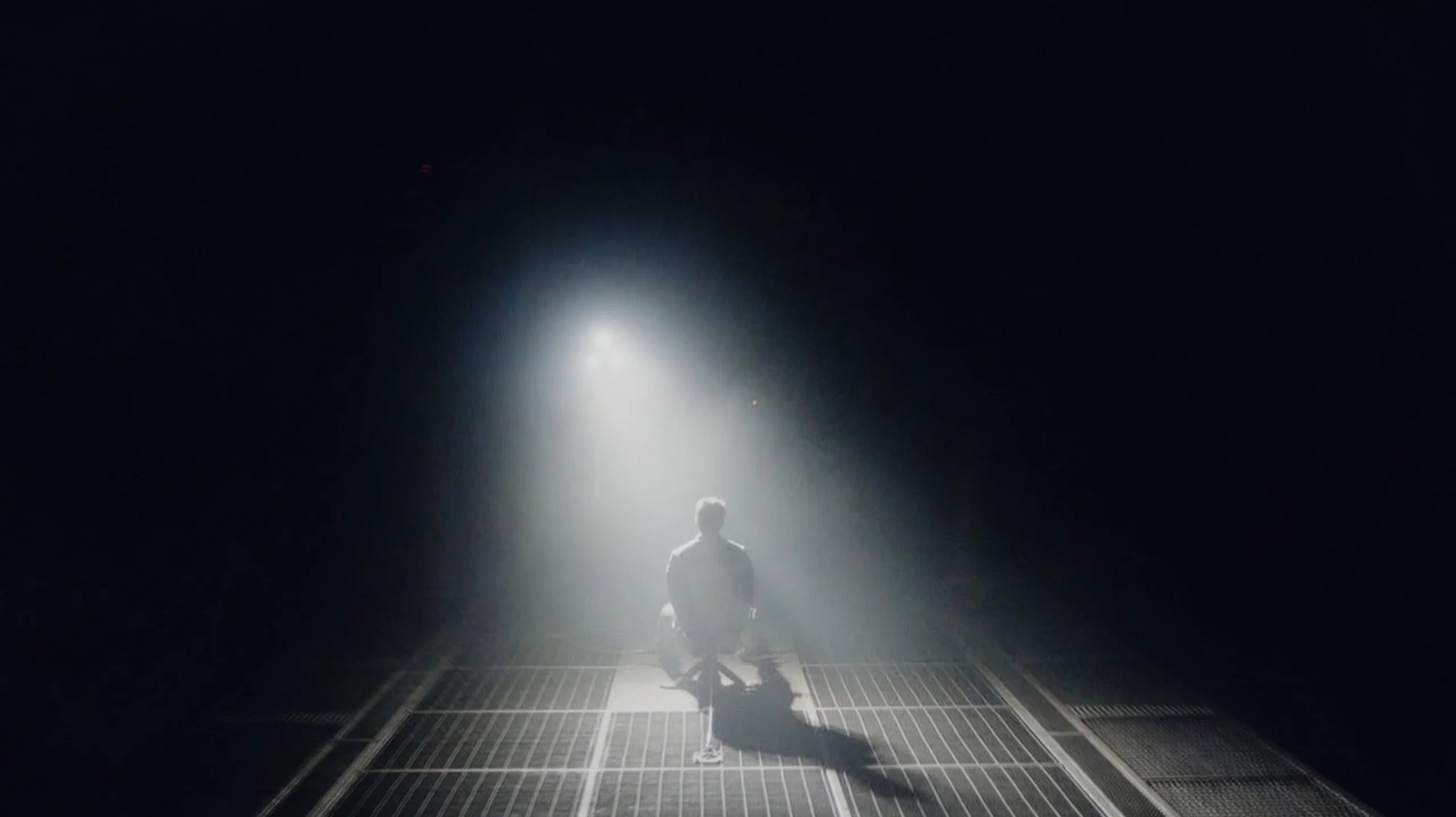
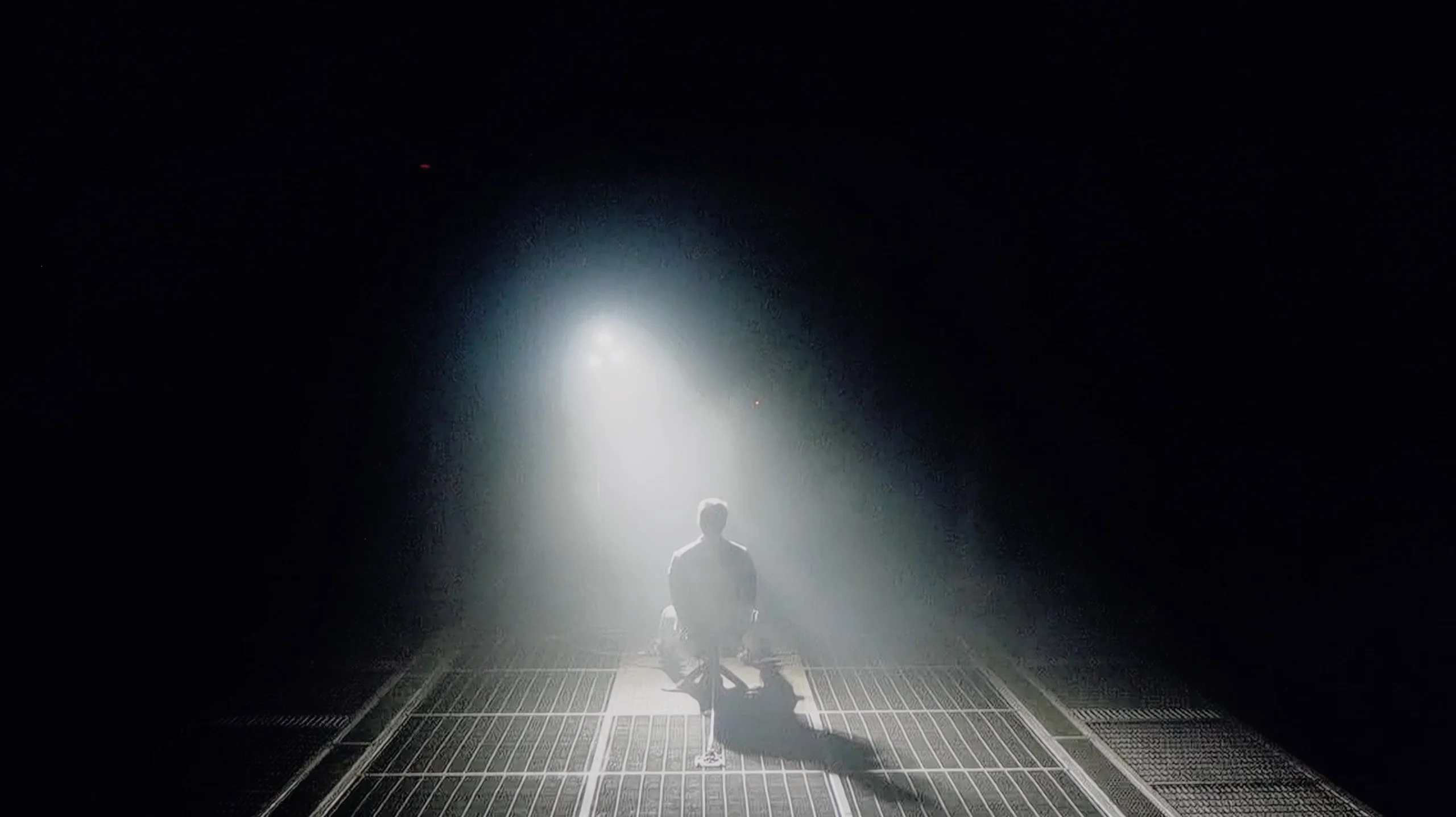
Check the visibility of bright lights on a dark background. Mini-LEDs often struggle with this. The photo does not compare black levels – that’s what the video below is for.
The video accurately shows differences in contrast and black levels between TVs, as well as potential issues: halo around bright objects or Mini-LED zone operation visible as brightness jumps.
In the 75-inch version of the Philips PUS9010 that we tested, an IPS panel has been used, which is immediately evident in the black levels and contrast category. Compared to the 55-inch variant with a VA panel that we tested earlier, the difference is noticeable right from the first screens. The black is shallower, and in a dark room, the display clearly falls into greys. The TV is not equipped with local dimming, so when the lights are out, dark scenes lose depth. In practice, the picture looks distinctly worse than in the smaller 55-inch variant, especially during movie viewings in the evening. The situation is somewhat salvaged by Ambilight. The rear lighting can subtly "deceive" the eye, enhancing the perceived contrast and making the black appear a bit deeper. It’s a simple trick, but it works. That’s why this model is definitely better watched with Ambilight turned on. It doesn’t have to be a multi-coloured mode tracking the image. Even a solid white backlight can improve the perception of dark scenes.
Black levels and contrast on the Philips PQS9000 are decent for an LCD TV without local dimming. That's mainly down to the VA panel — in our movie scenes contrast often exceeded 5000:1, and at weaker points fell to around 4000:1. That delivers an image with quite good depth and a clear advantage over typical IPS panels, where blacks much more easily look grey. Unfortunately, that's about as far as the panel's capabilities go. The TV has no local dimming, so it can't dim a dark background separately while keeping strong highlights in another part of the screen. All it has is global dimming, which brightens or dims the whole backlight at once. In a completely dark room those limitations become visible: blacks take on a dark navy tint, and shadowy scenes lack the depth of a good screen with zoned local dimming. Thankfully Ambilight helps here. The light on the wall makes on-screen blacks appear deeper and helps mask the panel's glow a little. It doesn't change the TV's actual contrast, but it affects how our eyes perceive it. In this case Ambilight is therefore not just decorative, because it can also make evening viewing more pleasant.
HDR effect quality
5.2/10
5.5/10
Luminance measurements in HDR:

Result
374 nit

Result
383 nit

Result
397 nit

Result
391 nit

Result
401 nit
Result
449 nit
Result
467 nit
Result
487 nit
Result
486 nit
Result
507 nit
Scene from the movie “Pan” (about 2800 nits)


Scene from the movie “Billy Lynn” (about 1100 nits)


The photos show two HDR10 movies. 'Pan' is one of the brightest productions ever made, while 'Billy Lynn' (soldier) has brightness typical of streaming (Netflix, Prime, HBO MAX). Notice the intensity of effects and detail in whites.
Static HDR10


The photos present the visibility of white details in various HDR formats. They do not show brightness differences between TVs (these can be compared in the previous gallery).
Dynamic: Dolby Vision
Dynamic: Dolby Vision


The photos present the visibility of white details in various HDR formats. They do not show brightness differences between TVs (these can be compared in the previous gallery).
HDR luminance chart:
Philips PQS9011 / PQS9001 (The One 2026)
PHILIPS PUS9010 (IPS)
In the Philips PUS9010 version with an IPS panel, the HDR brightness sadly performs worse than in the previously tested 55-inch variant with a VA panel. The difference reaches about 100 nits, which is noticeably significant given the relatively low values. While the VA version could exceed 500 nits, here the maximum brightness reaches around 400 nits. This level still allows for watching movies and series in HDR, especially on streaming platforms, but the effects are clearly more subdued. Bright elements don't have the same impact, and scenes requiring high luminance are less impressive. On the plus side, the coverage of the DCI-P3 colour gamut is commendable. The IPS version offers about 91%, which is roughly 5% more than the variant with a VA panel. This translates into slightly better colour saturation in HDR content, despite the lower brightness. Colours can appear more vivid and cohesive, especially in colourful scenes.
The Philips PQS9000 is a moderately bright TV — in our HDR scenes it reached roughly 450 to just over 500 nits. That’s enough to notice a difference compared with SDR. Sun reflections, lamps or flares have a bit more punch than on basic TVs, whose brightness often tops out around 300 nits. It’s not, however, a level where bright elements look especially striking. The biggest limitation remains contrast. Without local dimming, brightening a bright object also lifts the black level around it. So there’s no clear separation between strong highlights and a dark background, and it’s that kind of pairing that really shows what HDR can do. The PQS9000 offers more than the cheapest models, but despite decent brightness the effect remains fairly basic.
Colours
Philips deserves praise for the colours. Although the manufacturer markets this model as QLED, it actually uses a PFS phosphor instead of quantum dots. The solution itself doesn’t prevent good results. On test patterns and in measurements of film scenes we recorded about 94% DCI-P3 coverage and 75% BT.2020. For this class of TV that’s really good. In practice this means the vast majority of colours used in HDR films and series will have appropriate saturation. Lush greens or intense reds aren’t a problem and add appeal to the picture. Limitations are easier to notice in some games and rarer content that use the most saturated shades of the wide BT.2020 gamut. In those situations, displays with wider colour coverage, such as SQD or RGB LED, can show more. At its price point the PQS9000 has nothing to be ashamed of.
Factory color reproduction
5.9/10
5.1/10


This gallery shows how colors change after professional TV calibration. If you notice the difference, we recommend ordering this service at SkalibrujTV.com.
Factory Mode
After calibration
We evaluated colour reproduction, as always, on factory settings, focusing on the movie mode, which in the case of Philips usually offers the best starting point. This is also a good moment to show how much the same model of TV can vary depending on the panel used. Looking at the white balance, the overall tendency remains similar to the version with the VA panel. There is still excessive red in the whites, however, in the tested unit with the IPS panel, there are also losses in the blue channel. As a result, the picture has a slightly different colour character, which is well illustrated in the comparative materials. This is a very good example showing why ready-made settings downloaded from the internet do not always work even within the same model.
However, returning to the assessment itself, this unit performs quite well, especially in SDR content. Colour tests show correct saturation and colour consistency, without glaring errors that could hinder everyday viewing. In HDR materials, it is possible to notice slight losses in reds, but these are not flaws that completely spoil the image perception. The biggest limitations do not stem directly from the colours, but rather from the whites and blacks. The use of an IPS panel and slightly lowered gamma means that the image is slightly boosted in brightness, and weak blacks further affect perceived contrast. This makes everything look brighter, but at the same time, it lacks depth, especially during evening viewing.
The factory picture settings for Movie mode on the PQS9000 unfortunately need tweaking. In SDR the biggest problem is an excess of red in the white balance, which makes whites, greys and skin tones too warm, in places even slightly pink. Gamma runs below the reference across most of the range. The TV therefore brightens midtones and highlights, making the image look flatter than it should.
In HDR the white balance itself performs significantly better. Apart from minor deviations the components sit close together, so there isn’t the same obvious tint as in SDR. The EOTF curve, however, shows a slight brightening of parts of the image, and the biggest issue appears when measuring the wide colour gamut. Many shades deviate substantially from the target, with errors reaching ΔE 8–9. The good gamut coverage we praised earlier therefore doesn’t mean the TV hits specific colours accurately. It can display a wide range of colours, but out of the box it doesn’t use that range very precisely.
Color reproduction after calibration
8/10
7.7/10


The photos show how movies look on the TV. Pay attention to black detail visibility, colors, and shadow tint.


The photos show how movies look on the TV. Pay attention to black detail visibility, colors, and shadow tint.
After calibration, the picture has been brought to a really reasonable level. The whole thing looks cohesive and natural, and when it comes to colour reproduction, it's hard to definitively say whether we're dealing with a VA or IPS panel. This is a good sign, showing that the television has a solid foundation for further adjustments. The larger colour gamut in this variant is a plus, as it can subtly enhance the depiction of colourful scenes, especially in HDR content. However, this advantage is largely offset by the boosted blacks resulting from the use of an IPS panel. The limited depth of black affects perceived contrast, particularly when watching in a dark room. As a result, despite noticeable improvement post-calibration, the final rating remains the same as that of the variant with a VA panel. Better colours are not able to fully compensate for the weaker blacks.
Calibration brought a big improvement, especially with SDR content. We managed to even out the white balance and remove the earlier colour cast, and the Color Checker measurements now look very good. Colours are much closer to what they should be on screen, so with regular TV or SDR movies we can be happy with the result. Unfortunately HDR spoils that a bit. On the one hand it's limited by the panel itself, because calibration won't improve contrast or replace local dimming. On the other hand there are colour errors we couldn't correct because the CMS settings, i.e. colour management, were greyed out and inactive. That loses Philips points with us. The white balance can be fine-tuned, but without access to wide gamut controls you can't as effectively sort out colours in HDR. It's a shame, because the SDR results show the potential is there, but we weren't allowed to fully make use of it everywhere.
Smoothness of tonal transitions
8.5/10
8.6/10
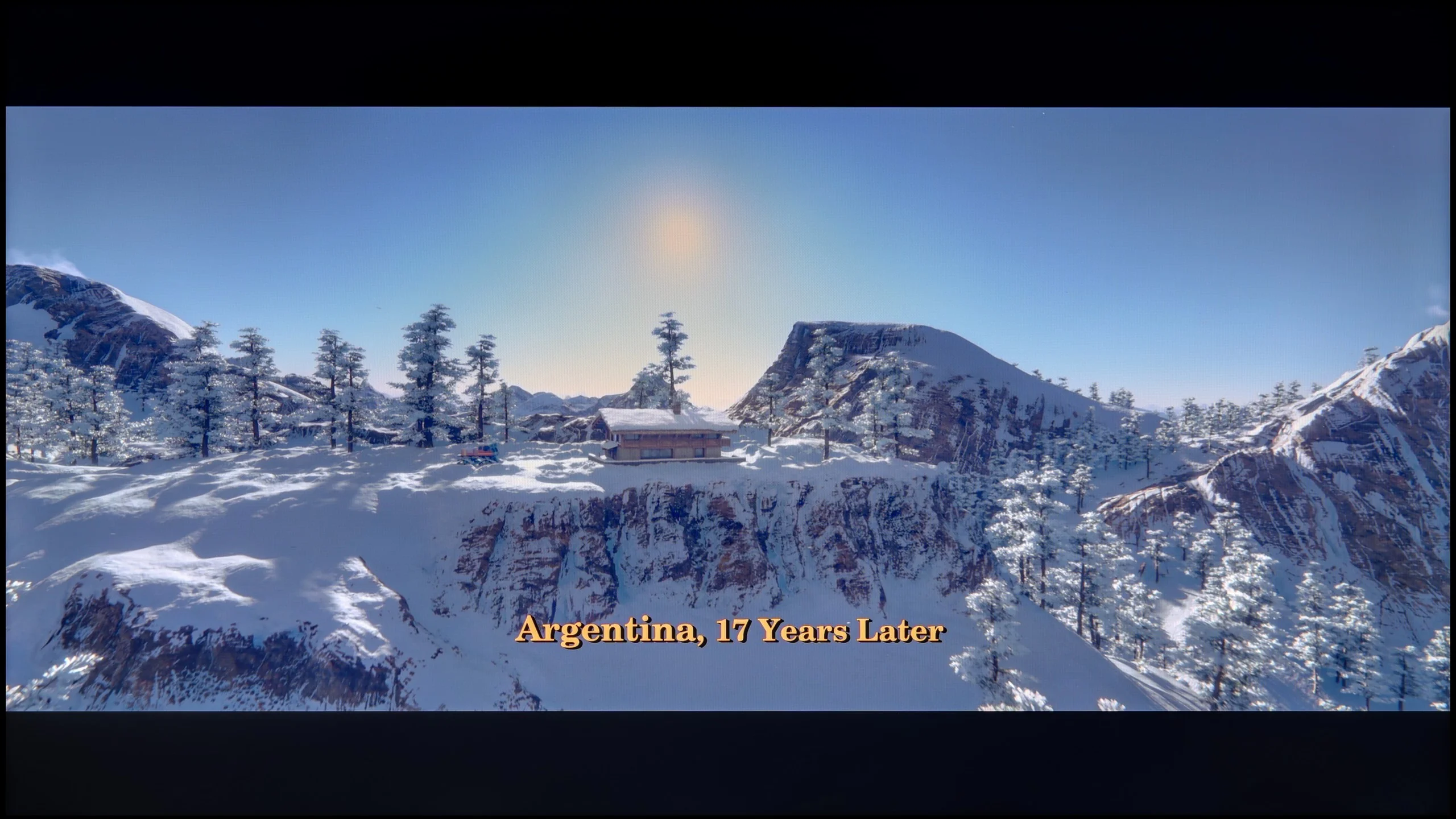




These are selected scenes that show smooth tonal transitions from one color to another. If you see distinct banding, it’s the TV panel’s fault.

These are selected scenes that show smooth tonal transitions from one color to another. If you see distinct banding, it’s the TV panel’s fault.

These are selected scenes that show smooth tonal transitions from one color to another. If you see distinct banding, it’s the TV panel’s fault.

These are selected scenes that show smooth tonal transitions from one color to another. If you see distinct banding, it’s the TV panel’s fault.
When it comes to the fluidity of tonal transitions, in the 75-inch version with an IPS panel, we have mixed feelings. Looking solely at the colour gradients, the transitions perform even better than in the variant with a VA panel. Colours blend more smoothly, and typical banding issues are less noticeable. However, the situation changes drastically in dark scenes. The tragic blacks characteristic of IPS severely mar the perception of tonal transitions in low brightness levels. The boosted blacks make it difficult to discern subtle colour shades, and the very unnatural glow from the panel further worsens the situation. In the tested unit, the backlight bleed was particularly noticeable at the edges, where light practically seeped through to the screen. This not only negatively impacts the perception of dark scenes but also significantly hinders a reliable assessment of the gradation itself.
Philips PQS9000 handles tonal transitions very well. It looks especially good in dark scenes, where shades blend smoothly into one another without visible banding or clear boundaries between colours. As a result, even on large, uniform areas the image looks smooth. Minor imperfections only appear in the brighter tones, but you have to look closely to notice them. During normal viewing they are unlikely to distract from the film. In this category, Philips performs really well.
Image scaling and smoothness of tonal transitions
6.7/10
7/10

Smooth transition function
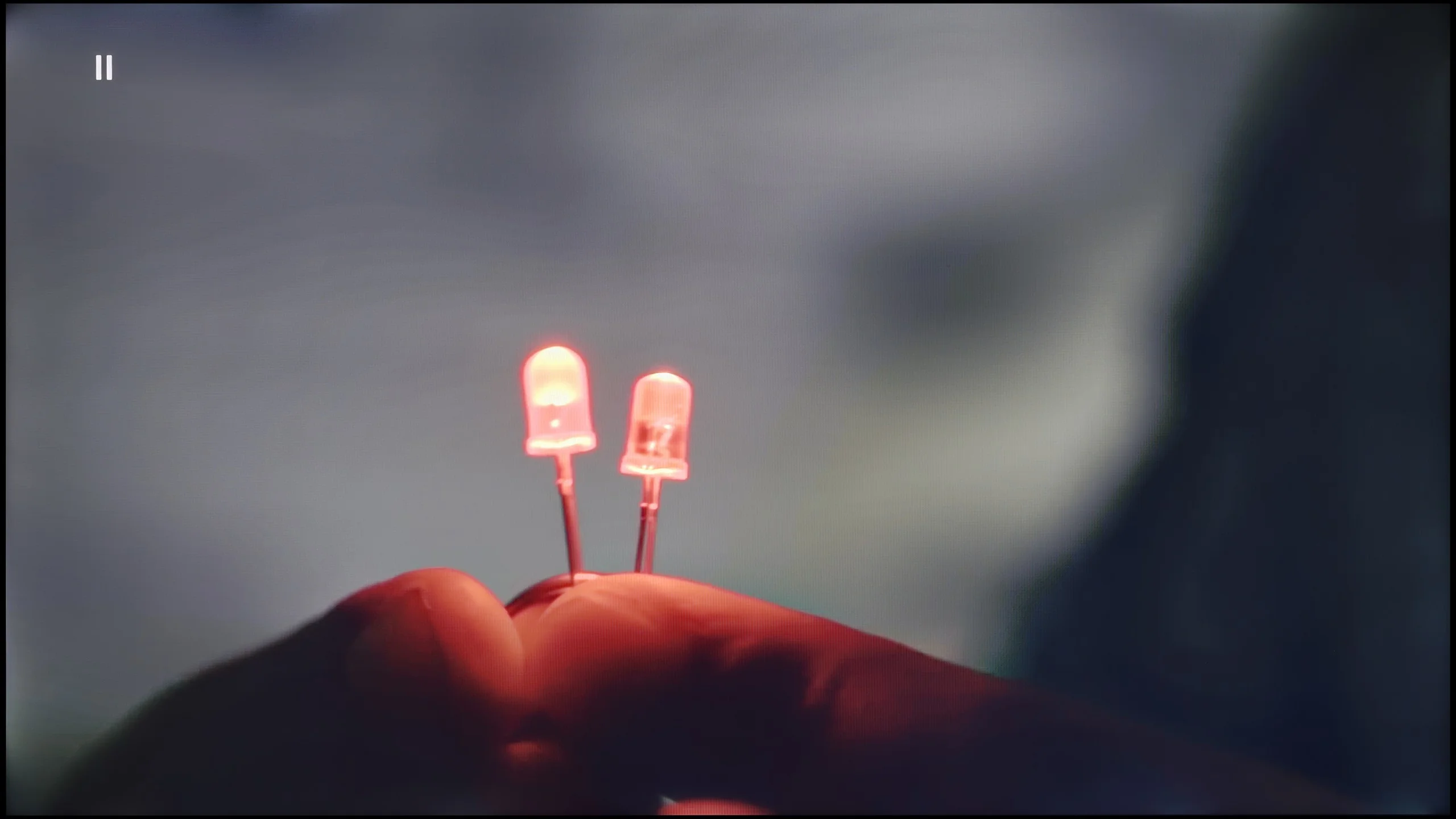
The match photo shows how the TV smooths weak tonal transitions in low-quality video.
Image scaling SD (576i)


The model photo shows how it handles upscaling of SD material.
In the Philips PUS9010, we find another iteration of the P5 Perfect Picture image processor, which aims to improve the quality of lower-grade materials. One of the components of this system is a distortion reduction function that smooths tonal transitions. It works effectively and actually reduces visible banding. Unfortunately, it does so quite aggressively. In practice, it can mute details such as material textures or film grain. This is a clear compromise, so we wouldn't particularly recommend it for movie sessions. For more casual content, like YouTube or regular television, it performs much better. The P5 processor also handles lower resolution materials quite well. The image is soft, at times even too soft, but it can easily be corrected using the sharpness slider, adjusting the effect to personal preferences. A positive aspect is also the absence of edge cropping in SD materials, which is still not standard in this class of televisions.
Digital image processing on the Philips PQS9000 performs well, although we have a few reservations. The "Distortion Reduction" function helps smooth tonal transitions in lower-quality sources, but it works rather unevenly. It can improve one part of the picture, only to, moments later and still within the same scene, lose its way and show banding between shades again. On the plus side, it doesn't strip away film grain or fine noise, so the image retains its texture. We found the "Medium" setting worked best and that's the one we recommend.
The upscaling to 4K itself is adequate, though the image is very soft. Edges are heavily smoothed, which may leave some viewers wanting more clarity. In that case, it's worth slightly increasing the sharpness in the TV menu, as this will help emphasise edges more. Don't overdo the sharpness slider, though, or you'll get artificial halos instead of an improvement.
Blur and motion smoothness
7.7/10
8.1/10
Blur (native resolution, maximum refresh rate):






Blur (4K@144Hz):



Blur (1080p@240Hz):



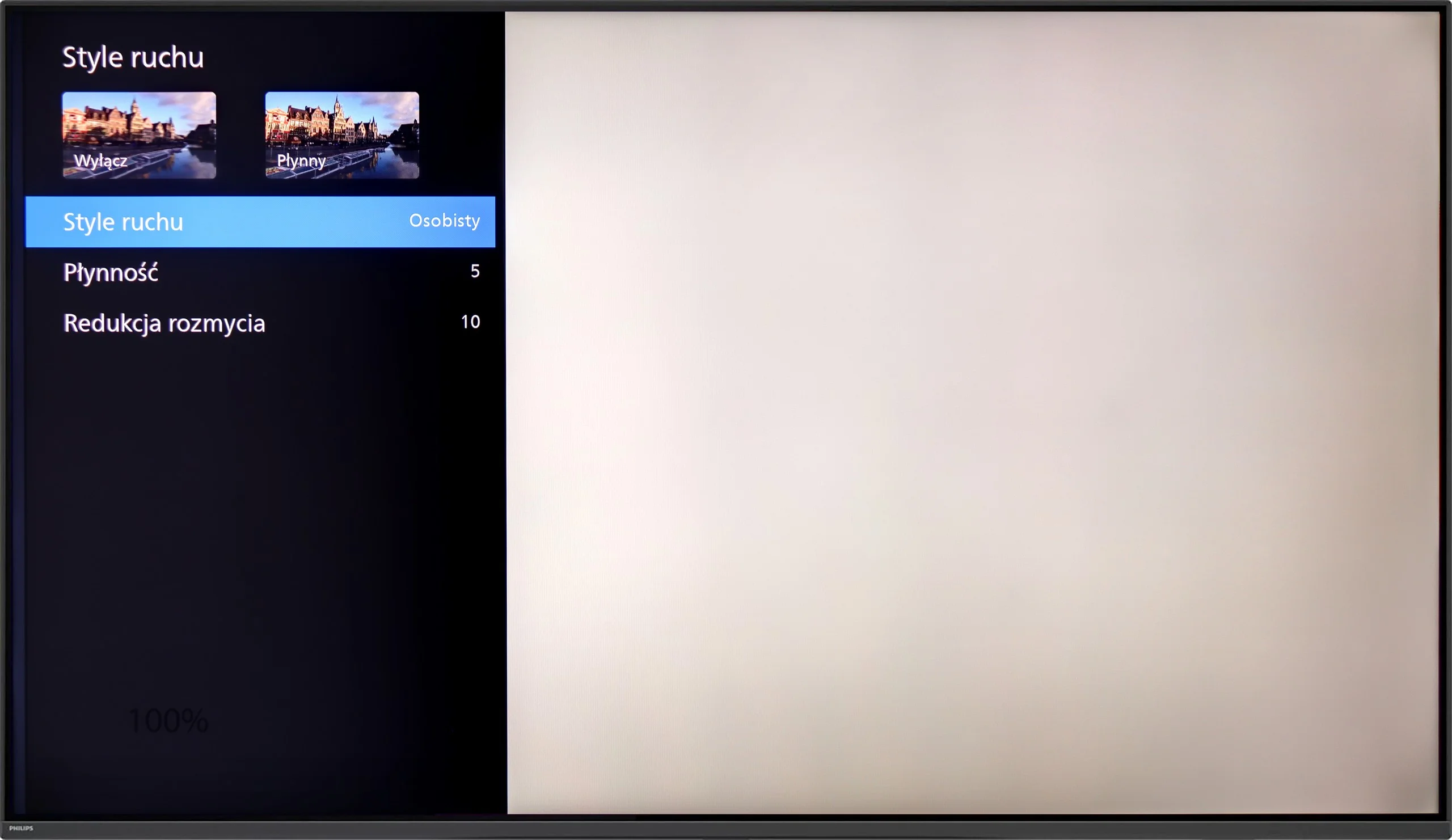
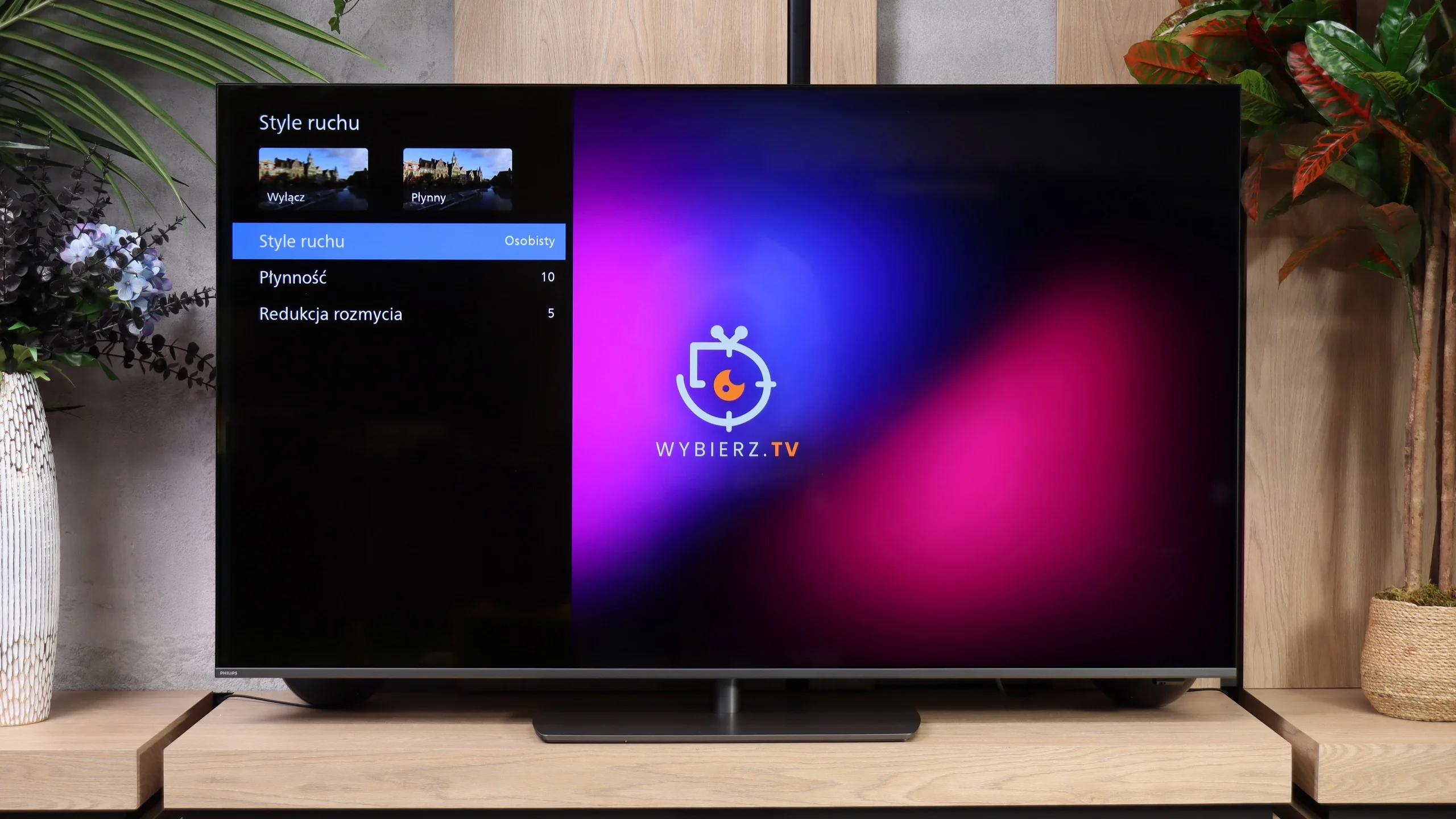
Philips PUS9010 has a 4K panel with a refresh rate of 144 Hz, which will be appreciated mainly by sports fans and gamers. This is especially noticeable in dynamic scenes where the motion is sharp, and annoying blur is almost non-existent. When it comes to movies (standard 24 fps), Philips offers us a proven set of settings known from its higher series. Two sliders are used to control motion. “Smoothness” allows you to adjust the picture to your liking: at low settings, it maintains a cinematic character, while moving the slider to the right gives us a perfectly smooth, albeit slightly “theatrical” effect. Meanwhile, “Motion Blur Reduction” is a feature designed for sports – it ensures that fast-moving objects do not lose detail and remain clear.
In terms of motion handling the Philips PQS9000 performs exceptionally well for an LCD TV. It's not just about the 144 Hz refresh rate, but above all how quickly the panel itself responds. At 120 Hz you can hardly see the typical trailing smears behind moving objects. What's particularly pleasing is that this also applies to darker backgrounds, where many VA panels clearly struggle. Here motion remains clear, and in this respect Philips has pleasantly surprised us.
The "Motion Styles" feature is used to adjust how motion is displayed. It includes two sliders: "Smoothness" and "Blur Reduction", allowing you to tailor the effect to the material you're watching and your personal preferences. Our suggested settings are shown in the photo. Treat them as a starting point and see which level of smoothing suits you best.
Console compatibility and gaming features
9.8/10
9.5/10
- ALLM
- VRR
- VRR range48 - 144Hz48 - 240Hz
- Dolby Vision Game Mode
 Yes, high input lag
- Correct implementation of HGIG
- 1080p@120Hz
- 1440p@120Hz
- 4K@120Hz
- Game bar
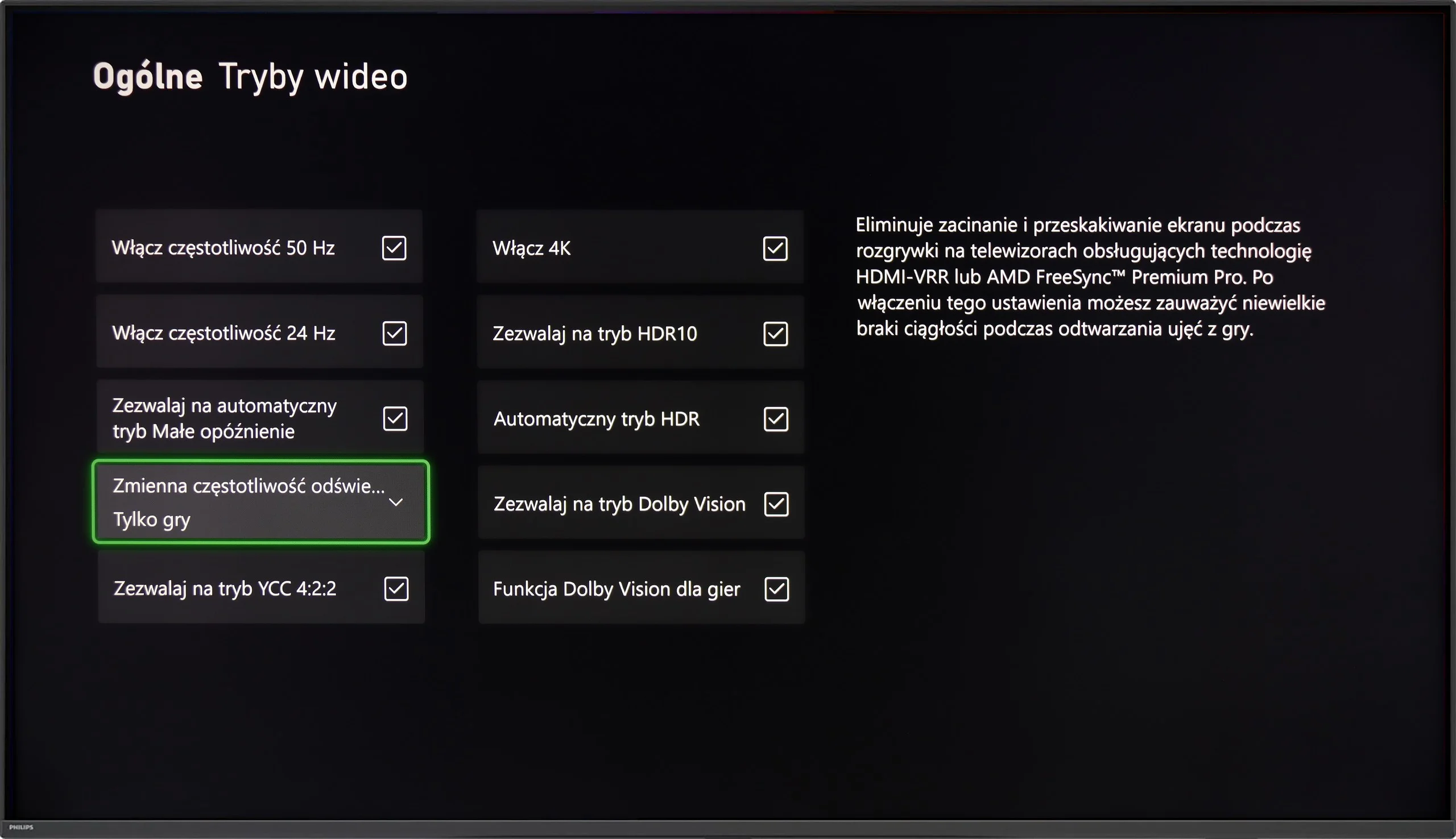
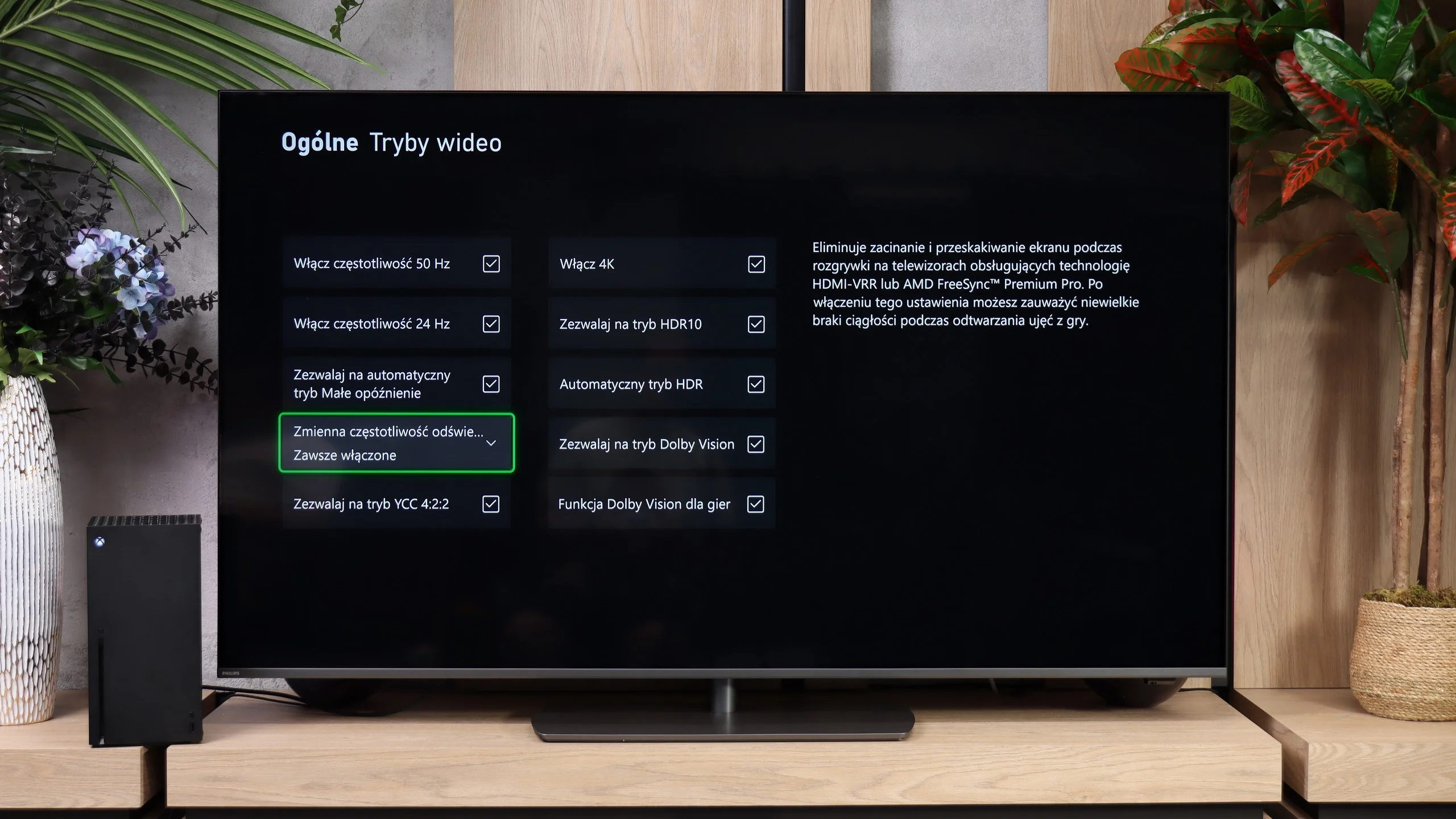
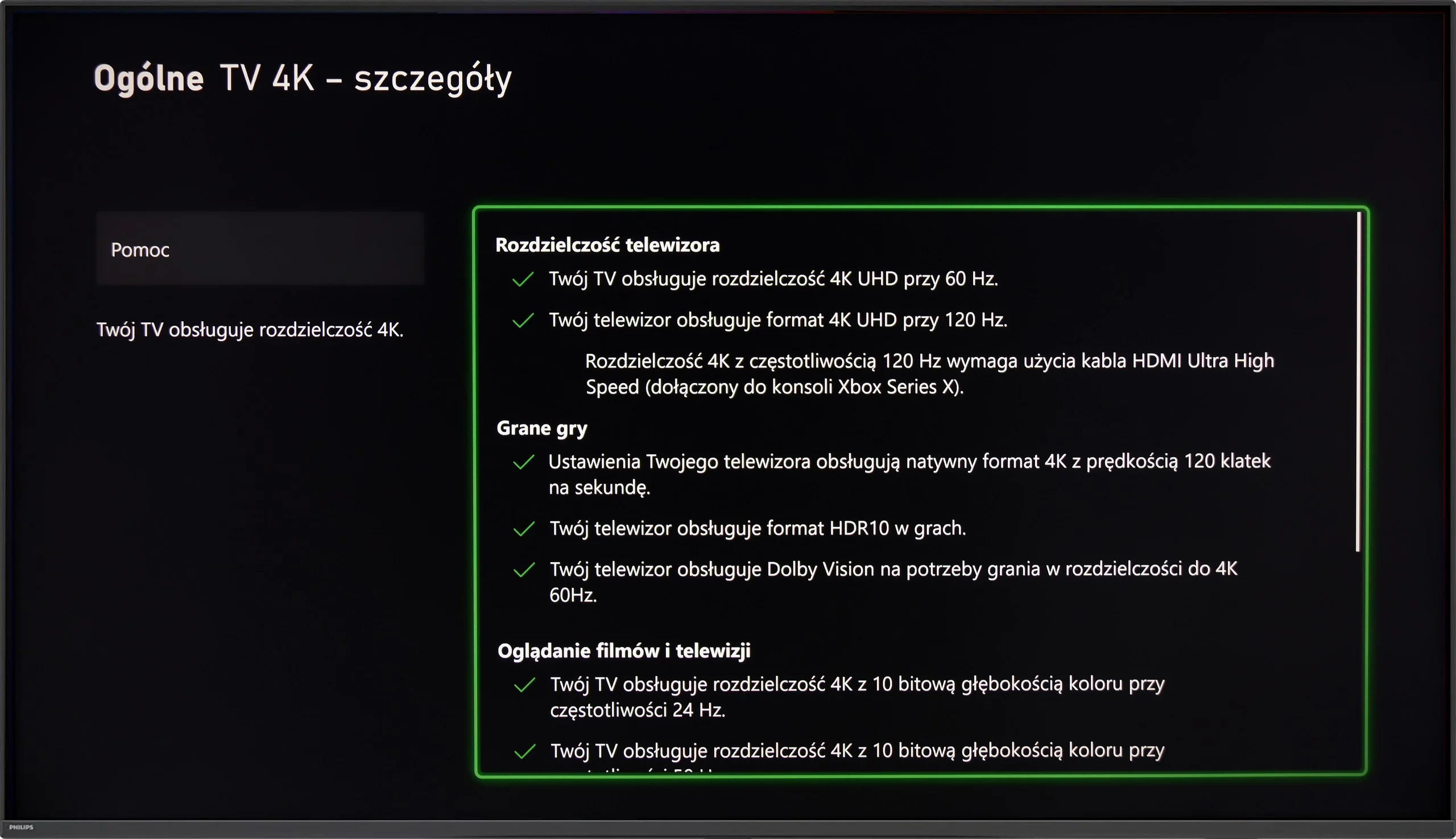
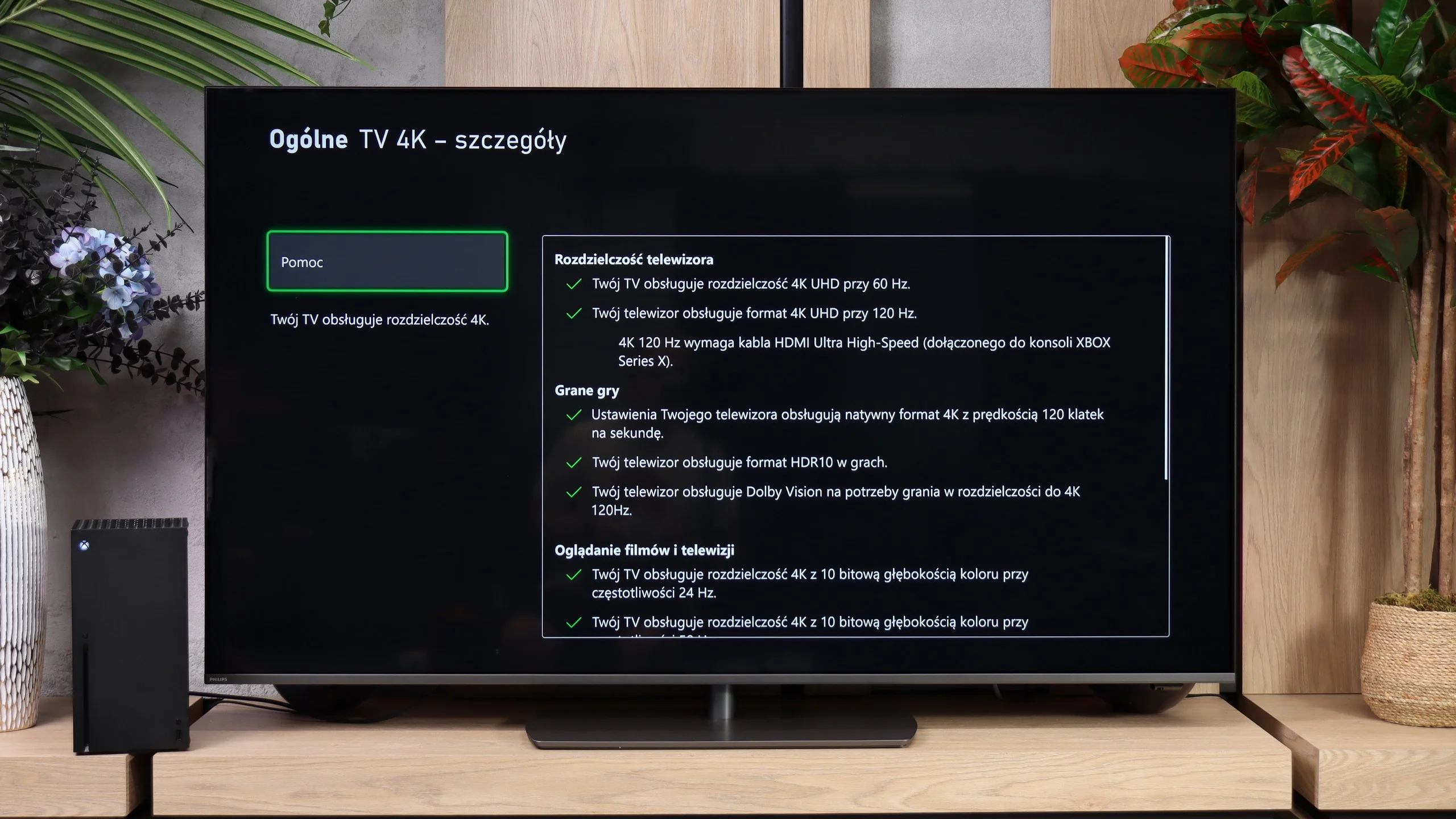
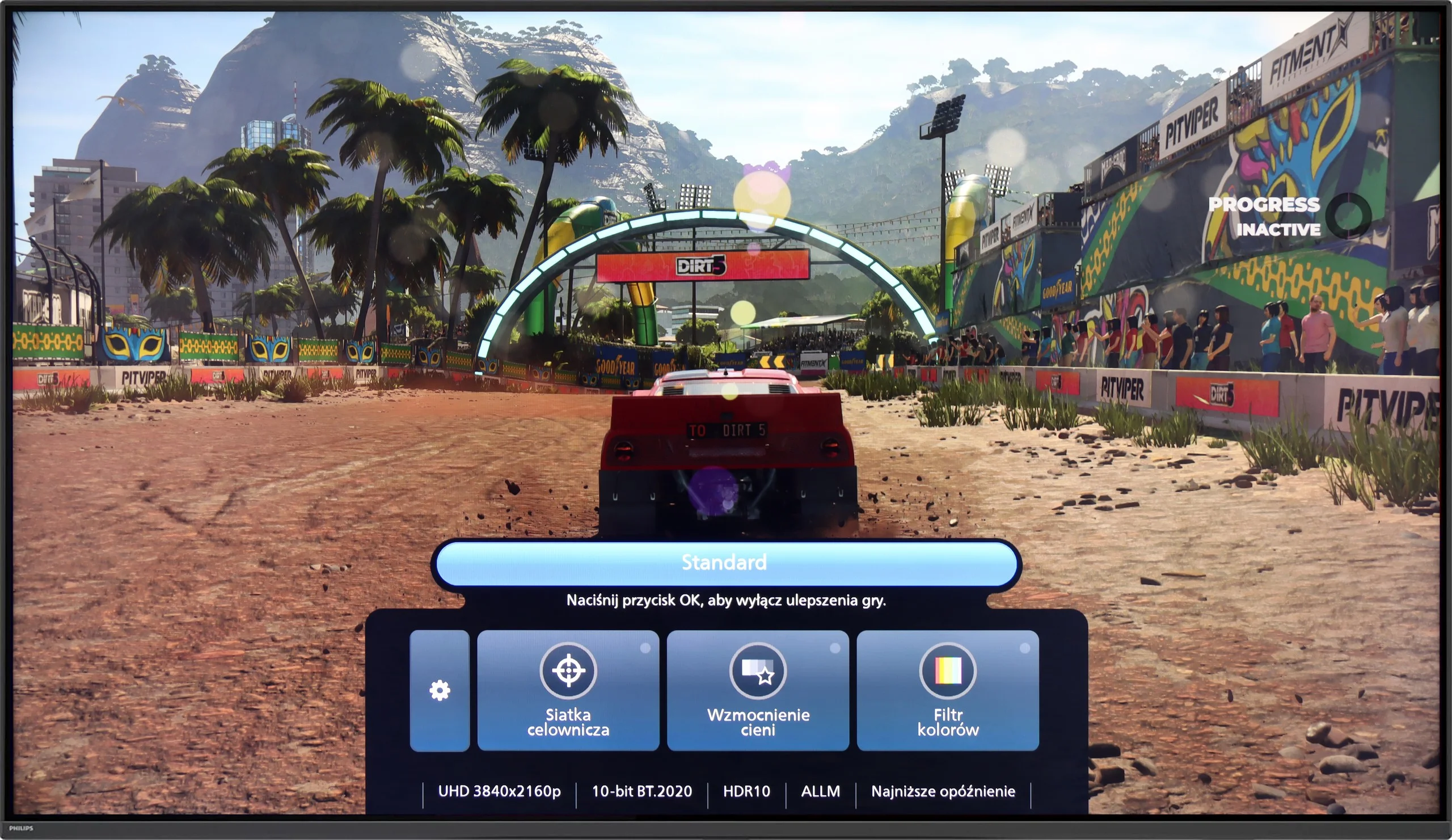
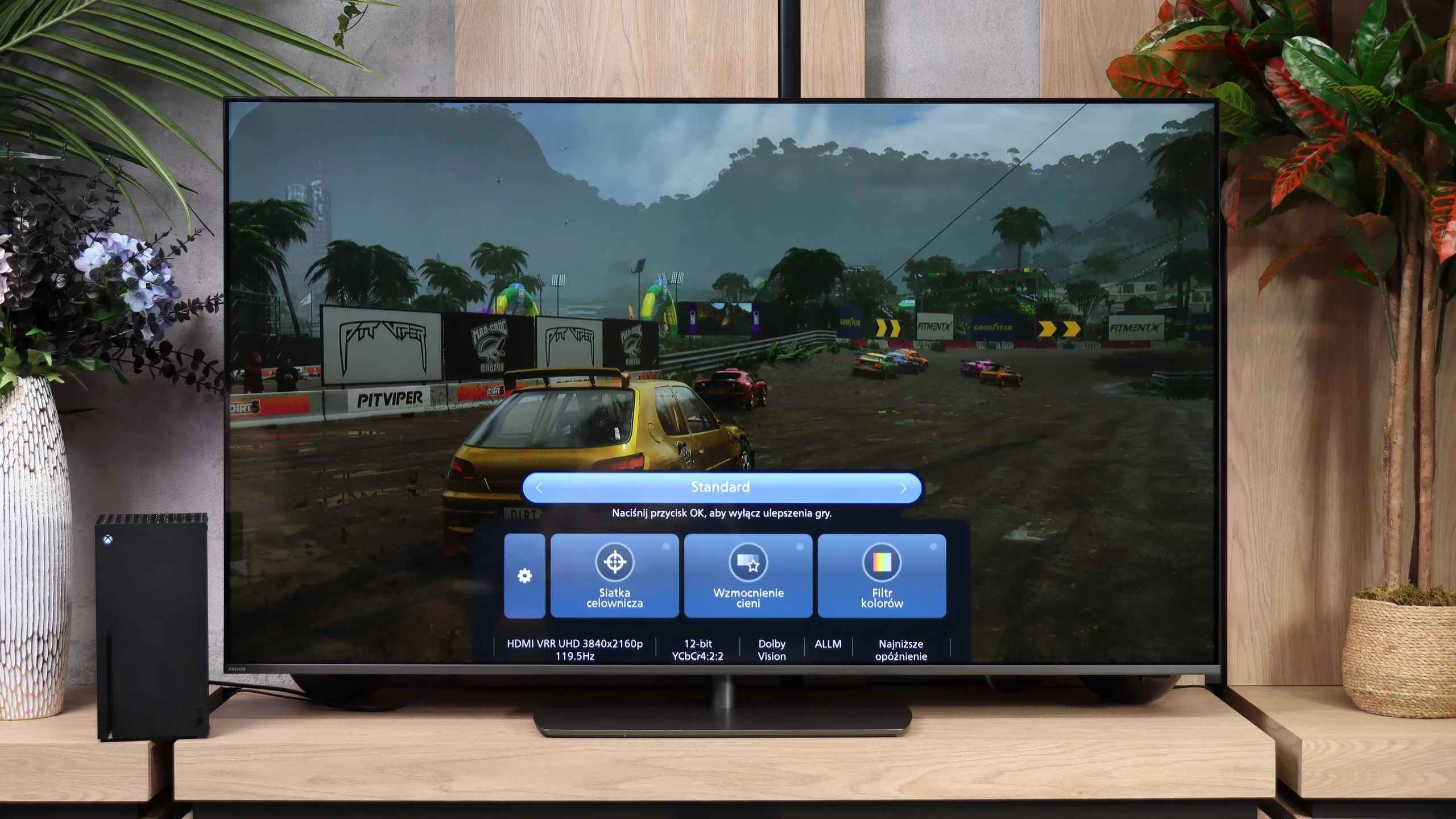
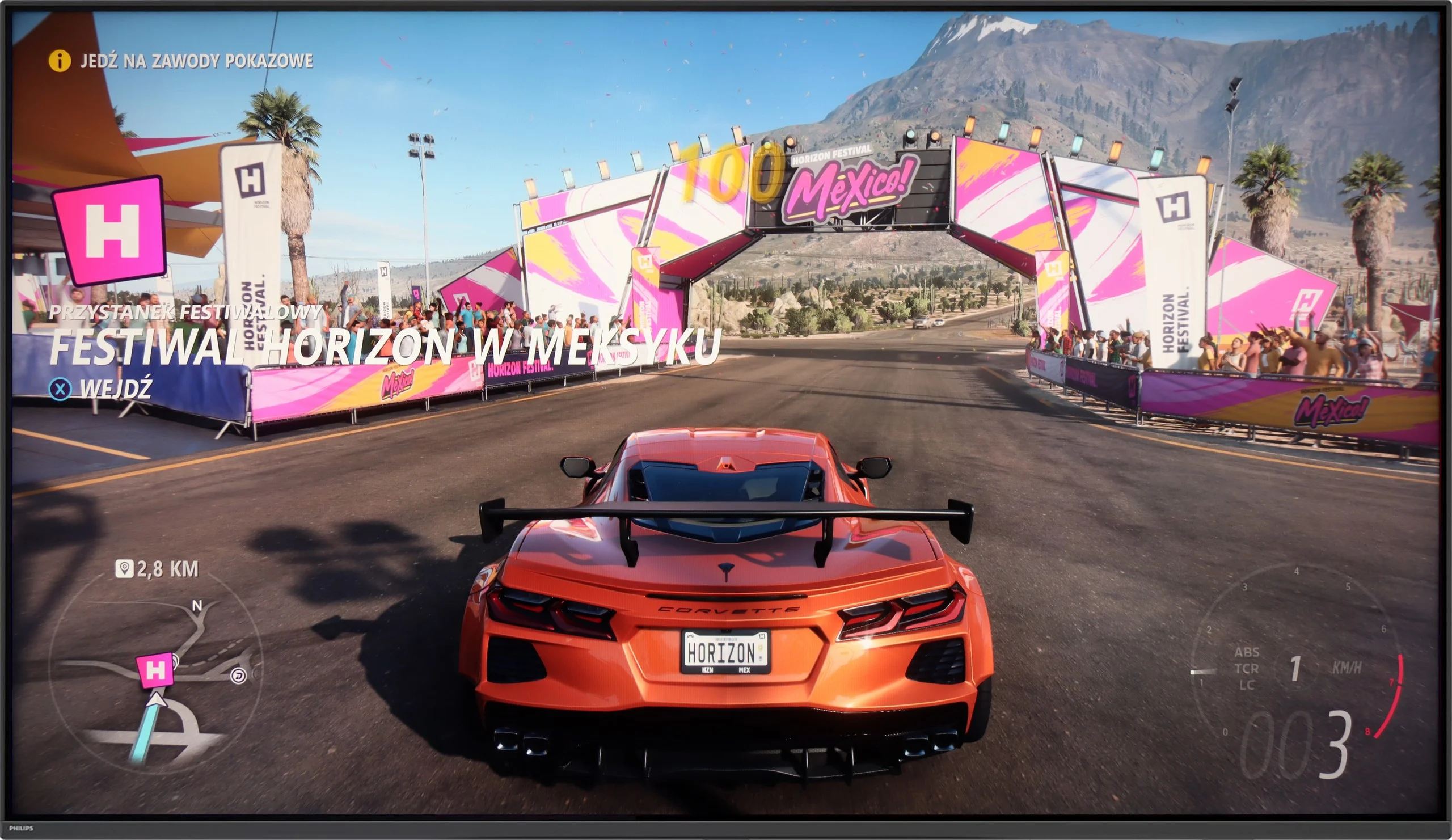
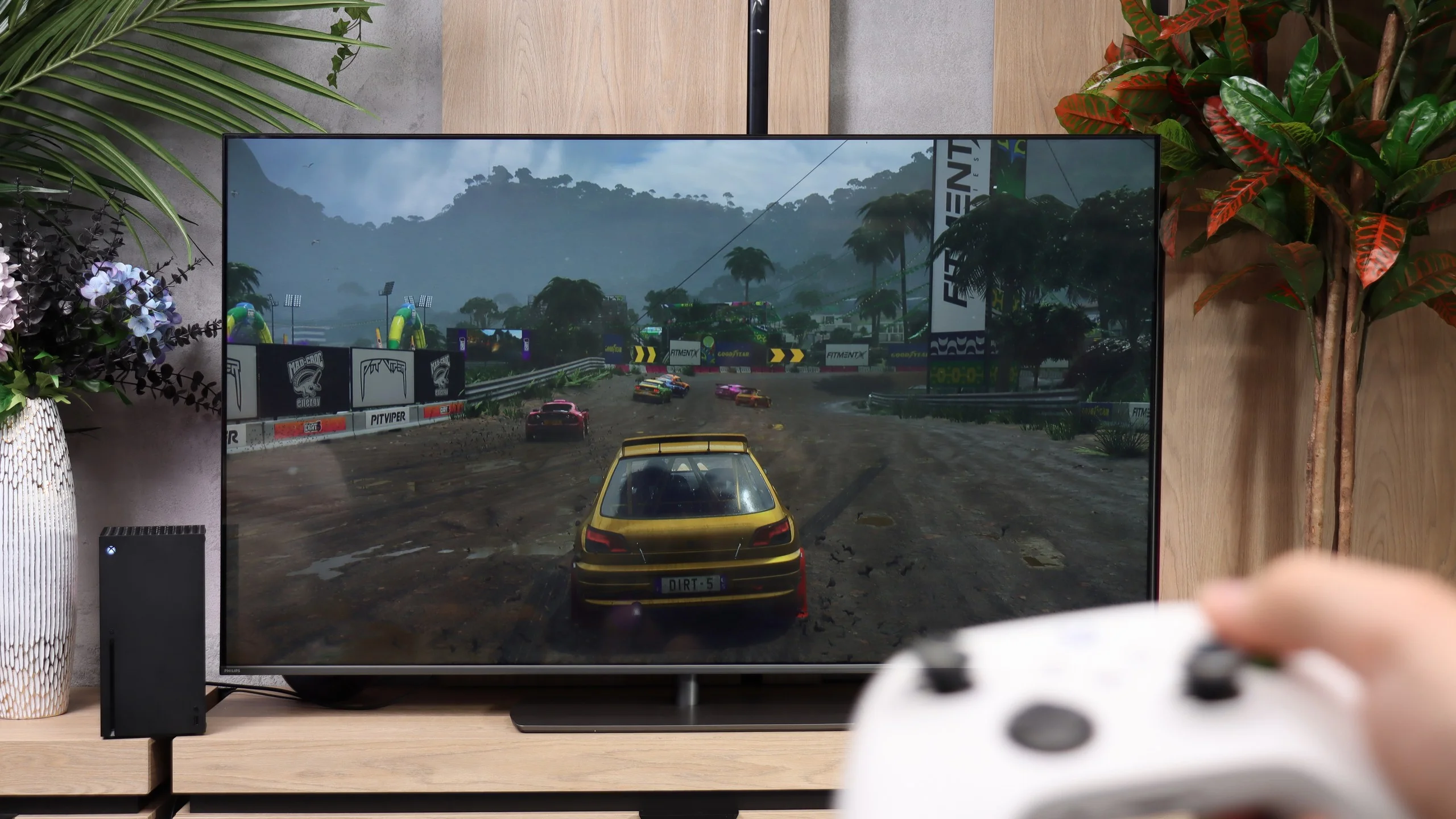
Philips PUS9010 is a solid machine for gaming. It has everything that’s important: VRR, automatic game mode (ALLM), and support for HGiG. The latter is fantastic – it allows you to set HDR in games exactly the way the developers envisioned. The TV handles 120 Hz refresh rates effortlessly at every popular resolution (1080p, 1440p, and 4K). It doesn’t matter if you connect a PS5, Xbox, or a powerful PC – everything runs smoothly and just as it should. Gamers will also appreciate the Game Bar. It’s a quick, clear menu where you can immediately see if the low latency mode is active. This is especially useful when frequently switching between different consoles. The whole experience is enhanced by Ambilight. Evening sessions with this backlighting create a whole different level of atmosphere; the image seems larger, and dynamic scenes are even more impressive. Even if someone isn’t a fan of such “gimmicks,” it’s hard to deny that it makes an impression.
Features for gamers
In terms of gaming features the Philips PQS9000 has a lot to offer. Four HDMI 2.1 ports let you connect multiple devices without having to choose which one gets the full capabilities. Consoles can use 120 Hz at Full HD, 1440p and 4K, and a PC can also run 144 Hz at 4K or 240 Hz if you drop to Full HD. There's also VRR, which matches the refresh rate to the frame rate and prevents screen tearing. Its range runs from 48 to 240 Hz, with the upper limit applying to Full HD mode.
It also includes ALLM, so the TV switches itself into game mode, and a properly working HGiG, which is handy when setting HDR on the console. There's a Game Bar for quick access to settings and signal information. The list even includes Dolby Vision gaming, but it's hard to enjoy because of very high input lag. Apart from that caveat, the feature set is really solid.
Input lag
9.5/10
7.2/10
SDR
HDR
Dolby Vision
In terms of responsiveness, the Philips PUS9010 performs very well. The input lag is around 9 ms at 120 Hz and 18 ms at 60 Hz, so the response to movement with the controller is quick and predictable. In practice, even dynamic action games or e-sports titles pose no issues. Dolby Vision in games is less impressive. The lag then increases to around 35 ms, which for less demanding players is still acceptable, but more sensitive individuals may feel a slight sluggishness in control. For this reason, HDR10 with HGiG enabled remains the better choice. In this model, it works correctly, providing lower lag and more predictable brightness behaviour, without the issues that can occur with Dolby Vision.
Input lag is less impressive than the rest of the gaming hardware. At 60 Hz we measured 32 ms, both in SDR and HDR. That's enough for more relaxed games, but in fast shooters you can already feel a slight lag. At 120 Hz the delay drops to 16 ms and gaming is noticeably more pleasant, though rivals can respond even faster. The biggest problem appears when Dolby Vision is enabled. At 60 Hz the delay is as much as 213 ms, and at 120 Hz it reaches 106 ms. The response to controller input is then clearly delayed, which seriously disrupts gameplay. So with the PQS9000 it's definitely better to stick with HDR10. Dolby Vision is supported in games, but its practical usefulness remains limited.
Compatibility with PC
8.9/10
8.6/10
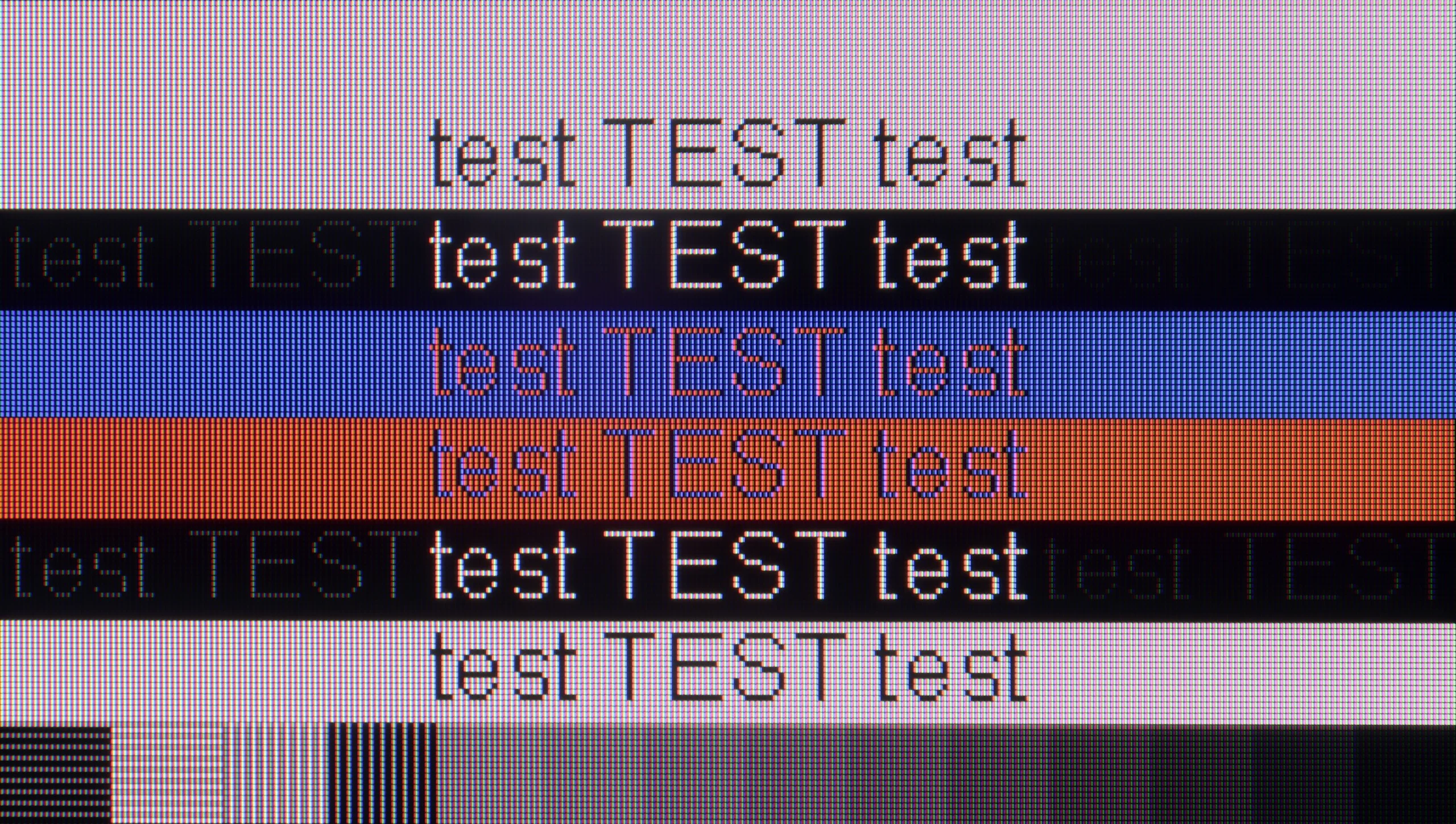
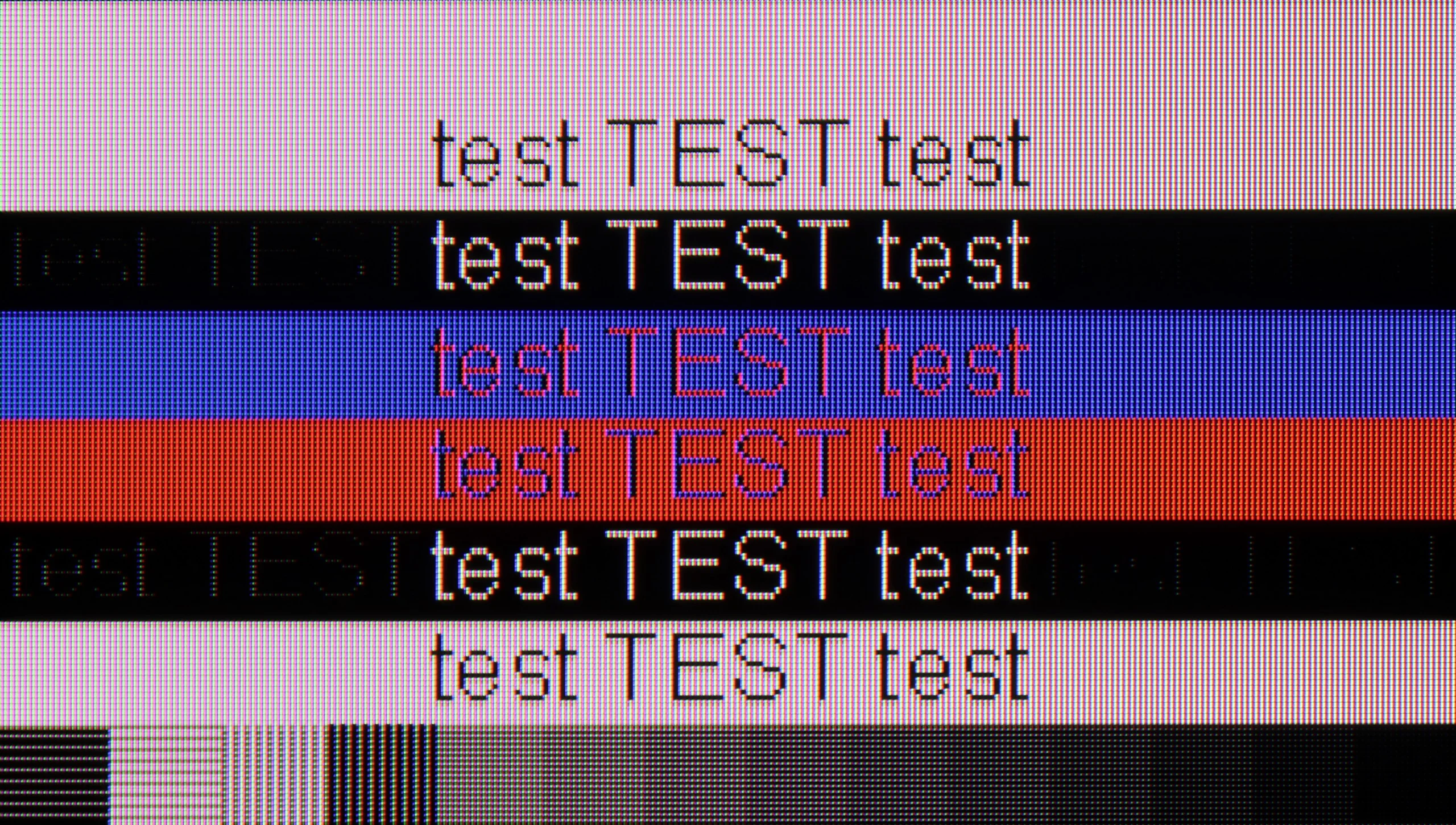
The photo shows the legibility of small fonts. Ideally, lines should be the same thickness on both light and dark text, with minimal pixel gaps.
Philips PUS9010 (2025) is a very good television for using with a PC. The manufacturer has included a dedicated 144 Hz mode for PC gamers, and the television correctly supports variable refresh rates for both NVIDIA and AMD graphics cards. G-Sync and FreeSync functions work seamlessly, making PC gaming smooth and free from screen tearing. Since we already know that the television is very suitable for gaming, it’s also worth noting the readability of text, especially during daily work with a PC. The use of an IPS panel definitely works in its favour. Chroma has been implemented correctly, so one can speak of almost perfect font reproduction. Text is sharp, clear, and does not cause problems even with prolonged use. However, from our meticulous observations, we must note a minor detail. With very dark text, vertical and horizontal lines can have slightly different brightness levels. This is, however, purely a technical flaw, virtually imperceptible in practice, especially in the case of the 75-inch variant, where the distance from the screen further masks this effect.
The PQS9000 earns a high mark for PC use mainly thanks to its gaming capabilities. Its 144 Hz refresh rate at 4K and support for G-Sync Compatible and AMD FreeSync Premium Pro let you synchronise frames on compatible NVIDIA and AMD cards. Working with text also fares well. Regular fonts are sharp and legible, and with proper 4:4:4 chroma support coloured letters, icons and small desktop elements do not lose their clarity. The biggest caveat concerns very small, dark text: the horizontal strokes of letters are noticeably darker than the vertical ones, which makes some characters look uneven. You probably won't notice this from the couch, but if someone plans to put The One on their desk and work up close, that flaw may become annoying.
Viewing angles
5.8/10
3.2/10
The viewing angles on the Philips PUS9010 are very good, and this is one of the biggest advantages of the IPS panel. Compared to the variant with a VA panel, the difference is clear. The image maintains significantly better consistency, and the colours remain stable even when viewed from a large angle. Of course, with a change in position, the brightness level does drop slightly; however, the degradation of the image is much less than in the VA version. It isn't at the level known from OLED screens, but among LCD televisions, you can talk about having one of the better viewing angles available on the market.
Viewing angles are one of the weakest points of the Philips PQS9001. Just move to the side and the colours noticeably lose saturation, and the image looks washed out and loses contrast. When watching with several people, seats directly in front of the screen will therefore be by far the best.
Unfortunately, this is a typical trait of VA panels. Good contrast when viewed head-on comes at the expense of poorer off‑axis performance. Most TVs with that panel have a similar problem and The One is no exception. The rotating stand helps a little by letting you angle the screen toward the viewer, but with widely spaced seats it won't solve the issue.
Daytime performance
5.4/10
6.1/10
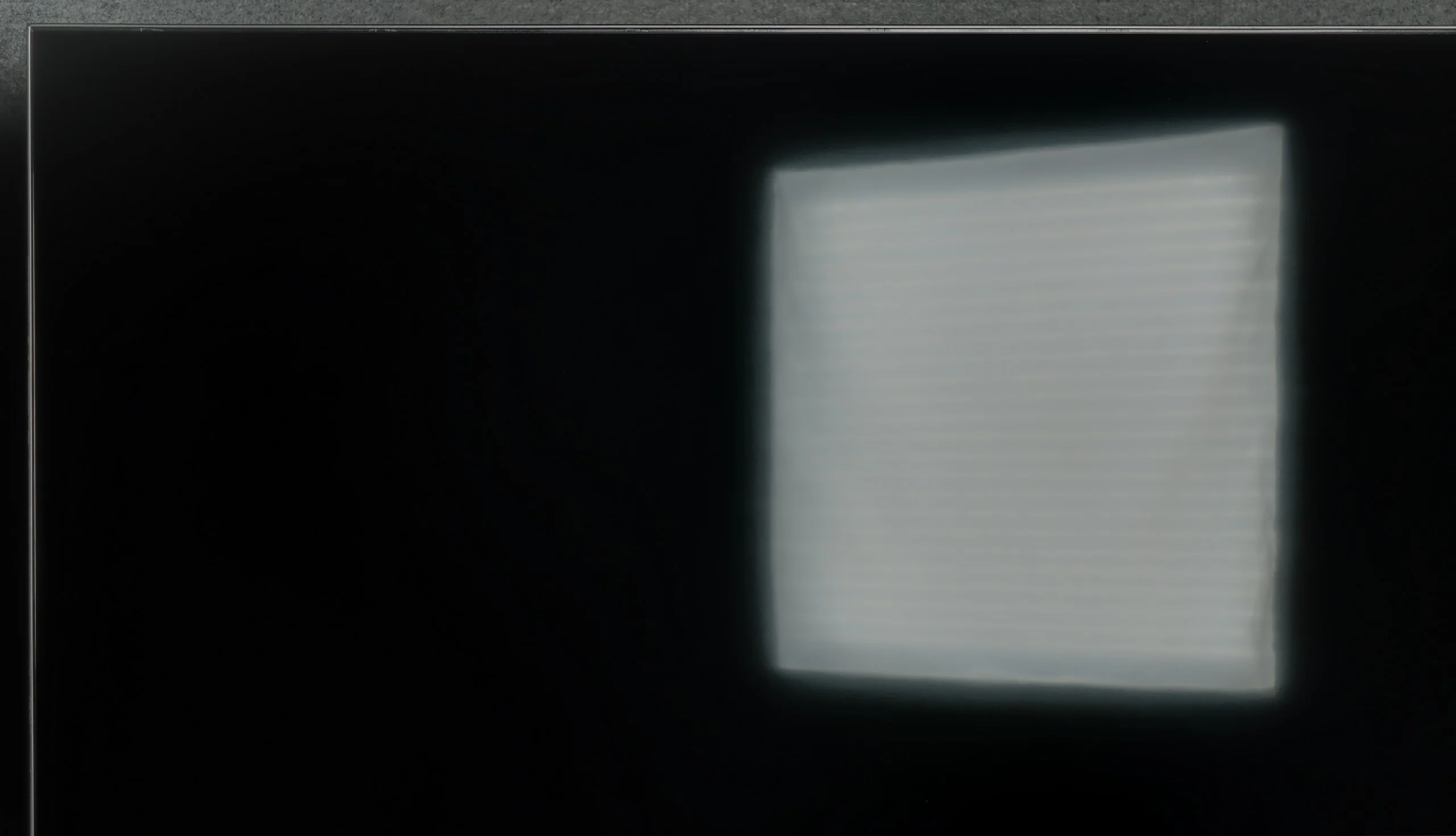
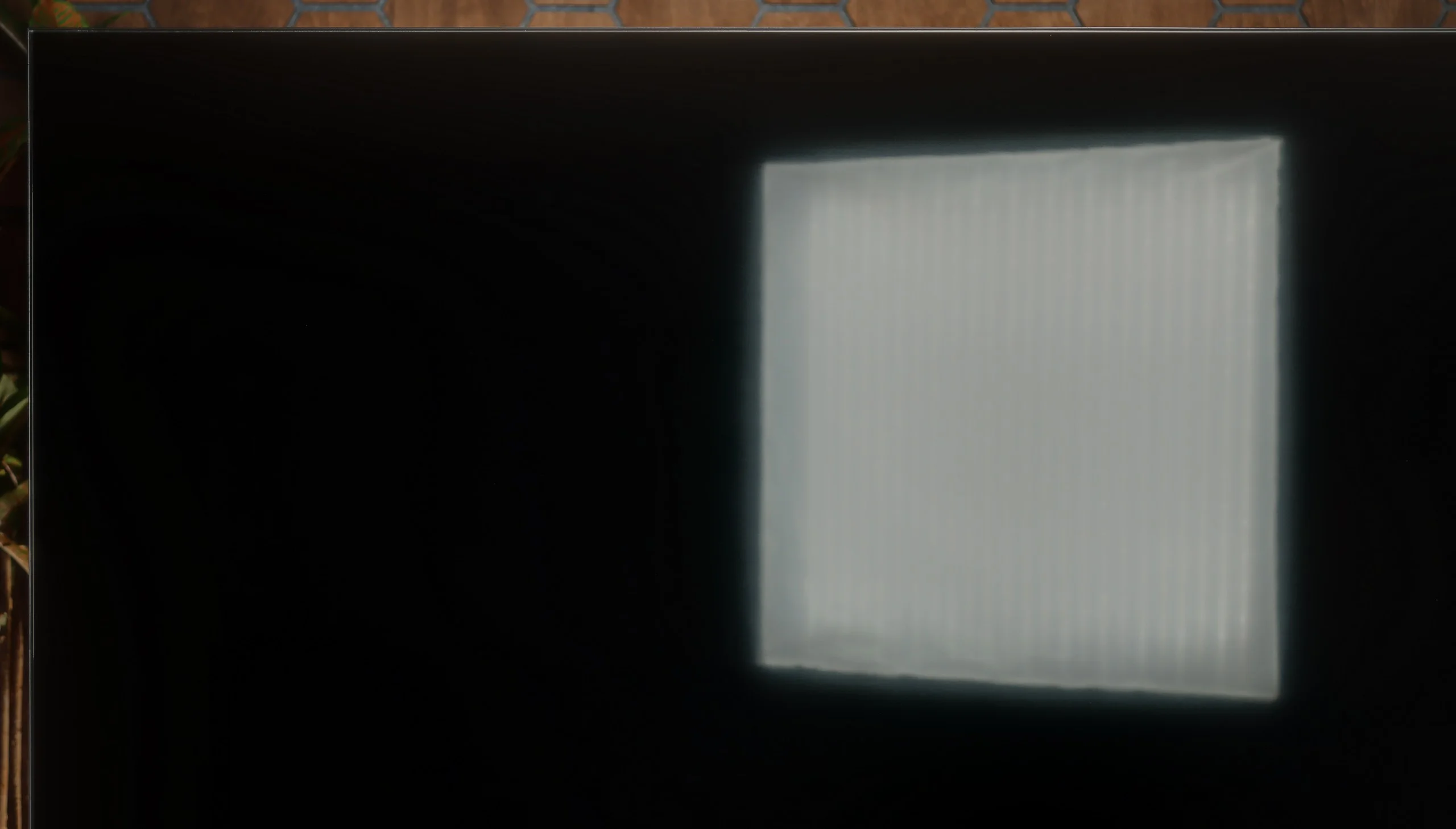
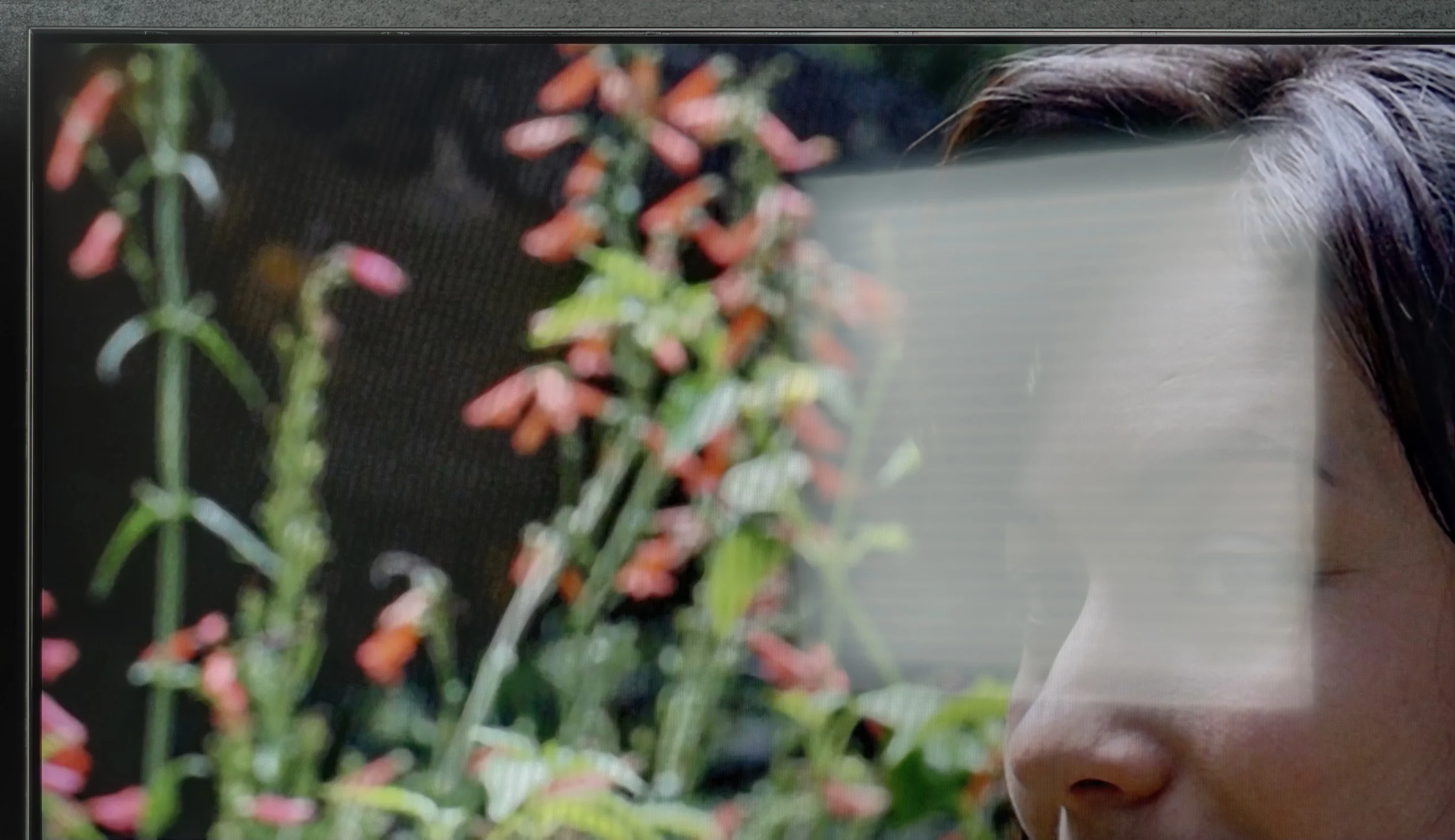
Panel brightness
Philips PQS9011 / PQS9001 (The One 2026): 502 cd/m2
PHILIPS PUS9010 (IPS): 398 cd/m2
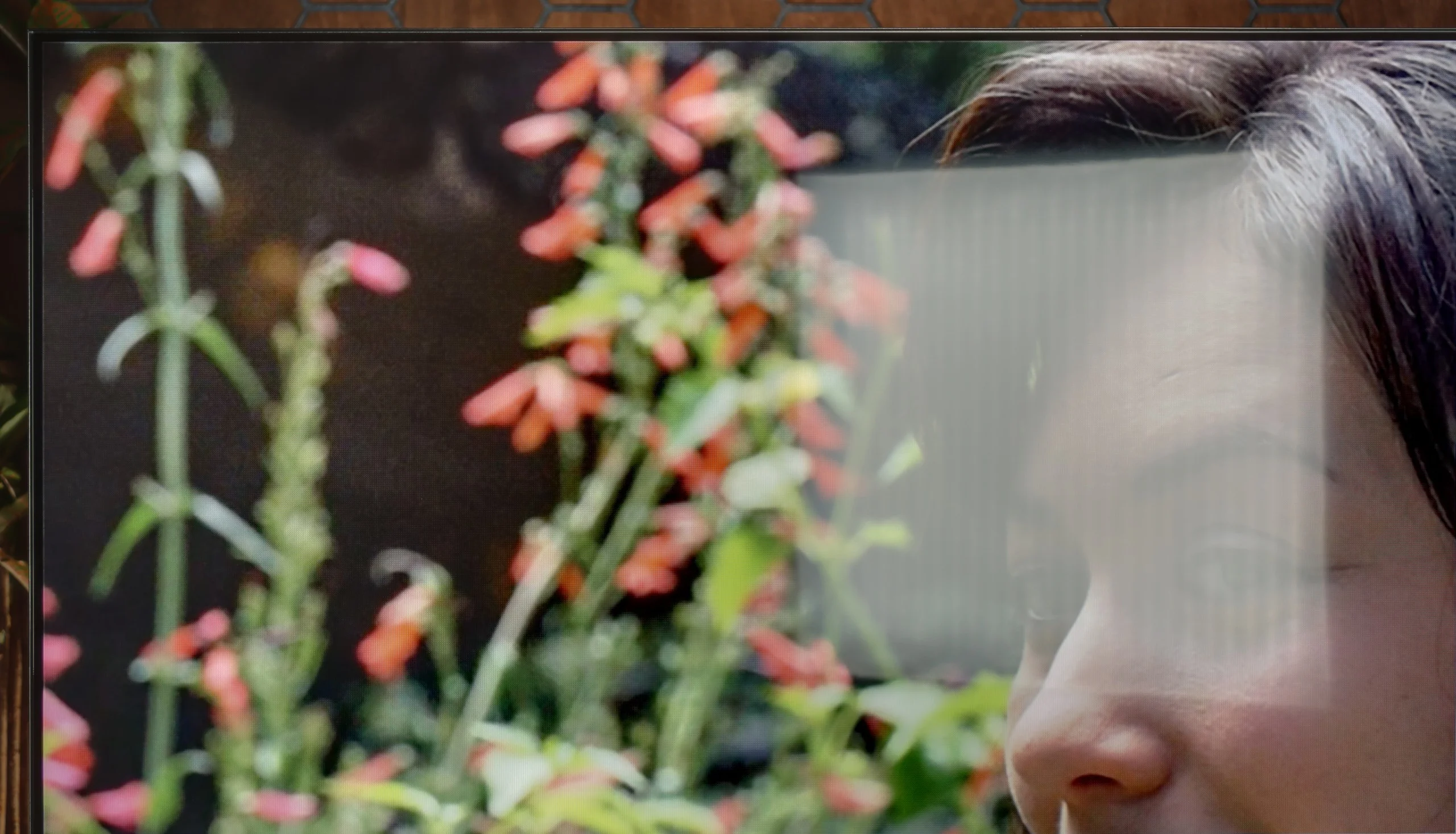
In terms of use in a bright room, the Philips PUS9010 performs reasonably well. The applied satin matrix effectively dampens reflections and does not cause a mirror effect, meaning the screen does not distract as much from light coming in from windows or lamps. Unfortunately, compared to the variant with a VA matrix, the television performs less well. The screen is noticeably darker, which can be felt in a strongly sunlit room. Under normal daytime conditions, this does not present a major problem, but in very bright surroundings, the difference compared to the VA version is noticeable.
Philips PQS9001 performs quite well for daytime viewing. The biggest advantage is a stable brightness of around 500 nits, regardless of how many bright elements appear on the screen. Even when watching winter sports or an all-white scene, the picture doesn't dim. In a typical living room that level is more than enough to comfortably watch TV without having to block out the windows.
The satin finish does a decent job of reducing reflections, though it doesn't remove them completely. A window opposite the screen will be visible and can be distracting, especially in darker scenes. Blacks hold up well in daylight, so the image doesn't become overly washed out. For everyday viewing it's therefore quite good, as long as the sun isn't shining directly on the screen.
Panel details
Subpixel Structure:
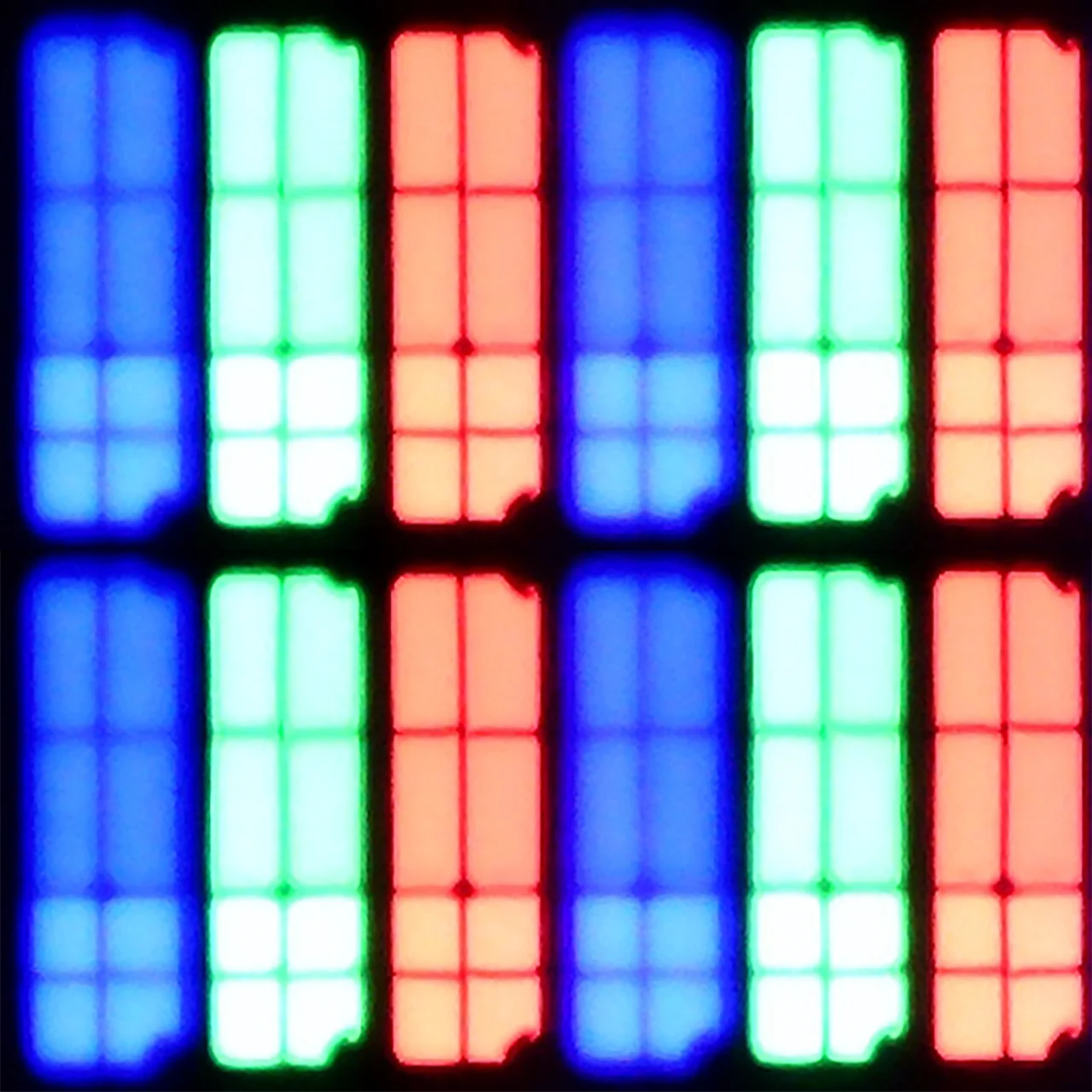
Panel uniformity and thermal imaging:
PHILIPS PUS9010 (IPS)
Philips PQS9011 / PQS9001 (The One 2026)
TV features
6.1/10
7.6/10
- SystemTitan OSTitan OS
- System performanceDecentDecent
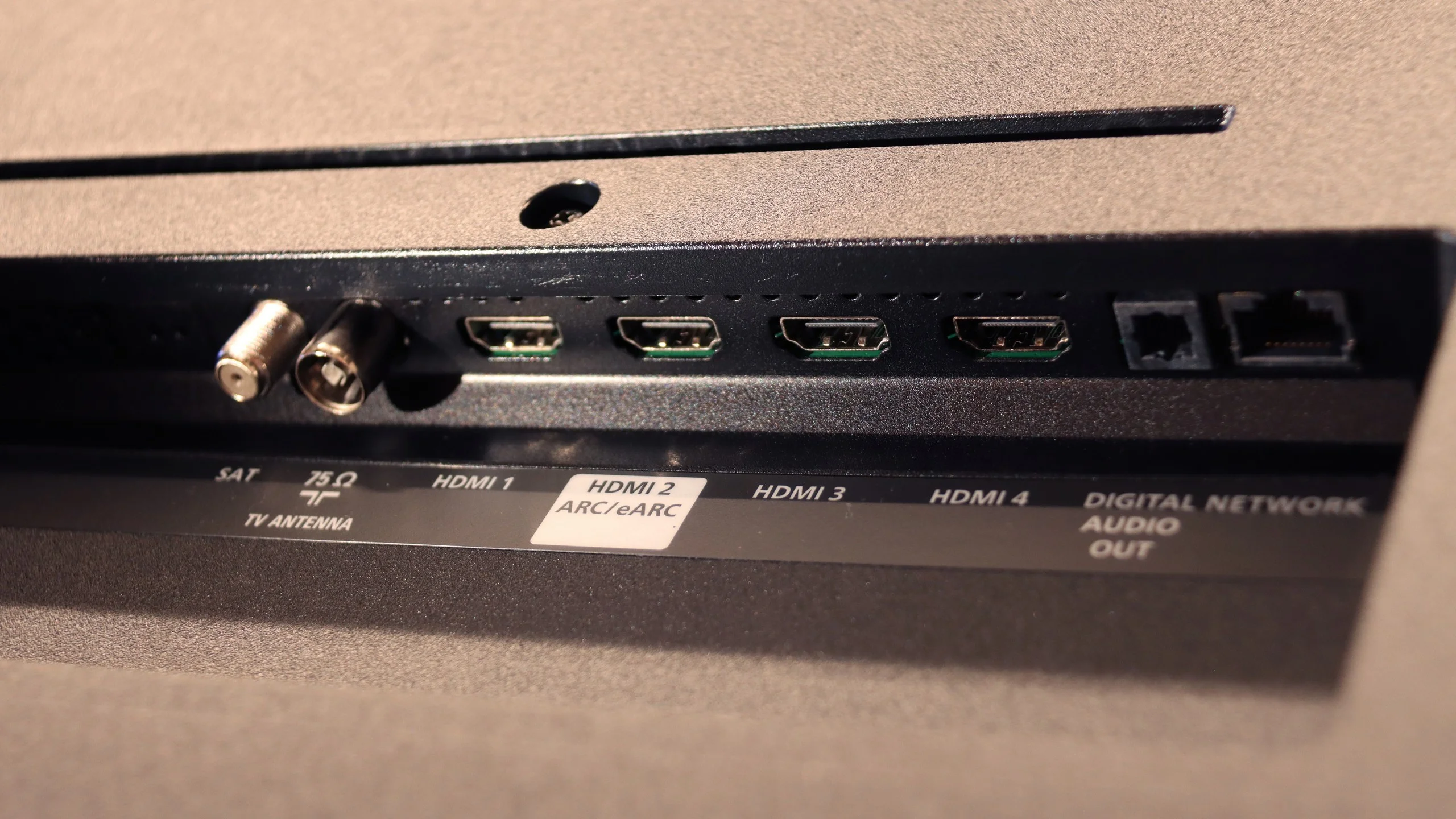
- HDMI inputs2 x HDMI 2.0, 2 x HDMI 2.1 48Gbps0 x HDMI 2.0, 4 x HDMI 2.1 48Gbps
- Other inputsToslink (Optical audio)
- OutputsToslink (Optical audio), eARC (HDMI), ARC (HDMI), Mini-Jack (Headphones)Toslink (Optical audio), eARC (HDMI), ARC (HDMI), Mini-Jack (Headphones)
- Network InterfacesWi-Fi 2.4GHz, Wi-Fi 5GHz, Ethernet (LAN) 1GbitWi-Fi 2.4GHz, Wi-Fi 5GHz, Ethernet (LAN) 100Mbps
- TV receptionDVB-T, DVB-T2, DVB-S, DVB-S2, DVB-CDVB-T, DVB-T2, DVB-S, DVB-S2, DVB-C
Classic features:
- Recording to USB (terrestrial TV)

- Recording programming
- Picture in Picture (PiP)
- RF remote control (no need to aim)
- Backlit remote control
- Teletext
- Audio only mode
- Bluetooth headphones support
- Simultaneous Bluetooth headphones & TV audio
Smart features:
- AirPlay
- Screen mirroring (Windows Miracast)
- Voice search
- Voice search in native language
- Ability to connect a keyboard and mouse
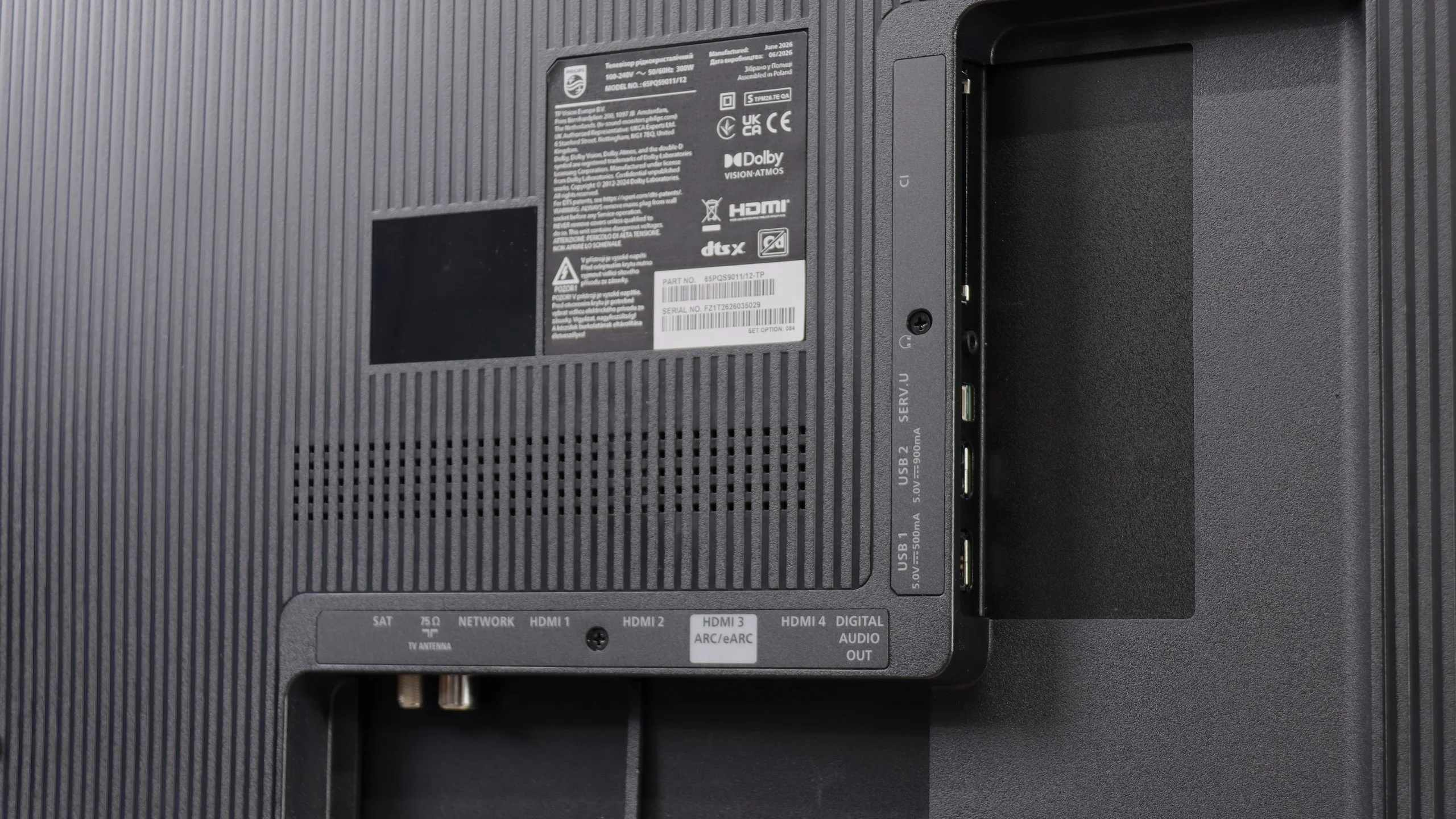
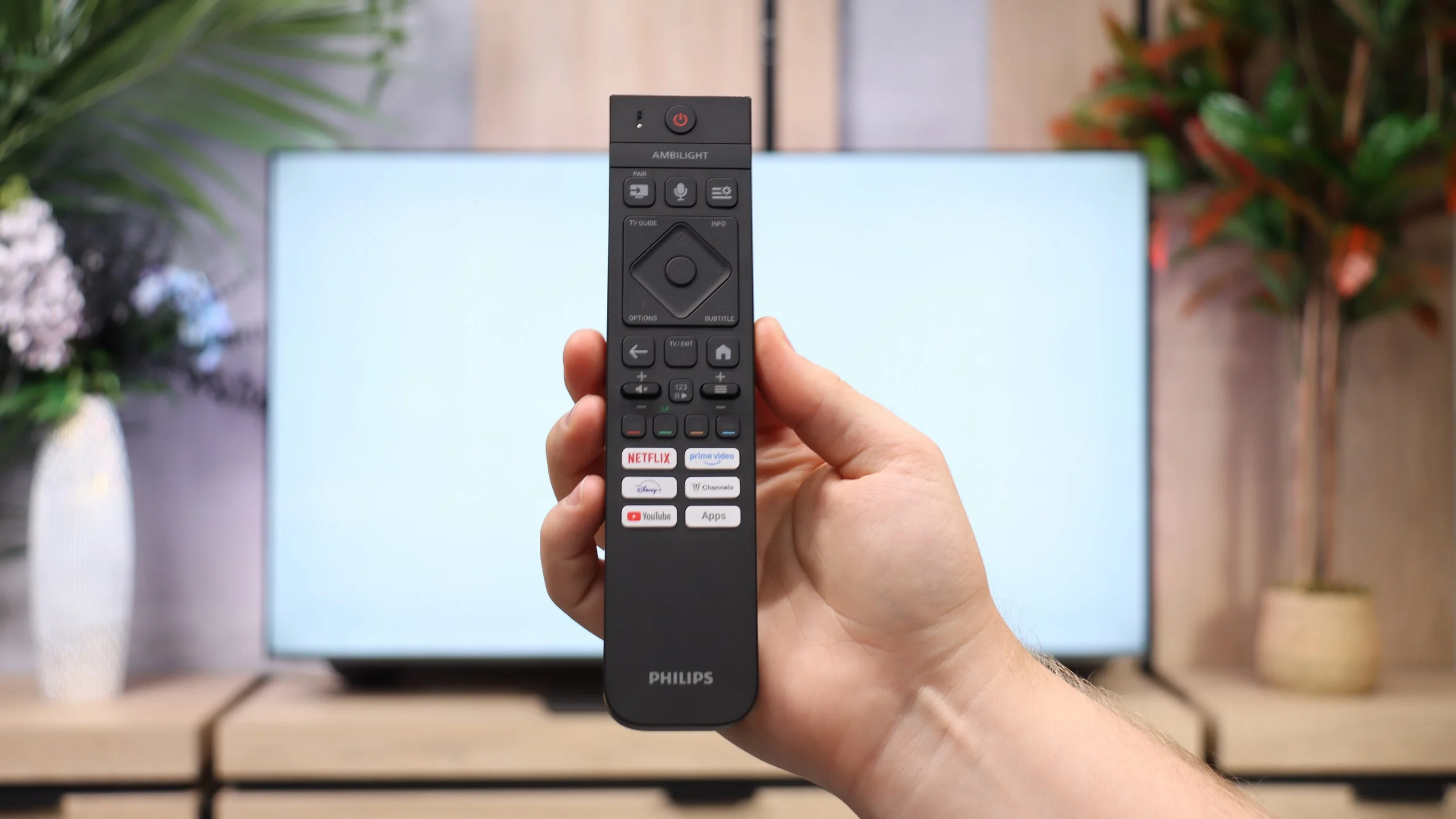
Sound connection options
- HDMI audioeARC (HDMI), ARC (HDMI)eARC (HDMI), ARC (HDMI)
- Other audio outputsToslink (Optical audio), Mini-Jack (Headphones)Toslink (Optical audio), Mini-Jack (Headphones)
- Wireless audioBluetoothBluetooth
Supported audio formats (external HDMI eARC audio):
- Dolby Digital Plus 7.1
- Dolby True HD 7.1
- Dolby Atmos in Dolby Digital Plus (JOC)
- Dolby Atmos in Dolby True HD
- DTS:X in DTS-HD MA
- DTS-HD Master Audio
Senior accessibility
- Numeric keyboard on TV
- Font size adjustment
- Audio description
Classic TV Features
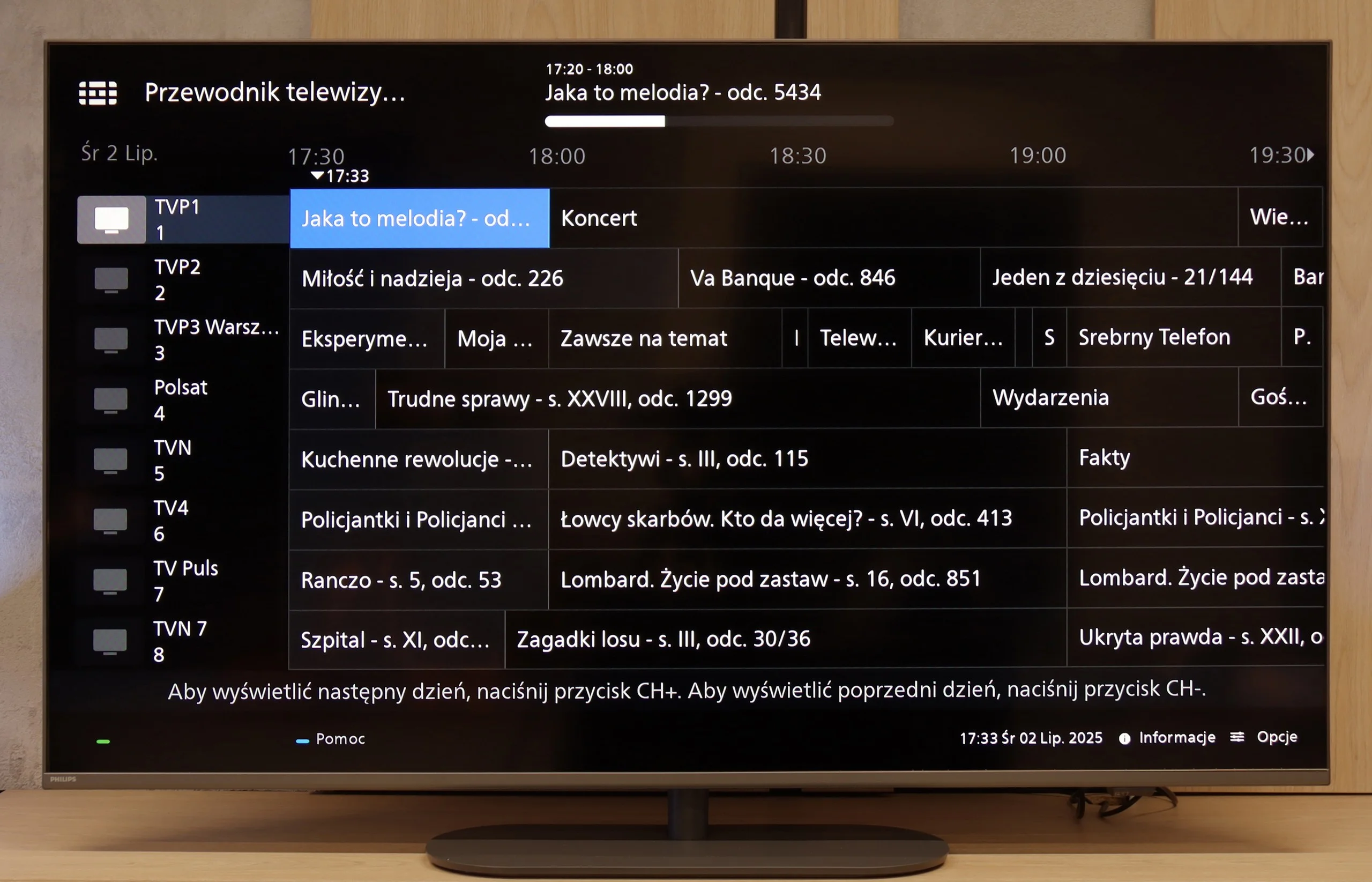
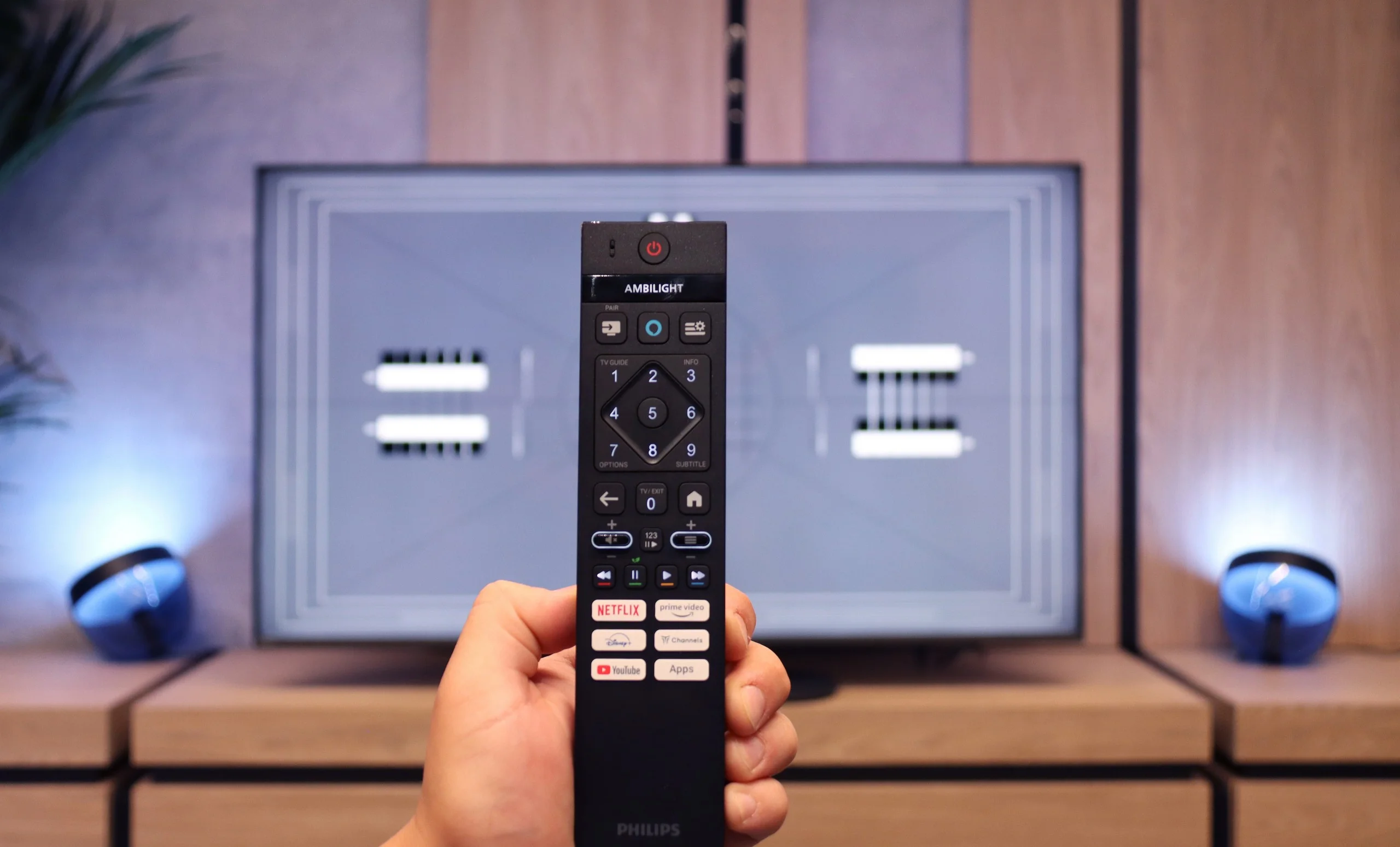
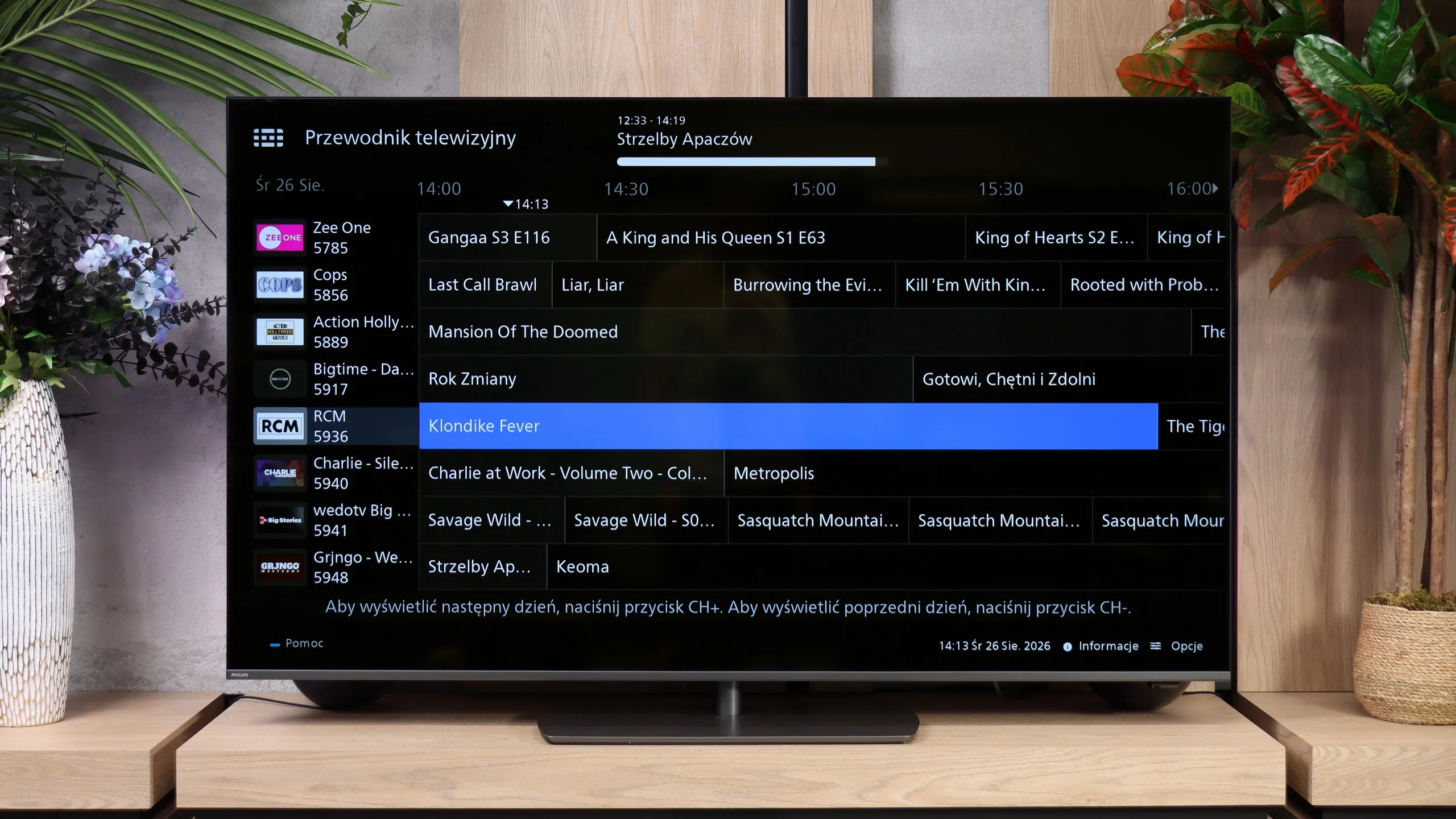
When it comes to classic features, the Philips PUS9010 is rather average. It includes basics such as EPG, teletext, and the ability to connect headphones via Bluetooth. However, that's basically where the stronger points end. Unfortunately, it lacks USB recording and the PiP mode (picture in picture). These are features that are becoming less common, but they can still be useful in everyday use. On the plus side, the remote control comes with a numeric keypad. It's modern, backlit, and visually makes a very good impression. It's just a pity that it's still an infrared remote, so it requires aiming at the screen. With such a modern look, it really would have been nice to have Bluetooth radio control.
Smart TV
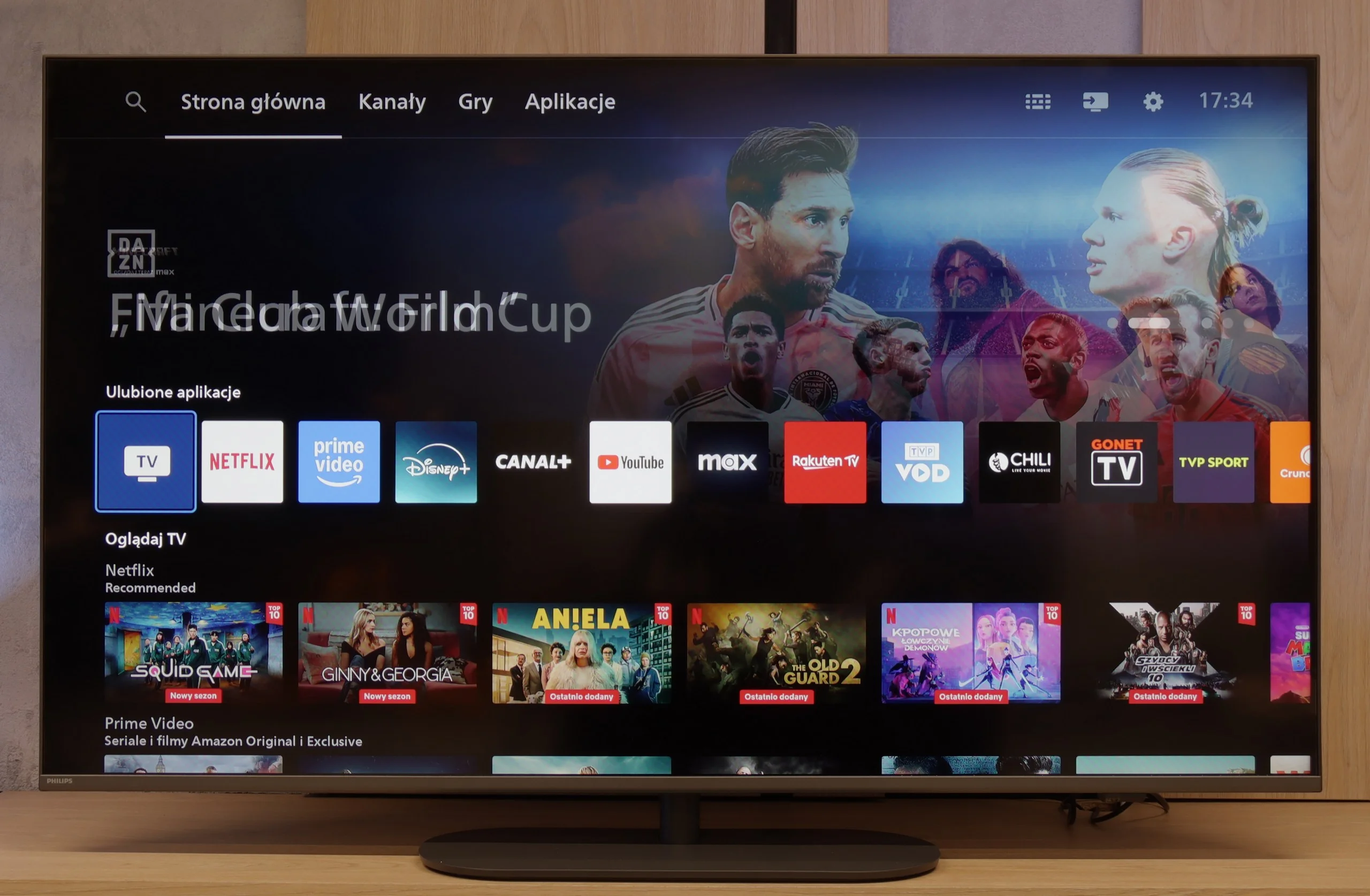
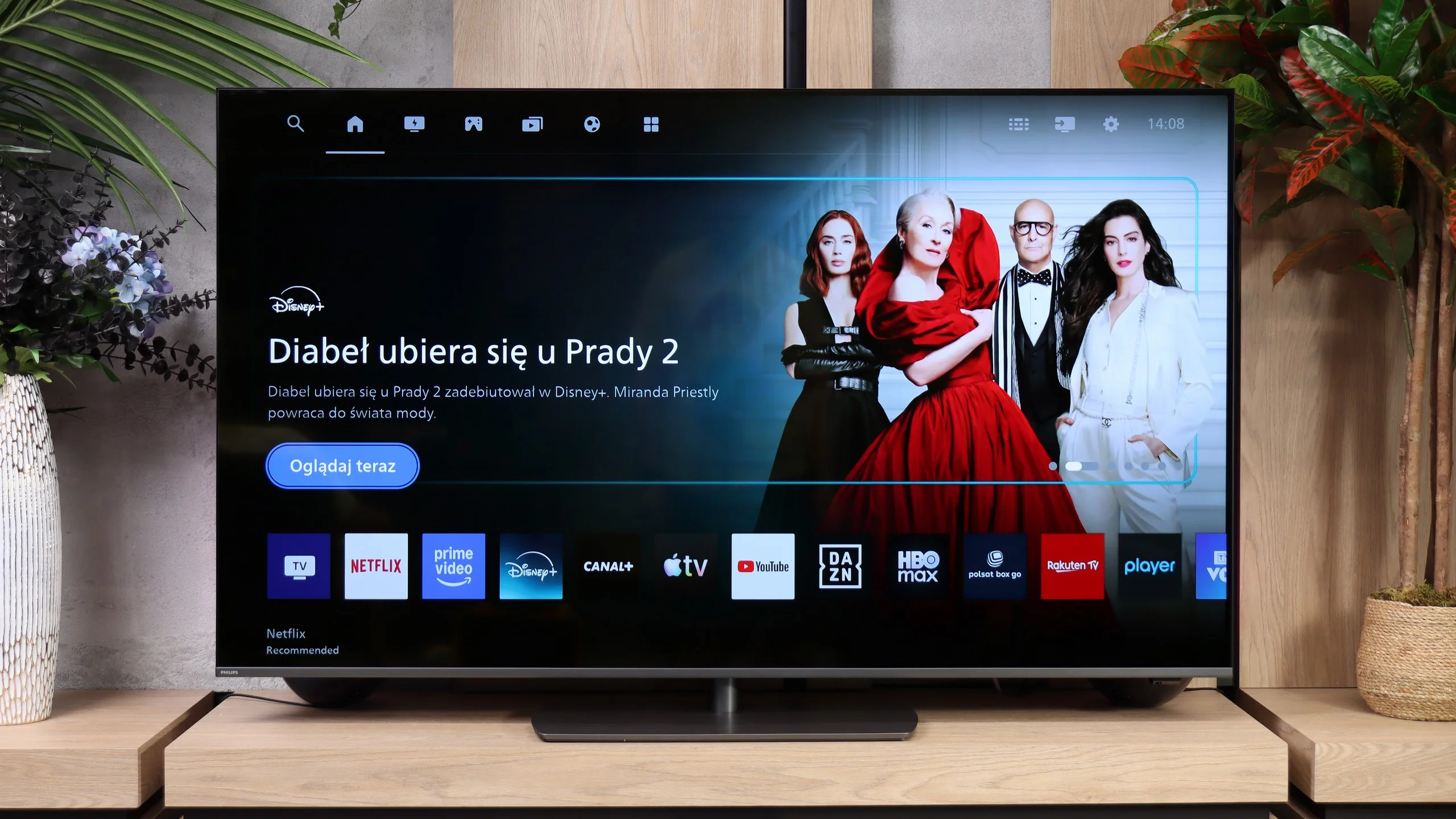
Most Philips TVs from 2025, including the PUS9010, run on the Titan OS system. This is still a relatively young platform and unfortunately, its limitations are still visible. The system itself runs quite smoothly, noticeably better than in the manufacturer's cheaper models, and during testing, it did not encounter problems when using screen mirroring or AirPlay, which is still not a given. However, the biggest drawback remains the limited number of available applications. This can be partially circumvented by connecting a keyboard and mouse to the TV and using the built-in web browser, but this is more of a makeshift solution than a convenient daily option.
Titan OS in this year’s The One shows that Philips has been working on its system. Compared with last year’s version, many little things and functions that didn’t work properly before have been fixed. Now we can easily use AirPlay, mirror a computer screen via Miracast, or do voice searches in Polish. The system itself runs decently, though it’s far from the fastest. The app library has also grown. It includes Netflix, Prime Video, Disney+, CANAL+, Apple TV and YouTube. The selection is still smaller than on Google TV, but when using popular services Titan increasingly gives fewer reasons to complain.
Classic features also show an improvement in everyday convenience. You can connect Bluetooth headphones and listen through them at the same time as the TV speakers. There’s also a mode that turns off the screen and leaves only the audio. Recording to USB and picture-in-picture (PiP) are missing. What’s most disappointing is the remote. Despite backlit buttons, it still controls the TV via infrared, so you have to point it at the screen. The system has picked up a number of useful fixes, but that part of the user experience remains unchanged and can be irritating in everyday use.
Apps
6.7/10
7.2/10






















Playing files from USB
7.9/10
8.6/10
Supported photo formats:
Maximum photo resolution:
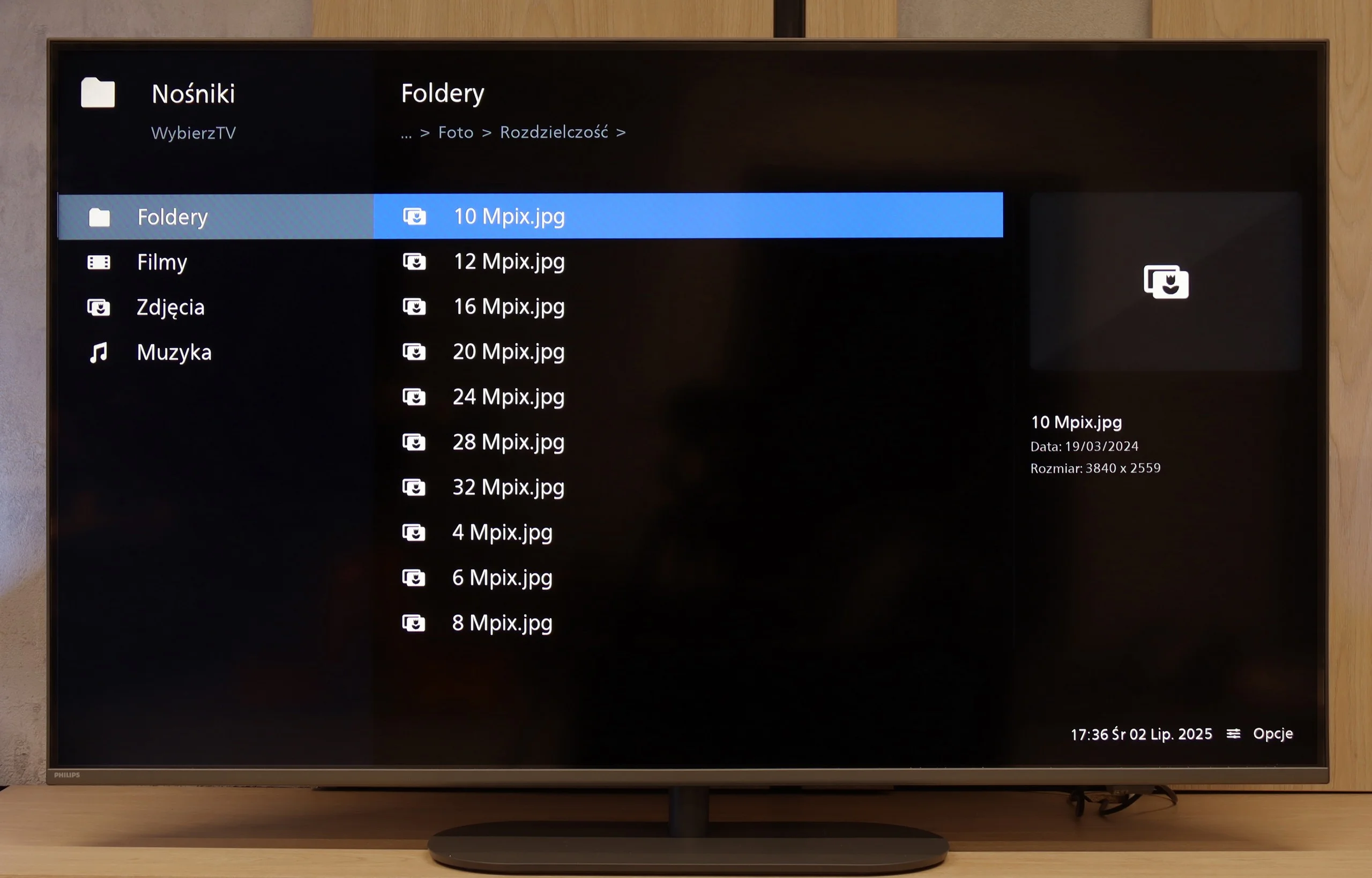
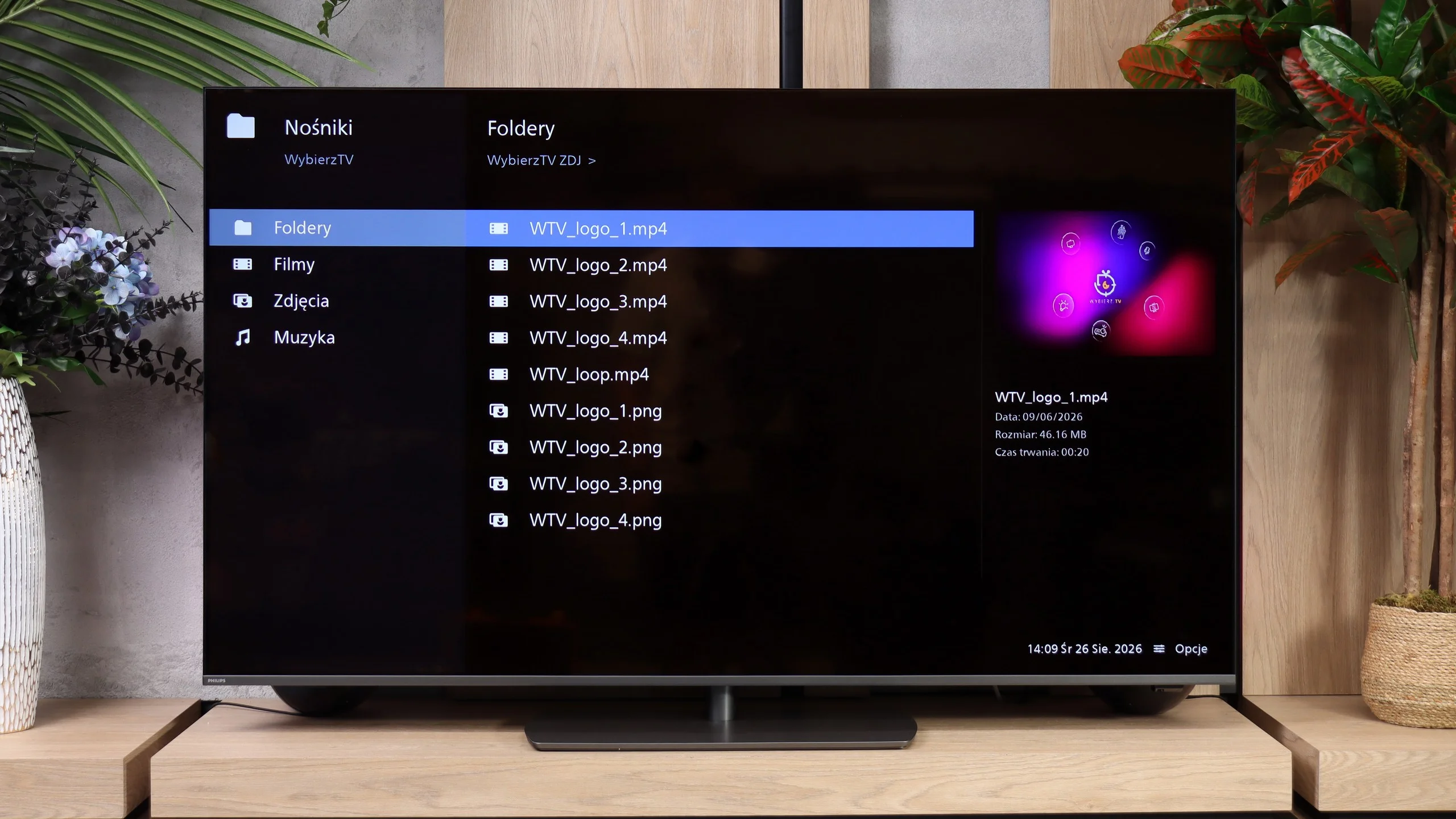
The media player in the new Philips is a solid standard. It handles most popular video and audio files, operating stably and predictably. Although fans of rarer subtitle formats or specific image resolutions might feel a bit disappointed, for the average user, the built-in software does the job. It’s a convenient solution that means we don’t have to involve external equipment to play materials from an external drive.
The built-in USB player runs quickly and smoothly and handles most of the files we tested without trouble. Music playback is solid, from common MP3s to FLAC files, including 96 kHz/24-bit. It's perfectly adequate for everyday media playback from a USB stick. However, our biggest complaint is again the handling of photos. The player is quite selective about resolution: it opened our 8, 16 and 32 Mpix files but failed with, among others, 4, 12 and 24 Mpix. It's hard to find any logic in that when a larger photo works but a smaller one doesn't. That can be annoying when browsing holiday photos.
Sound
6.6/10
6.9/10
- Maximum volume85dB96dB
- Dolby Digital Plus 7.1
- Dolby True HD 7.1
- Dolby Atmos in Dolby Digital Plus (JOC)
- Dolby Atmos in Dolby True HD
- DTS:X in DTS-HD MA
- DTS-HD Master Audio
The sound from the Philips PUS9010 is simply adequate. The tested unit offers a 2.0 setup with a total power of 40 W, which is more than sufficient for everyday watching of TV, movies, or series. The sound is pleasant, but it's hard to describe it as anything above average, especially if you're after strong bass or greater dynamics. On the plus side, it supports a wide range of audio formats. When connecting a soundbar or home theatre system, the TV easily handles Dolby Atmos and DTS, without the need to fiddle with settings or lose sound quality. For those planning external speakers, this is definitely good news.
The Philips PQS9001 has a 2.0 audio system with a total power of 40 W, that is, two 10 W speakers on each side. It sounds fairly good and definitely better than most budget TVs. There's plenty of volume, but the sound itself lacks depth. The biggest issue is the lack of low end, so explosions in films or heavier sections of music don't have the proper weight.
High frequencies aren't reproduced evenly either. Measurements show a noticeable dip around 2 kHz, then a boost at 6-7 kHz and a drop above about 8 kHz. That can emphasise sibilance and add a bit of harshness to the sound, despite the rolled-off top end. It's fine for everyday viewing, but for films and music it's worth considering additional audio. All the more so because the TV supports spatial audio formats, including Dolby Atmos and DTS. A compatible soundbar or AV receiver will make better use of those formats than the built-in speakers.
Sound Quality Test
Acoustic Measurements
No acoustic data
96dBC (Max)
75dBC
Reader comments
Comments are provided by the external service Disqus (Zeta Global). Once loaded, Disqus may set cookies and process data about your activity.
We will remember your choice on this device. Provider's privacy policy