 Direct comparison
Haier M95E is, on paper, a television that looks like the dream come true for any "bargain hunter." When we look at the specifications – a Mini LED panel with hundreds of zones, powerful brightness exceeding 1500 nits, a QLED 144Hz matrix, phenomenally low input lag, and sound branded by Harman Kardon – everything screams "flagship!" So we are dealing with equipment that theoretically should throw down the gauntlet to the most expensive players on the market. Unfortunately, if you read our review carefully, you’ll need to read it quite closely, because there is one word that appears almost in every paragraph: "but..." And it is this word that perfectly summarizes this model. The M95E is a television of gigantic contradictions and wasted potential, where nearly every advantage is brutally countered by a fundamental software flaw. So we have hundreds of dimming zones, but the algorithms controlling them create a distracting disco on the screen. We have phenomenal HDR brightness, but the television completely struggles with tone mapping and burns details. We have an ultra-fast, non-tearing 144Hz matrix, but motion smoothing systems for movies are virtually non-existent. We have a great package for gamers, but without HGiG and with font display issues. Finally, we have superb sound, but wrapped in a clumsy and frustrating Smart TV system. This is exactly why the Haier M95E is such a frustrating device. It’s a story about fantastic hardware that lacks the final, most crucial polish – refined software.
- Matching (Score) |
- Our verdict |
- TV appearance |
- Where to buy |
- Contrast and black detail |
- HDR effect quality |
- Factory color reproduction |
- Color reproduction after calibration |
- Smoothness of tonal transitions |
- Image scaling and smoothness of tonal transitions |
- Blur and motion smoothness |
- Console compatibility and gaming features |
- Input lag |
- Compatibility with PC |
- Viewing angles |
- Daytime performance |
- Panel details |
- TV features |
- Apps |
- Playing files from USB |
- Sound
M95 / M95EUX
Available screen sizes: 65”
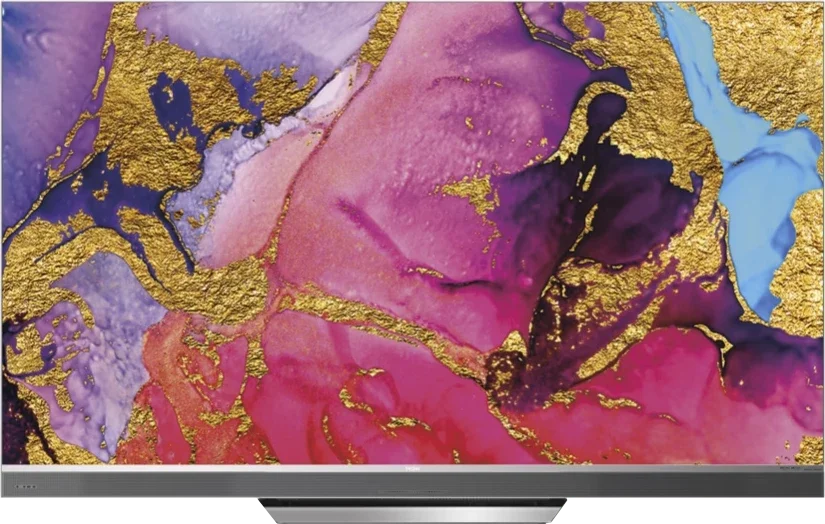
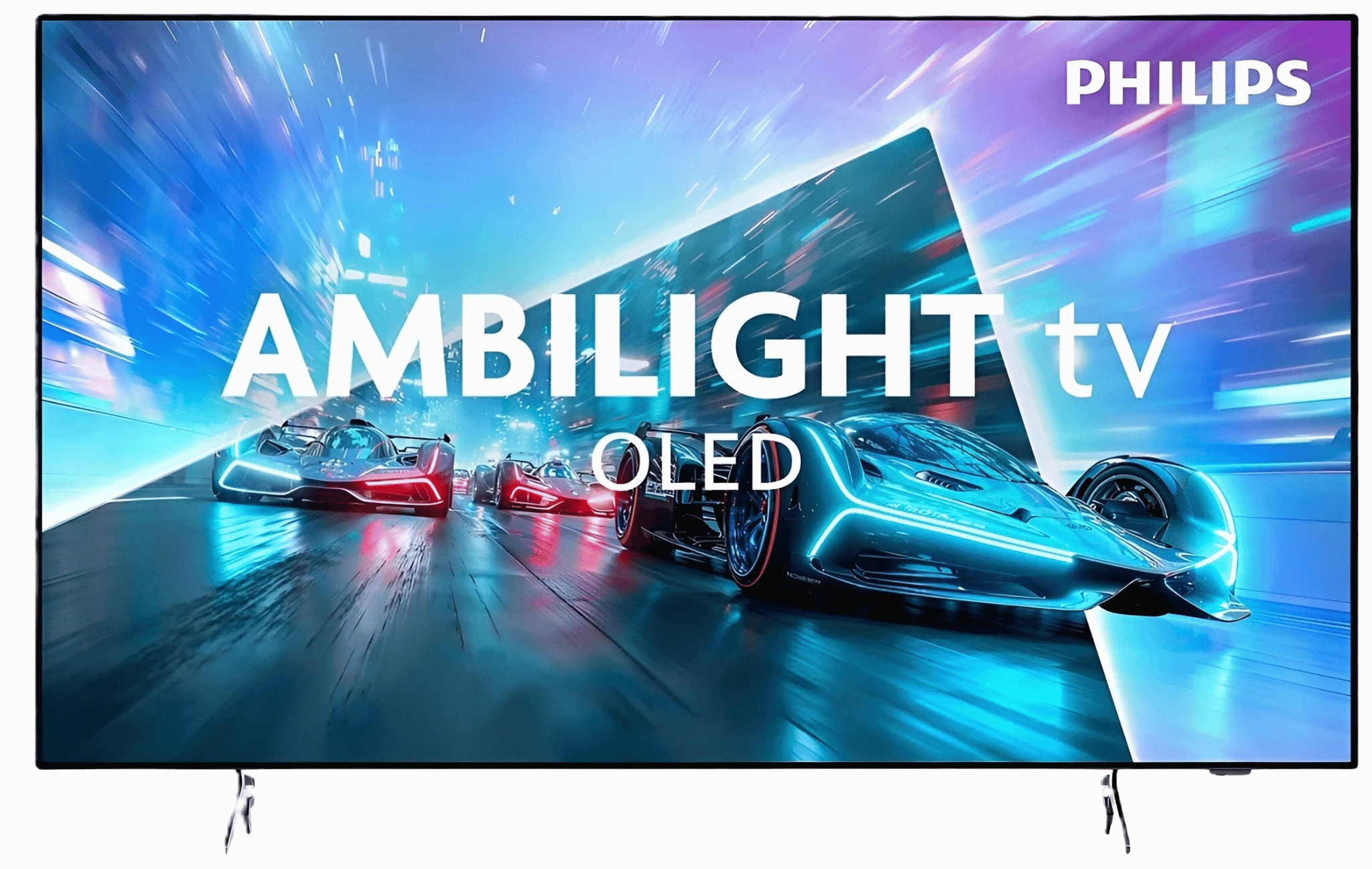
Panel type: LCD VA
Resolution: 3840x2160
System: Google TV
Model year: 2025
Complete the survey to find out the result
Panel type: WRGB OLED
Resolution: 3840x2160
System: Titan OS
Model year: 2026
Complete the survey to find out the result
Overall rating
7.3
7.7
 Movies and series in UHD quality
6.9
8.0
 Classic TV, YouTube
6.1
8.7
 Sports broadcasts (TV and apps)
5.6
8.5
 Gaming on console
8.0
9.0
 TV as a computer monitor
6.6
7.6
 Watching in bright light
8.5
4.5
 Utility functions
6.3
7.9
 Apps
9.6
7.7
 Sound quality
9.2
7.0
Complete the survey to find out what fits your preferences
Advantages

Phenomenal sound: Built-in audio system from Harman Kardon
Very high brightness: up to 1700 nits
Good panel for gaming and sports: 144Hz, low motion blur
Low input lag: below 10 ms (at 120Hz)
Complete gaming package: Two HDMI 2.1 ports, support for 4K@144Hz, VRR (G-Sync) and ALLM provide a solid foundation for consoles and PCs
Great tonal fluidity: The TV handles gradients and color transitions excellently
Wide color gamut (QLED): 96% DCI-P3 coverage guarantees vibrant and saturated colors
Support for Dolby Vision and HDR10+
Perfect blacks and very high contrast
Impressive HDR for evening viewing
Very good color reproduction after calibration
Wide viewing angles
Ambilight enhances the viewing experience 🙂
120 Hz panel useful for gaming and sports
Four HDMI 2.1 inputs
Dolby Vision support (improves the picture in many HDR scenes)
Disadvantages

Very underdeveloped dimming algorithms are the biggest flaw. Mini LED zones "dance" on the screen
Clunky Google TV system: The entire interface runs slowly, has annoying stutters, and experiences errors
Non-functioning motion smoother in movies
Average performance with PC: At 120Hz and 144Hz, the TV struggles with sharp font display
Limited app selection on Titan OS
Lower SDR brightness compared with competitors
Screen reflections are distracting in a bright living room
Infrared remote requires pointing at the TV (sometimes slow to respond)
Visible posterization
Our verdict
Philips OLED761 shows that an entry-level OLED in the brand’s lineup can be a successful choice for watching movies. It performs best in the evening, when perfect black levels and impressive HDR let you appreciate the strengths of this panel. After calibration the colors are very well reproduced, so it's hard to find major faults with the picture during regular viewing. It doesn't always handle the brightest highlights in demanding HDR10 films equally well, but Dolby Vision helps in those scenes. This is a TV that can leave a really good impression when you turn off the lights. A big part of that experience is Ambilight. If you like backlighting the wall behind the screen, the OLED761 gives a concrete reason to consider Philips. You don’t have to pay extra for higher-tier models to get this feature combined with a good OLED picture. This model also works for gaming: the 120 Hz panel and four HDMI 2.1 inputs let you use it for movies, consoles, or a PC. That matters, because even the cheapest OLED in a lineup should be a versatile purchase, not a TV that’s only good for evening sessions.
Before buying, though, it’s worth looking at two limitations. The first is watching in a bright room. The OLED761 is a bit dimmer than rivals using a similar panel, and the absence of a polarizer in the OLED SE panel further reduces its performance in bright rooms. The second is Titan OS. The system runs more smoothly than in earlier versions, but it still offers a smaller selection of apps than the competition. Improved smoothness is welcome, but it won't replace access to the services you use every day, so it's best to check app availability before buying. We also didn’t like the remote. Even though it's backlit and has a full set of useful buttons, it requires precise aiming at the screen.
Ultimately, the Philips OLED761 makes the most sense for people who mainly watch in the evenings and want Ambilight. In those conditions it can confidently compete with the Samsung S85H or LG B6, and the choice between them will depend more on price, the operating system, and personal habits. Philips doesn't have a clear advantage in every use case, but you shouldn't treat it as an inferior option just because it opens the brand’s OLED range. At the right price it's a good buy... but only if the available apps meet your needs.
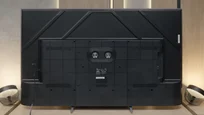
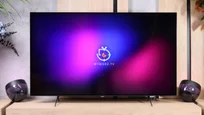
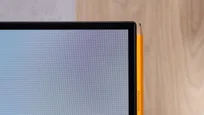
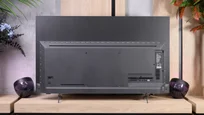
TV appearance




Contrast and black detail
6.8/10
10/10
Local dimming function: Yes, number of zones: 576 (24 x 24)
Contrast:


Result
152,100:1

Result
36,400:1

Result
37,800:1

Result
13,850:1

Result
5,350:1
Result
∞:1
Result
∞:1
Result
∞:1
Result
∞:1
Result
∞:1
Halo effect and black detail visibility:
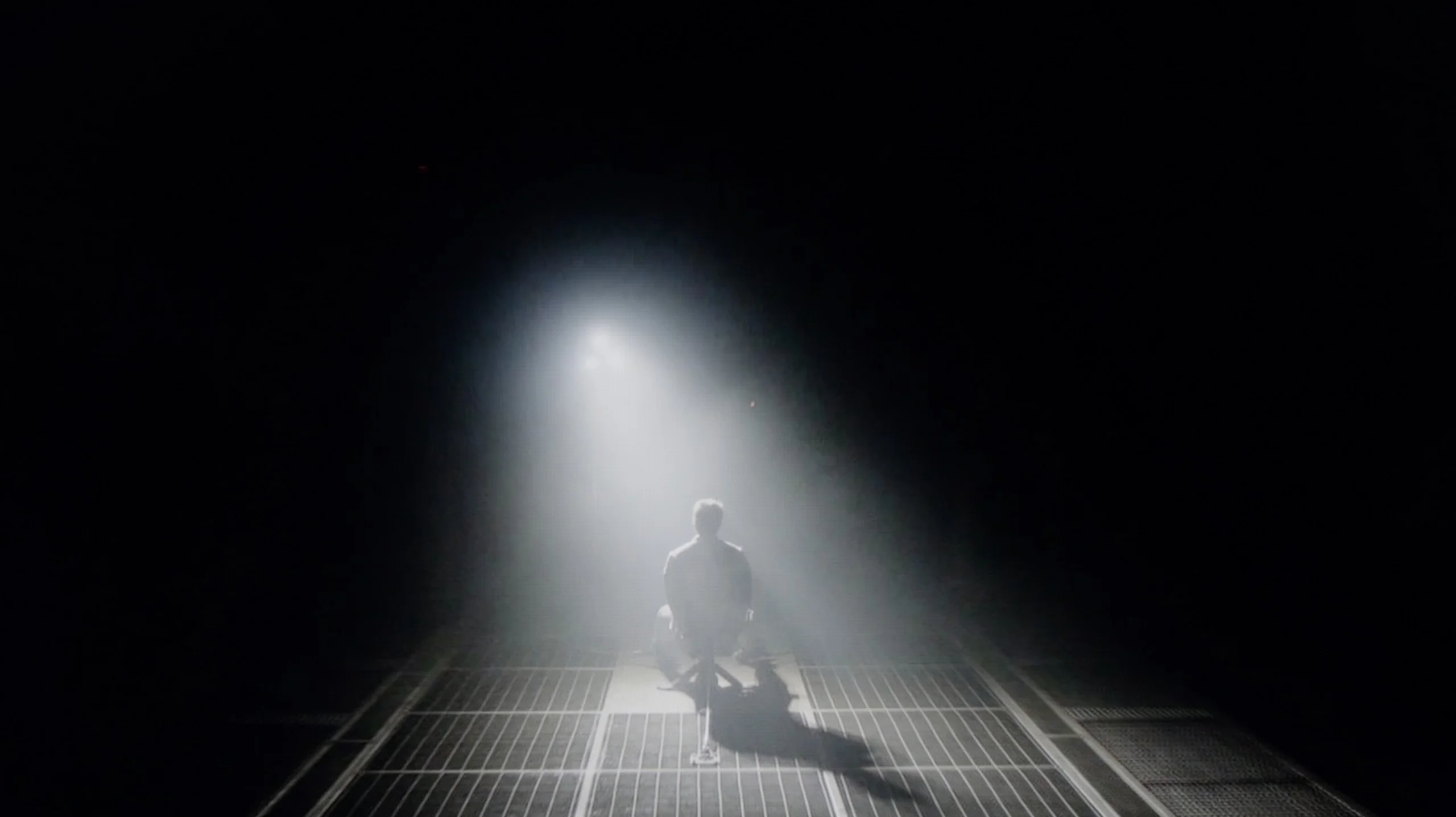
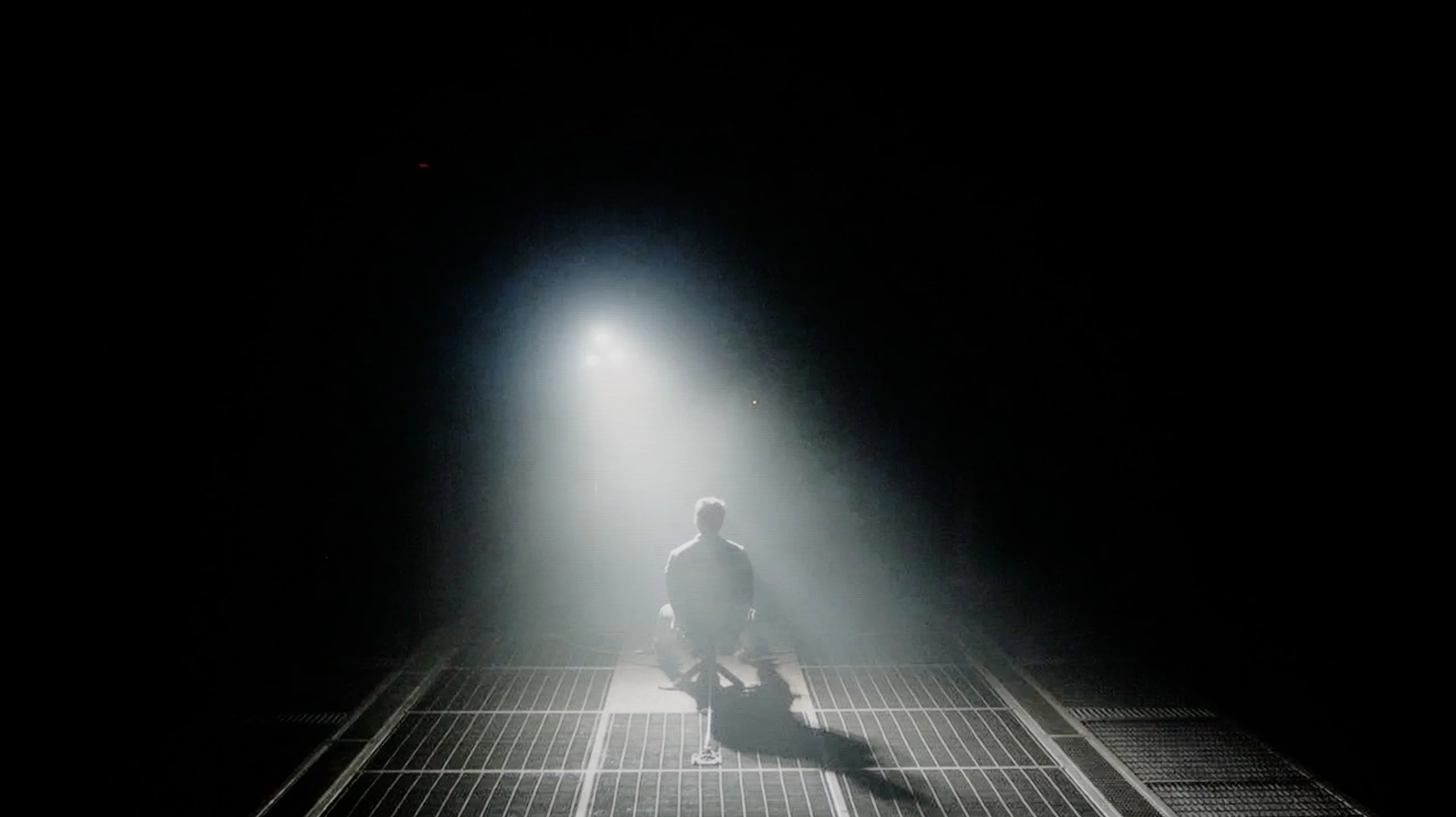
Check the visibility of bright lights on a dark background. Mini-LEDs often struggle with this. The photo does not compare black levels – that’s what the video below is for.
The video accurately shows differences in contrast and black levels between TVs, as well as potential issues: halo around bright objects or Mini-LED zone operation visible as brightness jumps.
Getting to the heart of the matter, which is the assessment of black levels and contrast, we must start with the specifications, which inspire genuine admiration on paper. The Haier M95E is a Mini LED design, equipped in the 65-inch version with an impressive grid of 576 independent dimming zones (a symmetric arrangement of 24x24). When we combine this technology with a VA-type panel, known for its native deep blacks, our expectations for image quality instantly rise. And indeed, as long as we feed the television static test patterns, everything looks phenomenal. The contrast measurements are so remarkable that the M95E almost throws down the gauntlet to the most expensive players on the market. Unfortunately, this delight lasts only until we turn on the first better film material.
As soon as motion appears on the screen – and we're not even talking about crazy chases, but about ordinary dialogues or camera transitions – the fundamental weakness of the unfinished algorithms controlling the backlighting comes to light. If you remember our tests of the Xiaomi S MINI-LED 2025 model, the story dangerously comes full circle. The dimming zones seem to have a life of their own, putting on a kind of "disco" of lights. Chaotic flashes and visible pumping of the backlighting are unfortunately very distracting and ruin the viewing experience, creating a huge HALO effect. Importantly, we conducted tests using the "High" dimming setting. It turned out that in our unit, this was the only mode in which the zones actually managed to work sensibly in HDR content without simultaneously causing a drastic drop in overall brightness. All of this leads to one conclusion: The M95E has enormous but completely underutilized hardware potential. It clearly lacks the hours spent refining the software, which forced us to lower the score in this critical category.
In this category the Philips OLED761 receives the highest score. The OLED panel allows each pixel to be controlled independently, and where the image should be completely black you can simply turn the pixel off. As a result we achieved infinite contrast in all measurement scenes. When watching this translates to deep blacks and very clear separation of bright elements from a dark background. Even a small lamp or a star does not cause the surrounding area to be illuminated by the screen, something Mini LEDs still struggle with in demanding scenes. This is an advantage of the technology itself, so even the cheapest Philips OLED can match much more expensive models in this respect. In a dark room it’s especially obvious how much that precision delivers. Black doesn’t go gray just because a bright object appears next to it, and the TV doesn’t have to choose between dimming the light and preserving a dark background.
Certain reservations apply to the way shades just above black are displayed. In cinematic scenes the OLED761 can slightly brighten those tones, so the very darkest parts of the image can be a bit brighter than they should be. The start of the luminance curve confirms this. That doesn’t mean the panel can’t show perfect black, since completely black elements remain turned off. The imperfection affects the rendering of the darkest grays and, while it doesn’t negate the excellent contrast, it can be noticeable in some night scenes.
HDR effect quality
6.8/10
6.1/10
Luminance measurements in HDR:

Result
1147 nit

Result
629 nit

Result
1025 nit

Result
682 nit

Result
881 nit
Result
538 nit
Result
702 nit
Result
784 nit
Result
740 nit
Result
289 nit
Scene from the movie “Pan” (about 2800 nits)


Scene from the movie “Billy Lynn” (about 1100 nits)


The photos show two HDR10 movies. 'Pan' is one of the brightest productions ever made, while 'Billy Lynn' (soldier) has brightness typical of streaming (Netflix, Prime, HBO MAX). Notice the intensity of effects and detail in whites.
Static HDR10


The photos present the visibility of white details in various HDR formats. They do not show brightness differences between TVs (these can be compared in the previous gallery).
Dynamic: Dolby Vision
Dynamic: Dolby Vision


The photos present the visibility of white details in various HDR formats. They do not show brightness differences between TVs (these can be compared in the previous gallery).
HDR luminance chart:
Philips OLED761
Haier M95E
Luminance of RGB colors
If there is one category in which the Haier M95E undoubtedly shines, it is the HDR effect, driven by the raw power of the backlighting. This TV cannot be denied that it is a truly bright device. Both in most movie scenes and during our synthetic measurements, the panel easily achieved and often even exceeded the threshold of 1200-1500 nits. This directly translates to the viewing experience – the image has a striking impact and truly allows you to feel the magic of materials recorded in this format. However, one must be aware of a certain compromise. When particularly demanding scenes filled with small, yet intense bright spots appear on the screen, the M95E does not lose its punch nor dims, but it pays a different price for it. A very strong and noticeably distracting halo effect is generated around these bright elements. It is evident here that the algorithms controlling the dimming have been programmed to prioritize brightness and visibility of the smallest details, even if this comes at the cost of flawless black levels. We are not entirely convinced that this is the healthiest approach; however, it must be acknowledged that the overall capabilities of the M95E in this regard are quite substantial. A significant advantage is the fact that we are dealing with a Mini LED QLED construction. The use of a quantum dot layer brings tangible benefits in the form of wide color gamut coverage, which in our tests reached almost 96% of the DCI-P3 color space. This guarantees that the television has full predispositions to display vibrant and appropriately saturated colors.
Philips OLED761 uses the new-generation WOLED SE panels from LG Display, and in terms of HDR brightness it achieves results similar to its closest rivals, the Samsung S85H and the LG B6. Peak brightness is around 800 nits, which for an entry-level OLED is a solid result. Importantly, similar values also appear in movies. In scenes with small bright elements on a dark background we measured about 700-780 nits, so a flashlight, a specular highlight, or a lamp can clearly stand out. Combined with perfect black, this delivers a convincing HDR effect, especially during evening viewing. The panel’s capabilities, however, decrease as the bright area of the image increases. When a vast, sunlit landscape replaces isolated highlights, the TV can no longer maintain such high brightness. In a scene with an offshore drilling platform we measured 289 nits, and with even greater bright-area fill the result can approach about 200 nits. In practice this means a sun-drenched shot will look less spectacular than small lights in a night scene. Despite this limitation, the OLED761’s HDR performance deserves a positive assessment. It’s not a TV that will light up an entire room with every bright scene, but it can clearly show the difference between regular footage and HDR material. It performs best where bright accents appear on a darker background, because then the high brightness of individual elements and deep black combine for the best effect.
Colors
The Philips OLED761 also handles color well, because its panel covers the vast majority of the DCI-P3 gamut, which contains most of the colors found in HDR movies and TV series. As a result, in everyday viewing colors have proper saturation and the picture doesn’t look washed out. Limitations only become apparent in more demanding content that uses shades beyond DCI-P3 and within the wider BT.2020 color space. In such shots the most intense reds and greens can look less impressive than on QD-OLED, SQD-Mini LED, or RGB Mini LED displays. Another issue is saturation retention at high brightness. The WOLED panel uses an extra white subpixel to help brighten the image, but it doesn’t increase the brightness of the colors in the same way. Therefore very bright colors may wash out slightly, which is most noticeable on vivid neon signs or colorful light effects. These are limitations mainly visible in specific, demanding scenes. For most movies and TV shows watched regularly, the OLED761 is capable of delivering well-saturated, attractive colors.
Factory color reproduction
4.6/10
6.5/10
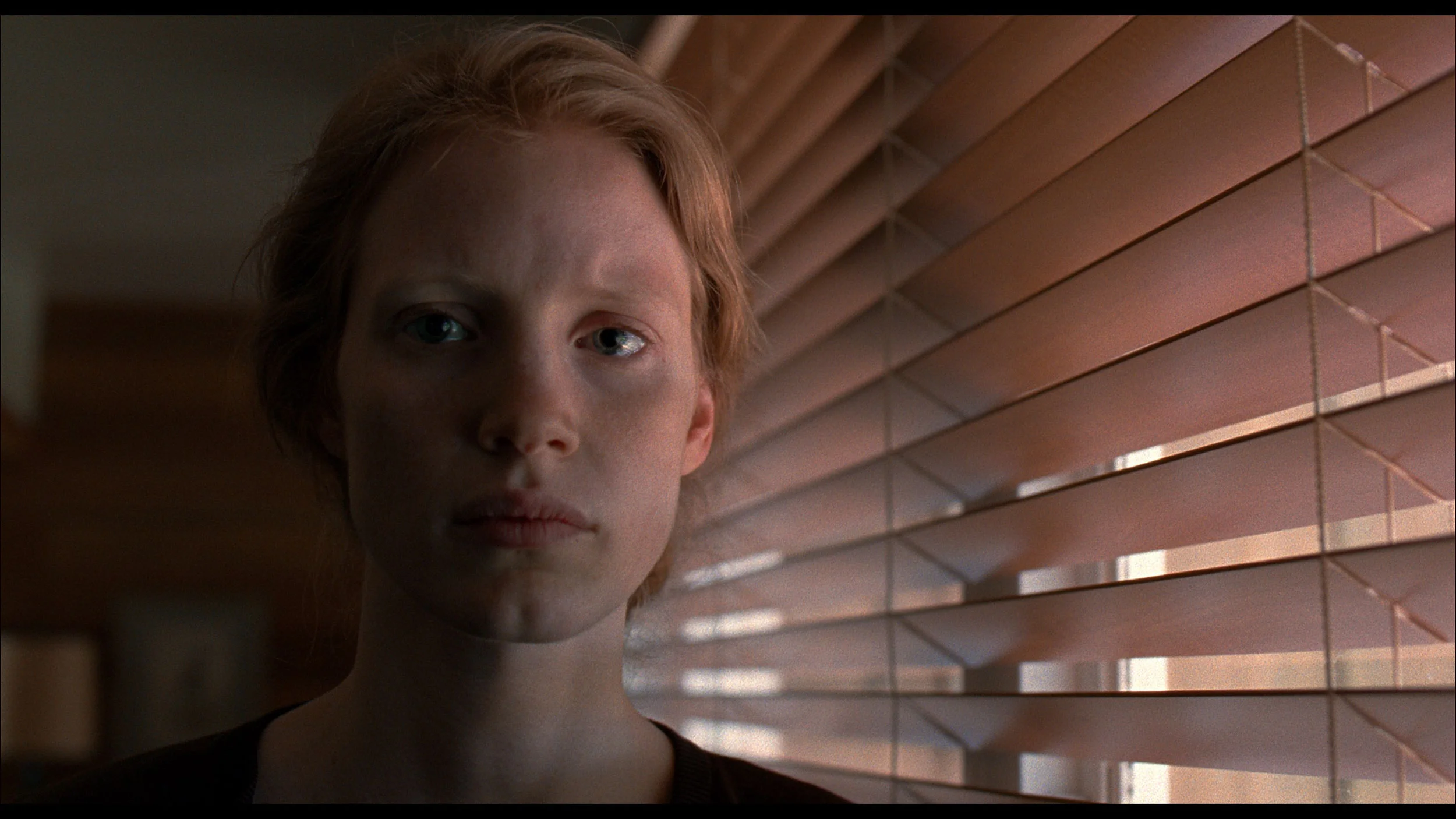
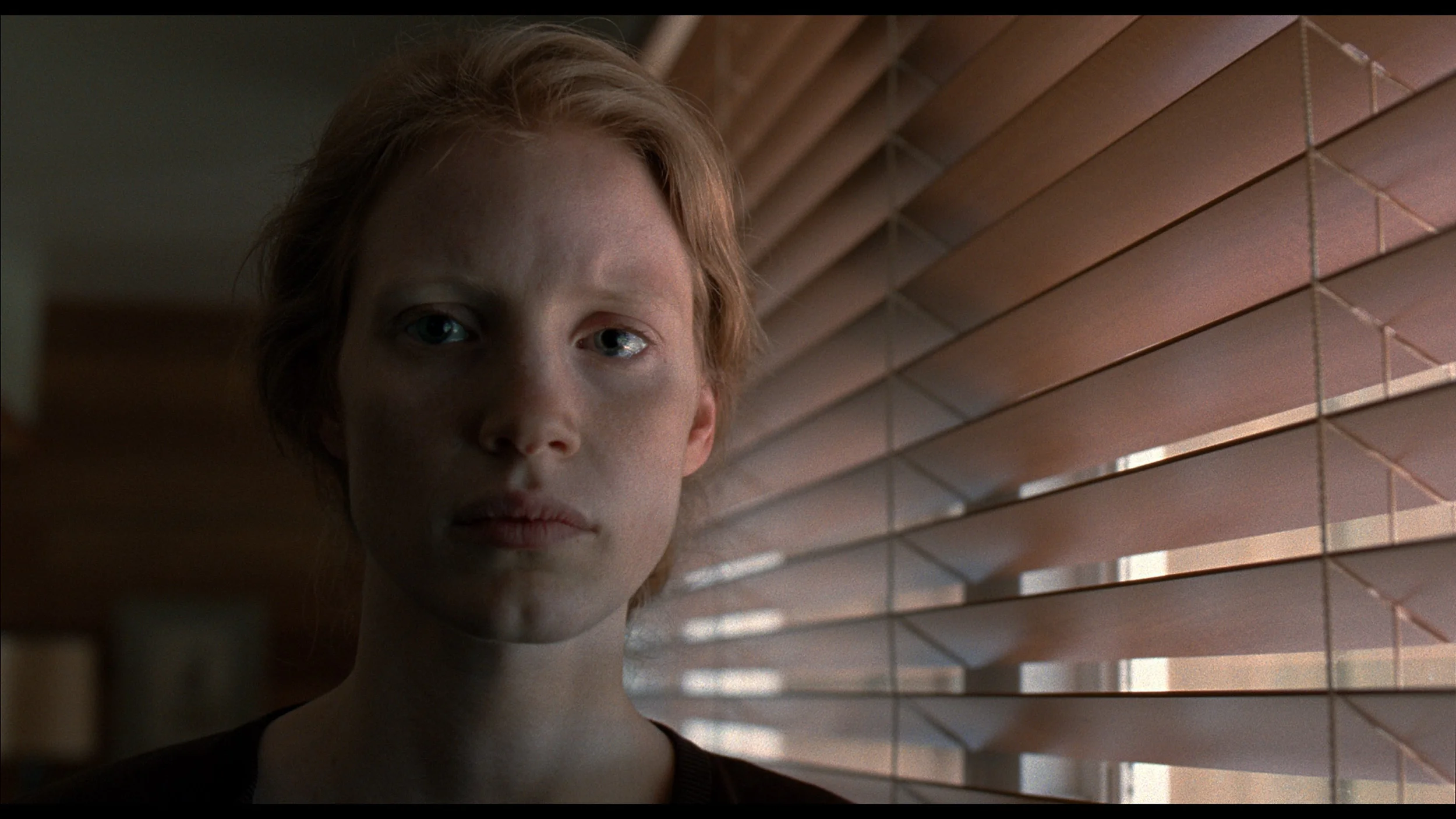
This gallery shows how colors change after professional TV calibration. If you notice the difference, we recommend ordering this service at SkalibrujTV.com.
Factory Mode
After calibration
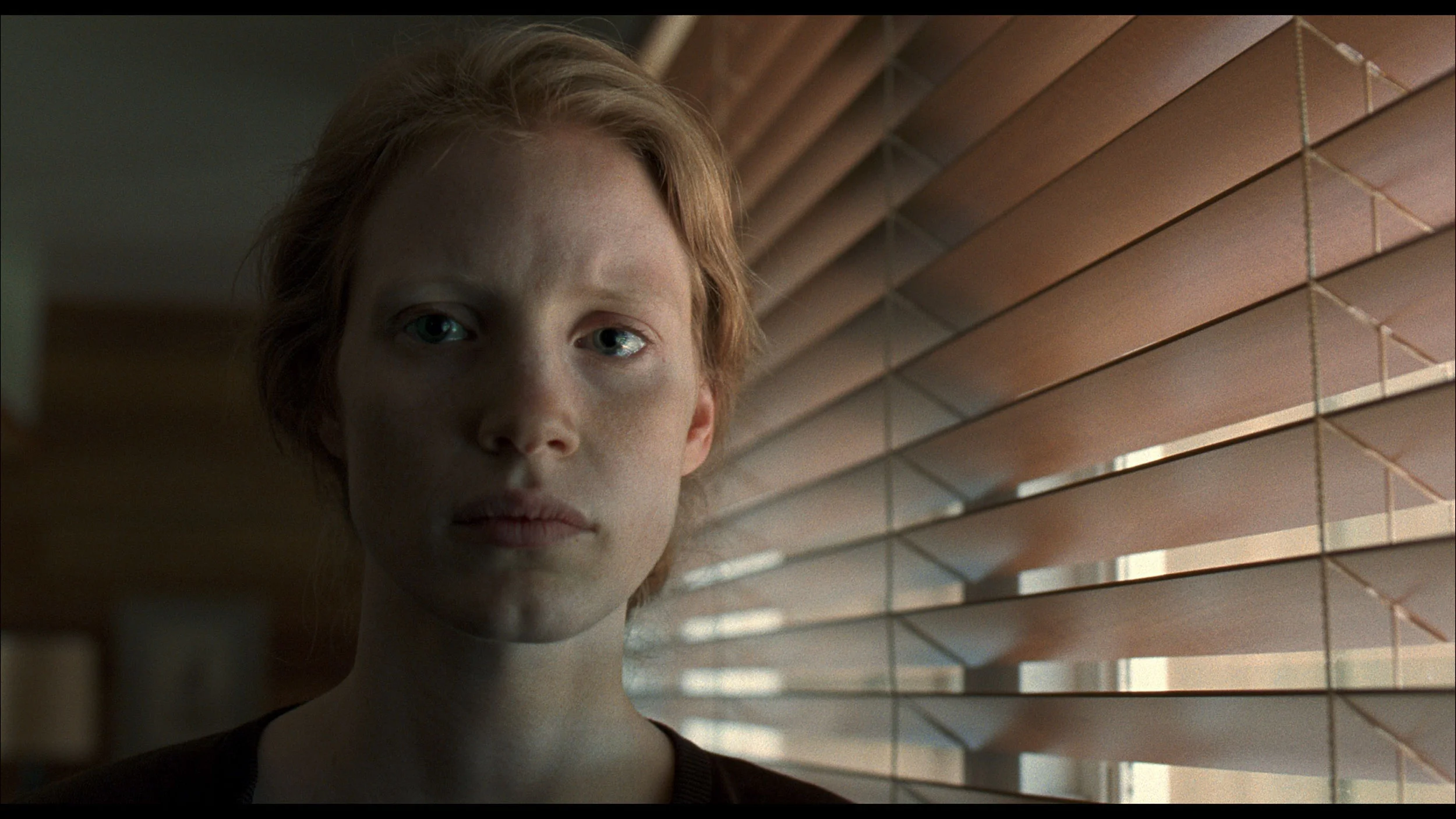
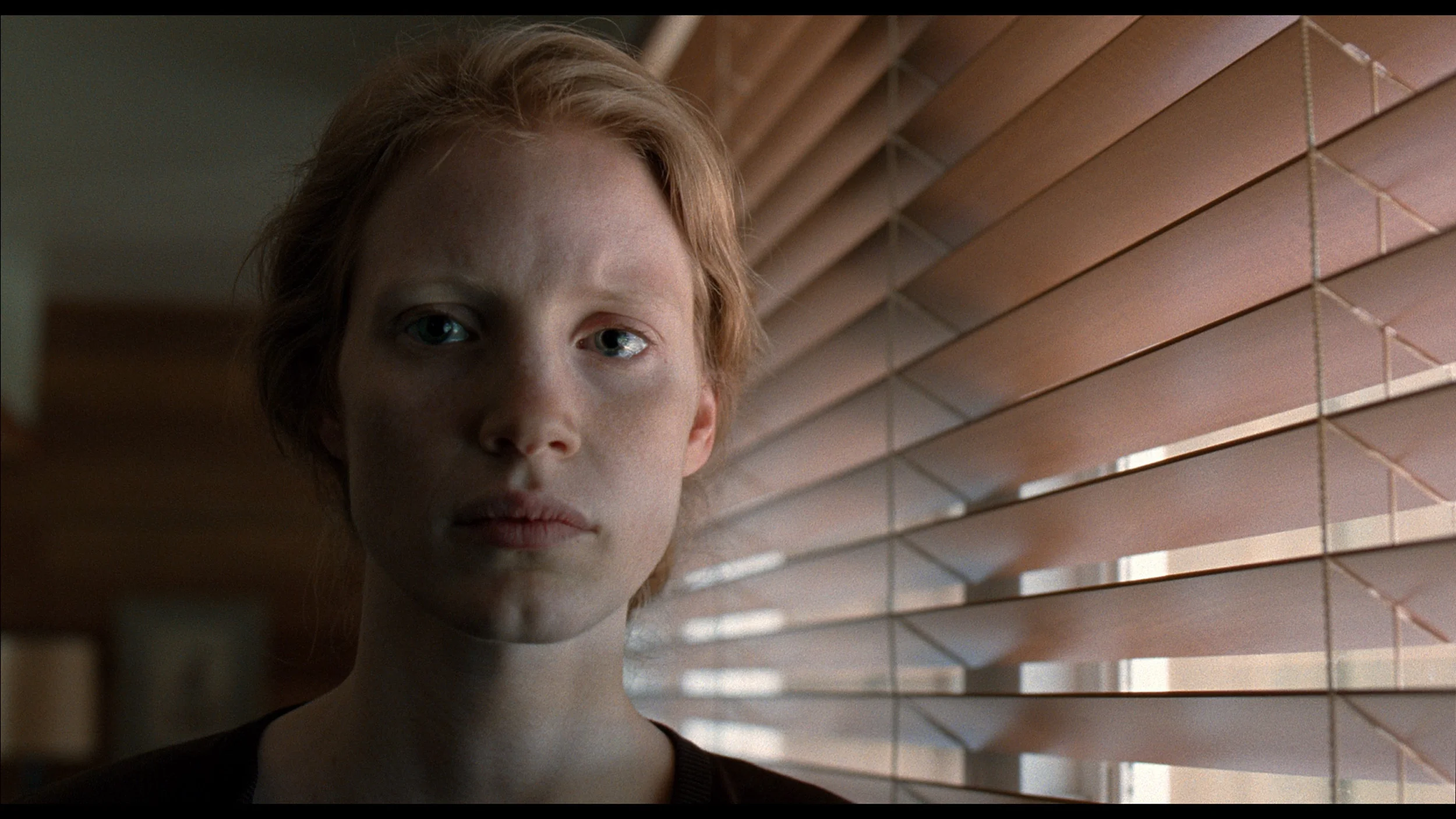
This gallery shows how colors change after professional TV calibration. If you notice the difference, we recommend ordering this service at SkalibrujTV.com.
Factory Mode
After calibration
We evaluate every television primarily based on its default cinema mode – in this case "Film" – which theoretically should be the "best" and most accurate right out of the box. Unfortunately, with the Haier M95E, the word "best" is absolutely not synonymous with the word "good." Even during SDR viewing, the picture revealed obvious issues: white balance skewed too much towards red, and excessive, unnatural color saturation led to visible color deviations. Worse still, the M95E also has trouble managing brightness (gamma curve), excessively darkening the entire scene. Such behavior is hard to commend, as it directly causes details in the shadows to blend into a black blob, which are irretrievably lost.
However, the real disaster struck after switching to HDR material while still remaining in "Film" mode. It's hard to guess who came up with such a fantastic idea – or perhaps it was simply a complete oversight of this stage by Haier's engineers – but the image, instead of cinema fidelity, began to resemble the bright "Dynamic" mode. The white balance exposed huge issues with the blue color, which in turn resulted in unnatural sharpening and artificial oversaturation of the entire scene. As if that weren't enough, the EOTF curve characteristics ruthlessly revealed that the television also has fundamental problems with local dimming management in this setting. We haven't calibrated many Haiers in our career, but we know for sure now that the M95E definitely needs it.
The factory settings of the OLED761's Film mode deliver a fairly pleasant picture, although colors are not completely neutral. In SDR material there is primarily a lack of blue, and in parts of the range red is reduced as well, causing whites and grays to take on a slightly yellow-green tint. You'll notice this most easily on neutral surfaces, which look warmer than they should. The colors themselves perform reasonably well, and most tested samples do not show large errors. So it's not a case where the tint completely changes the look of the movie you're watching. More attention is needed for how brightness is handled in SDR. Across most of the range the TV slightly darkens the image, which can make faces and background elements appear heavier and render details in darker areas less readable. At the same time, shades just above black are lifted. These two characteristics can occur together: the very deepest shadows become too visible while the rest of the scene is a bit too dark. In HDR a lack of blue is also visible, especially in the brighter parts of the image. Whites therefore take on a warm, yellowish tint that can be noticeable on clouds or snow. Darker tones have much better white balance, so the degree of this tint changes with scene brightness. Out of the box the OLED761 performs decently, but measurements show that white neutrality and how brightness is reproduced still require refinement through calibration.
Color reproduction after calibration
6/10
9/10


The photos show how movies look on the TV. Pay attention to black detail visibility, colors, and shadow tint.


The photos show how movies look on the TV. Pay attention to black detail visibility, colors, and shadow tint.
The calibration process left us with extremely mixed feelings. On one hand, we noted significant success in the area of colorimetry. Utilizing the options available in the menu, we managed to tame the white balance and bring it down to an acceptable level. As a result, SDR content was finally freed from the annoying red dominance, and the HDR image no longer resembled a vibrant, store demonstration mode. The entire color palette and its saturation were also clearly corrected – perhaps not perfectly, but to the extent that the software allowed, and the difference was visible to the naked eye.
Unfortunately, this is where our list of corrections basically ends, as M95E simply did not allow for more. As we indicated earlier, most settings related to image brightness do not respond to our commands at all. This means we were unable to control its fundamental characteristics in any way – neither the gamma curve nor the EOTF. In practice, the television in SDR content still tends to darken details, which was confirmed by the inflated gamma, merging details in the shadows. On the other hand, the EOTF curve in HDR mode still mercilessly exposed all the previously mentioned issues with chaotic local dimming zone management. And while the calibration process itself yielded quite a lot, removing most of the color issues, ultimately we had to capitulate.
After calibration the Philips OLED761 performs very well. The white balance was set almost perfectly, removing the previous color cast, so faces, whites and grays look more natural. The improved gamma means the image is no longer unnecessarily dark and it's easier to see detail in darker areas. Colors are reproduced with high accuracy, which, combined with deep blacks, produces a very pleasing picture for evening movie watching. It's clear that even Philips' entry-level OLED has considerable potential that is worth exploiting by fine-tuning the settings. In HDR the luminance response tracks the reference closely over most of the range, so most scenes retain their proper appearance. There is a slight lift in tones just above black and a tendency to render the brightest highlights a bit too strongly. These are, however, observations about specific parts of the image. In the most demanding shots some bright detail may still be missing, but the overall result after calibration is decidedly successful. The OLED761 can deliver a natural, well-balanced picture that lets you focus on the movie.
Smoothness of tonal transitions
9.4/10
7.4/10
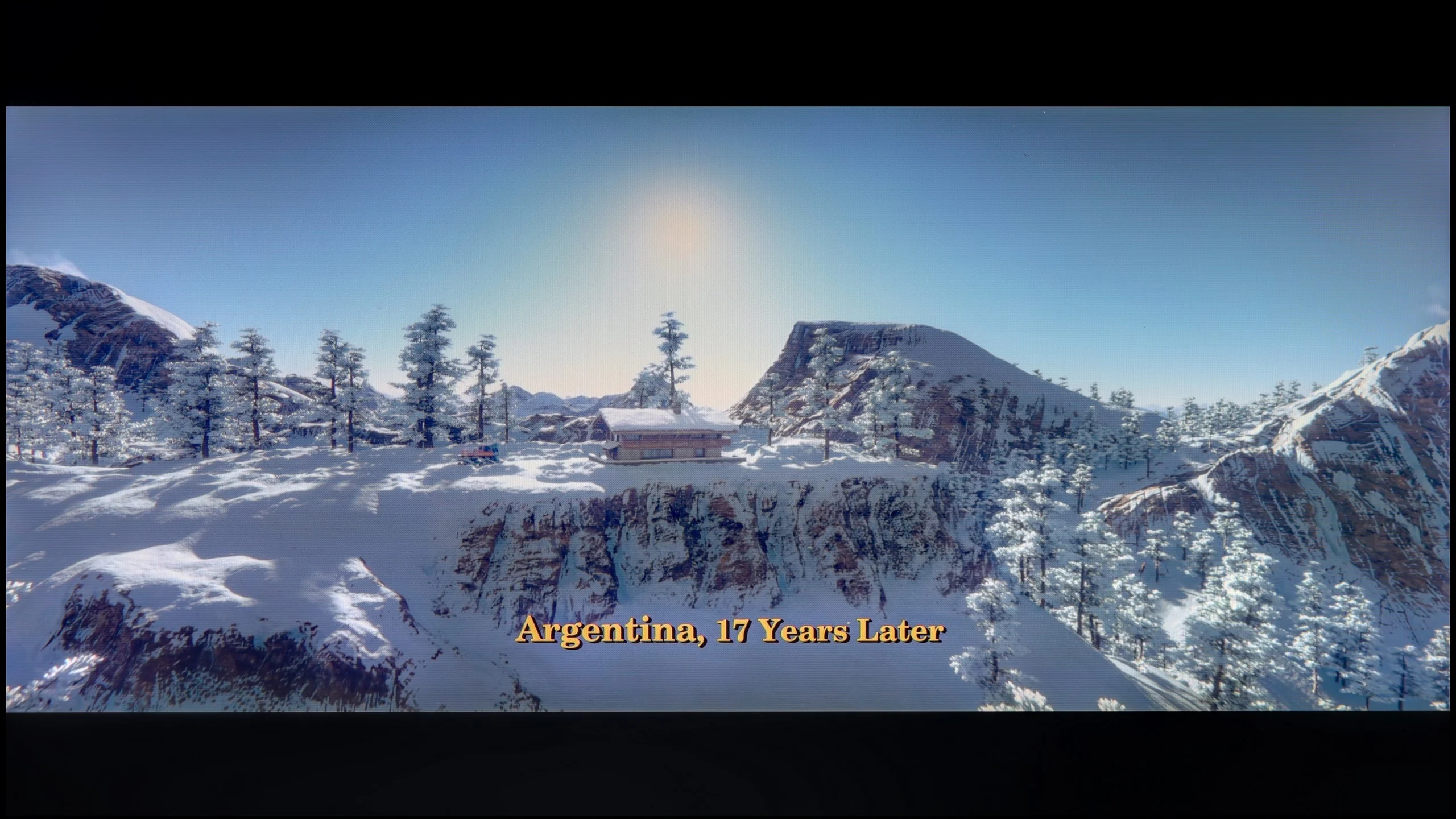

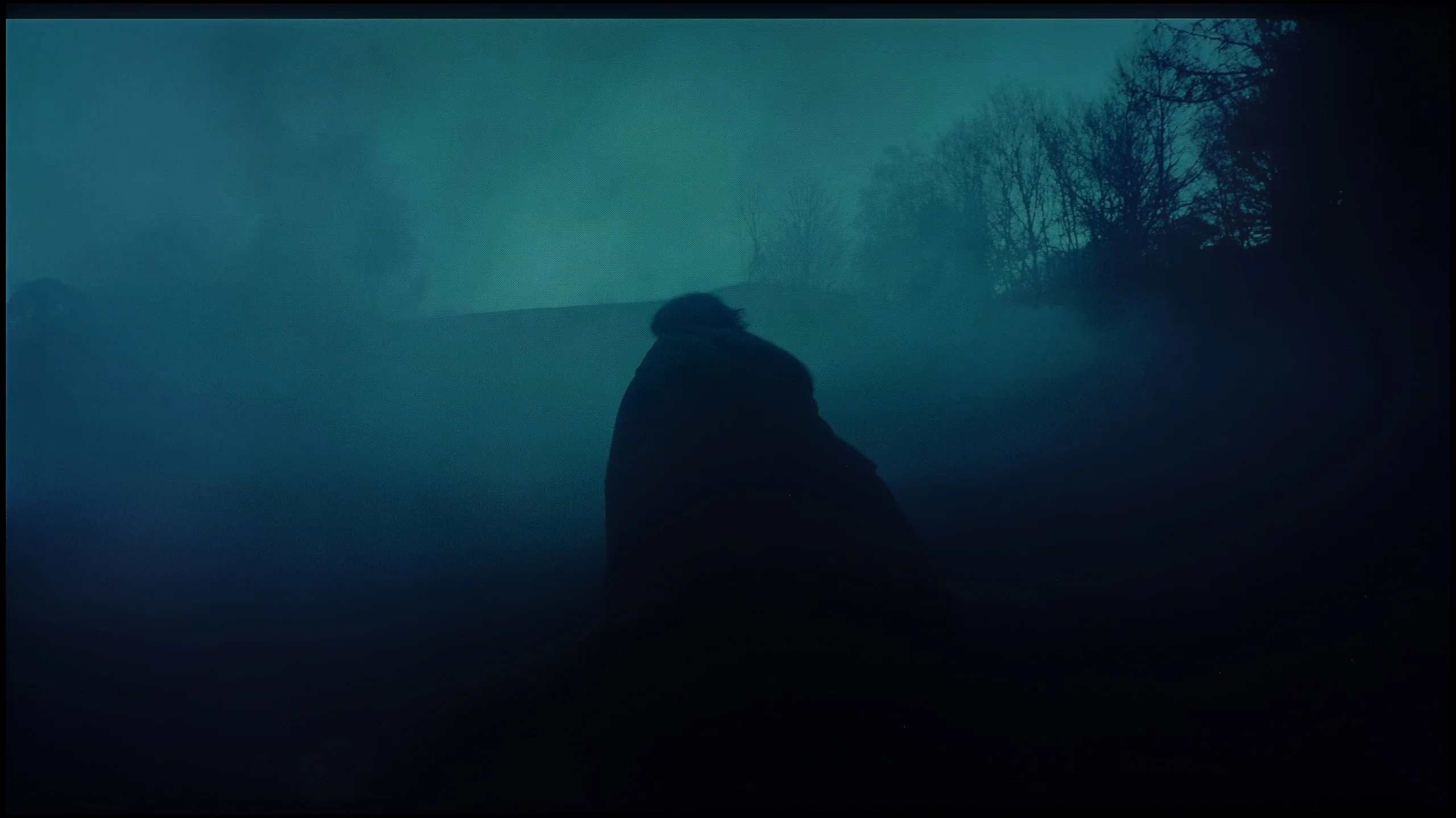


These are selected scenes that show smooth tonal transitions from one color to another. If you see distinct banding, it’s the TV panel’s fault.

These are selected scenes that show smooth tonal transitions from one color to another. If you see distinct banding, it’s the TV panel’s fault.
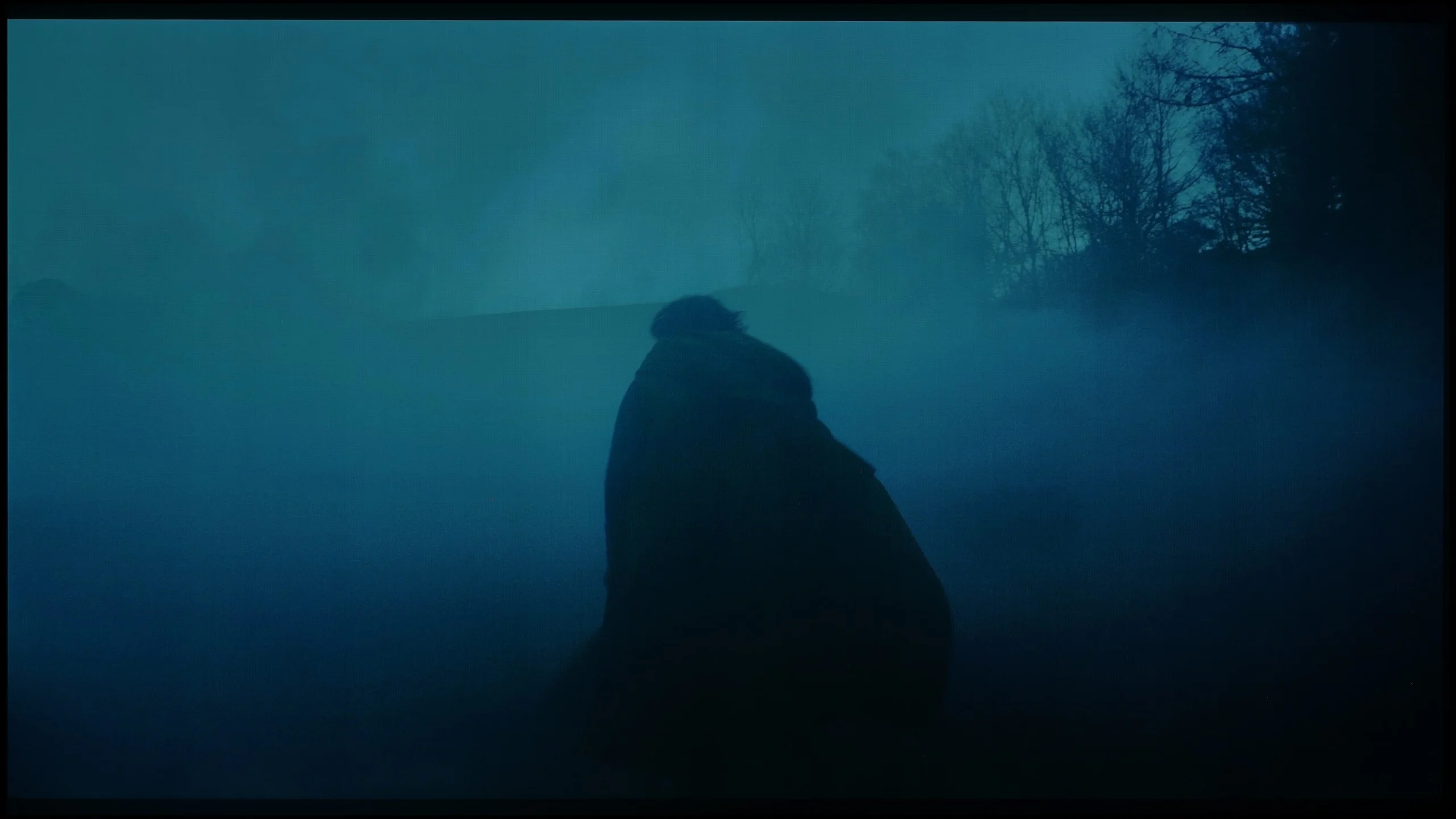
These are selected scenes that show smooth tonal transitions from one color to another. If you see distinct banding, it’s the TV panel’s fault.

These are selected scenes that show smooth tonal transitions from one color to another. If you see distinct banding, it’s the TV panel’s fault.
We are now moving on to a category that has proven to be one of the strongest aspects of the tested model. The fluidity of tonal transitions, or the ability to smoothly blend closely related shades, is at a very high level here. The Haier M95E excels at reproducing gradients, even in the most demanding, dark scenes, where many TVs can show unsightly banding (posterization). Although we did notice minimal shortcomings in very bright parts of the image, these are issues that are so symbolic that they do not ruin the overall, excellent impression. In this specific competition, the M95E deserves one of the highest ratings on our portal.
Philips OLED761 handles tonal transitions quite well, although on bright gradients you can notice slight boundaries between shades. They appear in most of the bright shots we checked, but are subtle enough that during normal viewing they shouldn't draw too much attention away from the movie. In darker scenes the imperfections are most visible during gradual fades to black and in the shot with red water, where the color transitions could be smoother. More than the gradation itself, panel nonuniformity can be more distracting. In dark scenes it shows up as fairly distinct bands, which make a uniform background look less even than it should. That's a different issue than the visible boundaries between shades, although the two can overlap during a viewing. We've seen similar banding so far in every OLED we've tested with the new WOLED SE panel, so this isn't a problem unique to the OLED761. The severity can vary between units.
Image scaling and smoothness of tonal transitions
5/10
7.5/10

Smooth transition function
The match photo shows how the TV smooths weak tonal transitions in low-quality video.
Image scaling SD (576i)


The model photo shows how it handles upscaling of SD material.
Well, what happens with those color transitions when lower quality material full of compression artifacts comes on screen? Unfortunately, we have some bad news for you. Although we can find an option in the menu responsible for smoothing tonal transitions in older content, we definitely DO NOT RECOMMEND using it. Its activation causes a barrage of additional, ugly artifacts, noticeably blurring the entire image, and the funniest part – it often doesn’t even remove those unwanted “stairs” it was supposed to fight against. This feature might as well not exist at all.
We can write many more positive things about the overall upscaling, which is the process of raising lower resolutions to the native 4K matrix. The image after upscaling looks really good – it's neither overly jagged nor artificially smoothed. In this particular matter, the M95E simply delivers.
Philips OLED761 does a pretty good job of improving lower-quality material. Its Pentonic 800 processor effectively smooths visible transitions between shades, which often appear in heavily compressed footage. This is handled by the "Artifact Reduction" setting. When enabled, banding on a uniform background becomes less noticeable, and importantly this doesn't come at the cost of noticeably blurring fine detail. It's a feature worth using when the source quality leaves something to be desired. The upscaling itself has the characteristic Philips softness: lower-resolution material looks fairly gentle, and fine elements and edges lack a bit of sharpness. In the shot with the model you can see this in the hair and thin branches, which could be more clearly defined. A plus is the lack of overscan, meaning the edges of the image aren't cropped. Even with a low-resolution signal the TV shows the full frame.
Blur and motion smoothness
6.5/10
8.5/10
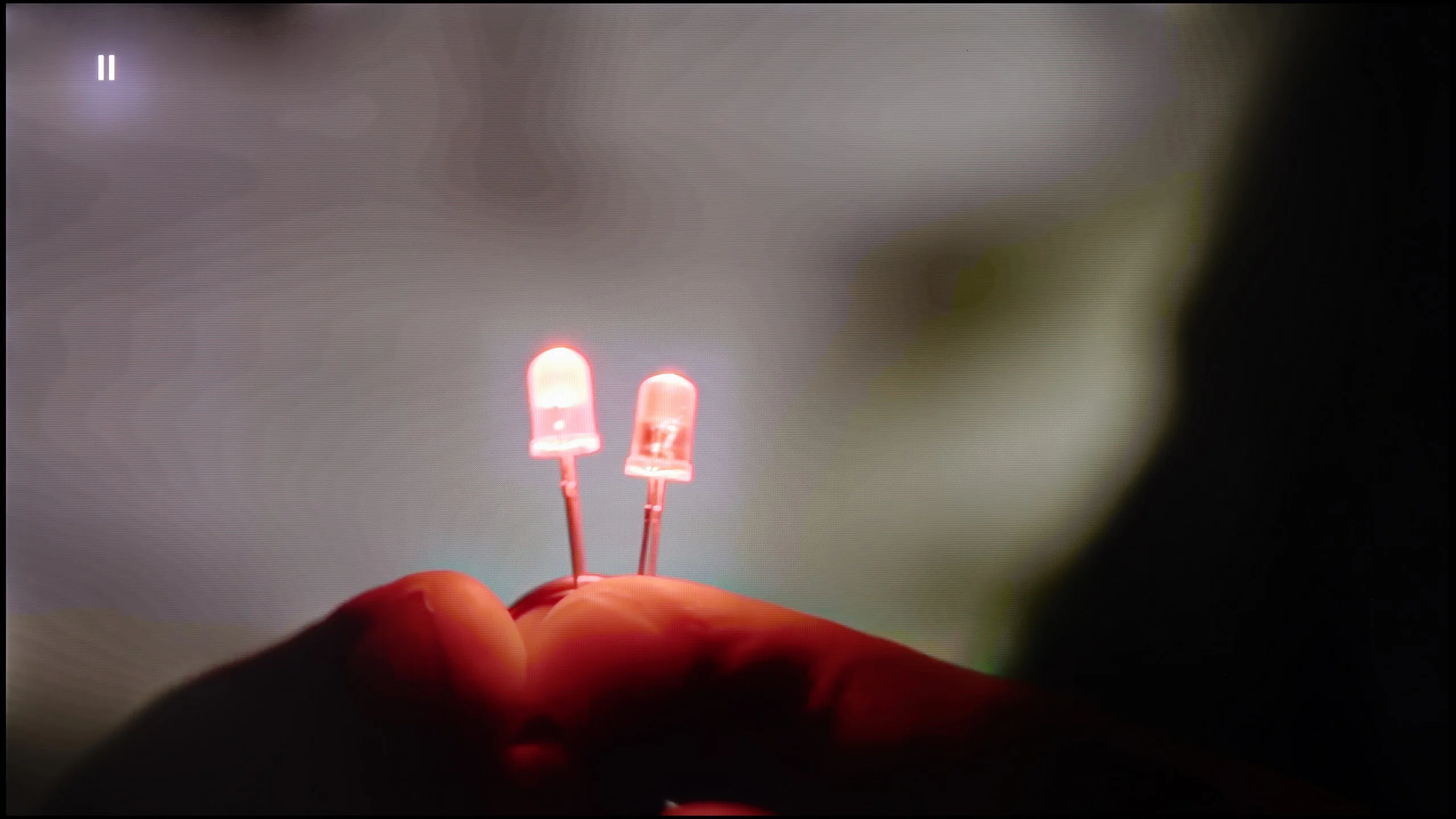
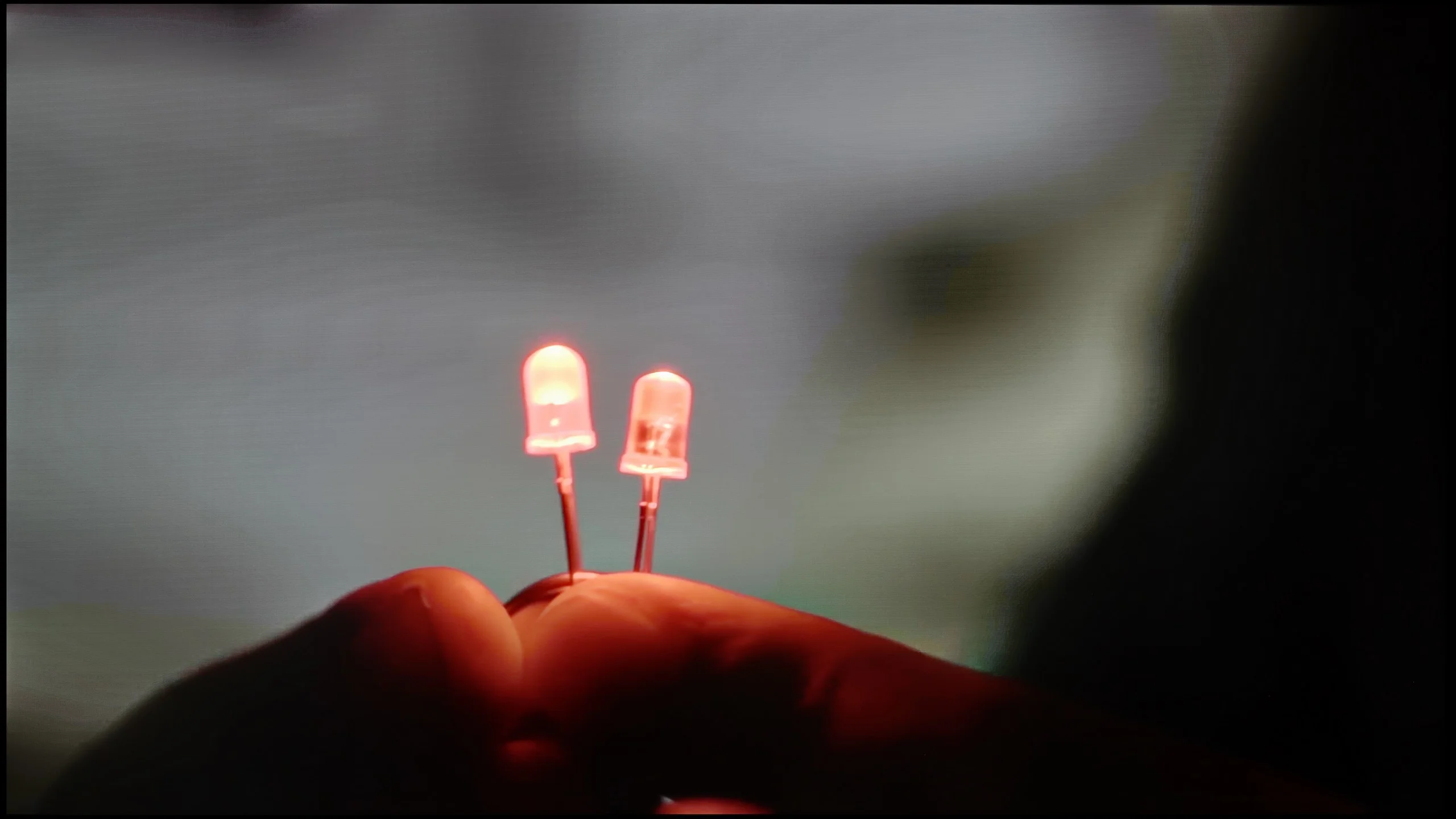
Blur (native resolution, maximum refresh rate):






Blur (4K@144Hz):



Blur (4K@60Hz):



When it comes to motion fluidity and ghosting, our feelings are quite mixed because the M95E is a paradoxical television. Let’s start with the absolute delights: the heart of the device is a 144Hz panel, but what truly impresses is its performance with 120Hz content, which is crucial for sports and console gaming. We must state with full responsibility that Haier has equipped the television with one of the best VA panels currently available on the market when it comes to minimizing ghosting. It is rare to encounter an LCD panel that offers such clean, sharp, and ghost-free motion. In this respect, the M95E is simply phenomenal.
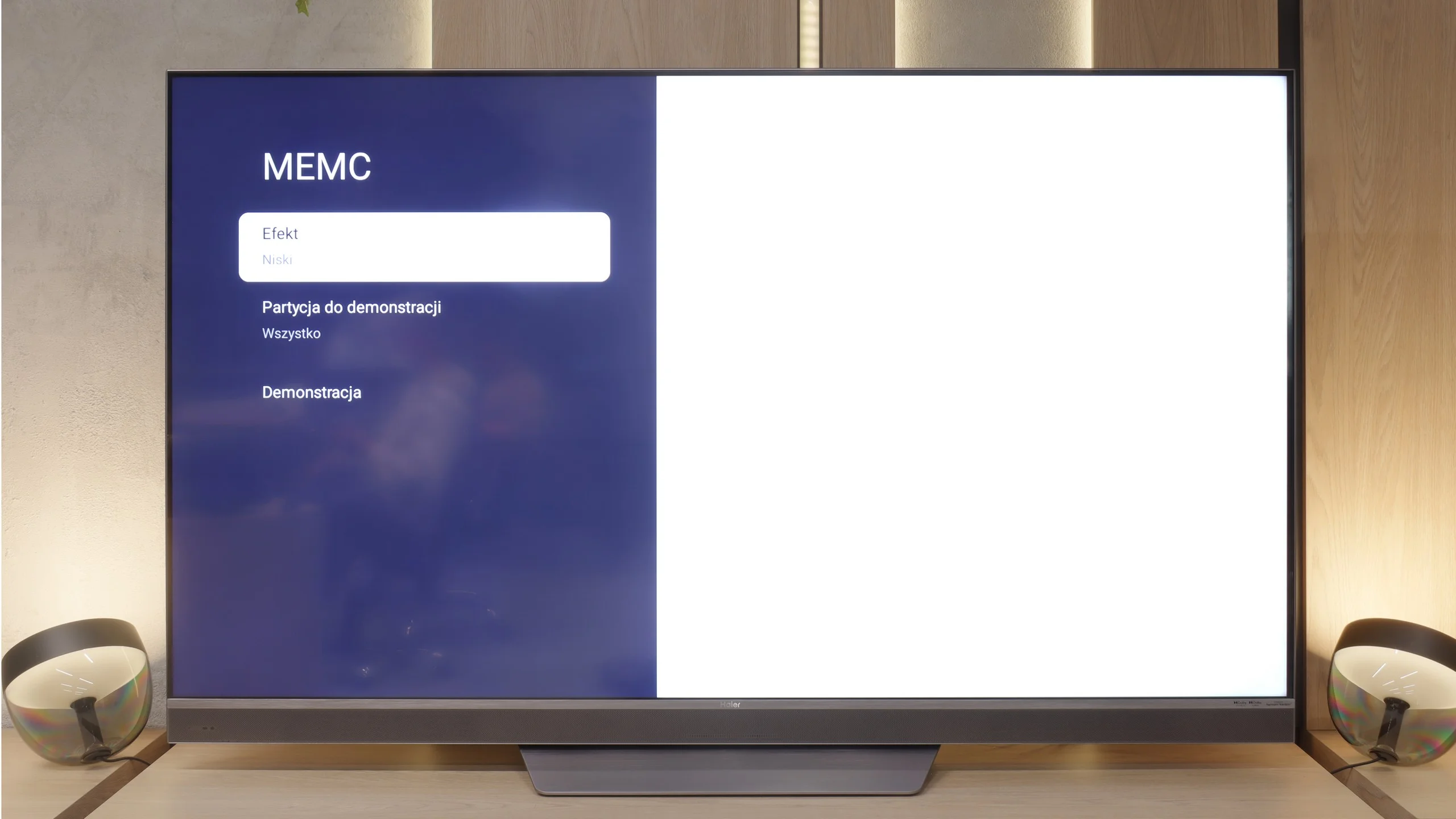
And this is exactly why the unpleasant surprise waiting for us on the software side is so painful. It turns out that this fantastic hardware potential is completely untapped, as the television practically offers no functioning options for improving fluidity. The smoothing systems, which should assist with lower frame rate content, can indeed be found in the Menu but essentially do not respond to our settings. The conclusion is brutally simple: if you intend to watch high fluidity material, you must be sure that the source is transmitting it natively at 120. In every other case, you must resign yourself to a rather raw, choppy image because the M95E will not help smooth it out in any way.
Philips OLED761 performs very well in fast-moving scenes. Thanks to the pixels' instantaneous response, moving objects leave virtually no trailing, which both sports viewers and gamers will appreciate. The 120 Hz panel also preserves good motion clarity, as seen in the UFO test: edges remain clear whether an object moves across a bright or dark background. With a 60 Hz signal there is more blur, but that is mainly due to how motion is displayed at the lower refresh rate, not because of a slow panel response.
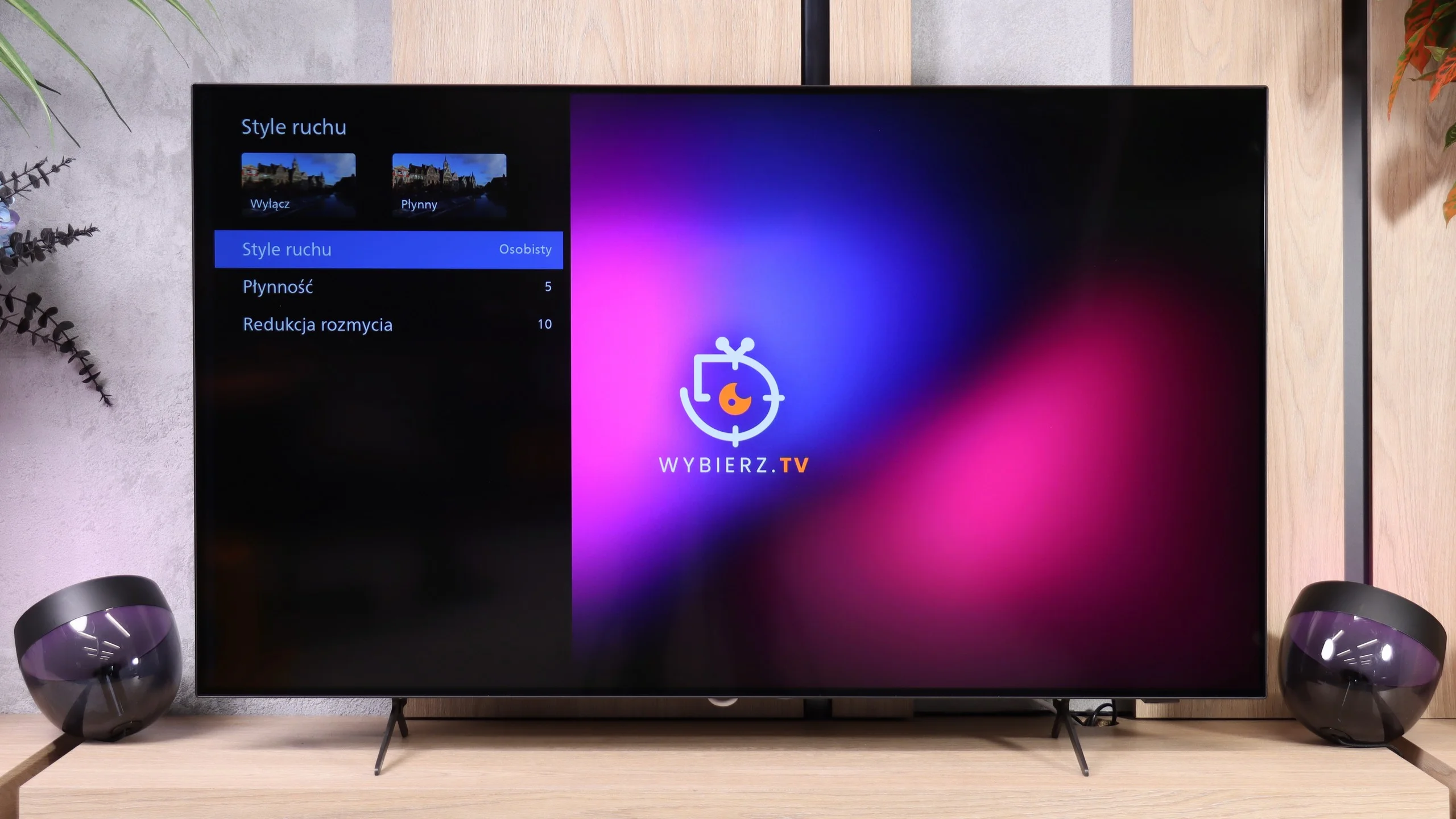
When watching films you can use the "Motion Styles" settings, which include the "Smoothness" and "Blur Reduction" sliders. They let you tailor the image to your preferences, from preserving characteristic cinematic motion to heavily smoothing it. A slight increase in smoothness is especially helpful for slow camera moves, which can look jumpy on a fast OLED. There is no BFI function, that is, black frame insertion to improve motion clarity, but even without it the OLED761 performs very well in this area.
Console compatibility and gaming features
8.1/10
10/10
- ALLM
- VRR
- VRR range48 - 144Hz40 - 120Hz
- Dolby Vision Game Mode
- Correct implementation of HGIG

- 1080p@120Hz
- 1440p@120Hz
- 4K@120Hz
- Game bar
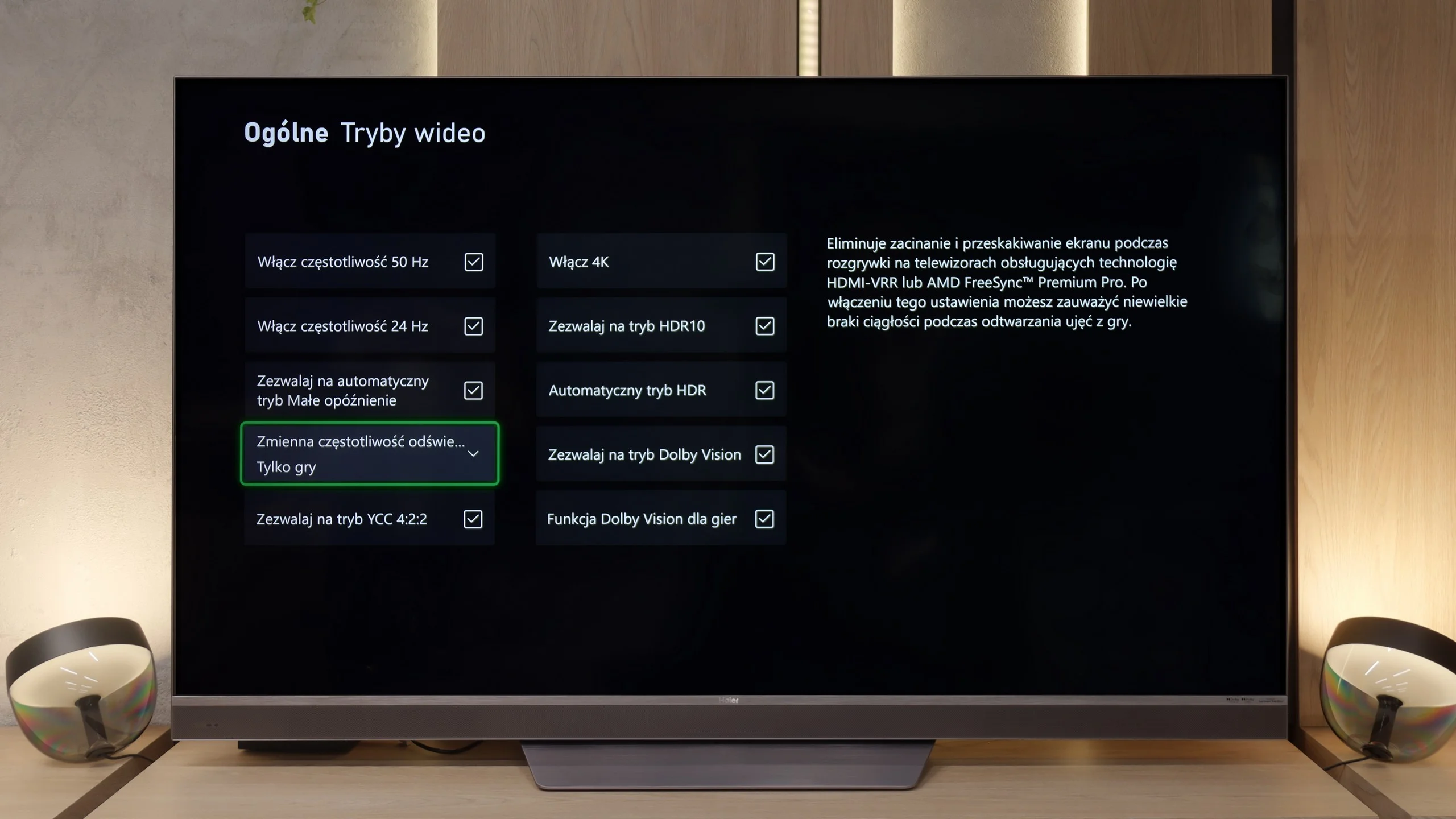
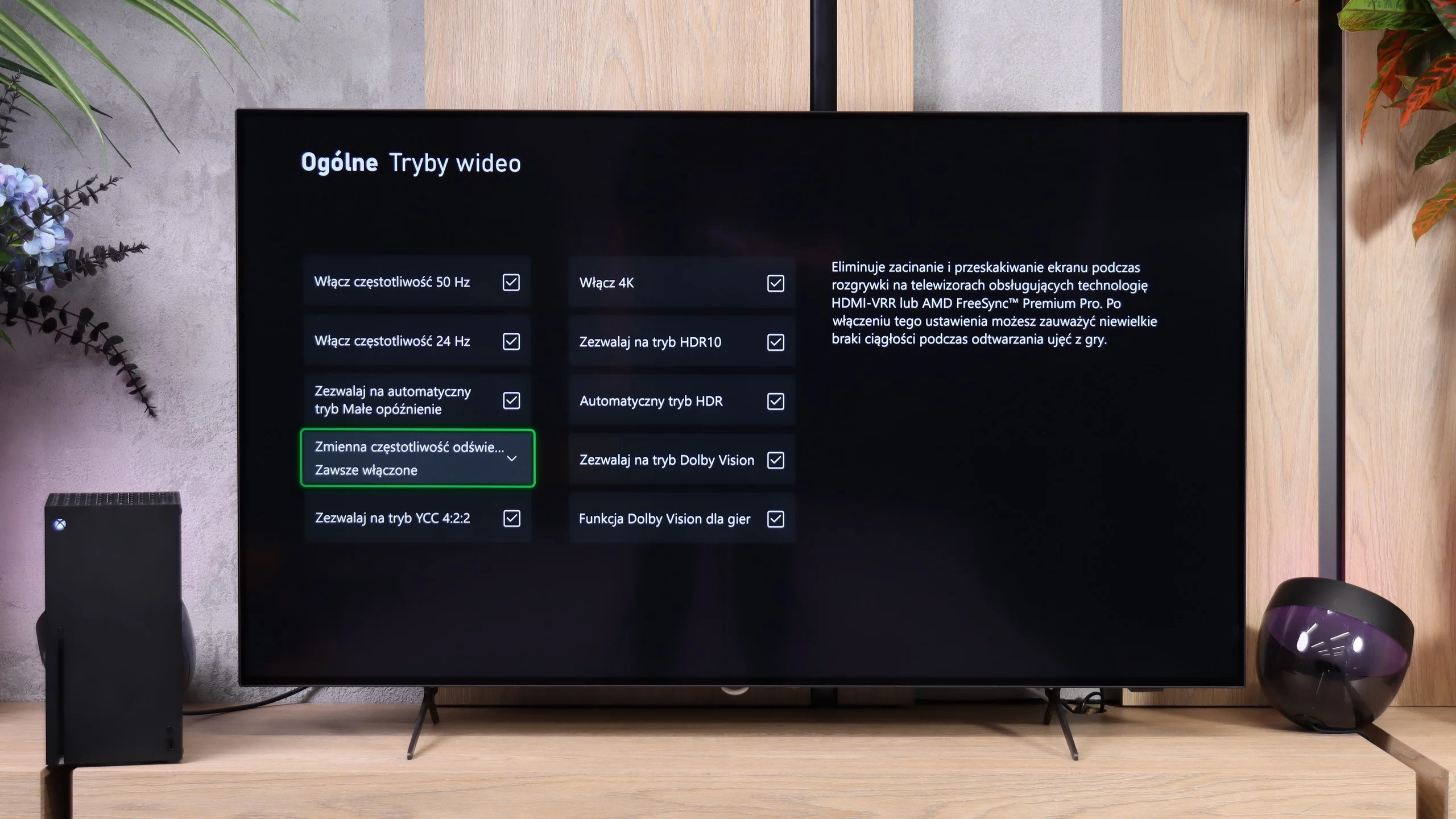
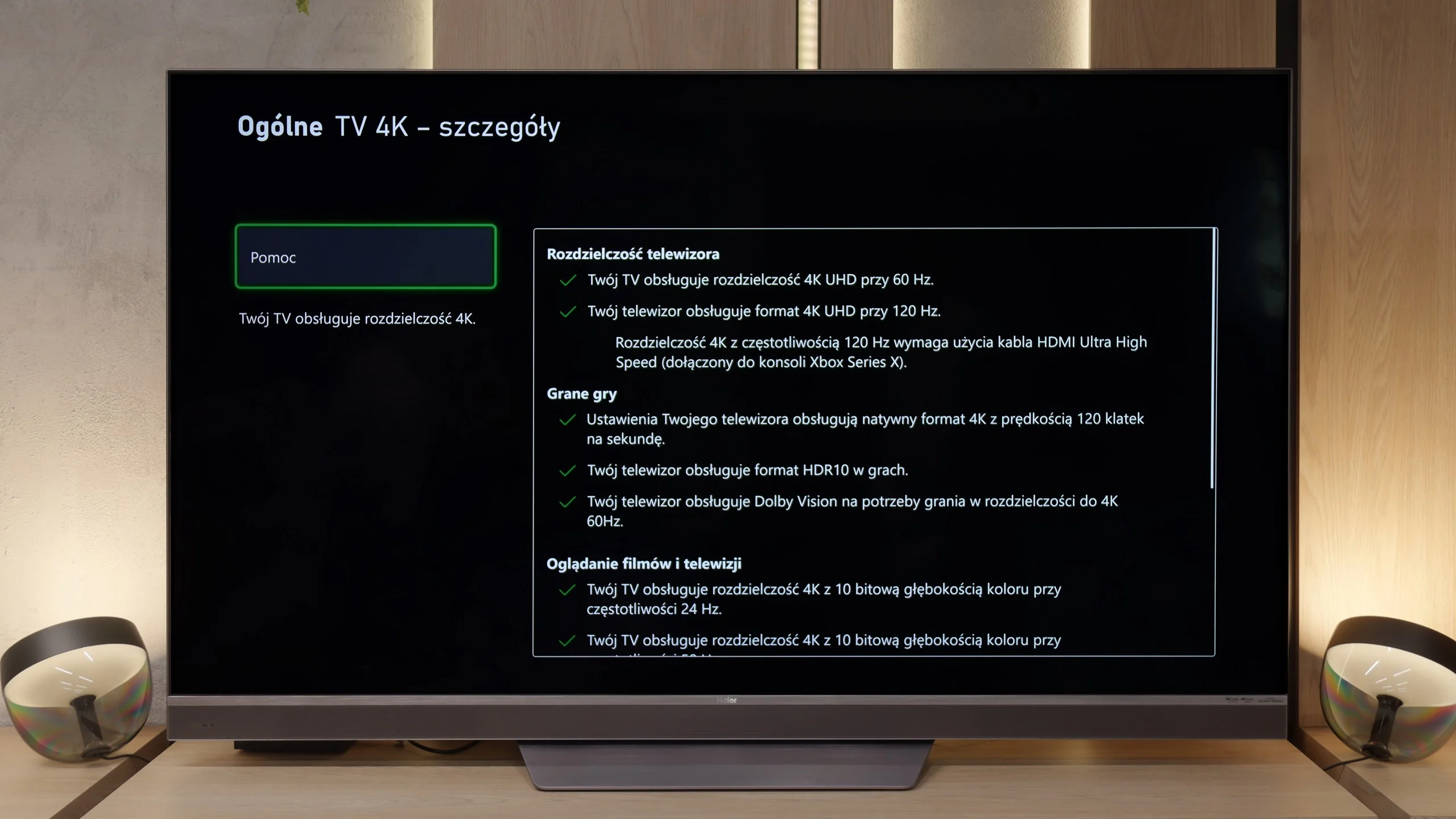
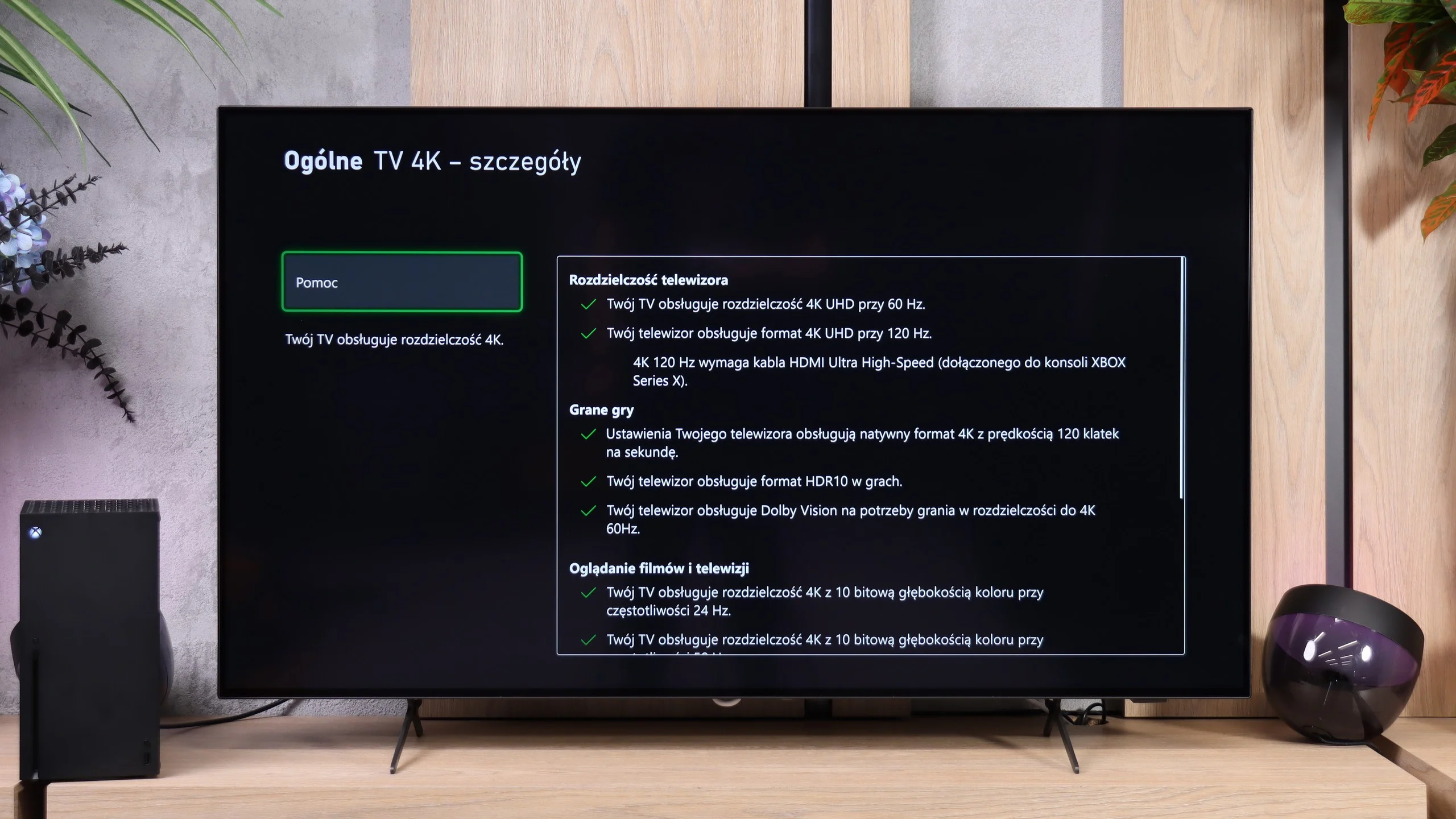
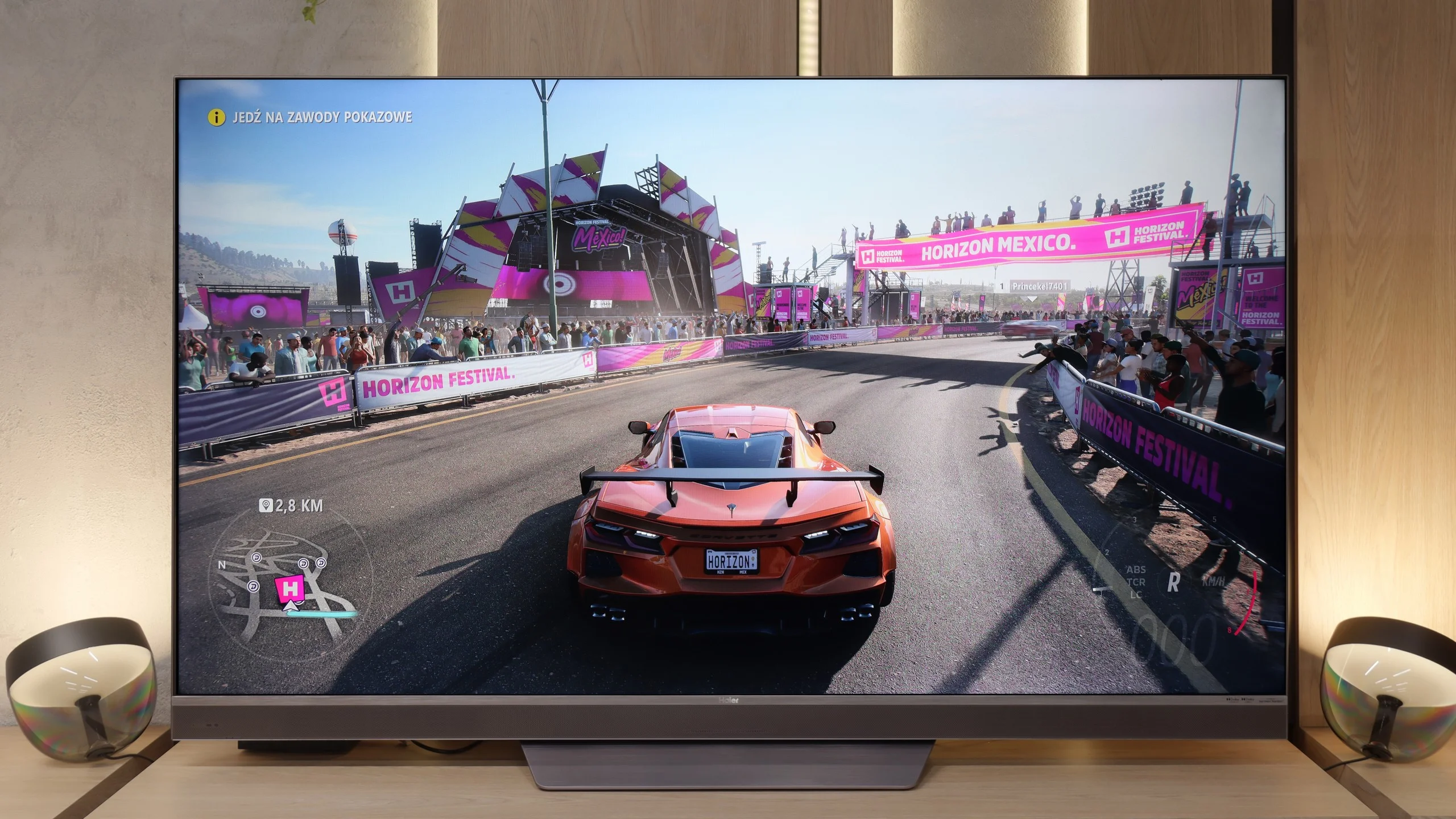
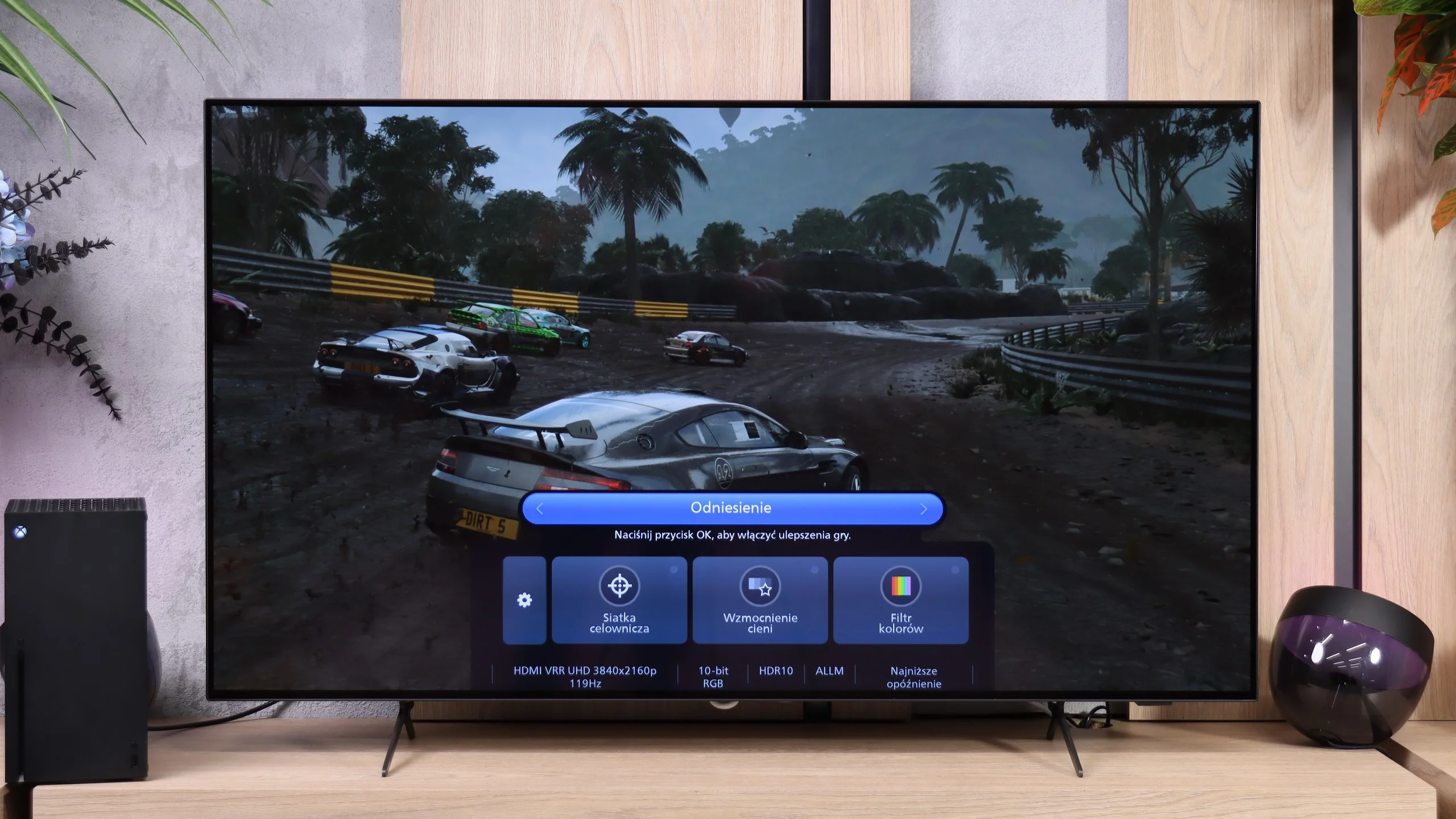
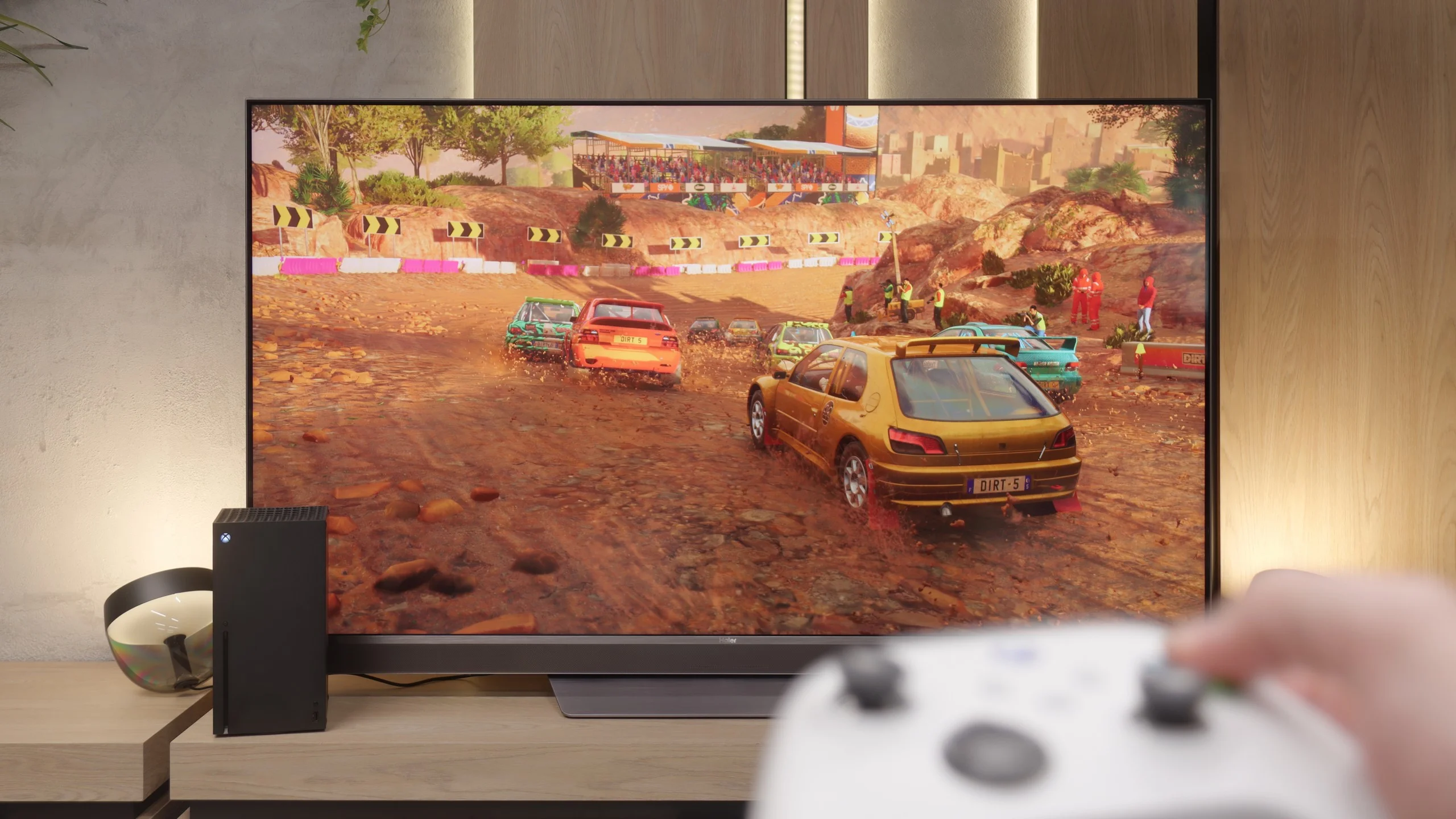
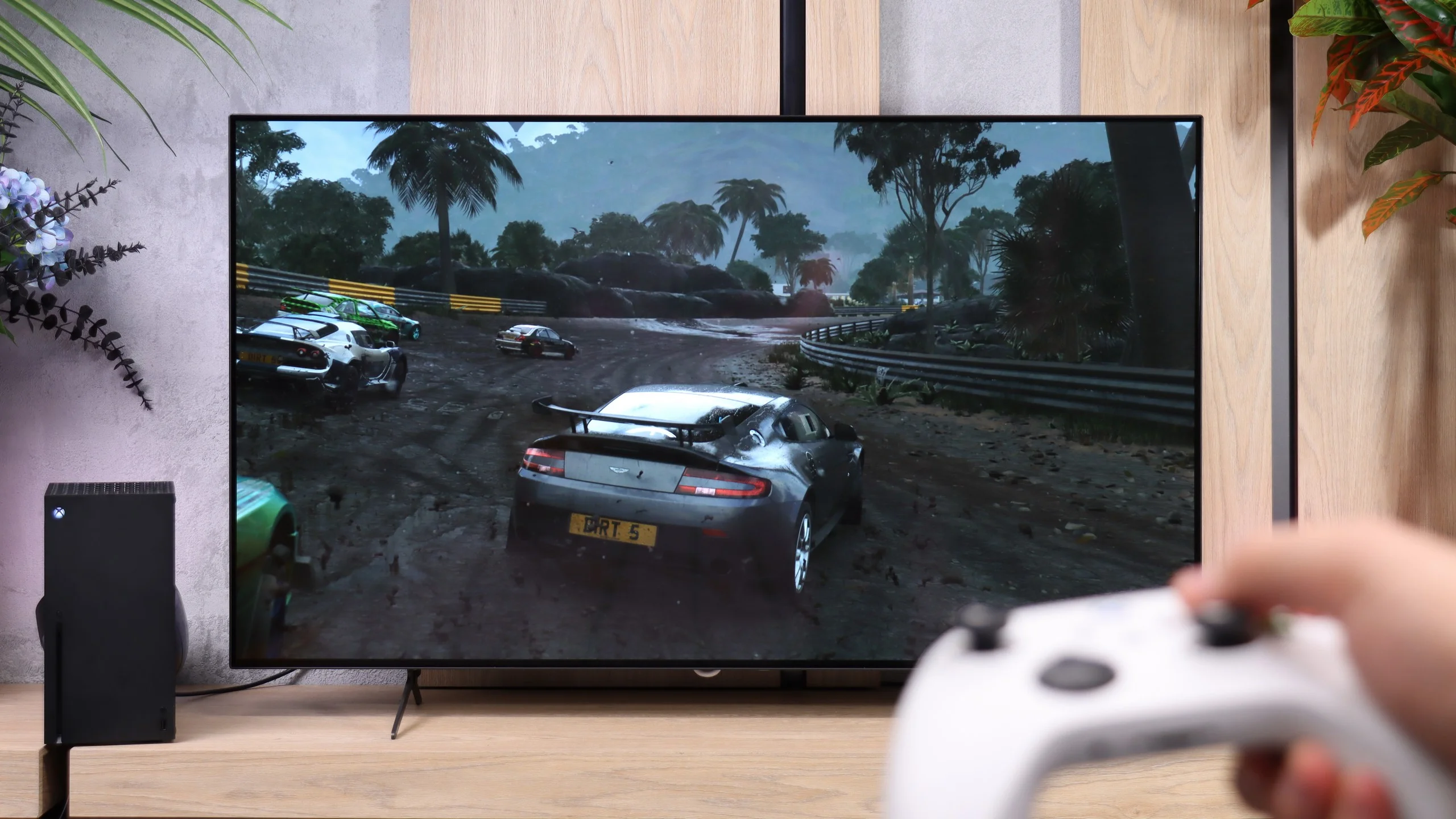
When it comes to features for gamers, the Haier M95E presents some really strong arguments. First of all, it is fully ready for the new generation of consoles and powerful PCs. It is equipped with two full-fledged HDMI 2.1 ports, which handle 4K signals at 120Hz effortlessly and even allow for gaming at 144Hz. This is a foundation that guarantees us full utilization of the potential of our equipment. Moreover, the key technologies work flawlessly here. The television accurately detects the console and automatically switches to low latency mode (ALLM), so we don’t have to dig into the settings. The frame synchronization (VRR) also works smoothly, eliminating the annoying tearing of the image when the game's fluidity slightly drops. Considering the remarkably low motion blur of the panel, which we have already mentioned, the M95E creates a truly comfortable and responsive gaming environment. Of course, this is not a perfect package. A dedicated "Game Bar," which would be a handy menu for gamers, would be a nice addition, but in essence, it is just a nice extra. A more serious shortcoming is the lack of support for the HGiG standard, which complicates the ideal HDR configuration on the console and can lead to overexposures. Despite these shortcomings, the basic "gaming package" offered by the M95E is really solid and fully functional.
Although the OLED761 is Philips' cheapest OLED this year, there are few compromises in its gaming features. The TV supports 120 Hz gaming in Full HD, 1440p, and 4K, so it can take advantage of high frame-rate modes on consoles. The fast OLED panel complements this well, so even during fast-paced gameplay you don't see smearing or trailing behind objects. When the console doesn't hold a steady frame rate, VRR operating from 40–120 Hz helps. The image doesn't tear during quick camera turns, and frame-rate fluctuations are less noticeable.
Philips also took care of convenience. When you start a game, the TV can automatically switch to a low-latency mode, and the most important settings are found in the handy Game Bar. You can check image parameters there, enable an on-screen crosshair, or brighten shadows if it's hard to spot an enemy in a dark area. The Game Bar itself may not be the flashiest on the market, but it does the job. There's also support for Dolby Vision for games and a properly implemented HGiG, which helps match the console's HDR settings to the screen's capabilities. So in terms of features, the OLED761 offers a lot.
Input lag
9.8/10
9.4/10
SDR
HDR
Dolby Vision
The key parameter for any player, often more important than colors or contrast, is responsiveness. In this category, Haier M95E shows no mercy. The input lag we measured for the 120Hz signal was below 10 milliseconds. This result is among the absolute market leaders, placing this model on par with dedicated gaming monitors. In practice, this means an immediate reaction to every movement of the controller, keyboard, or mouse.
Input lag on the OLED761 depends not only on the refresh rate but also on whether you're playing in SDR or HDR. SDR performs best: we measured 14 ms at 60 Hz and just 5 ms at 120 Hz, both in Full HD and 4K. Those are excellent results that let you enjoy quick controller response even in fast-paced games.
With HDR enabled the lag rises to 31 ms at 60 Hz and 13 ms at 120 Hz. Dolby Vision at 60 Hz gives a similar result of 30 ms. You can still play comfortably, especially in more relaxed titles, but it's a shame that turning on HDR comes with this drawback.
Compatibility with PC
6.6/10
7.6/10
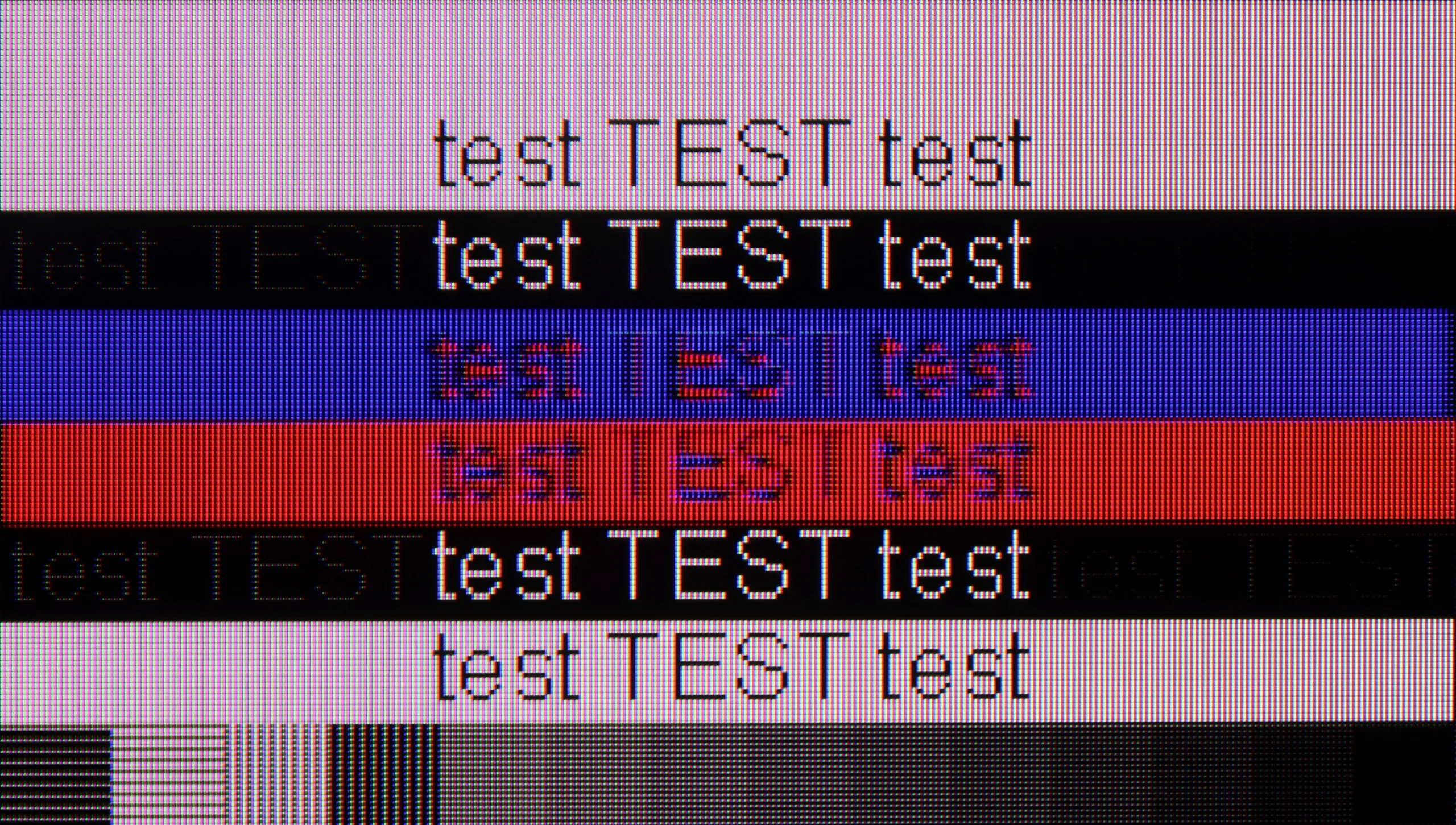
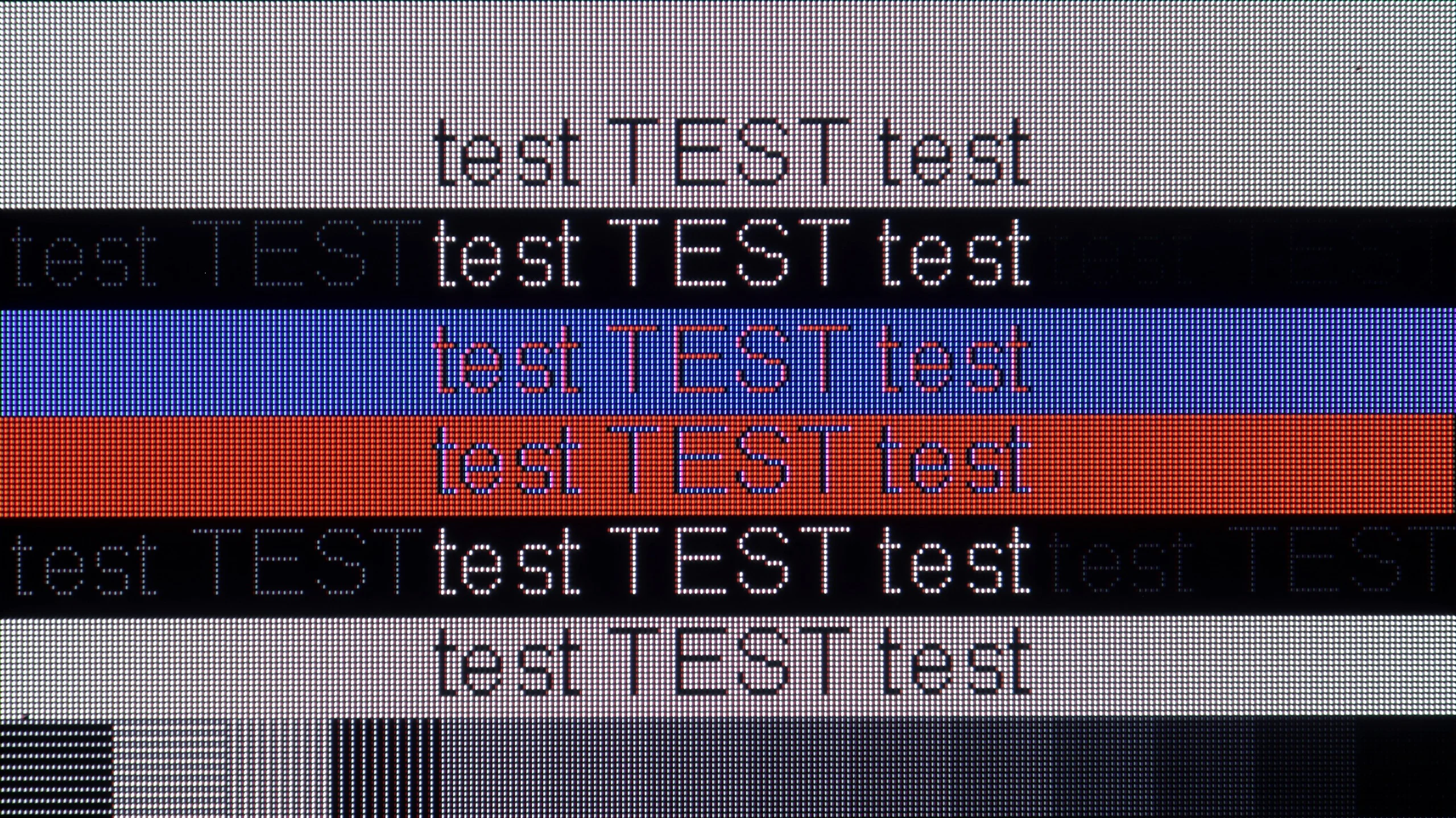
The photo shows the legibility of small fonts. Ideally, lines should be the same thickness on both light and dark text, with minimal pixel gaps.
As a monitor for PC gaming, the M95E performs really well. We have full support for 144Hz, there's VRR, and therefore, G-Sync works as well. In this regard – it's great. That's probably why our "average" rating in this category surprises you. The reason is simple: while it excels at gaming, regular text work is not its forte. When set to 120Hz or 144Hz, the TV's ability to display text is, to put it bluntly, poor. The text is blurry, and the colored letters become fuzzy due to the lack of full support for Chroma 4:4:4. Interestingly, there's a workaround – just switch the computer to 60Hz mode and everything returns to normal, with the fonts becoming sharp. The only downside is that it forces us to constantly juggle settings every time we want to stop gaming and do some work.
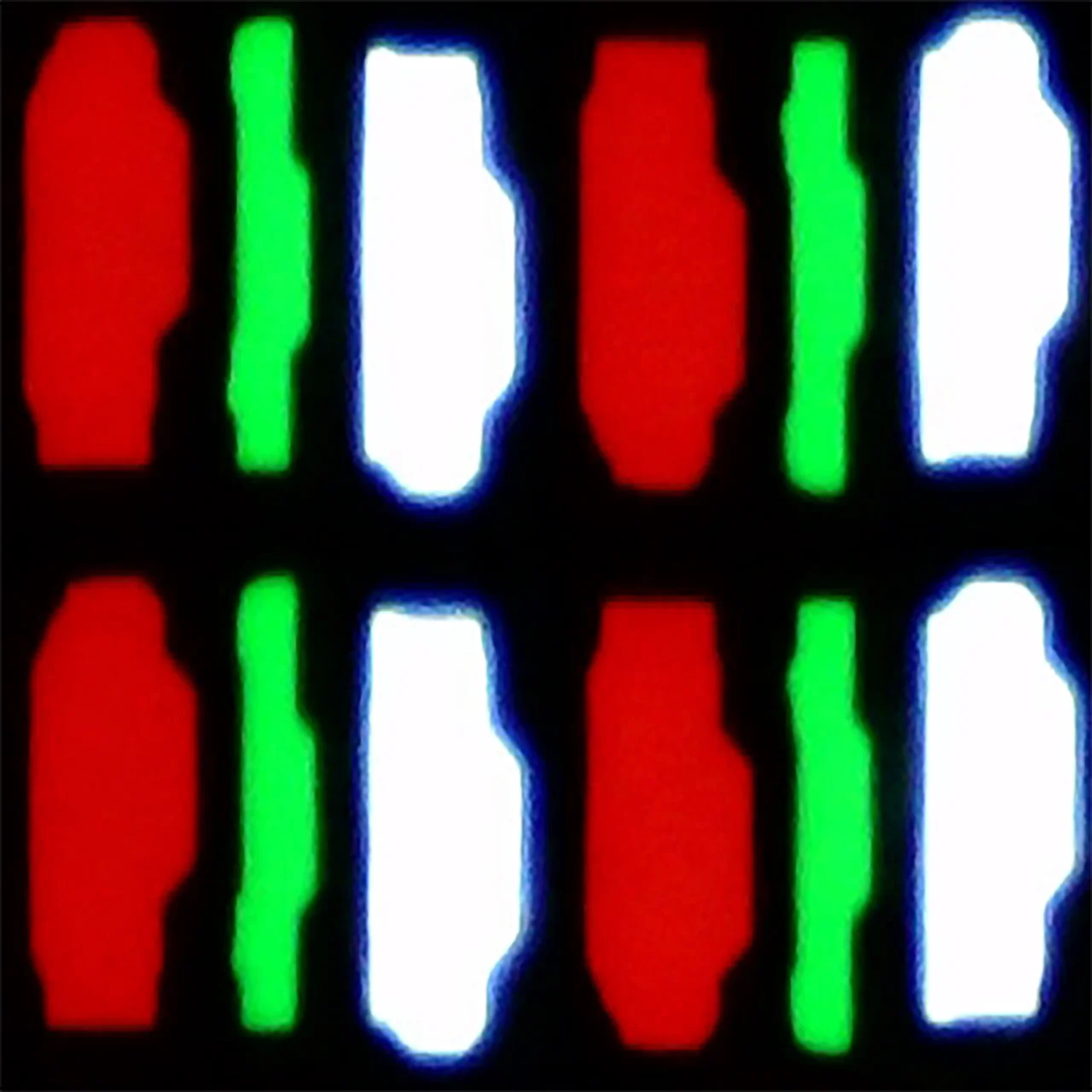
The Philips OLED761 performs well when connected to a PC. It properly supports 4:4:4 chroma, so small text is readable and colored letters retain their sharpness. When viewed up close, however, you can notice slight red fringes on the edges of characters. These stem from the RGWB subpixel layout used in the WOLED panel, which typical font-smoothing methods are not optimized for. This may not bother you while browsing the web, but if the TV will be used mainly for working with text, it’s worth taking into account.
In games the OLED761 performs noticeably better. The panel’s fast response and support for G-Sync and FreeSync let you enjoy smooth motion without annoying smearing or tearing. At 4K and 120 Hz in SDR we measured just 5 ms of input lag, so controls feel very responsive. Keep in mind that enabling HDR increases input lag, as noted earlier. The main drawback is the refresh rate capped at 120 Hz. The OLED761, like other tested models with the WOLED SE panel, does not offer an extra 144 Hz mode or higher refresh rates at reduced resolution. For most people this won’t be a serious issue, since 120 Hz already delivers very good smoothness. Only gamers with powerful PCs aiming to squeeze out the highest possible frame rates may feel a bit shortchanged.
Viewing angles
3.1/10
7.5/10
The issue of viewing angles is not surprising here – they are simply weak. The Haier M95E uses a VA panel, so as you move away from the screen's axis, the image quickly loses color saturation, and the contrast clearly fades. However, this is a typical and fully expected feature of this technology, so it's hard to consider it a significant drawback – this type of panel is just like that.
The OLED761 looks very good in this respect. You can sit off to the side and still see deep blacks and rich colors, without the noticeable degradation associated with VA panels. That's one of OLED's advantages, and it's easy to appreciate when watching with others. You don't have to sit in the middle of the couch for the movie to look the way it should. In that regard, only QD-OLED panels are better.
Daytime performance
8.5/10
4.5/10
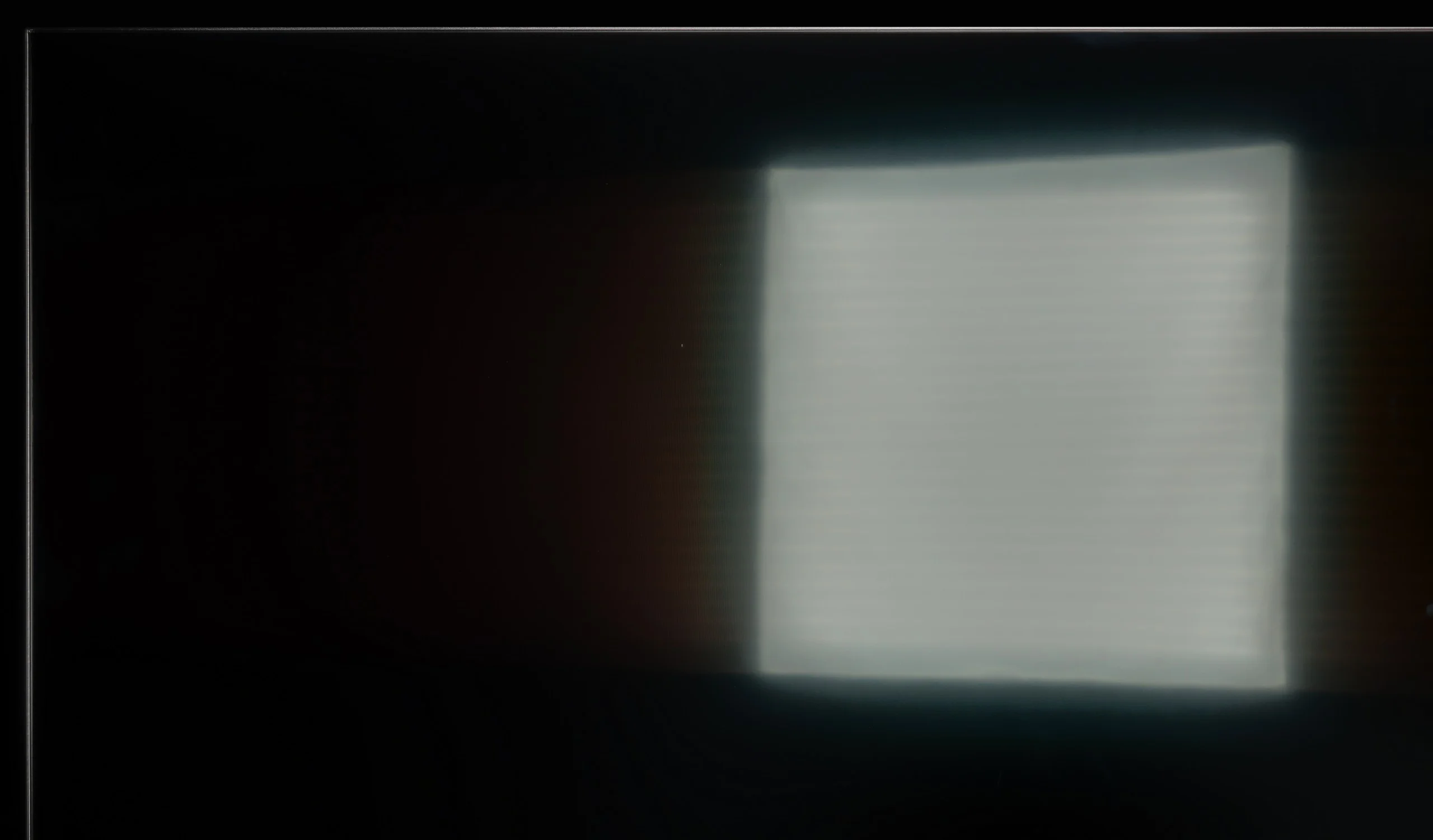
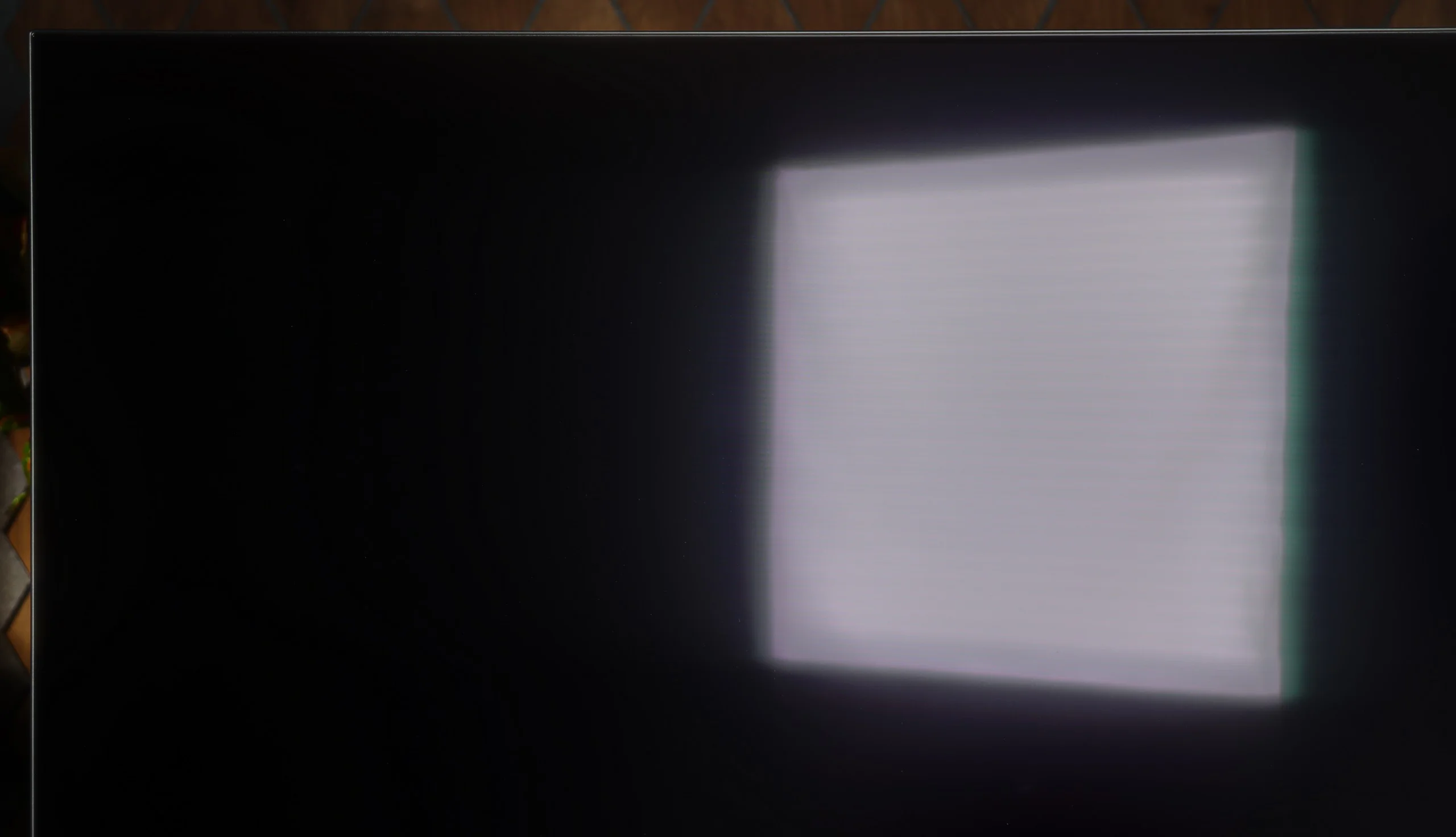
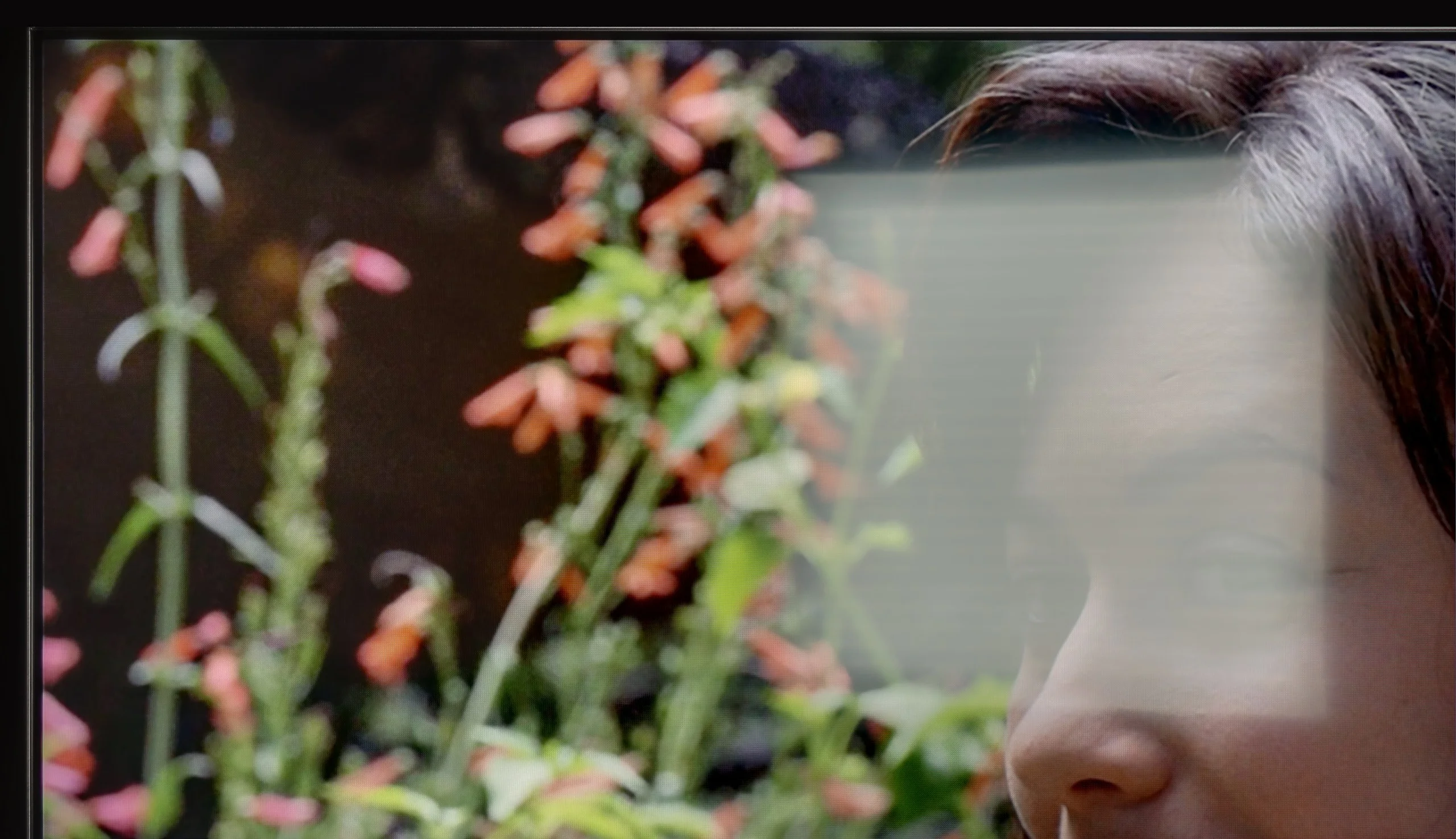
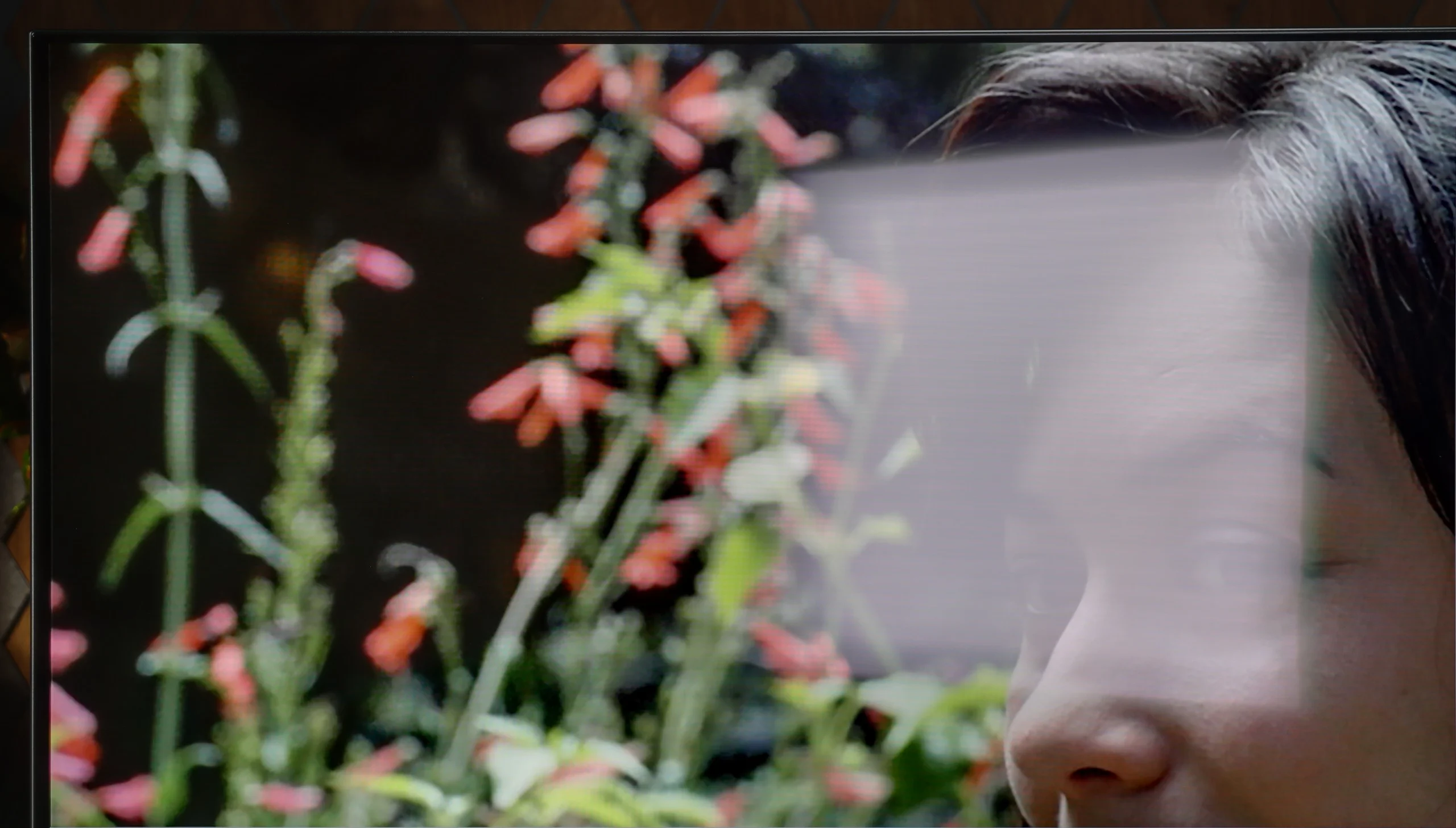
Panel brightness
Philips OLED761: 284 cd/m2
Haier M95E: 1039 cd/m2
If you are looking for a TV for a bright living room, the Haier M95E is one of the stronger candidates. Its efficiency in daytime conditions is primarily due to its very high brightness. In SDR mode, the panel averages over 1000 nits, which is a result that easily allows it to "break through" the light coming into the room, even in very challenging conditions. And although the M95E doesn't have some revolutionary, super-matte anti-reflective coating, its raw backlight power is entirely sufficient for it to perform excellently as a screen for watching "during the day".
Philips OLED761 is not the best choice for a very bright living room. Average SDR brightness is around 280 nits, so it performs slightly worse even than rivals using the same panel. In a brightly sunlit room the image simply lacks the punch to remain clearly visible, especially when watching darker scenes. In such conditions, covering the windows may be necessary. It doesn't help that the satin coating on the WOLED SE panel handles direct reflections poorly. A window or lamp opposite the screen is fairly clearly visible, and you get characteristic doubling and colored halos around their reflections. On the plus side, blacks still look good in a lit room, but at low TV brightness the reflections themselves can be distracting. The OLED761 is therefore best used where you can block the windows and make sure strong light doesn't reflect directly on the screen.
Panel details
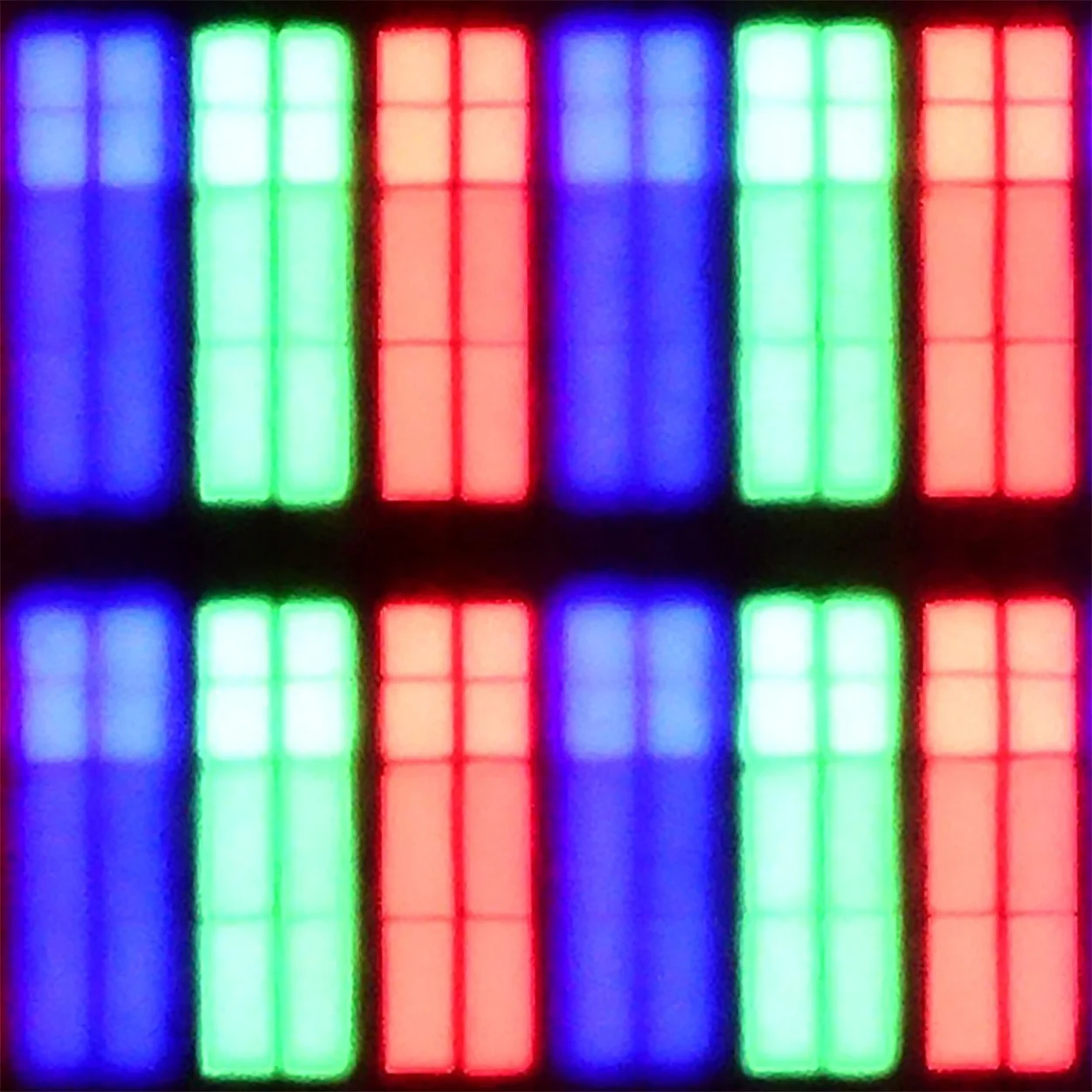
Subpixel Structure:
Panel uniformity and thermal imaging:


Haier M95E
Philips OLED761
TV features
6.3/10
7.9/10
- SystemGoogle TVTitan OS
- System performanceGoodGood
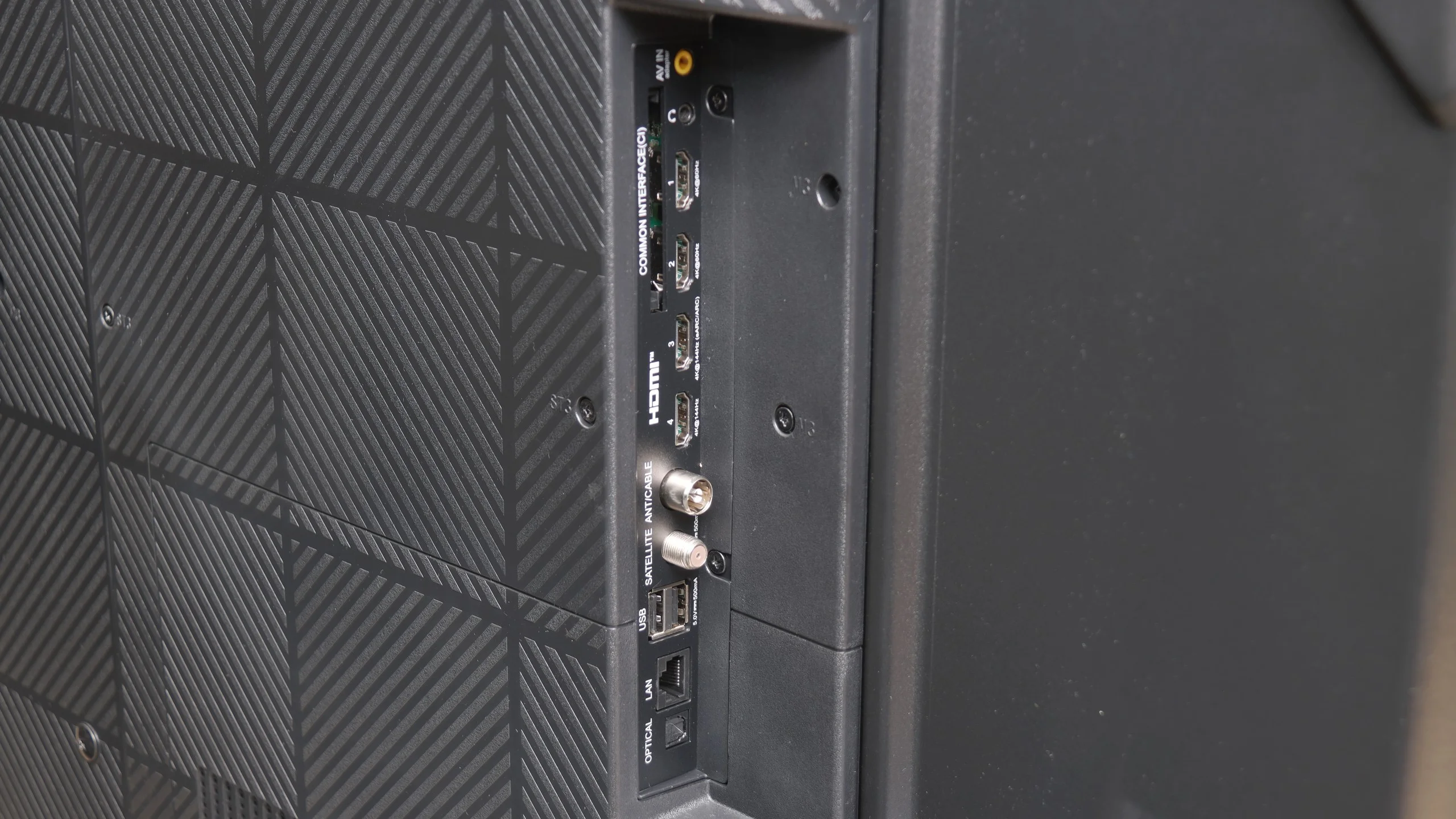
- HDMI inputs2 x HDMI 2.0, 2 x HDMI 2.10 x HDMI 2.0, 4 x HDMI 2.1 48Gbps
- Other inputsRCA (Chinch)
- OutputsToslink (Optical audio), eARC (HDMI), ARC (HDMI), Mini-Jack (Headphones)Toslink (Optical audio), eARC (HDMI), ARC (HDMI), Mini-Jack (Headphones)
- Network InterfacesWi-Fi 2.4GHz, Wi-Fi 5GHz, Ethernet (LAN) 100MbpsWi-Fi 2.4GHz, Wi-Fi 5GHz, Ethernet (LAN) 100Mbps
- TV receptionDVB-T, DVB-T2, DVB-S, DVB-S2, DVB-CDVB-T, DVB-T2, DVB-S, DVB-S2, DVB-C
Classic features:
- Recording to USB (terrestrial TV)
- Recording programming
- Picture in Picture (PiP)
- RF remote control (no need to aim)
- Backlit remote control
- Teletext
- Audio only mode
- Bluetooth headphones support
- Simultaneous Bluetooth headphones & TV audio
Smart features:
- AirPlay
- Screen mirroring (Windows Miracast)
- Voice search
- Voice search in native language
- Ability to connect a keyboard and mouse
Sound connection options
- HDMI audioeARC (HDMI), ARC (HDMI)eARC (HDMI), ARC (HDMI)
- Other audio outputsToslink (Optical audio), Mini-Jack (Headphones)Toslink (Optical audio), Mini-Jack (Headphones)
- Wireless audioBluetoothBluetooth
Supported audio formats (external HDMI eARC audio):
- Dolby Digital Plus 7.1
- Dolby True HD 7.1
- Dolby Atmos in Dolby Digital Plus (JOC)
- Dolby Atmos in Dolby True HD
- DTS:X in DTS-HD MA
- DTS-HD Master Audio
Senior accessibility
- Numeric keyboard on TV
- Font size adjustment
- Audio description
Classic Features of M95E
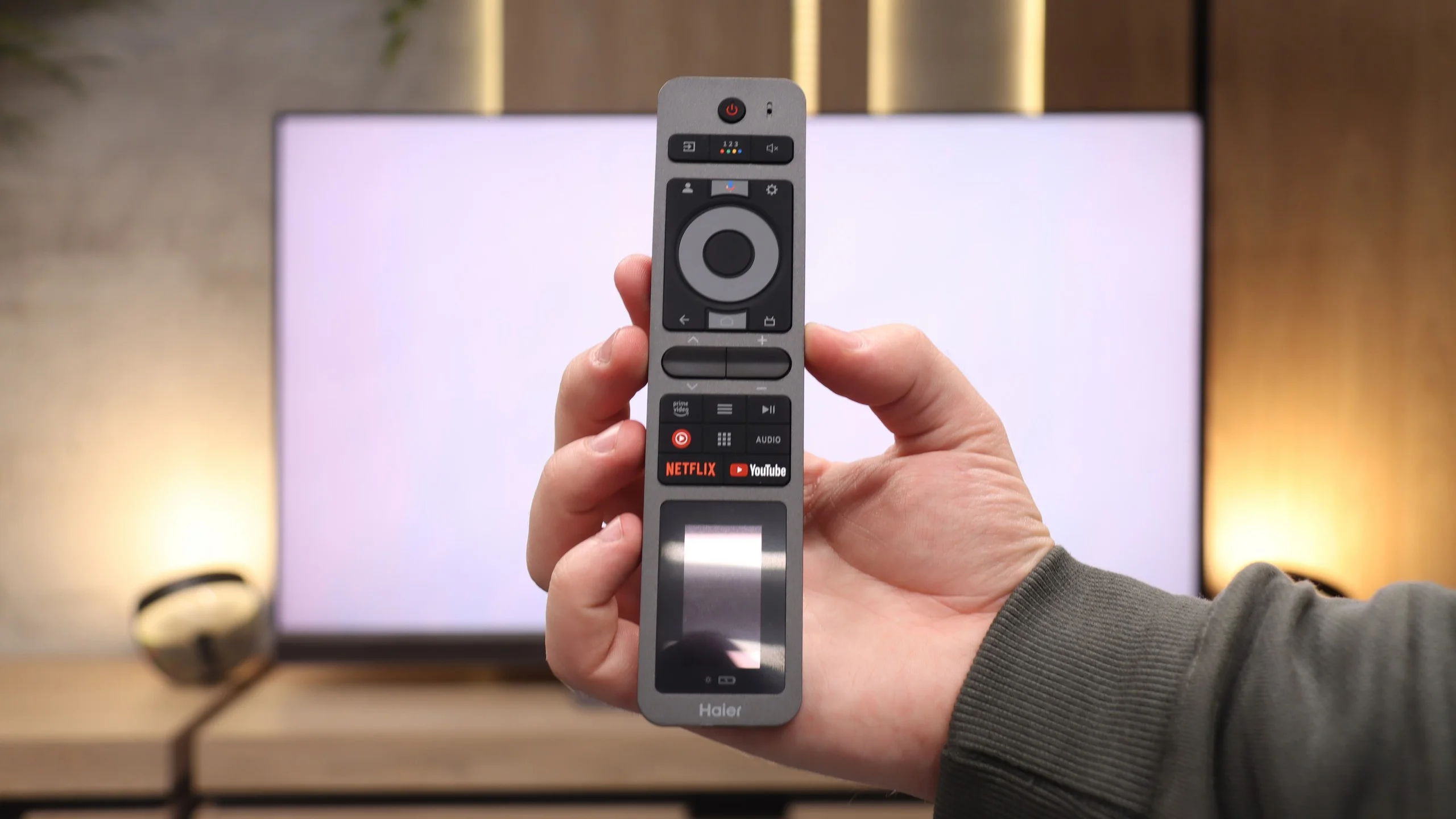
When it comes to the classic features of the television, the M95E falls, to put it mildly, short. The only real plus in this category is that we even get a remote control, although it has quite an awkward shape and is not the most comfortable to use. The real trouble began when we tried to search for terrestrial TV channels – the receiver stubbornly refused to connect to any antenna throughout the tests. To be sure, we checked the same setup on another television, where everything worked flawlessly, which rules out any fault on our side. Generally, apart from the fact that it has Bluetooth and a physical mini-jack headphone output, it’s hard to praise the M95E for anything here.
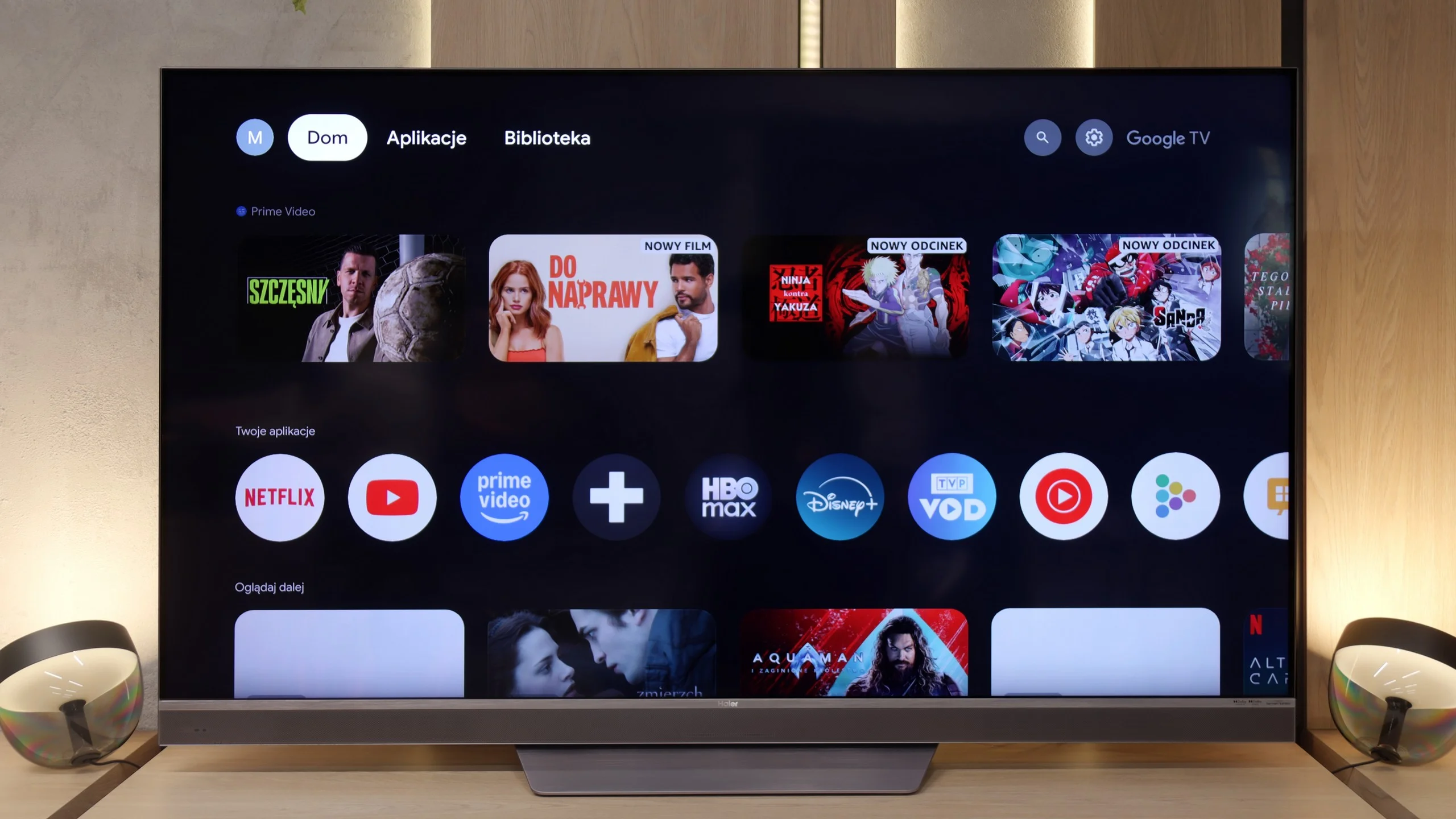
Operating System: Google TV
Well, you might ask, what about Smart features? After all, Google TV is a system that offers incredible capabilities. That's true, it usually is. And indeed, in the M95E, we find the same vast library of applications and access to a voice assistant as with any other manufacturer. However, this is where the advantages of this system in the tested model end. On our unit, the software simply ran sluggishly. We encountered annoying bugs, and the entire interface regularly experienced slight stutters in the most inappropriate places, which effectively discouraged us from using it.
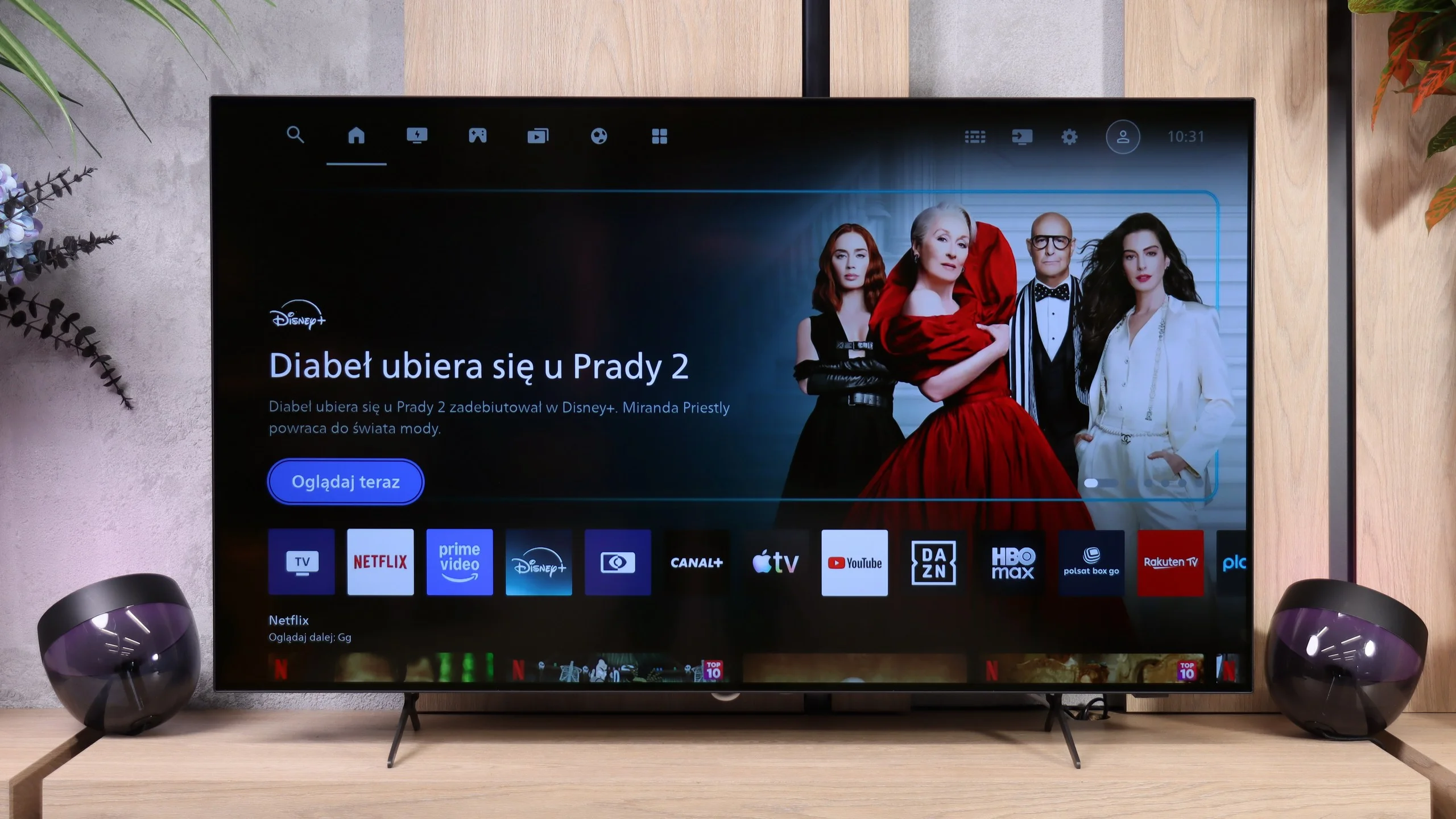
Titan OS
The OLED761 uses Titan OS instead of Google TV, a system that has been appearing more often in Philips TVs for several years. In that time the system has clearly matured. It responds to commands faster, navigates menus more smoothly, and features that previously caused problems are finally starting to work as they should. You can see real progress in everyday use, and that deserves praise. It still doesn't match the refinement and capabilities of webOS or Tizen, and it's a long way from the freedom and app selection offered by Google TV, but Titan OS is definitely moving in the right direction.
User features and ports
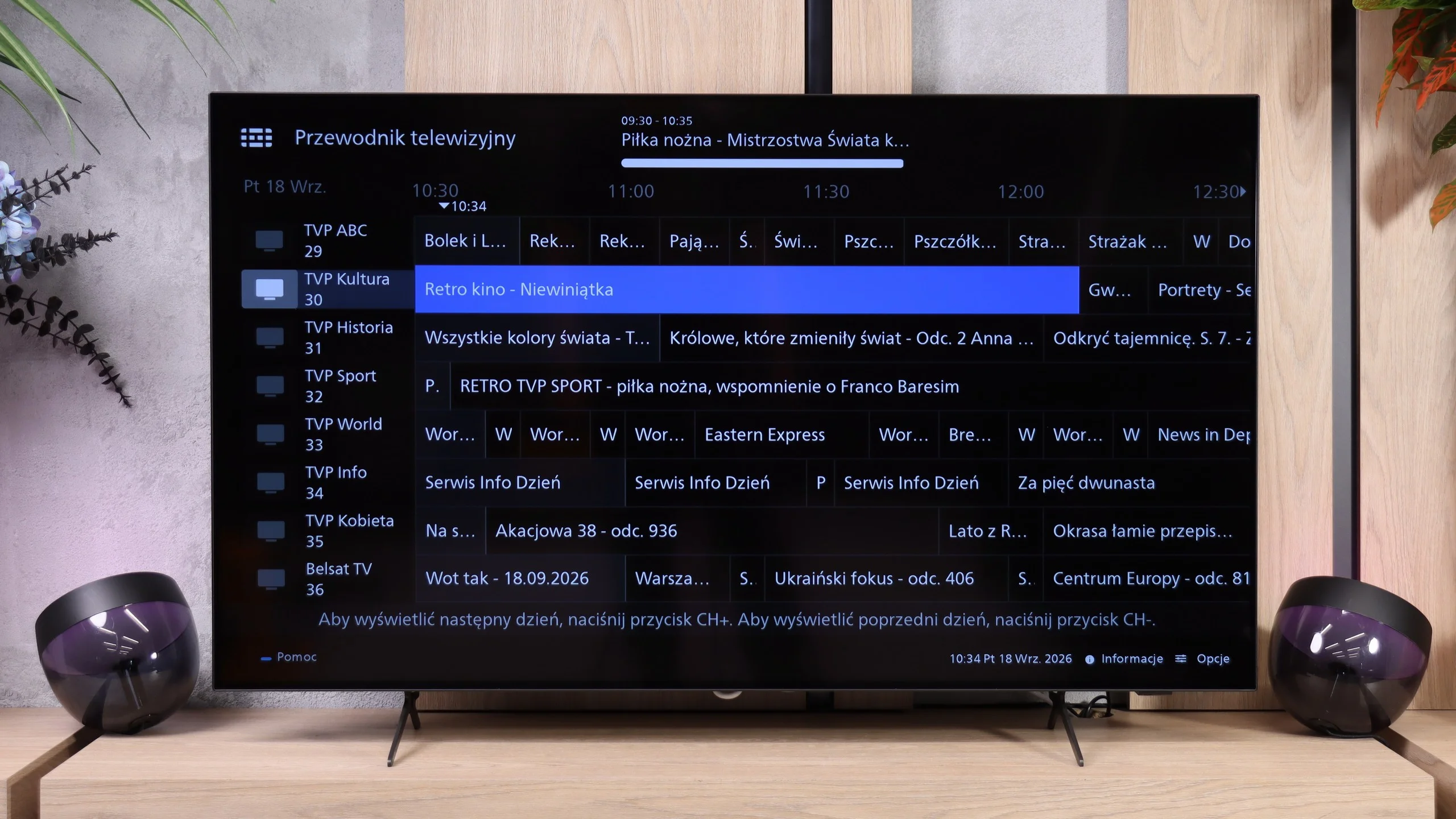
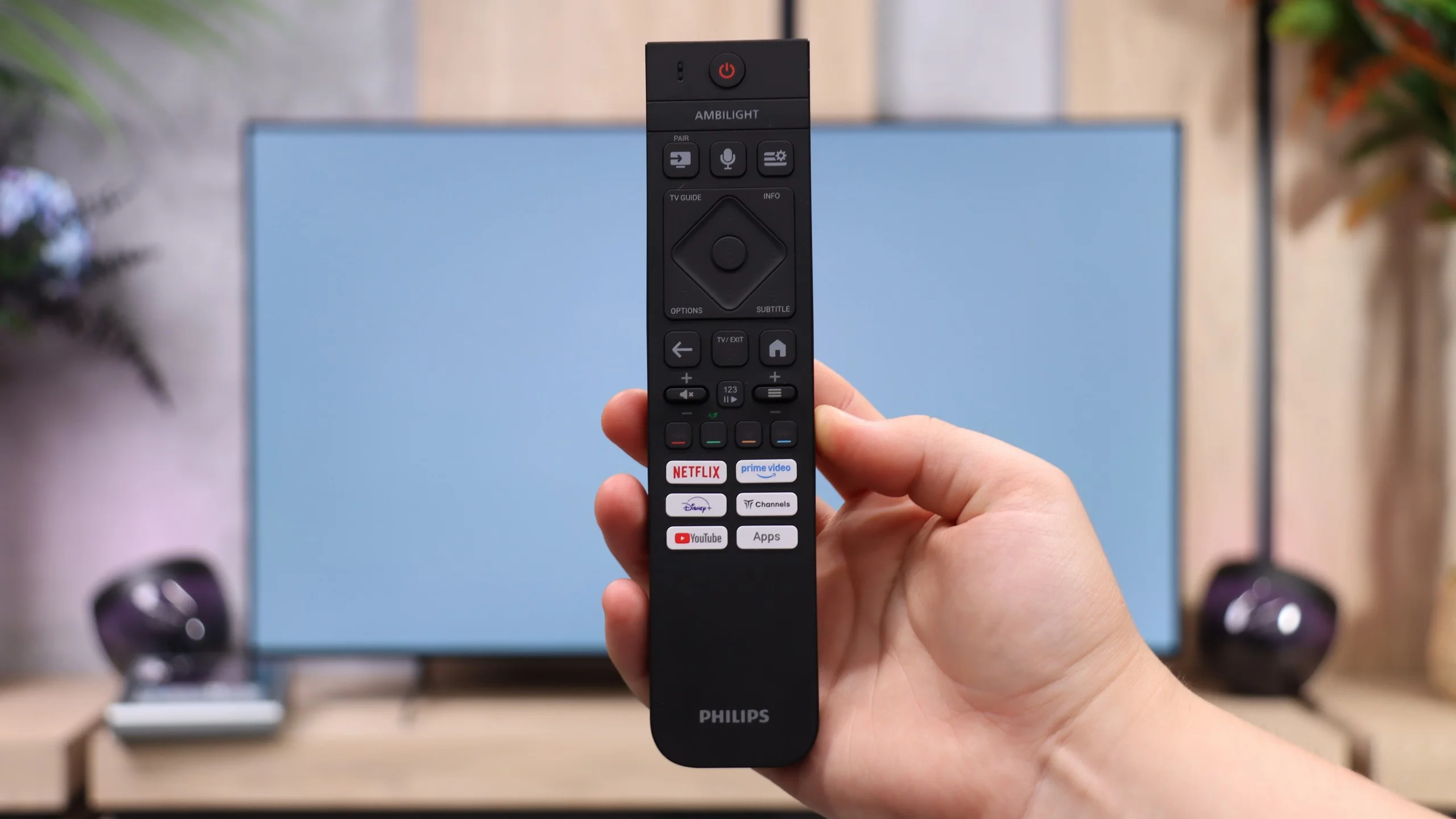
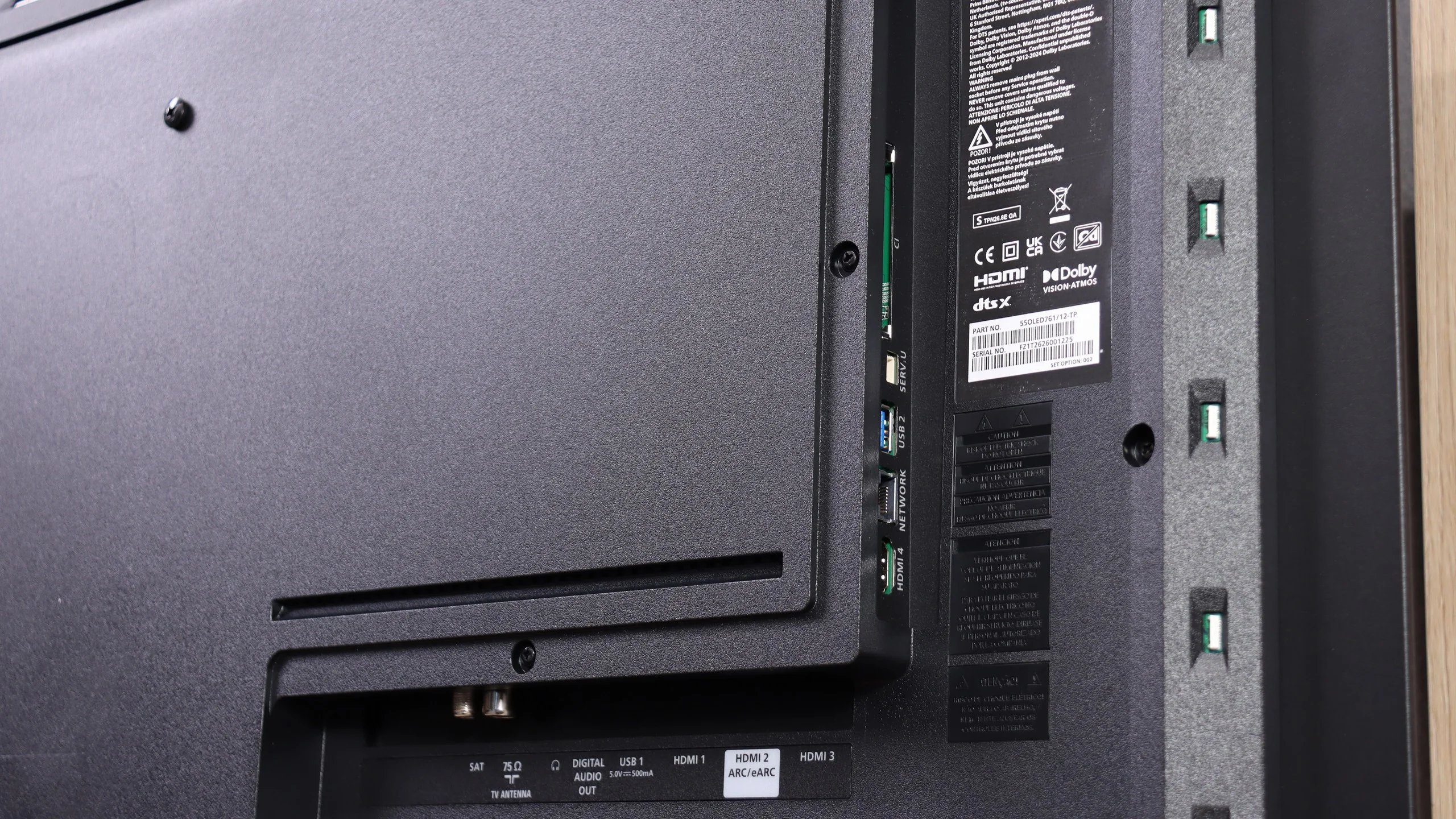
When watching regular TV you get basic conveniences, including teletext and a remote with a numeric keypad. The buttons are backlit, which is very handy in the evening, but it's hard to understand why Philips stubbornly sticks with infrared control for the remote. Having to point the remote at the TV can simply be inconvenient (the only feature that works via radio is voice control). There is also no USB recording or picture-in-picture. On the other hand, the port selection deserves praise: all four HDMI inputs support HDMI 2.1 at 48 Gbps, so after connecting a soundbar via eARC there are still three ports left that let you take full advantage of consoles and a PC. You don't have to worry about which device to connect at the cost of high refresh rates. There's even an analog mini-jack output, increasingly rare in new TVs but still useful for wired headphones or older audio equipment.
Ambilight
The most distinctive extra is, of course, Ambilight, for which Philips earns extra points from us. Lighting the wall with the colors from the screen can add a lot of atmosphere to movies and games, and it's also useful for relaxed evening viewing. The gentle glow means the bright screen isn't the only light source in a completely dark room, which can improve viewing comfort. It's worth tuning its intensity to the room rather than immediately setting it to maximum. For people who enjoy that style of watching, Ambilight can be one of the stronger reasons to choose the OLED761.
Apps
9.6/10
7.7/10






















Playing files from USB
9.5/10
8.6/10
Supported photo formats:
Maximum photo resolution:
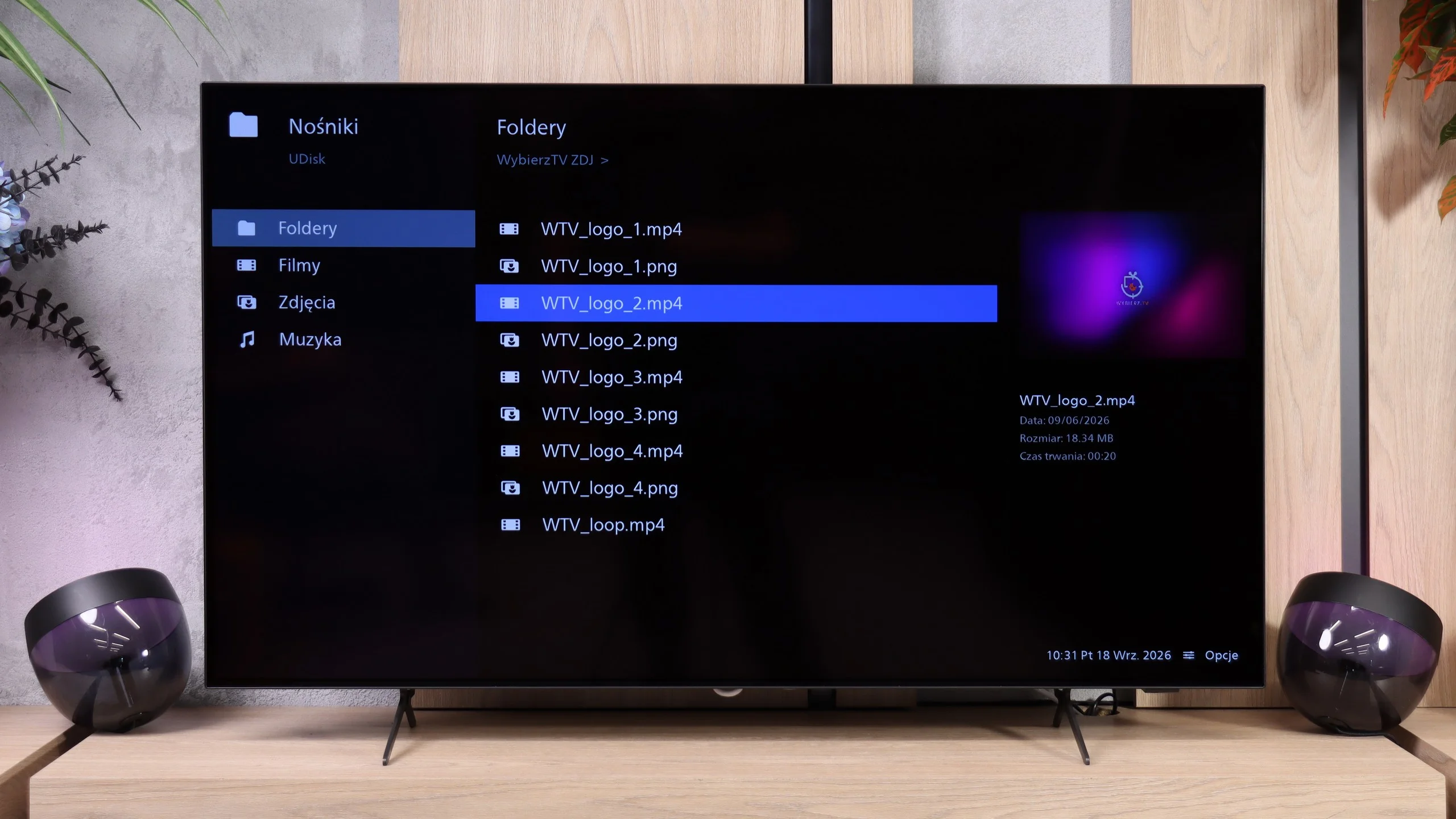
In such an unrefined and clunky system, we didn't expect any positive surprises. Yet, the built-in file player with USB turned out to be a real gem. To our surprise, the application worked smoothly and handled all the most important formats we threw at it flawlessly. It's one of the few components of the M95E software that seems to work exactly as it should.
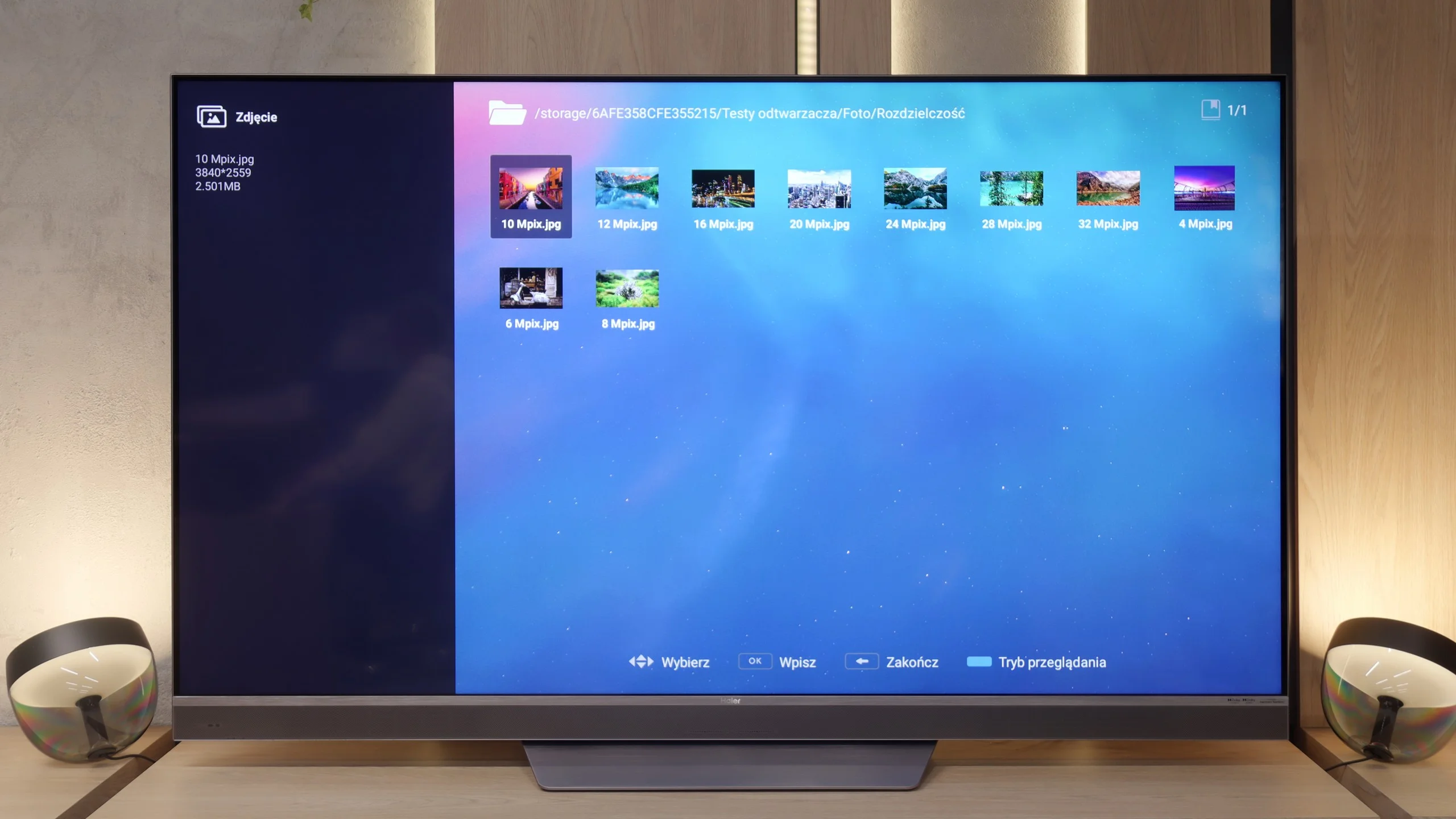
The USB player on the Philips OLED761 behaves rather oddly, and this is where you can see that Titan OS still needs refinement. Test videos and music files opened correctly, but photos caused the most problems. Interestingly, it wasn’t just a lack of support for certain formats, but also the photos’ resolution. The TV opened photos at 16 and 32 MP, yet it failed to handle some smaller ones, including 10 and 12 MP. So it’s hard to point to a simple rule for preparing photos that will guarantee they all display. If you plan to show vacation photos on the big screen, it’s worth checking the files beforehand or using screen mirroring.
Sound
9.2/10
7/10
- Maximum volume87dB90dB
- Dolby Digital Plus 7.1
- Dolby True HD 7.1
- Dolby Atmos in Dolby Digital Plus (JOC)
- Dolby Atmos in Dolby True HD
- DTS:X in DTS-HD MA
- DTS-HD Master Audio
After all this enumeration of shortcomings and wasted potential, we move on to a category that is like a breath of fresh air. The sound on the Haier M95E is simply phenomenal. We can confidently state that it is one of the best-sounding televisions that has graced our editorial office this year. The integrated soundbar, proudly positioned at the front, delivers really clear and balanced audio, serving us distinct dialogues and selective high tones. The real magic also comes from the back of the casing – that’s where two additional subwoofers are located, providing a surprisingly strong and pleasant bass. Of course, we will be realists. We are still talking about the capabilities of the speakers built into the television, and there is no comparison to a decent external audio system. Nevertheless, as an integrated solution, the M95E sounds really very good and leaves most of the competition far behind.
The Philips OLED761 sounds quite good for a slim TV. The midrange is the strongest, so dialogue is clear and it's easy to understand what the characters are saying. For watching TV shows, the news, or regular programs, the built-in speakers are more than adequate. However, it lacks deep bass, which is most noticeable in music and action movies. Explosions have less impact, and music lacks a fuller sound. So if you want a more cinematic audio experience, a soundbar with a separate subwoofer will be a noticeable complement to this setup. Especially since the OLED761 handles immersive audio formats like Dolby Atmos and DTS:X with ease.
Sound Quality Test
Acoustic Measurements
87dBC (Max)
75dBC
90dBC (Max)
75dBC
Reader comments
Comments are provided by the external service Disqus (Zeta Global). Once loaded, Disqus may set cookies and process data about your activity.
We will remember your choice on this device. Provider's privacy policy