 Katarzyna Petru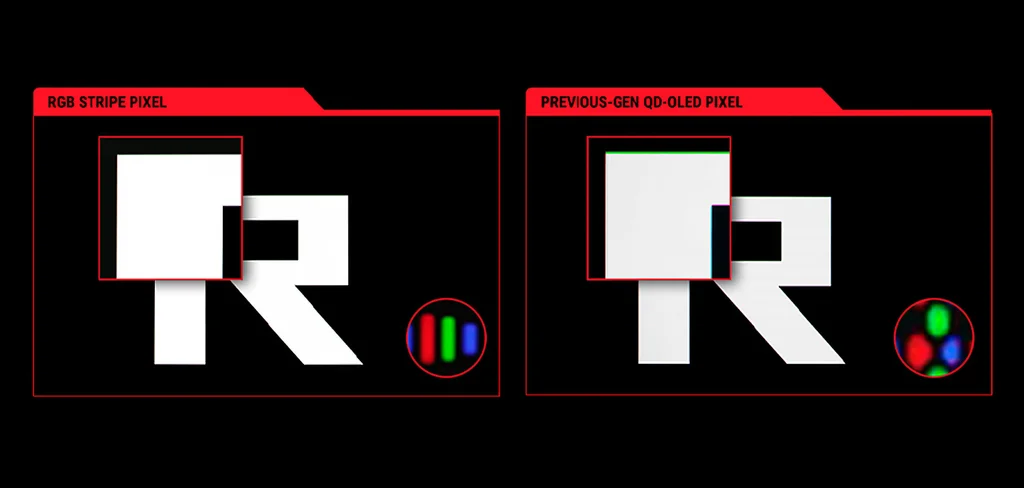
After the announcements of new OLED panels and QD-OLED with RGB-stripe pixel layout from LG Display and Samsung Display, the first real monitors using this technology have finally hit the market. Asus and MSI showcased their models, and everything suggests that by 2026, OLEDs will no longer be associated exclusively with gaming and multimedia. We had already seen an image of LG Display's RGB-stripe OLED pixels. Now, thanks to the announcements from Asus and MSI, we can also see the new "V-Stripe" QD-OLED pixel layout, which will feature in monitors in 2026.
The new pixel layout clearly improves text readability and virtually eliminates the color fringing effect, which was one of the biggest drawbacks of previous QD-OLED panels. This is an important step, as it opens the door to using QD-OLED not only in gaming but also in office work, programming, and professional applications. Additionally, the overall sharpness of the image and color reproduction accuracy also improve.
First QD-OLED Monitors with RGB Stripe
MSI has unveiled the first two QD-OLED monitors with a new subpixel arrangement: MPG 341CQR X36 and MEG X. The second model stands out with additional “AI” features such as AI Tracker, AI Gauge, AI Vision+, AI Scene, AI Goggle, and AI Scope. Both monitors have:
34 inches,
resolution of 3440×1440,
aspect ratio of 21:9,
refresh rate of up to 360 Hz.
This is currently the only announced QD-OLED panel for 2026 with RGB stripe, referred to as the 5th generation QD-OLED. MSI monitors also utilise a new layer called DarkArmor, which improves black depth and reduces colour bleed. This is a feature of the panel from Samsung Display, not just a proprietary addition from the manufacturer.
Asus also enters the RGB-stripe QD-OLED market
Asus has unveiled two very similar models: PG34WCDN and XG34WCDMS. Here, we also have:
34 inches,
3440×1440,
21:9 aspect ratio,
new QD-OLED RGB-stripe with an enhanced coating that Asus calls BlackShield.
The differences between the models are as follows:
PG34WCDN offers a refresh rate of up to 360 Hz,
XG34WCDMS reaches 280 Hz and 0.03 ms GTG.
Both monitors provide:
99% DCI-P3 coverage,
true 10-bit colours,
Delta E < 2,
VESA DisplayHDR 500 True Black certification,
support for Dolby Vision.
On board, we find DisplayPort 1.4, HDMI 2.1, and USB-C. Power delivery via USB-C is 90 W for the PG34WCDN and 15 W for the XG34WCDMS.
First OLED RGB-Stripe Monitor from LG Display
In addition to QD-OLEDs, Asus also showcased the PG27UCWM, the first monitor based on the new 27-inch OLED RGB-stripe panel from LG Display. The specifications look impressive:
27 inches,
4K (3840×2160),
240 Hz at 4K,
480 Hz at Full HD thanks to dual mode,
99% DCI-P3,
0.03 ms response time,
HDR with Dolby Vision support.
The monitor can be connected via DisplayPort 2.1A (80 Gb/s) or HDMI 2.1, making it one of the most future-proof OLEDs on the market.
CES 2026 is shaping up to be very interesting
This is just the beginning. Everything suggests that at CES 2026 we will see many more OLED and QD-OLED monitors with RGB-stripe, and the technology that has struggled with text and sharpness for years is finally maturing for universal applications. If manufacturers keep their promises, 2026 could be a breakthrough year for OLED monitors not just for gamers.