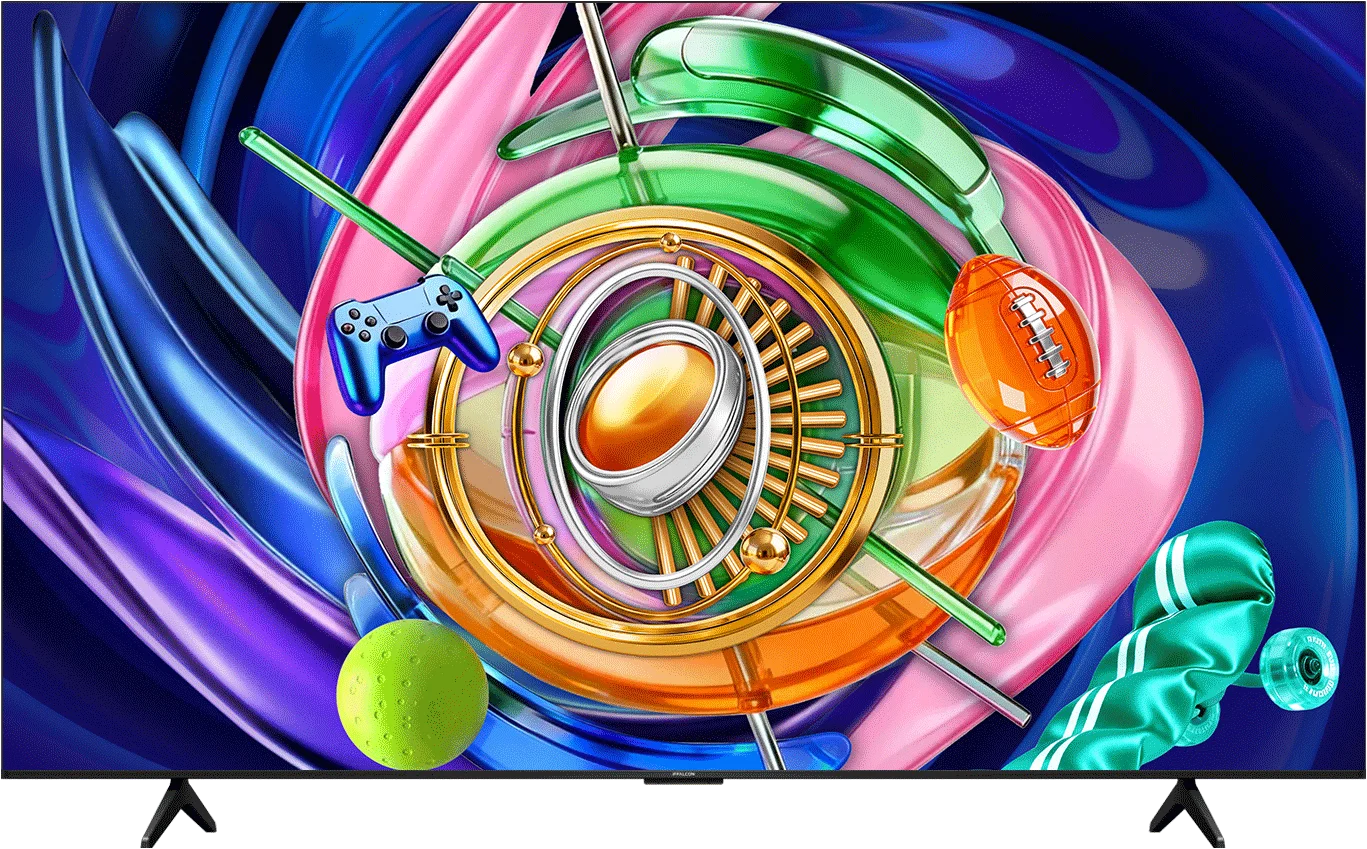
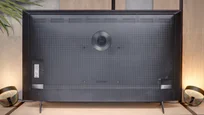
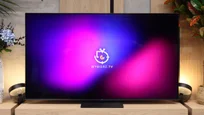
The iFFALCON U85X is a device that draws heavily from the technological solutions of its parent brand, TCL. It is hard not to get the impression that in terms of pure technical parameters, we are dealing with nearly a faithful copy of the successful C6K series (C69K/Q6C), although visually, the designers opted for references to the more budget-friendly P line. This specific combination makes the television do exactly what we expect from a solid Mini-LED at an even lower price. It provides very good contrast and a vivid HDR effect, which is directly due to the impressive number of local dimming zones. It is worth noting that, just like the models from the C series, the iFFALCON U85X turns out to be exceptionally tailored to the needs of gamers. You will find almost every function necessary for comfortable gaming, from full support for HDMI 2.1 ports, through ALLM and VRR technologies for console owners, to excellent compatibility with PCs. As a monitor, the device performs superbly not only due to its refresh rate support up to 240Hz but also because of its very sharp and legible font, which is not always a given in the world of televisions. Of course, it is not an ideal model, as it shares the same set of advantages and disadvantages as its counterpart under the TCL brand – mainly referring to issues like noticeable motion blur and aggressive brightness management in HDR. However, it all creates an extremely interesting mix that makes us seriously contemplate the sense of the existence of the iFFALCON brand as a separate entity, since the same product could successfully debut with a full-fledged TCL logo on the casing. Nevertheless, we have no major reservations about the device itself; it is truly a model worth attention as long as you manage to purchase it, as it is very difficult to obtain at the moment.
- Matching (Score) |
- Our verdict |
- TV appearance |
- Where to buy |
- Contrast and black detail |
- HDR effect quality |
- Factory color reproduction |
- Color reproduction after calibration |
- Smoothness of tonal transitions |
- Image scaling and smoothness of tonal transitions |
- Blur and motion smoothness |
- Console compatibility and gaming features |
- Input lag |
- Compatibility with PC |
- Viewing angles |
- Daytime performance |
- Panel details |
- TV features |
- Apps |
- Playing files from USB |
- Sound
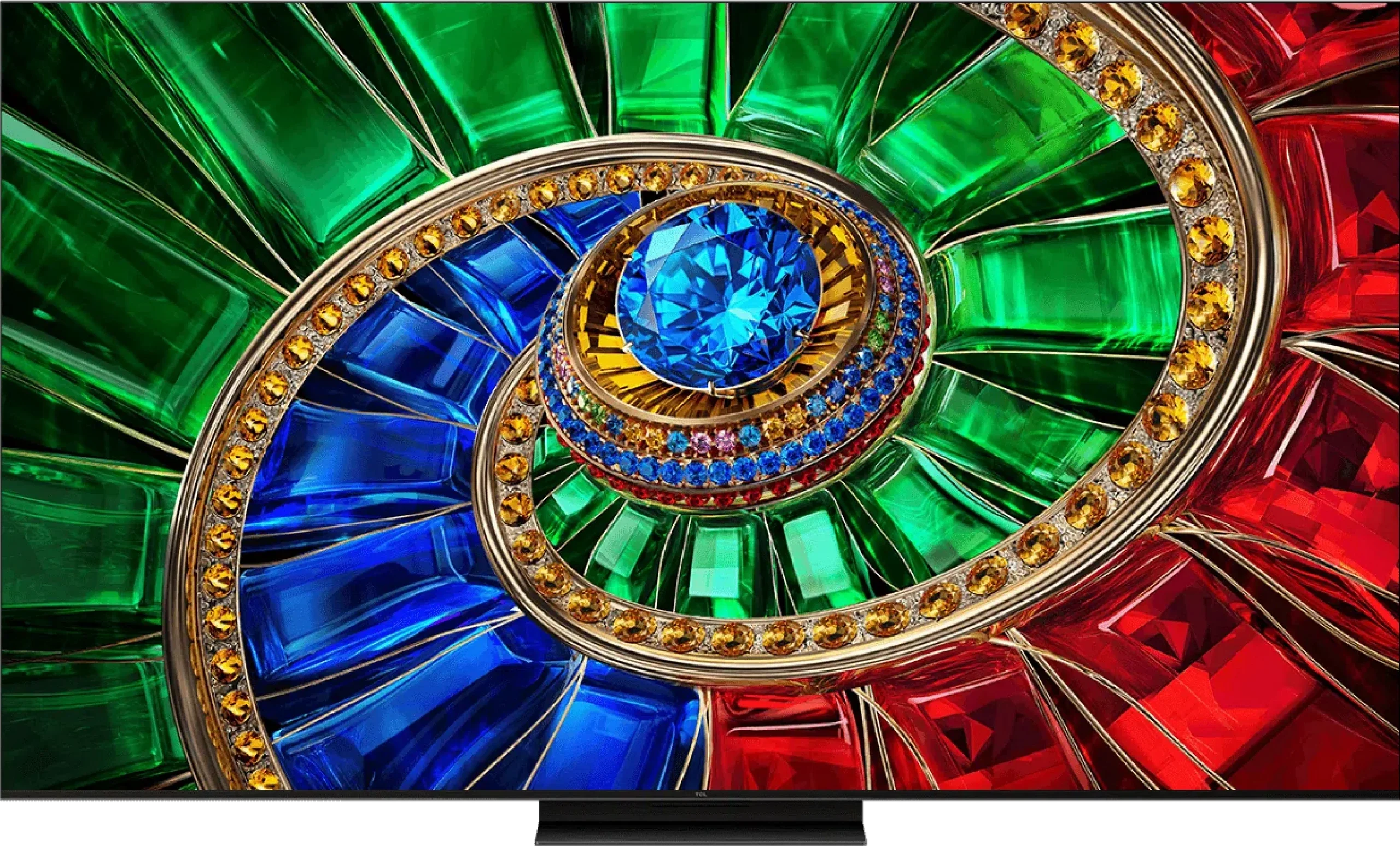
IFFALCON U85X vs TCL RM7L
 Direct comparison
U85X1
Available screen sizes: 65”
Panel type: LCD VA
Resolution: 3840x2160
System: Google TV
Model year: 2026
Complete the survey to find out the result
Panel type: LCD VA
Resolution: 3840x2160
System: Google TV
Model year: 2026
Complete the survey to find out the result
Overall rating
6.9
7.8
 Movies and series in UHD quality
 6.2
7.4
 Classic TV, YouTube
 6.3
7.1
 Sports broadcasts (TV and apps)
 6.1
6.9
 Gaming on console
 8.4
8.8
 TV as a computer monitor
 8.6
8.4
 Watching in bright light
 5.6
7.8
 Utility functions
 7.6
7.8
 Apps
Apps 9.6
9.6
 Sound quality
 6.9
7.8
Complete the survey to find out what fits your preferences
Advantages

Good contrast and black: VA panel with MINI-LED local dimming zones
High HDR brightness: sturdy 650 nits
Decent colors: thanks to the PFS filter (according to the manufacturer QLED)
Amazing for gamers: full HDMI 2.1, 144Hz, very low input lag, and VRR/ALLM features
Great as a monitor: 240Hz mode, support for G-SYNC/FreeSync
Powerful sound – dedicated subwoofer provides a realistically felt bass
Versatile Smart TV – advanced Google TV system with full AirPlay support
Very high HDR and SDR brightness
Good black levels and contrast (VA panel + mini-LED)
Impressive picture
Full support for HDR formats, including Dolby Vision and HDR10+
Extensive gaming features (VRR, ALLM, HGiG)
Good motion handling with low blur (up to 288Hz)
Disadvantages

Visible smearing
Backlight management could be better
Poor viewing angles – typical color degradation of VA panels when viewed from the side
Software errors – inaccurate menu translations and occasional drops in system fluidity
Poor digital image processing due to the use of the older MediaTek Pentonic 700 processor
The glossy screen coating does little to reduce reflections
Only two HDMI 2.1 ports
Less stable colors, dependent on the dimming algorithm (a characteristic of RGB panels)
Our verdict
The TCL RM7L is a TV that can’t be fairly judged by measurements and charts alone. Although it isn’t uncompromising hardware, in everyday use it more than holds its own. It delivers a bright, dynamic, and saturated image, which makes it great for HDR content, gaming, or fast-paced movies. The RM7L doesn’t chase perfect “reference” performance. Instead it serves up a picture that simply pleases the eye. It’s also hard to fault in daily use. Google TV runs smoothly and provides access to a full suite of apps, and the comprehensive set of features for gamers means the TV handles being connected to a console or PC just as well as an evening session on the couch. It’s simply a versatile TV that will suit most home uses. The most interesting thing, however, is TCL’s approach to backlighting. Instead of chasing numbers and increasing the number of dimming zones (as in the C7L), they went with RGB Mini-LED technology. The result is really intriguing. While black levels and contrast are very good, in the toughest scenes — bright objects on a dark background — blooming can be a bit more noticeable than with the sibling model. Interestingly, the glow itself takes on the color of the displayed element, which makes it look much more natural and less distracting than on traditional Mini-LED screens.
And here’s the dilemma. Placing the RM7L next to the TCL C7L, it’s hard to reach a clear, objective verdict. Both models cost almost the same, but represent two completely different backlight design philosophies. The C7L wins on dimming precision thanks to a larger number of zones, while the RM7L makes up for it with the specific, extremely pleasing character of its RGB panel. Until recently the choice came down to a simple count of zones; today, as TCL shows, it’s much more interesting. If we had to choose between the two ourselves, we’d lean slightly toward the C7L because of the greater number of zones and equally impressive, saturated colors, but the final decision always depends on what an individual expects from their equipment.
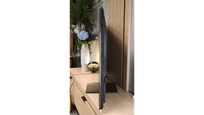
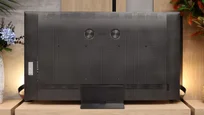
TV appearance


Contrast and black detail
7.3/10
7.7/10
Local dimming function: Yes, number of zones: 224 (14 x 16)
Local dimming function: Yes, number of zones: 448 (16 x 28)
Contrast:


Result
113,850:1

Result
24,800:1

Result
10,950:1

Result
7,000:1

Result
6,050:1
Result
258,450:1
Result
41,400:1
Result
18,800:1
Result
15,650:1
Result
8,350:1
Halo effect and black detail visibility:
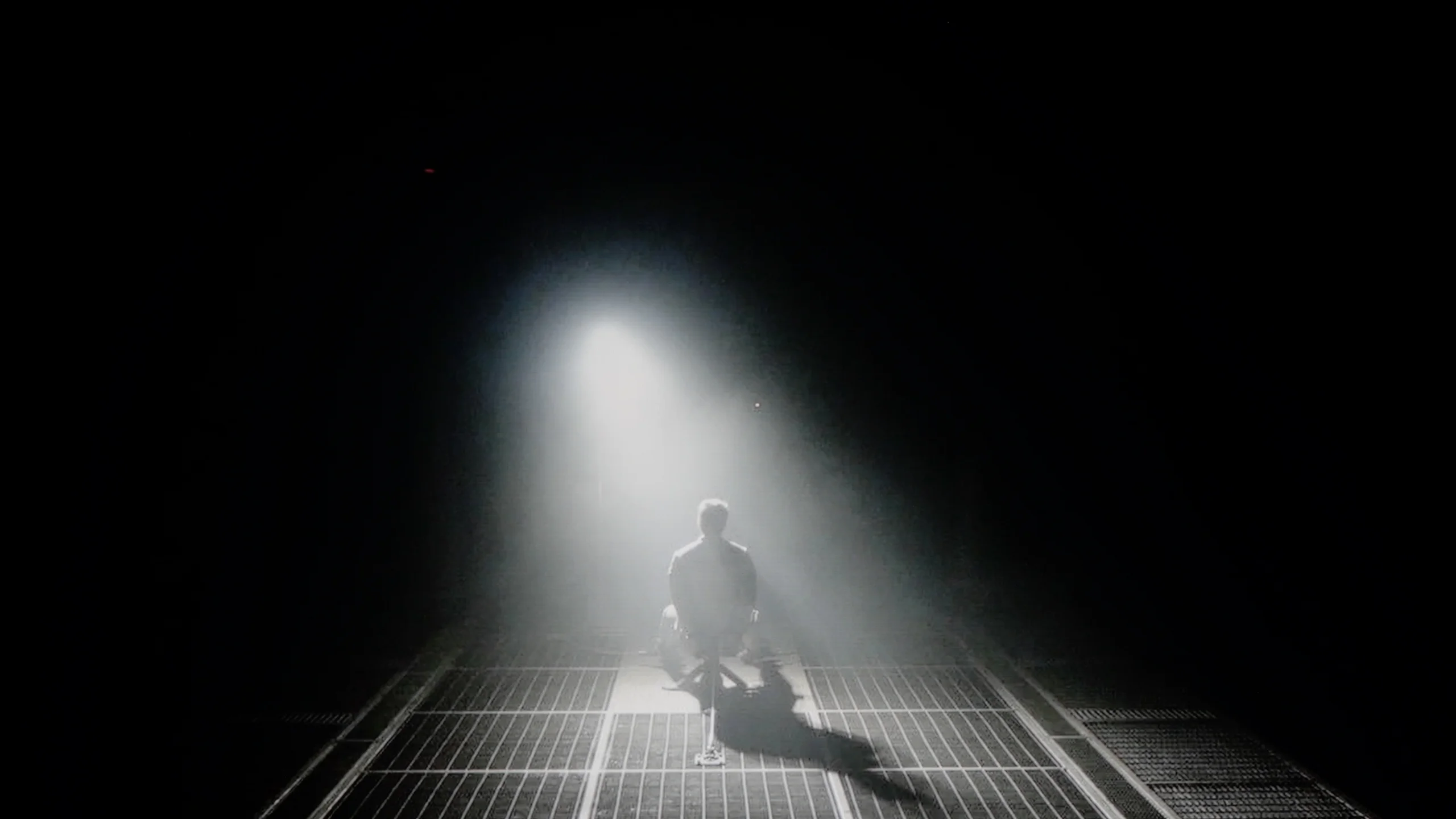
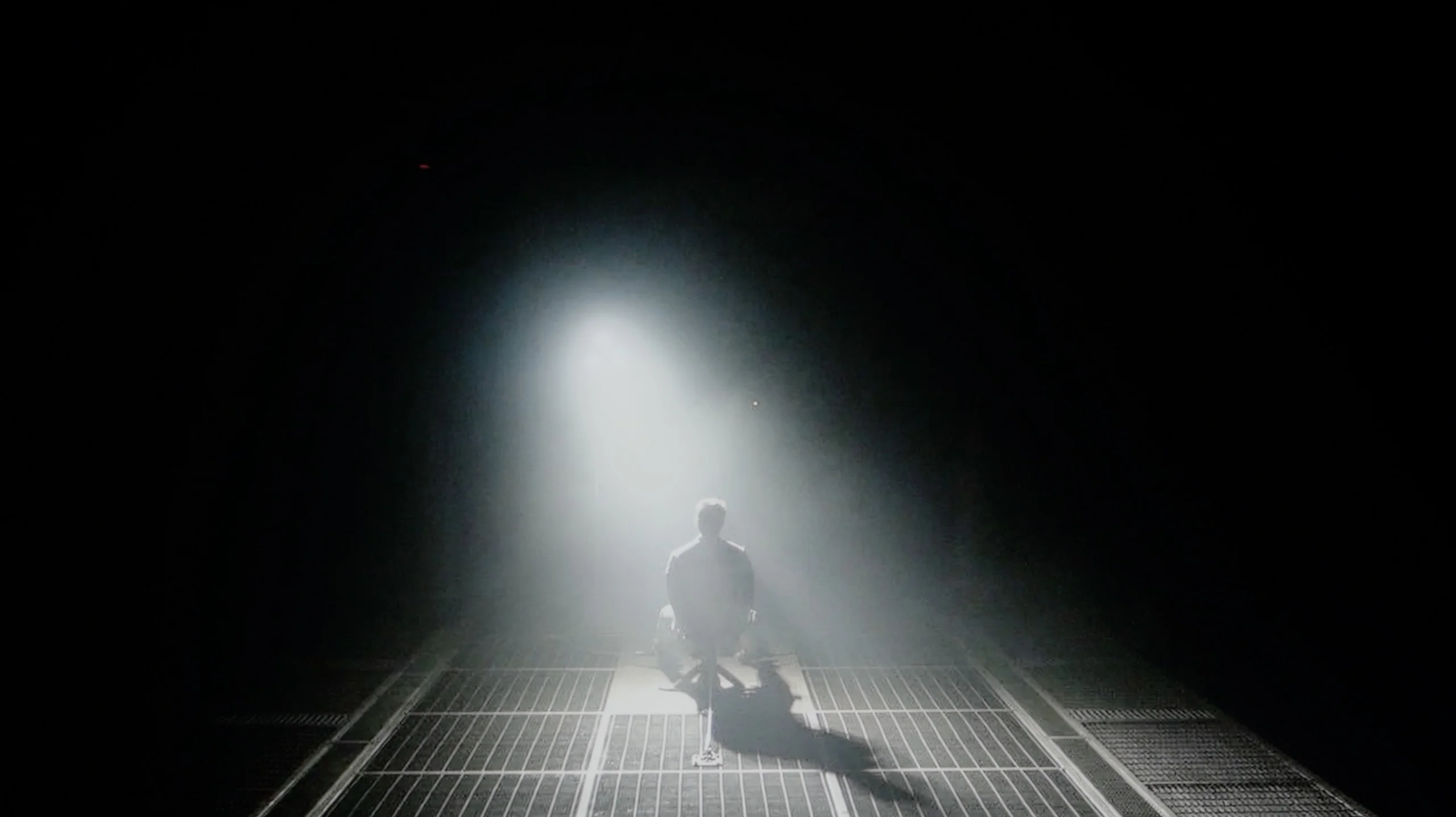
Check the visibility of bright lights on a dark background. Mini-LEDs often struggle with this. The photo does not compare black levels – that’s what the video below is for.
The video accurately shows differences in contrast and black levels between TVs, as well as potential issues: halo around bright objects or Mini-LED zone operation visible as brightness jumps.
In terms of black levels and contrast, the 65-inch iFFALCON U85X is almost an exact replica of the solutions known from TCL's C6K and C69K models, offering the same number of 224 local dimming zones in a 14x16 arrangement. Thanks to the use of a VA panel and such a solid number of zones, the device can generate an image with impressive depth, where our measurements in real movie scenes indicated a contrast exceeding 100,000:1. Of course, at this level of hardware, local dimming does not always exhibit perfect precision, so in more challenging scenes with bright details on a dark background, we have to reckon with the occurrence of halo effects, which are subtle glows around objects. Nevertheless, the overall quality of black levels is very high and will certainly satisfy the majority of users seeking cinematic experiences. The image certainly appears to have greater depth than in solutions without any local dimming technology.
Black performance on the TCL RM7L is really good. The combination of a high-contrast VA panel with a zone-based RGB Mini-LED backlight allows the TV to achieve very high contrast figures. In most of the scenes we measured, the results were good enough that dark parts of the image looked deep and convincing. The RM7L performs best in less demanding shots where black occupies a large portion of the screen and bright elements are relatively small. In such conditions contrast can reach six-figure values. As scene complexity increases, results gradually fall off, but that is a natural characteristic of any LCD TV using local dimming.
However, the RM7L has noticeably fewer zones than its counterpart using an SQD Mini-LED backlight. In the 65-inch version the difference is more than twofold, so you more often see more pronounced blooming around bright elements on a dark background. In terms of pure dimming precision, the RM7L is therefore not as accurate as the C7L. RGB Mini-LED has its own advantage here though. The bloom is not simply white, it takes on the color of the displayed element. A good example is the helicopter cockpit scene from Sicario 2, where a greenish bloom appears around the green lights instead of the typical bright halo known from conventional Mini-LED TVs. The halo effect is still visible, but because its color matches the image it is less distracting and looks more natural.
Ultimately we rate the RM7L and C7L similarly for black-level performance. The C7L controls the backlight better thanks to a larger number of zones, while the RM7L makes up for it with the character of its bloom. The bloom is somewhat larger, but its color blends better with the displayed image.
NOTE: Naturally, as the TV size increases the number of zones grows, yet we expect similar contrast results across RM7L sizes. It’s also worth adding that TCL lists the number of "color zones" in its product brochures, not the actual dimming zones. Since each color zone consists of three RGB channels, the advertised number should be divided by three. Therefore 1,344 color zones in the 65-inch unit we tested mean 448 actual dimming zones.
Size | Dimming zones (actual) | Color zones |
|---|---|---|
65" | 448 | 1344 |
75" | 600 | 1800 |
85" | 720 | 2160 |
98" | 960 | 2880 |
HDR effect quality
4.7/10
6.6/10
Luminance measurements in HDR:

Result
627 nit

Result
165 nit

Result
390 nit

Result
124 nit

Result
528 nit
Result
914 nit
Result
538 nit
Result
653 nit
Result
494 nit
Result
1413 nit
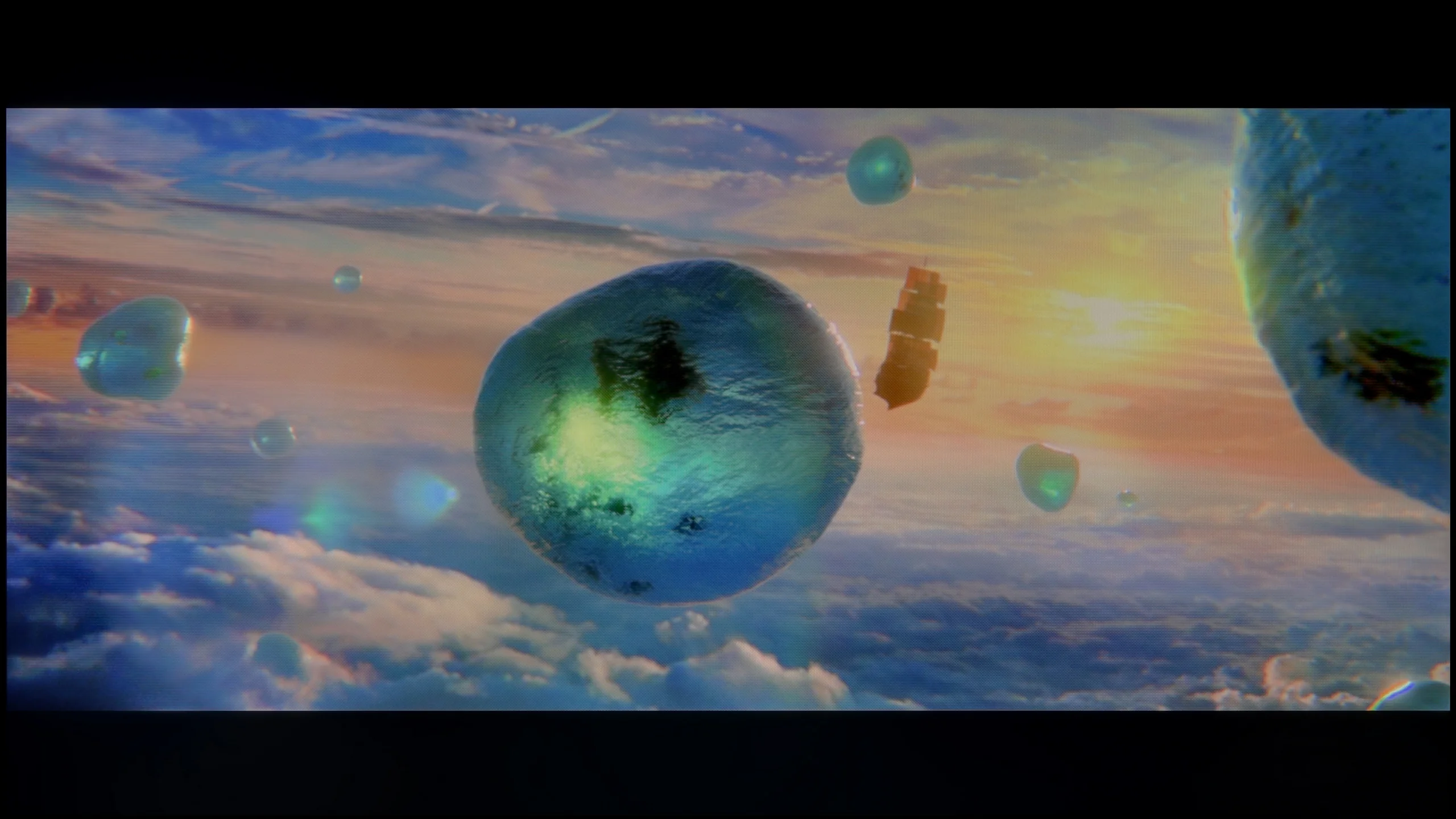
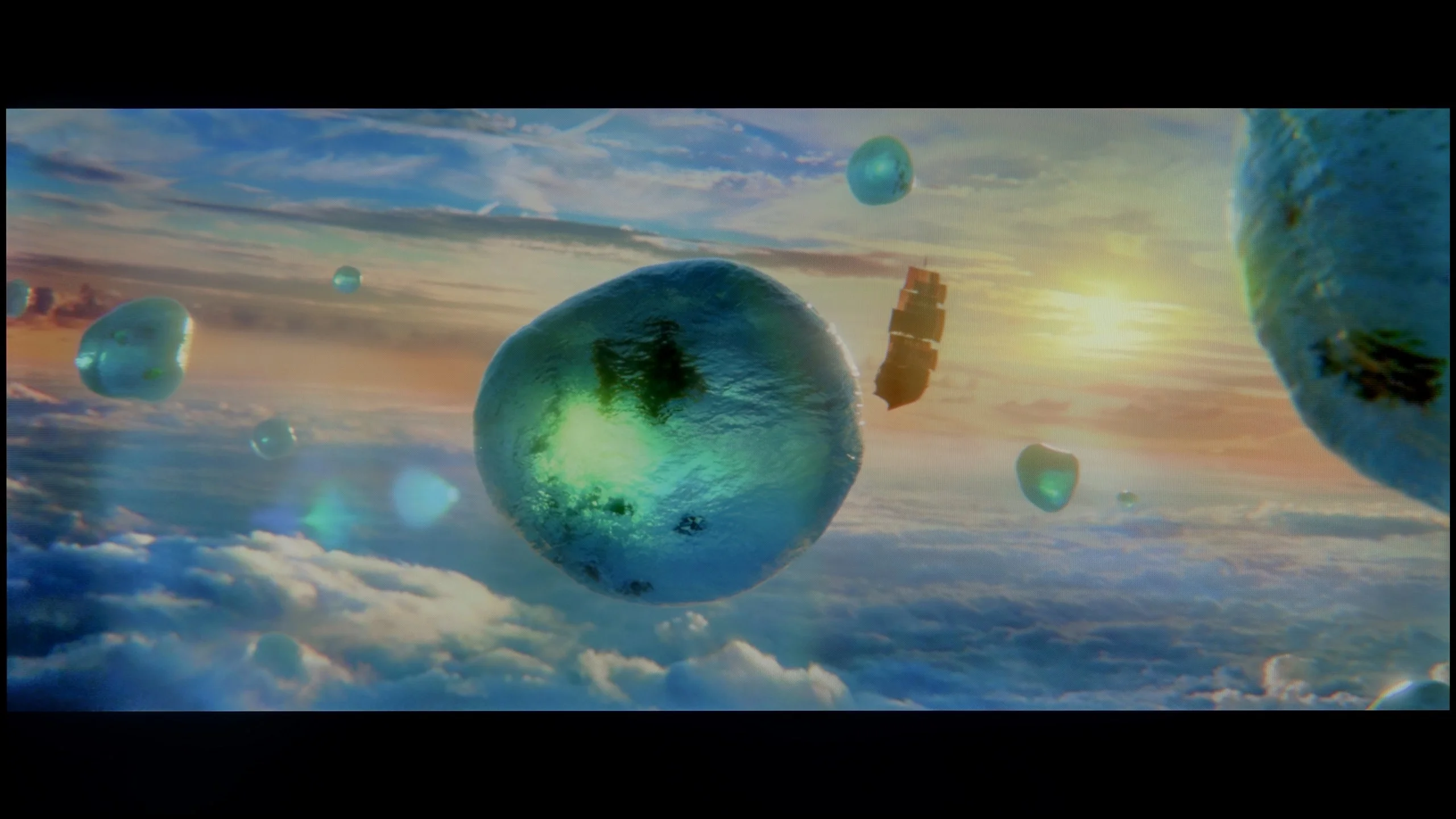
Scene from the movie “Pan” (about 2800 nits)
Scene from the movie “Billy Lynn” (about 1100 nits)
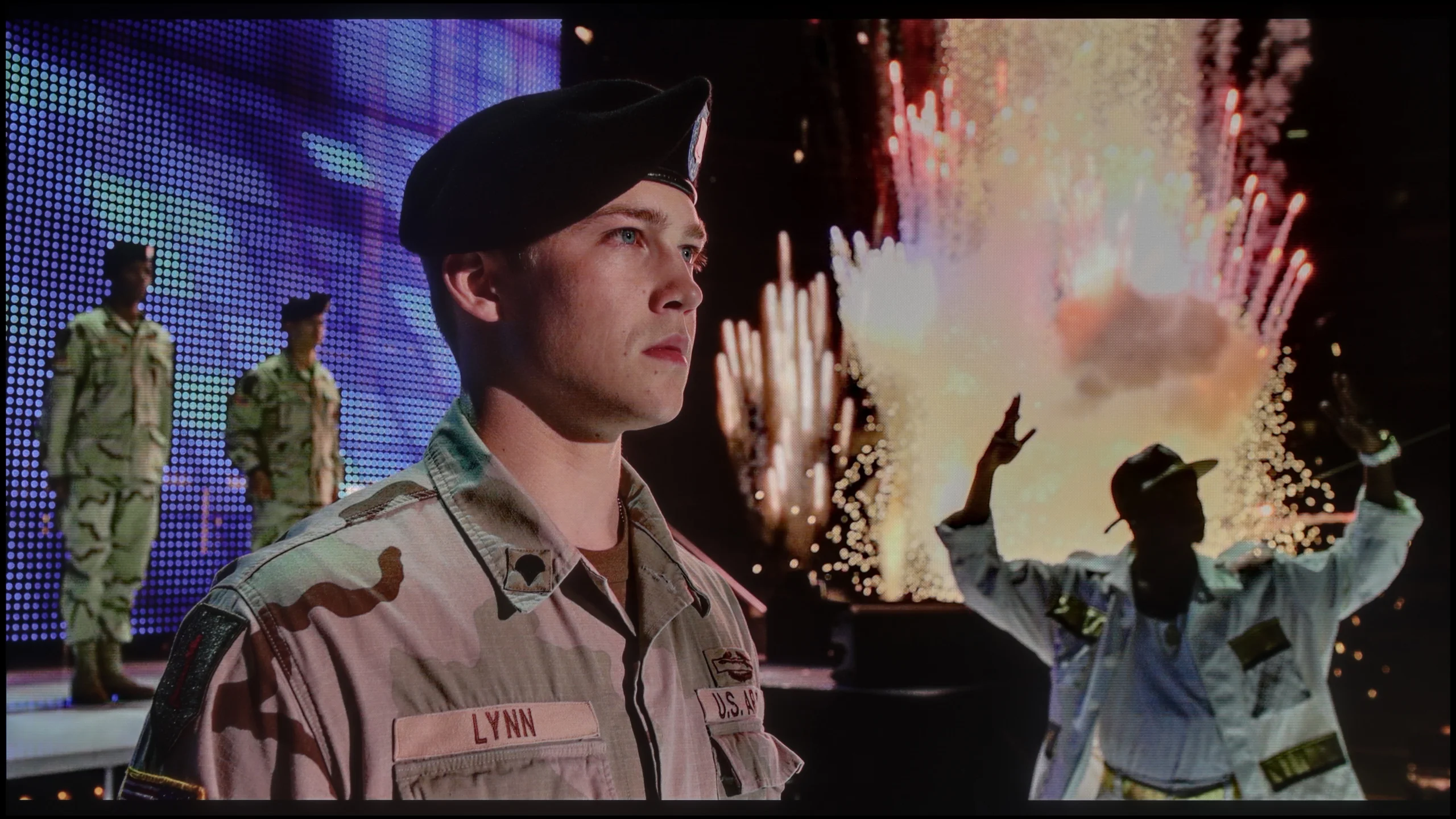
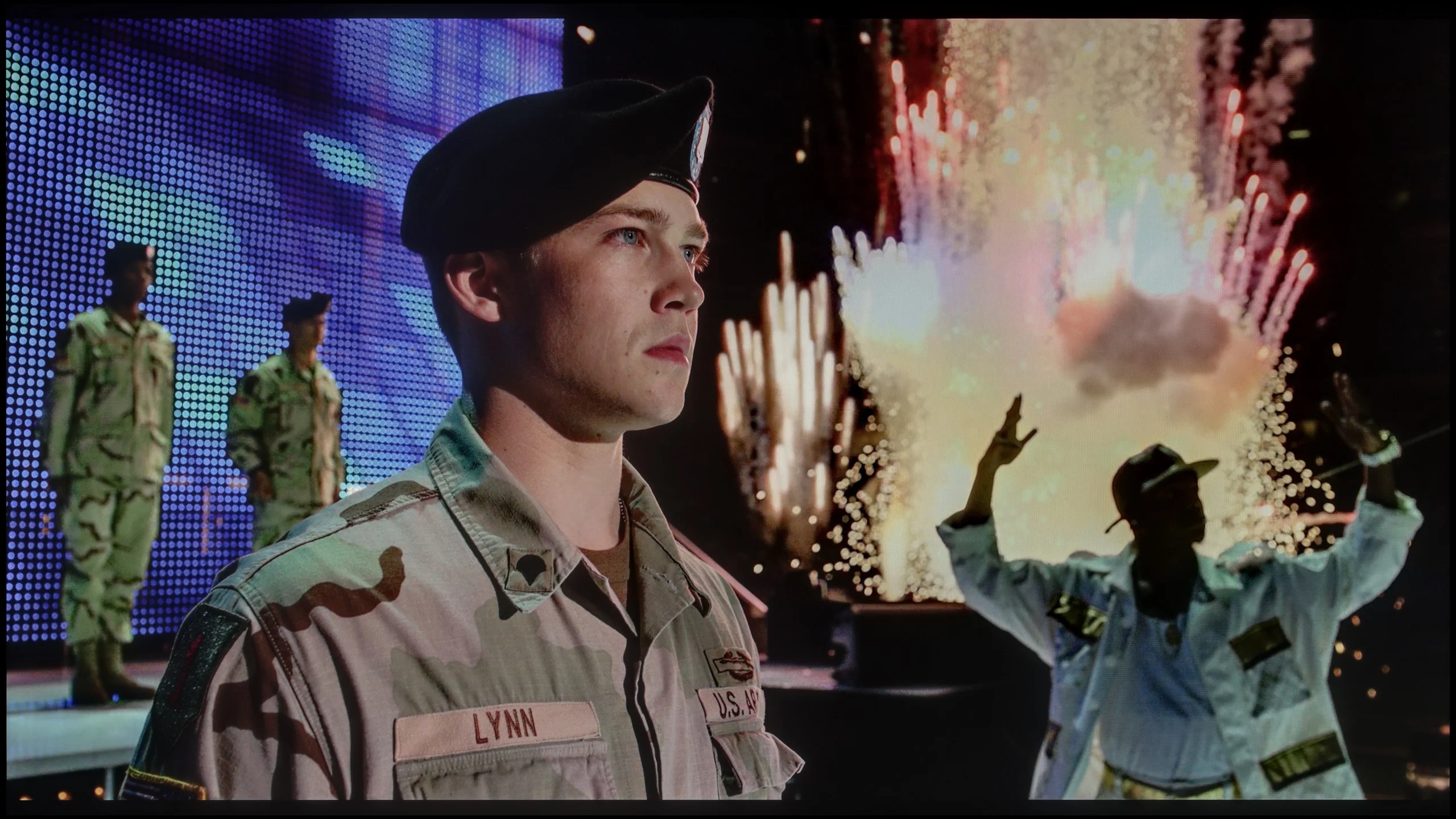
The photos show two HDR10 movies. 'Pan' is one of the brightest productions ever made, while 'Billy Lynn' (soldier) has brightness typical of streaming (Netflix, Prime, HBO MAX). Notice the intensity of effects and detail in whites.
Static HDR10


The photos present the visibility of white details in various HDR formats. They do not show brightness differences between TVs (these can be compared in the previous gallery).
Dynamic: Dolby Vision
Dynamic: Dolby Vision


The photos present the visibility of white details in various HDR formats. They do not show brightness differences between TVs (these can be compared in the previous gallery).
HDR luminance chart:
TCL RM7L
IFFALCON U85X
iFFALCON U85 handles HDR in a rather dual manner – on one hand, it can surprise with a solid peak brightness of around 650 nits, which places it well above average in this price segment. This is particularly evident in full-screen, bright scenes. Examples from movies like Life of Pi or the final test sequences from The Meg prove that the TV can maintain the strength and essence of the HDR effect when the entire panel has to "light up," delivering truly satisfying experiences. However, problems begin in high-contrast scenes, where smaller, bright details appear on the screen; the dimming algorithms prioritize deep blacks to such an extent that they can suppress the brightness of small highlights to just 100 nits, drastically reducing the dynamism of the image and depriving us of the true "punch" we expect from HDR standards. However, the question of colors remains a sweetener; thanks to the use of the PFS phosphor filter (marketed as QLED by the manufacturer), they look very good, achieving nearly 94% coverage of the DCI-P3 color palette, allowing for a rich and vibrant image in most content.
The TCL RM7L is a bright TV. In our measurements its peak brightness hovered around 1600 nits. That's clearly less than the C7L, which can approach 2600 nits, but in real movie scenes the difference between the two models isn't that big. In less demanding shots with many bright elements on screen, the RM7L can hold around 1000 nits, and sometimes a bit more, approaching 1500 nits. It performs worse in dark scenes with small highlights; then their brightness can fall to around 500 nits. However, this behavior is not accidental. The TV intentionally dims small elements to better control the backlight and maintain higher contrast. This comes at the cost of their intensity, but it's typical behavior for local-dimming TVs in a similar price bracket.
Color gamut coverage
In HDR it's not only brightness that matters, but also color. And here the RM7L has a lot to show. Colors are strongly saturated, and a wide color gamut is one of its bigger strengths. In measurements it reached about 96% of DCI-P3 and around 83% of BT.2020. It's worth remembering, though, that on a TV with this kind of backlight the result can vary depending on the scene. On test patterns colors look best, while in movies their saturation can be a bit lower than on SQD Mini LED or QD-OLED TVs. The backlight construction itself is also interesting. The RM7L doesn't use the classic red, green and blue diode set. TCL used two green diodes and one blue, and obtains the red color using a PFS phosphor. You can see this in spectrometer measurements, but it doesn't have a major impact on the picture. Colors are still produced correctly.
Factory color reproduction
4.8/10
5.8/10


This gallery shows how colors change after professional TV calibration. If you notice the difference, we recommend ordering this service at SkalibrujTV.com.
Factory Mode
After calibration
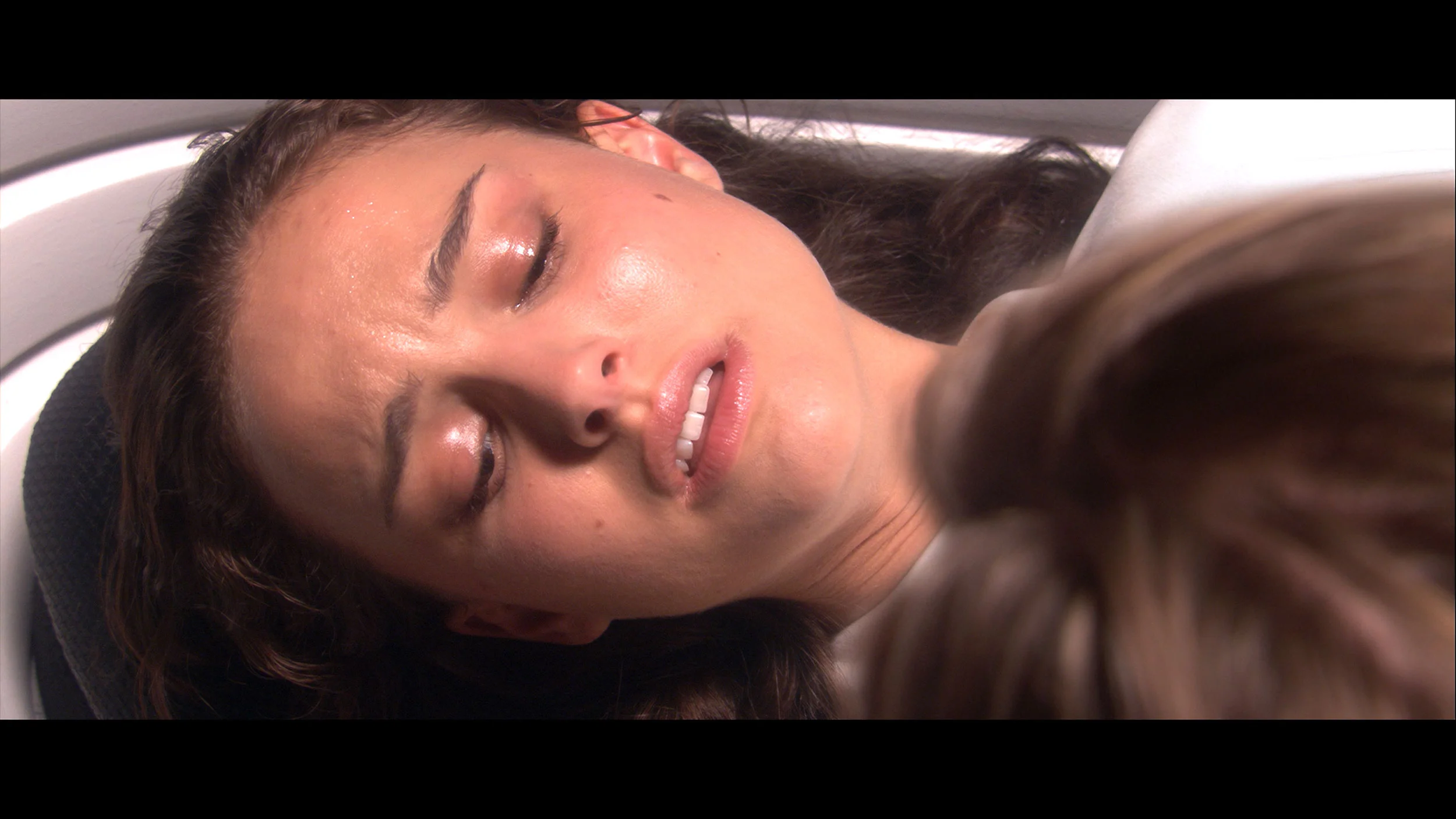
This gallery shows how colors change after professional TV calibration. If you notice the difference, we recommend ordering this service at SkalibrujTV.com.
Factory Mode
After calibration
We tested the factory colors in the iFFALCON U85X model in “Film” mode, which is definitely the most reliable among all available settings, although it is still far from perfect. The main problem that stands out in both SDR and HDR content is improper white balance - an excess of blue and red components gives the image a slight purple tint, which undermines the naturalness of film scenes. However, an even greater challenge is the way the television manages its brightness. Analyzing the gamma curve for the SDR signal, we noticed significant instability: instead of sticking to the reference value of 2.4, the device oscillates around 2.2, only to suddenly experience an unnatural jump to around 3.0. In practice, this leads to confusing effects - large bright areas on the screen appear too dark, while smaller elements are unnecessarily brightened. A similar feature can be found in the EOTF curve, which makes the image unpredictable and loses its cinematic authenticity.
We checked the factory colors in Filmmaker Mode, the best picture setting available to the user. TCL has been using it in its TVs for two years, and its purpose is to present the image as faithfully as possible in line with the creators' intent. On the RM7L this was indeed the best-calibrated mode, although it wasn't without flaws. The biggest issue was the white balance. An excess of red and blue caused the picture to take on slightly pinkish tones. This was visible in both SDR and HDR. Additionally, the luminance response was slightly boosted, which made the image appear a bit brighter but also less contrasty than it should have been.
Color reproduction after calibration
7.5/10
8/10
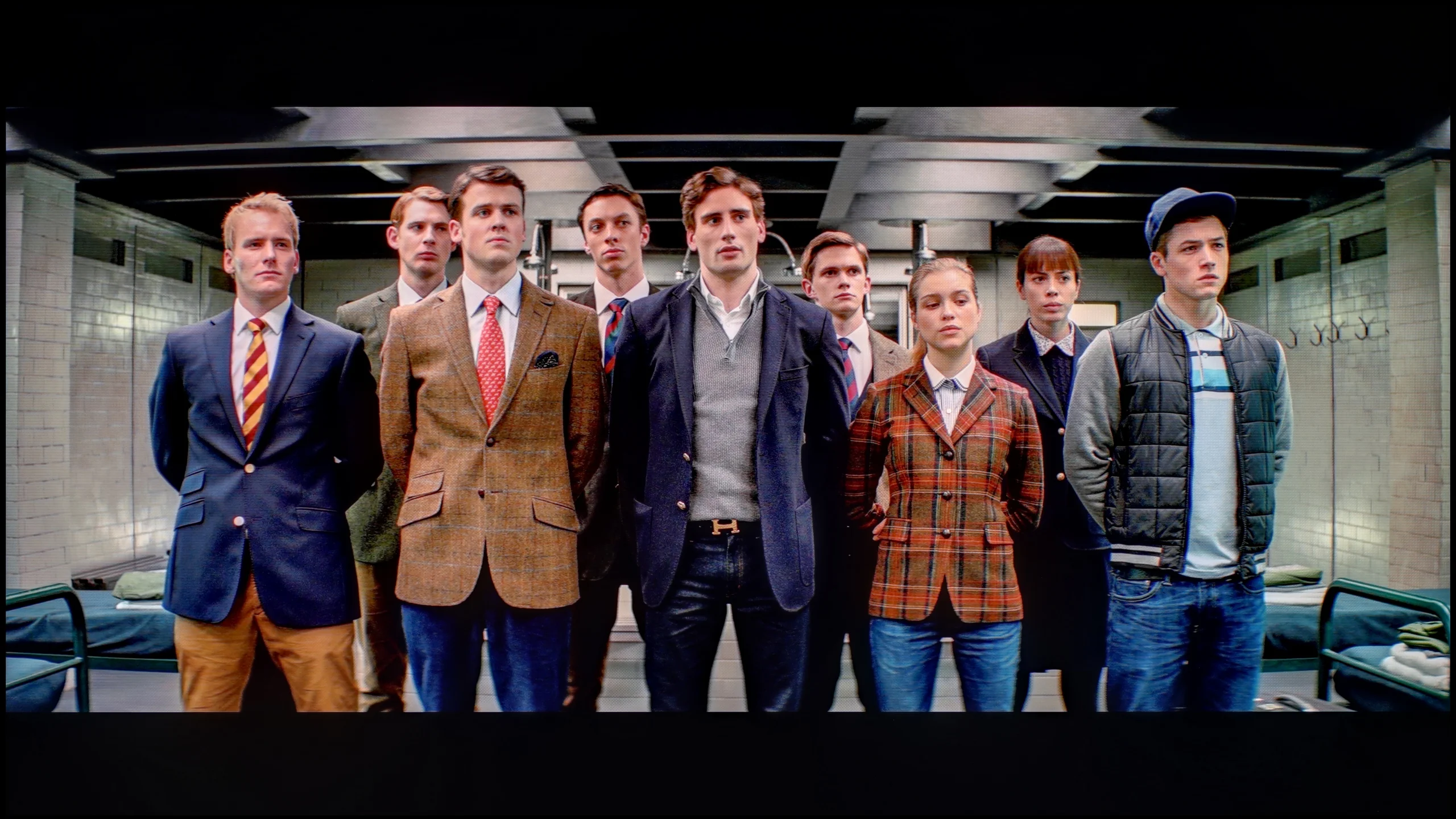
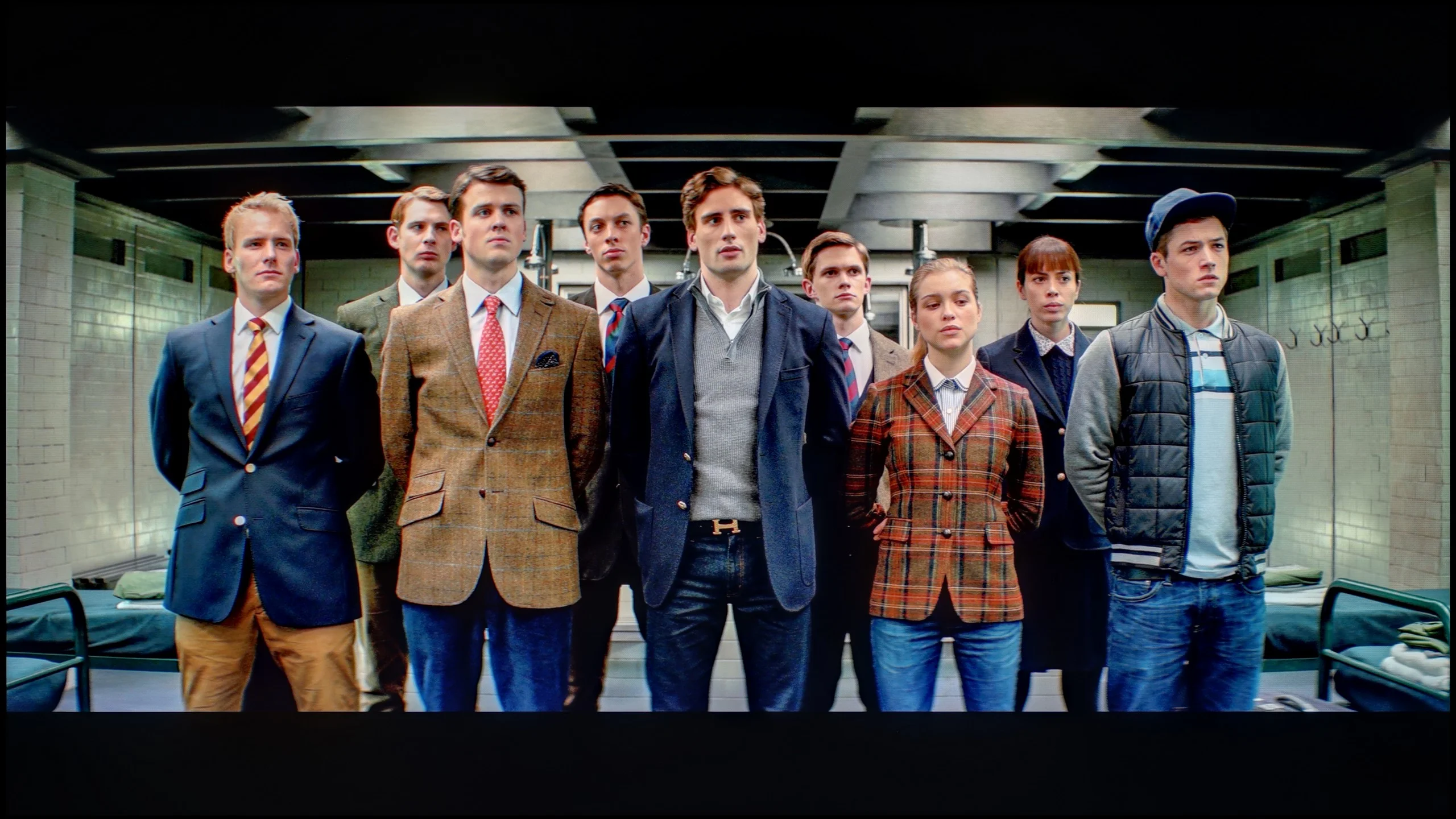
The photos show how movies look on the TV. Pay attention to black detail visibility, colors, and shadow tint.


The photos show how movies look on the TV. Pay attention to black detail visibility, colors, and shadow tint.
After professional calibration of the movie mode, we must admit that the effect is more than satisfactory – the iFFALCON U85X undergoes a true transformation. Color errors in SDR content dropped to a level below 2, making them practically imperceptible to the human eye. We managed to set the white balance almost perfectly, and brightness management (gamma) became nearly exemplary. As a result, with standard quality materials, the television looks simply perfect, and it's hard to find any faults with it.
In the case of HDR signal, the situation has also improved significantly, although here the nature of the device is a bit more pronounced. Color errors have been reduced to around 3, which is an outstanding result in this price range. However, it is worth taking a look at the EOTF chart (available on the right side of the screen in the filters: 4K HDR, gamma / EOTF) to see what is not immediately visible regarding brightness management by the U85. Although the reference line looks decent, in actual film scenes, the television still interprets the signal "in its own way" due to very aggressive local dimming algorithms. Does this disqualify this model for watching HDR content? Absolutely not. It's simply a typical ailment of almost every Mini-LED that has to reconcile high brightness with an attempt to maintain deep black. One just has to be aware of these technical limitations, which are unavoidable in this segment.
Thanks to a fairly extensive calibration menu, we were able to correct the vast majority of the errors described earlier. The biggest change was to the white balance. After calibration it looks very good, so the image lost its pinkish cast and became much more neutral. The luminance response itself also improved. Both the SDR gamma and the HDR EOTF curve are now much closer to the reference values. The image is no longer unnecessarily brightened, and darker areas look more natural and have more depth. Better luminance accuracy also affected the colors, which after calibration are noticeably more accurate. Not everything could be set perfectly, though. In HDR material the RM7L still interprets part of the signal its own way and does not always follow the reference curve exactly. This is most apparent in some darker scenes, where the TV can either slightly lift the shadows or darken them completely. That was the source of the earlier impression of a slightly brightened, less contrasty image. Even so, the calibration delivers a very good result here. It removes the most visible errors and, above all, makes the image much closer to how it should look.
Smoothness of tonal transitions
7/10
8.9/10
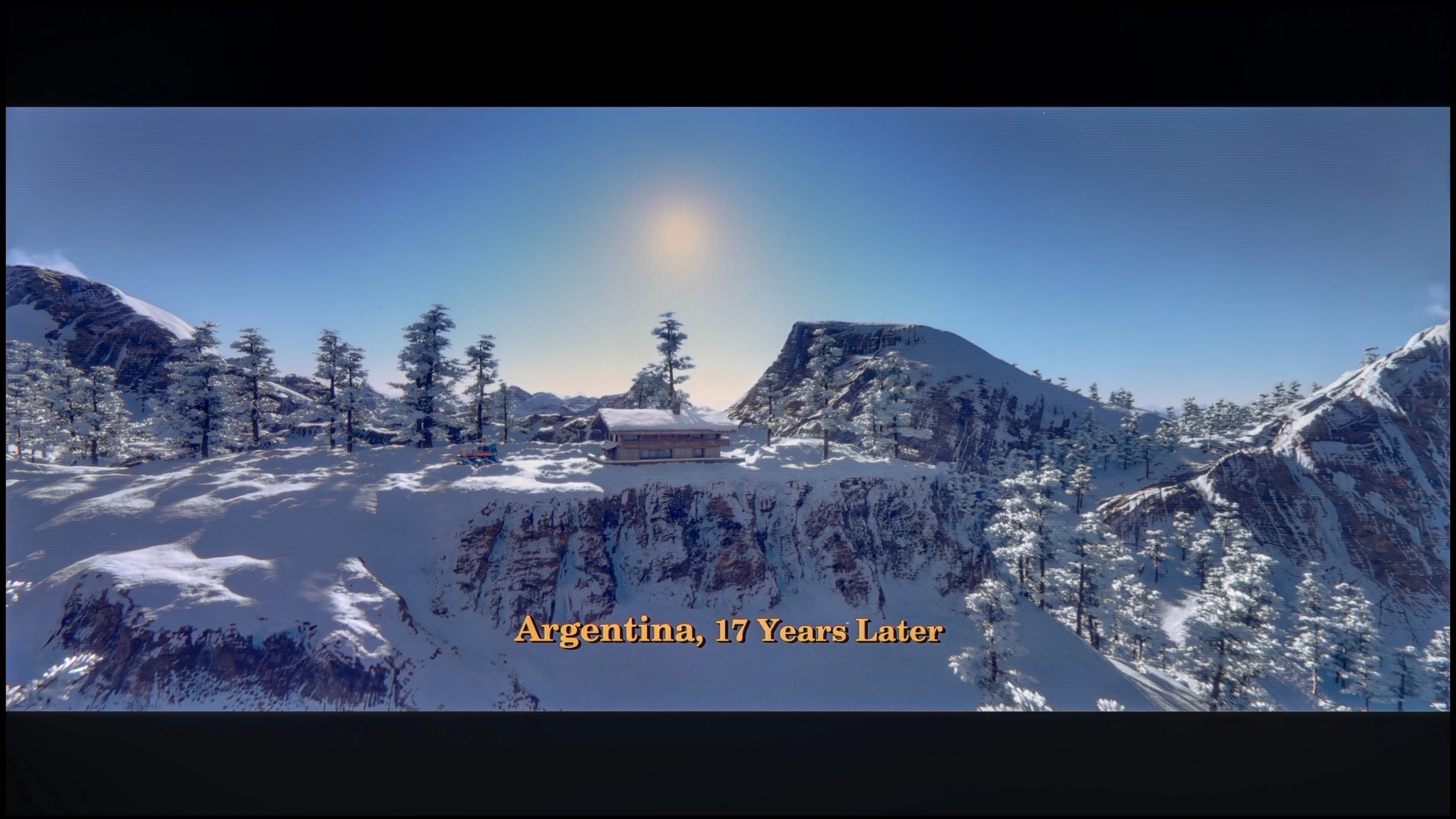
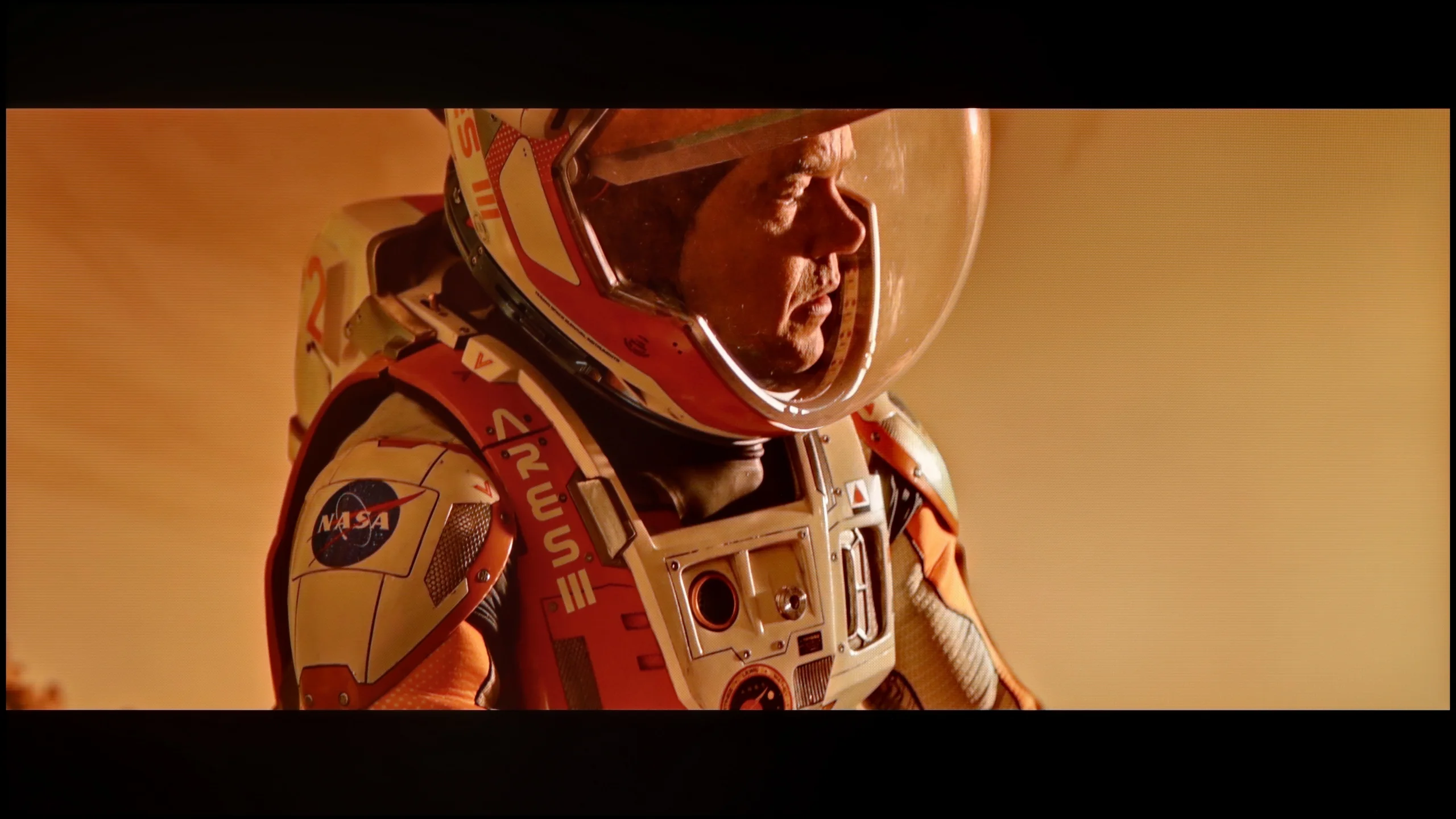
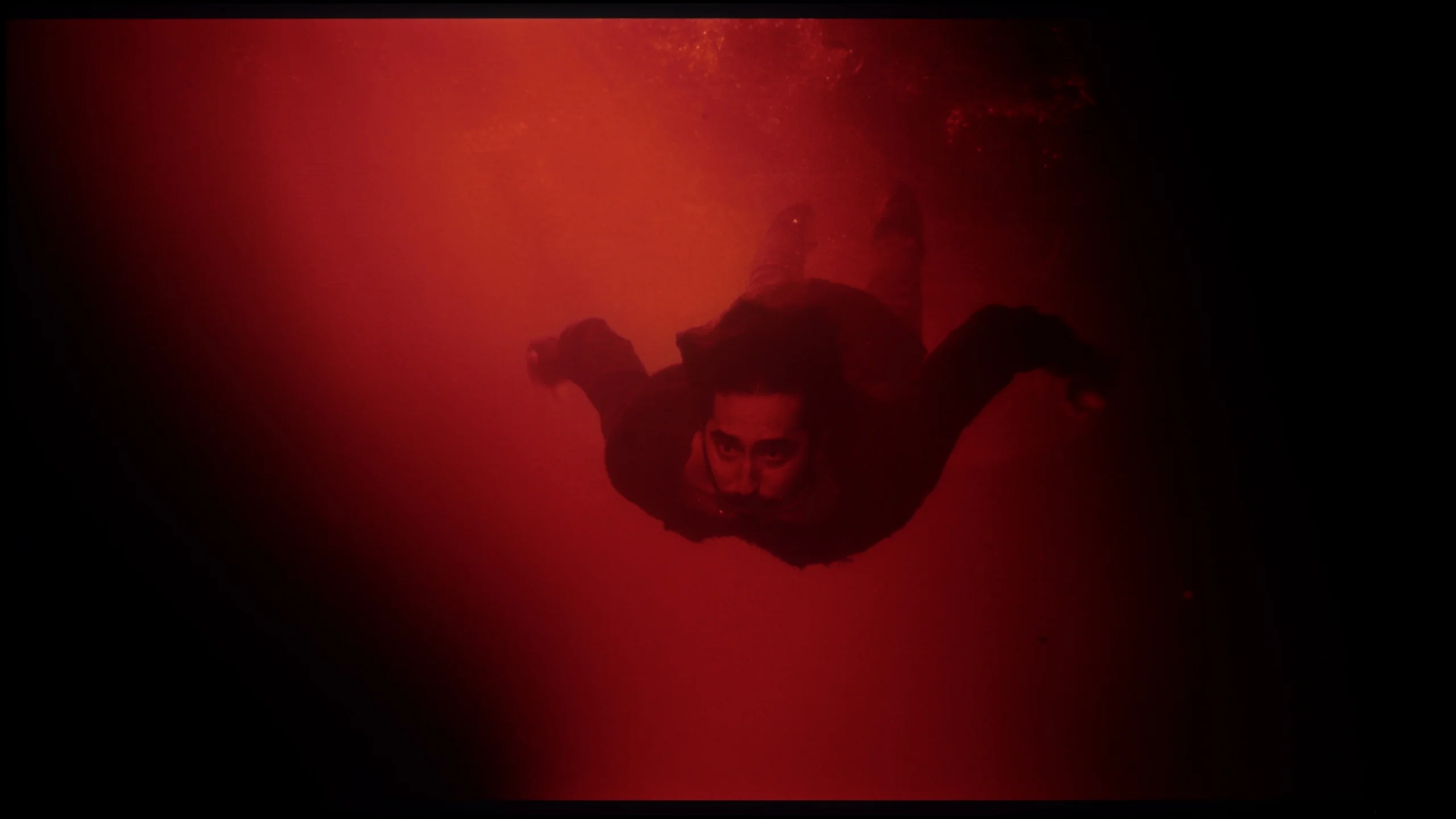
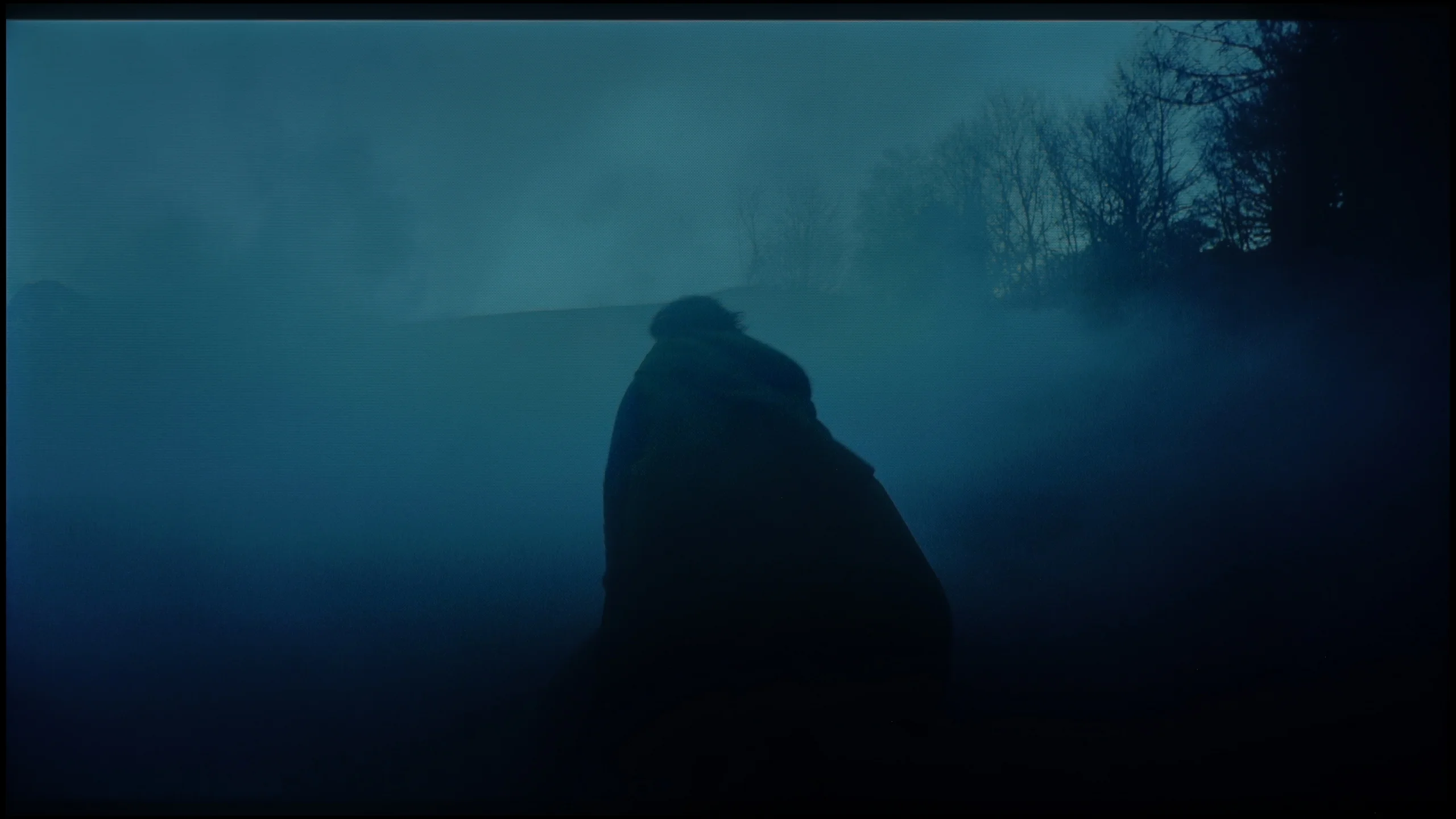
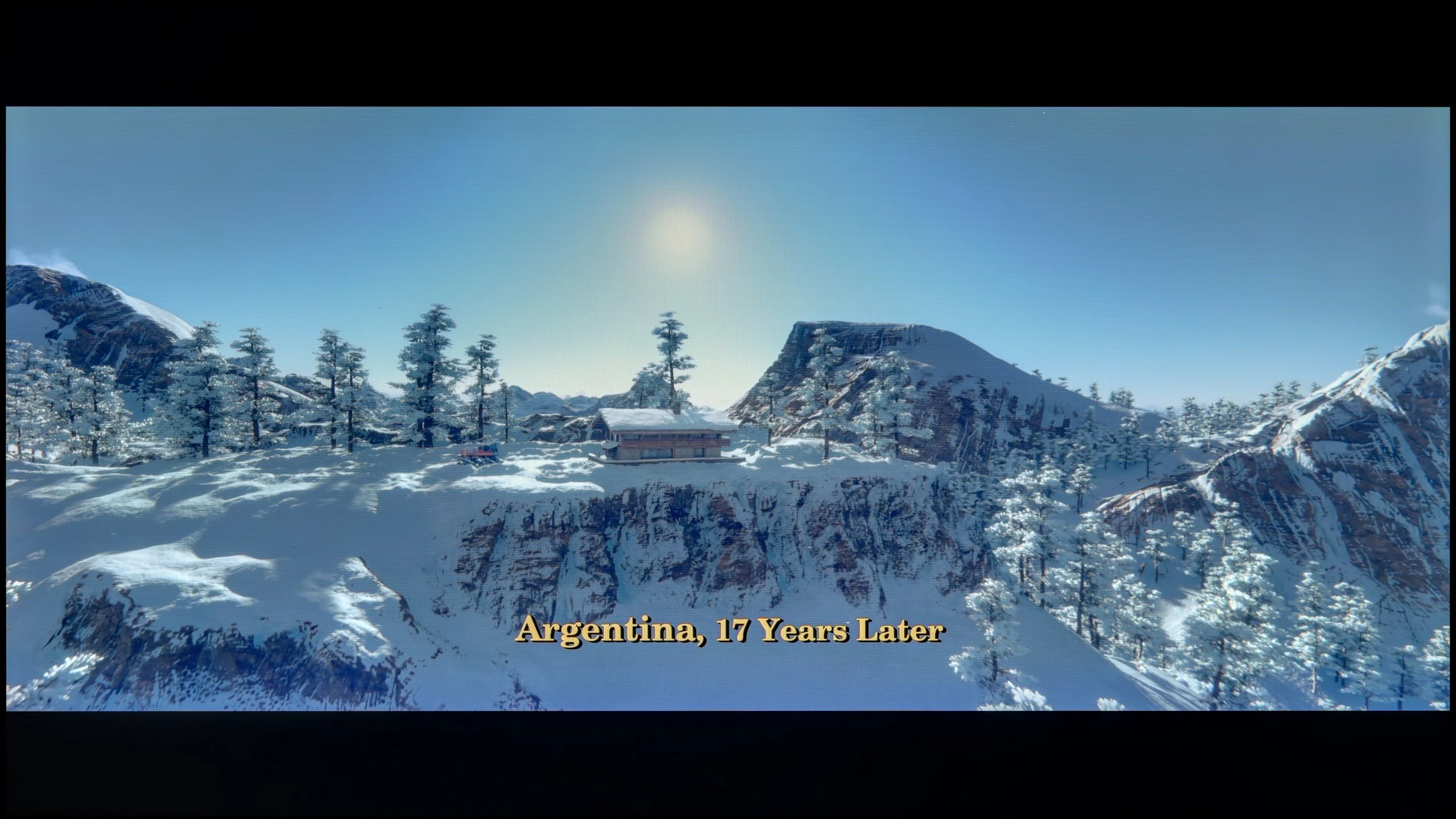
These are selected scenes that show smooth tonal transitions from one color to another. If you see distinct banding, it’s the TV panel’s fault.
These are selected scenes that show smooth tonal transitions from one color to another. If you see distinct banding, it’s the TV panel’s fault.
These are selected scenes that show smooth tonal transitions from one color to another. If you see distinct banding, it’s the TV panel’s fault.
These are selected scenes that show smooth tonal transitions from one color to another. If you see distinct banding, it’s the TV panel’s fault.
When it comes to the smoothness of tonal transitions, the iFFALCON U85X performs quite decently. In most scenes, gradients are almost imperceptible, so the irritating "banding" of colors shouldn't be noticeable during everyday viewing, for example, on ChooseTV. However, it must be honestly admitted that in very dark frames, the image is not always perfectly smooth, and certain imperfections in transitions between shades can be observed. Nonetheless, this result is more than satisfactory and does not spoil the overall perception of the image.
The smoothness of tonal transitions on the RM7L is very good. In both bright and dark scenes the gradients are smooth and there is no obvious color banding. Minor issues only appear in exceptionally demanding material, such as our fourth test pattern with red water transitioning to black. It should be noted, however, that most TVs do not reproduce this scene perfectly. So in everyday use this should not be a major problem.
Image scaling and smoothness of tonal transitions
5/10
5.5/10

Smooth transition function
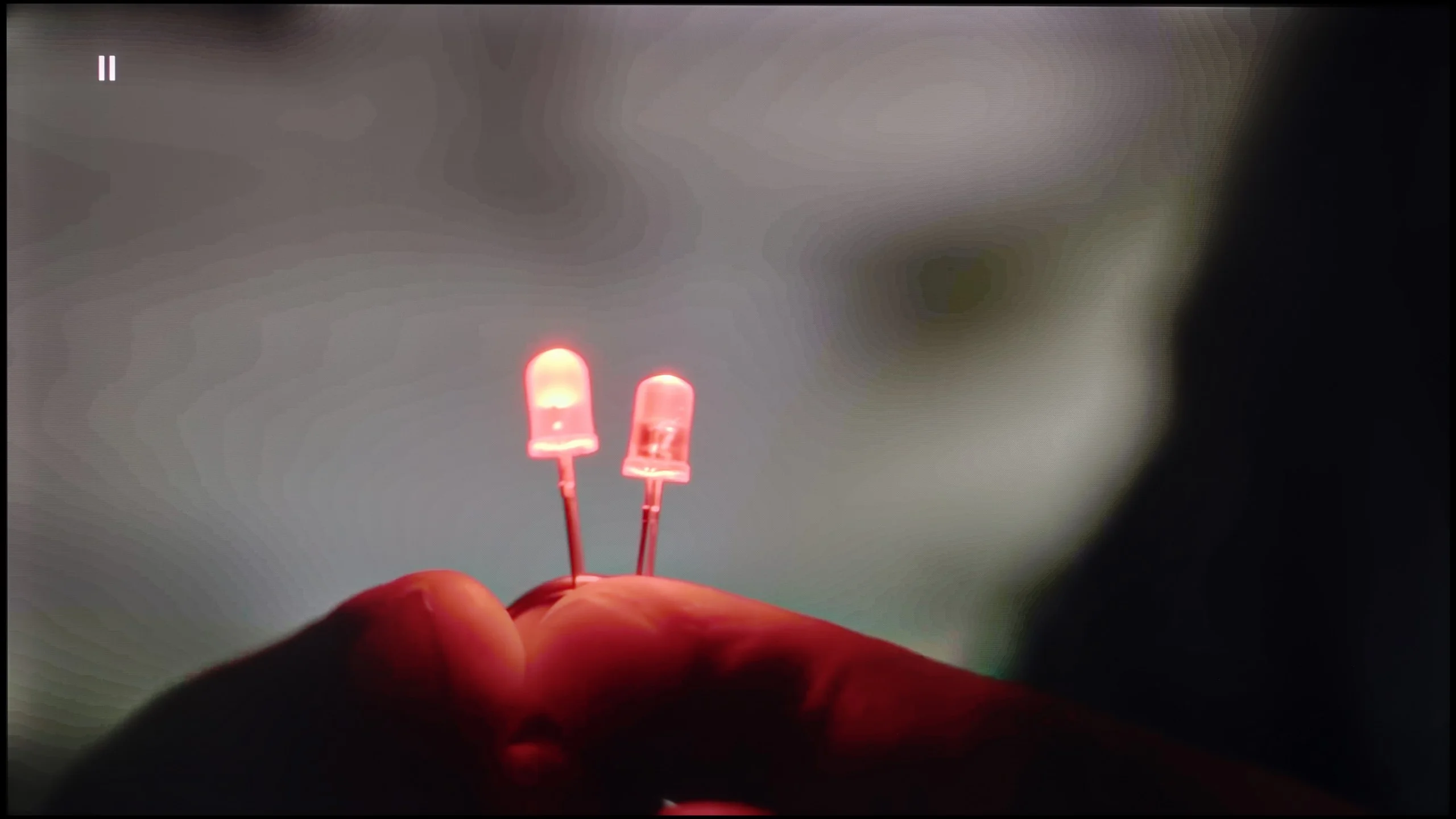
The match photo shows how the TV smooths weak tonal transitions in low-quality video.
Image scaling SD (576i)


The model photo shows how it handles upscaling of SD material.
When it comes to scaling the image to 4K resolution, the iFFALCON U85X performs solidly. The device efficiently enhances low-quality signals, making even older materials look clean and clear on the 4K matrix. At extremely low resolutions, such as 480p, you can notice slightly jagged edges (especially on thin lines), but let's face it – this is a scenario you'll only encounter when watching very old footage, so it's not a real issue in everyday use.
However, the digital processing aimed at smoothing tonal transitions is significantly worse. Although the menu features a function called “Gradual Smoothing”, its effectiveness is at least debatable. In practice, it does not effectively reduce banding (color stepping), and worse, it can cause more harm than good. This filter can be too aggressive where it shouldn't be, artificially smoothing out details that should not be touched, such as the natural texture of the face or fine details of the skin's texture. Instead of improving quality, this feature can give the image an unnatural, “plastic” look, so it's best to use it with great caution or, better yet: leave it turned off.
Upscaling and digital image processing are not the RM7L's strong suit. TCL used a MediaTek Pentonic 700 SoC here, designated MT5896, which isn't among the best processors at handling lower-quality content. The biggest problems show up with heavily compressed material from YouTube or regular broadcast TV. The processor can't effectively hide posterization and the characteristic color banding. The feature meant to smooth them does little here, and it often interferes too much with the picture, smoothing faces or fine textures, for example. For that reason, it's best to simply leave it off.
Straightforward upscaling to 4K looks better. Lower-quality sources remain reasonably sharp and retain enough detail. It's not on par with the best processors on the market, but for everyday viewing the result is entirely acceptable.
Blur and motion smoothness
6.8/10
7.8/10
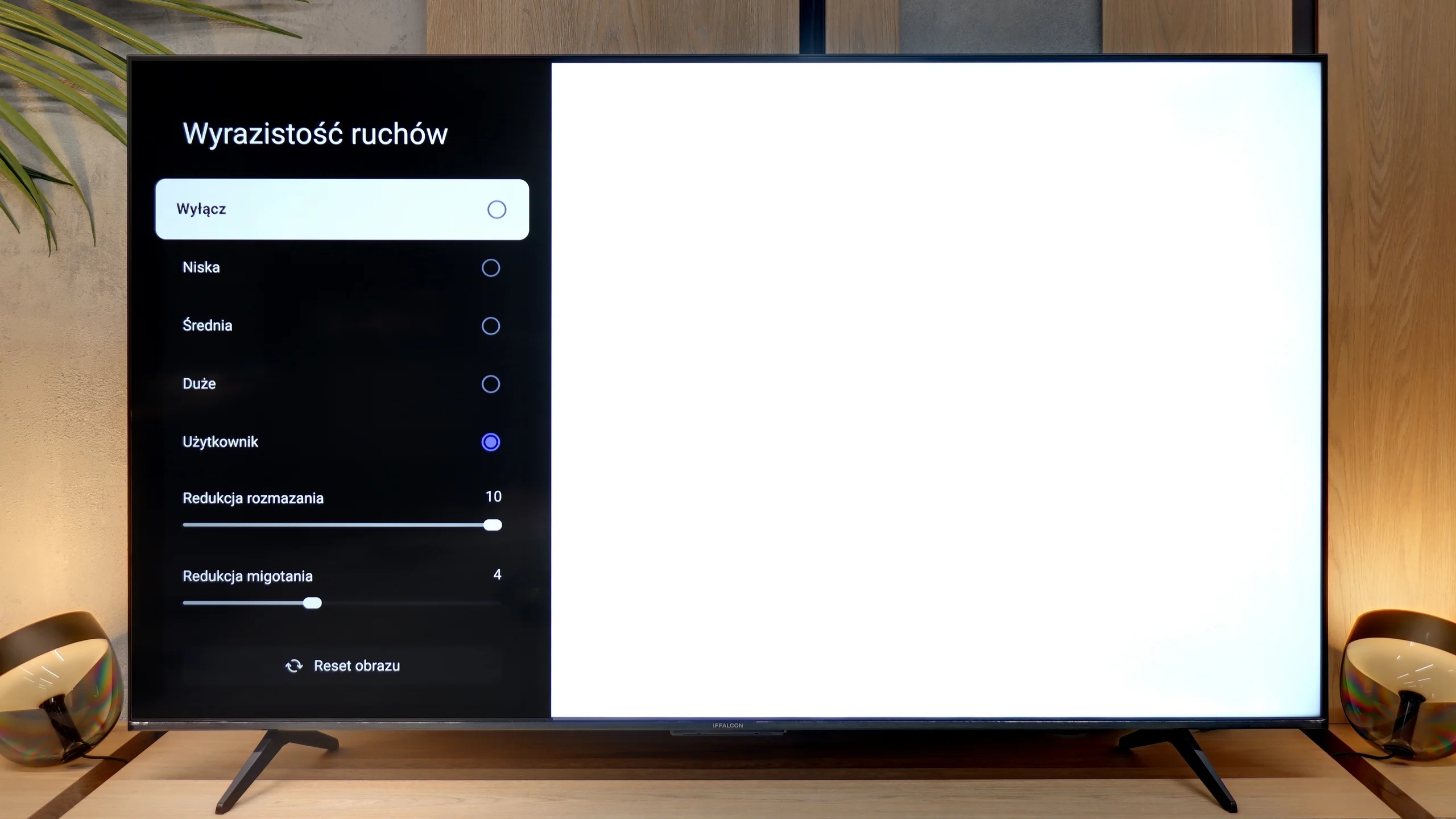
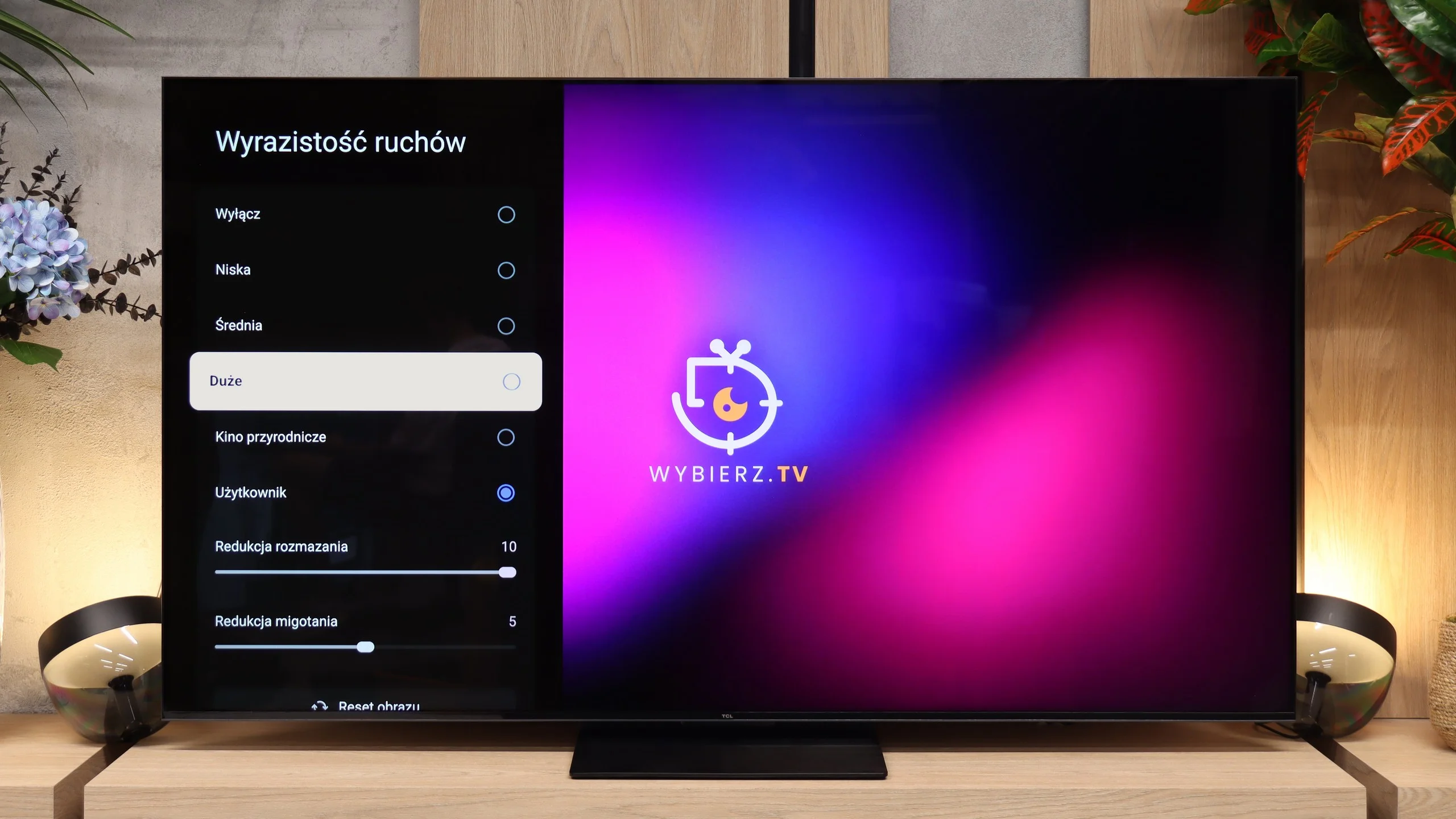
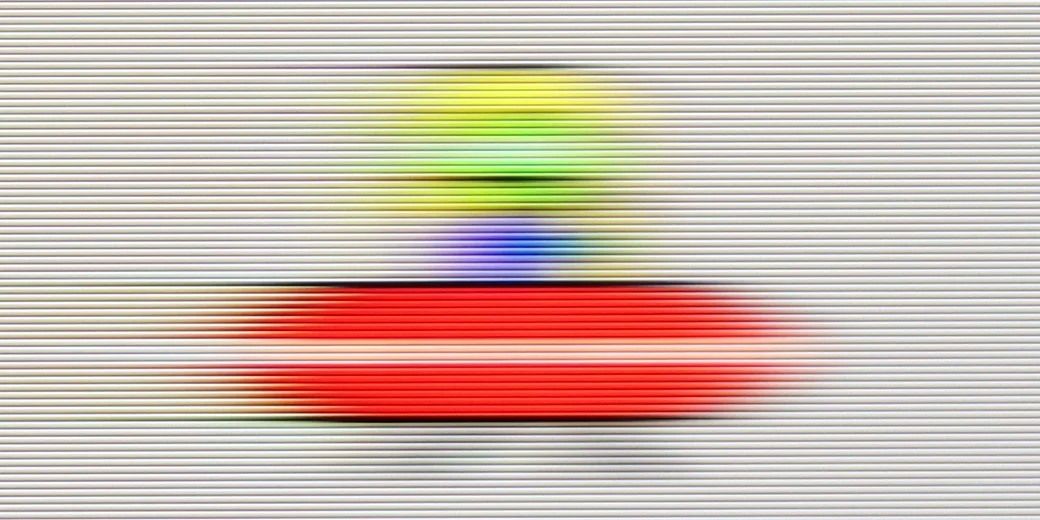
Blur (native resolution, maximum refresh rate):

Blur (BFI function enabled):
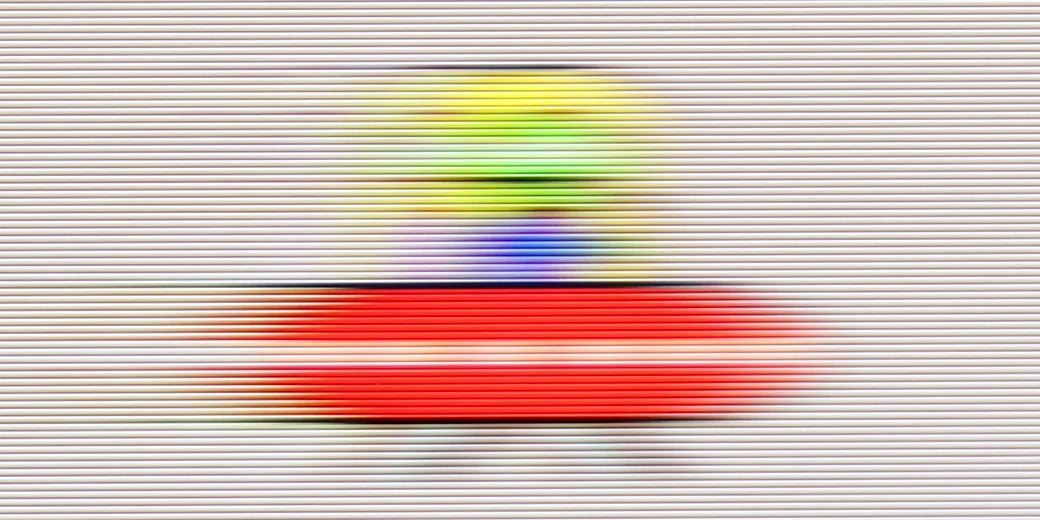
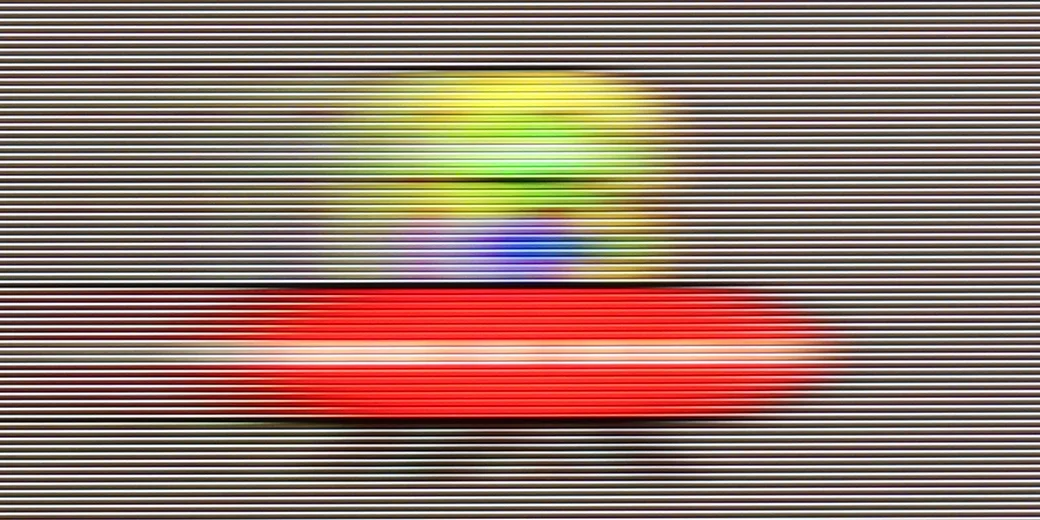
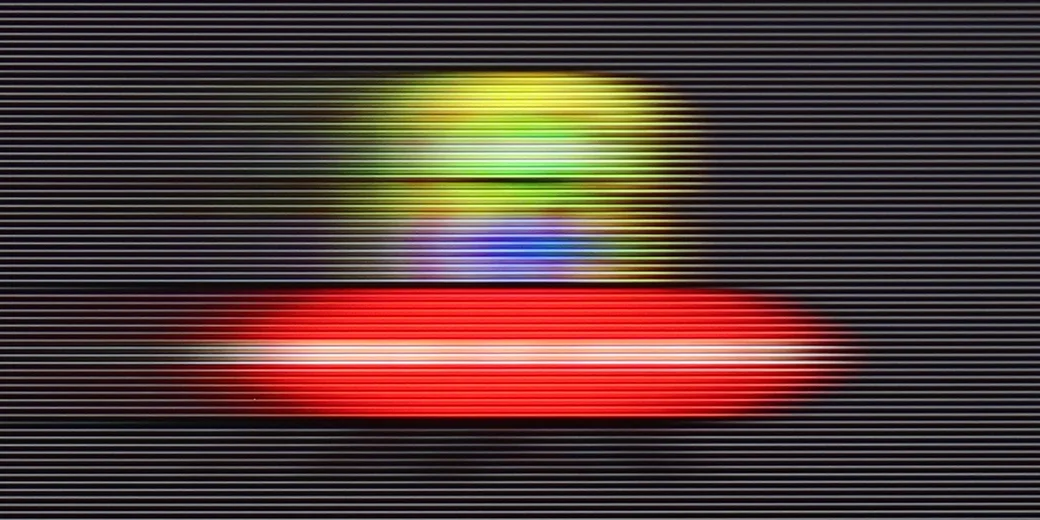


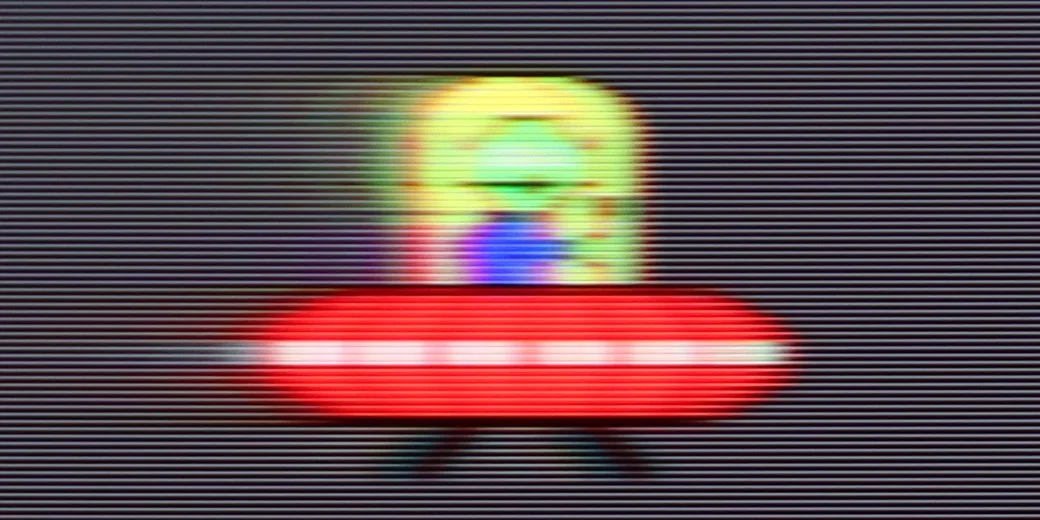
Blur (4K@144Hz):
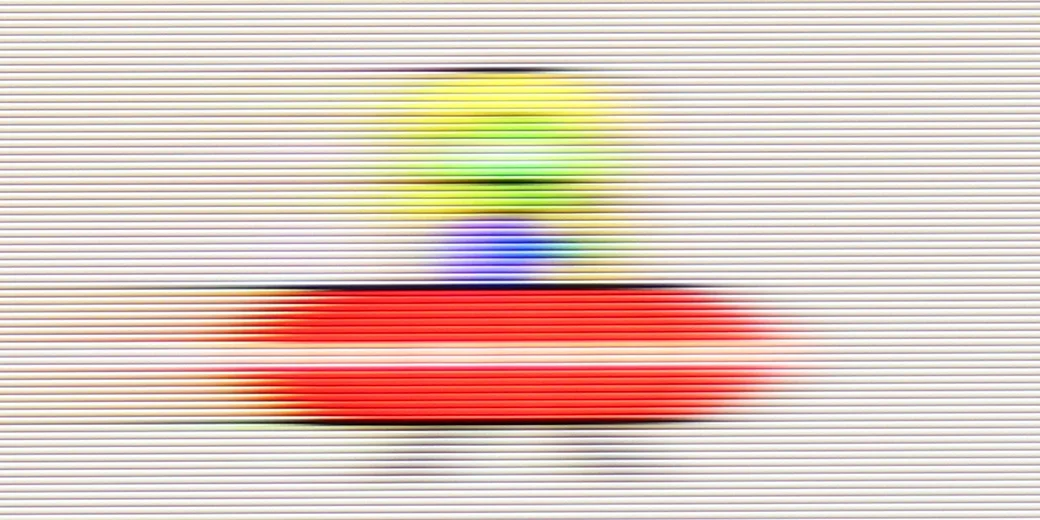
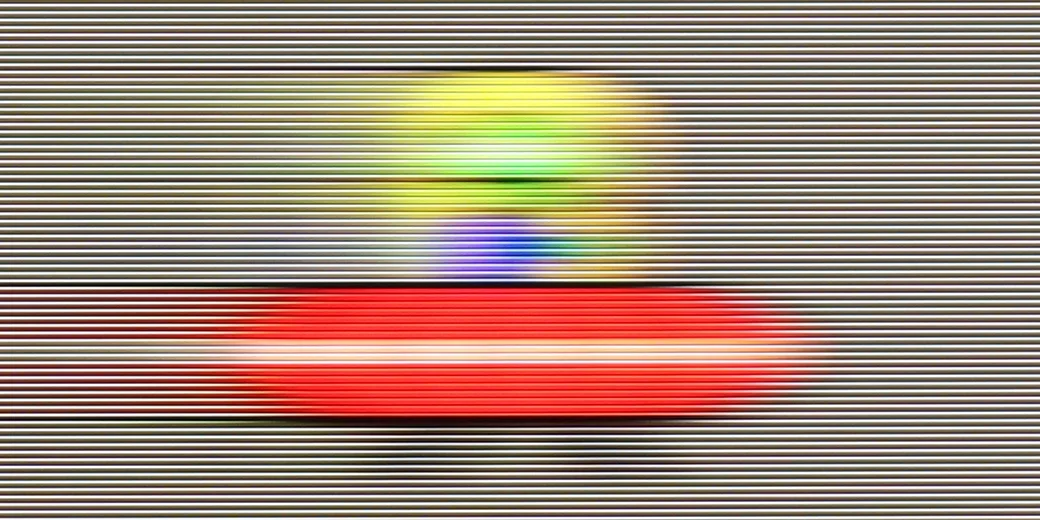
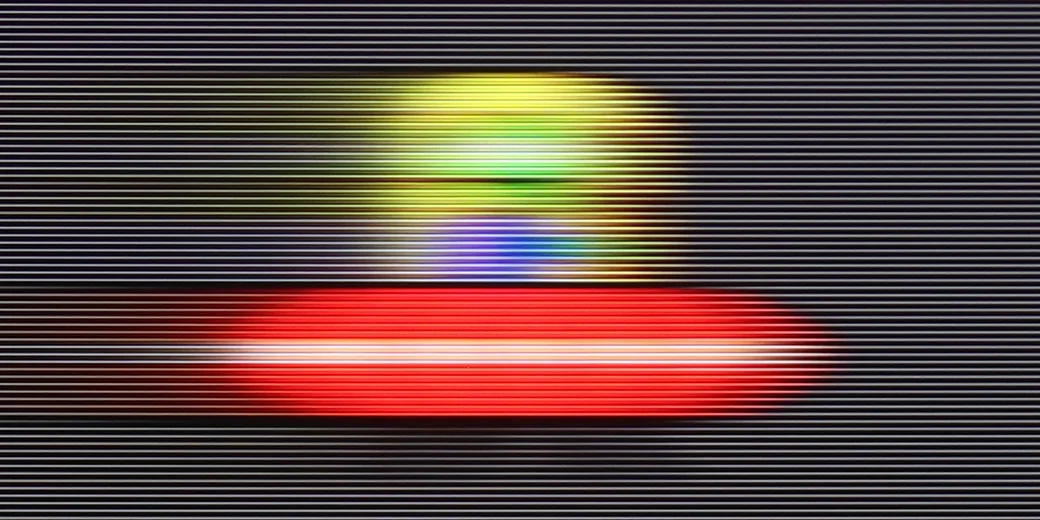
Blur (4K@144Hz ):

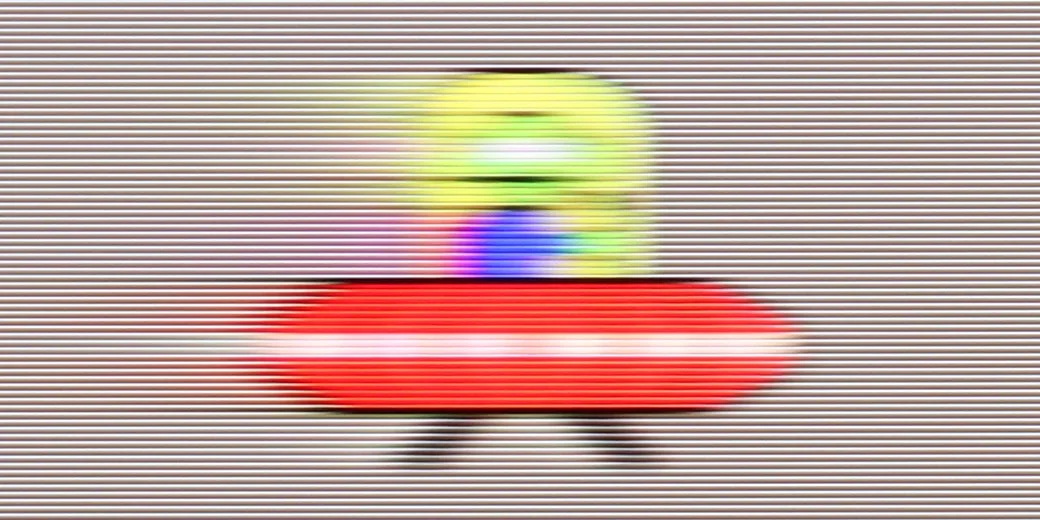
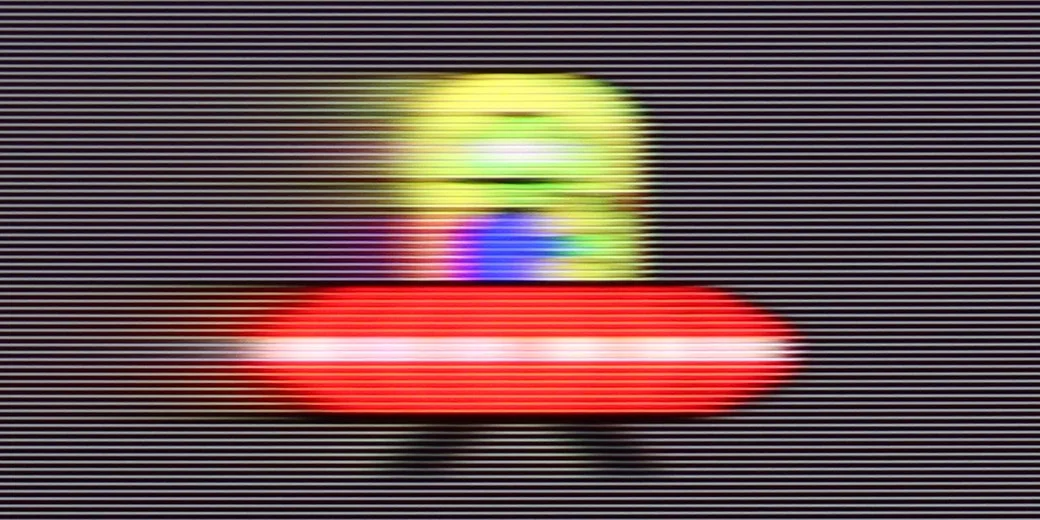
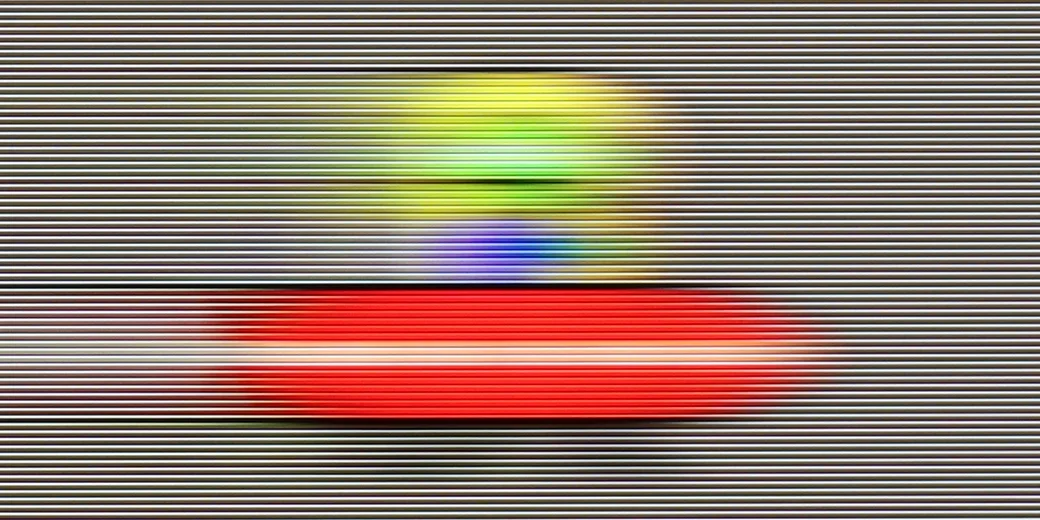
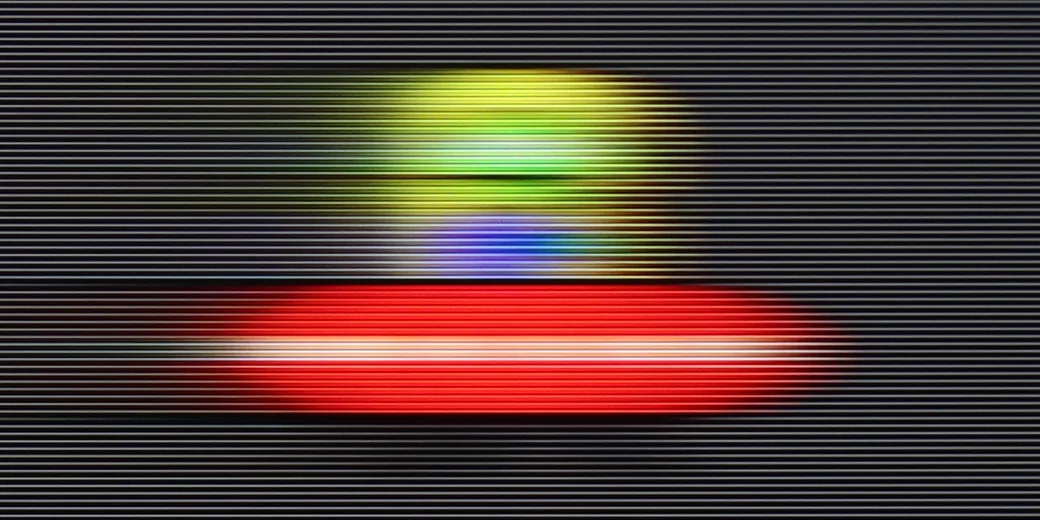
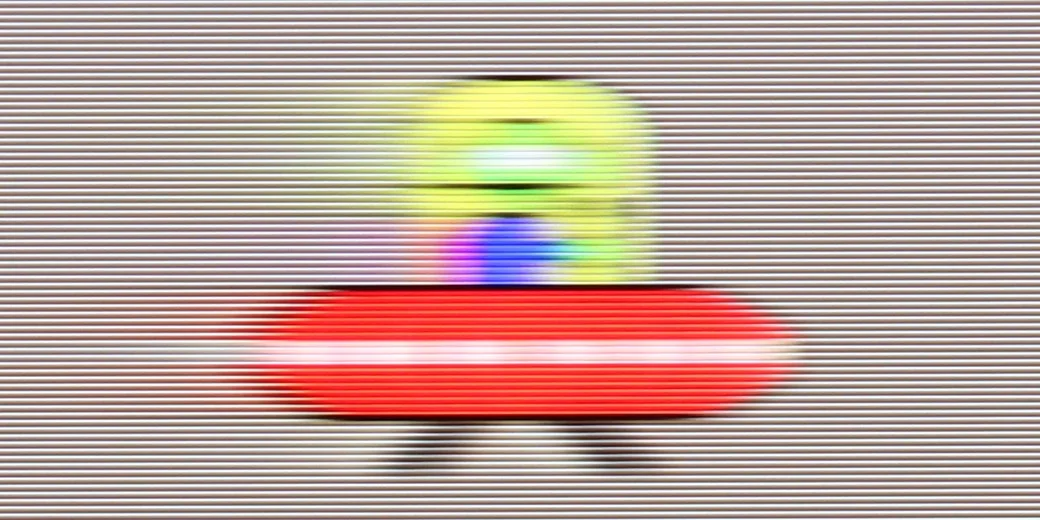
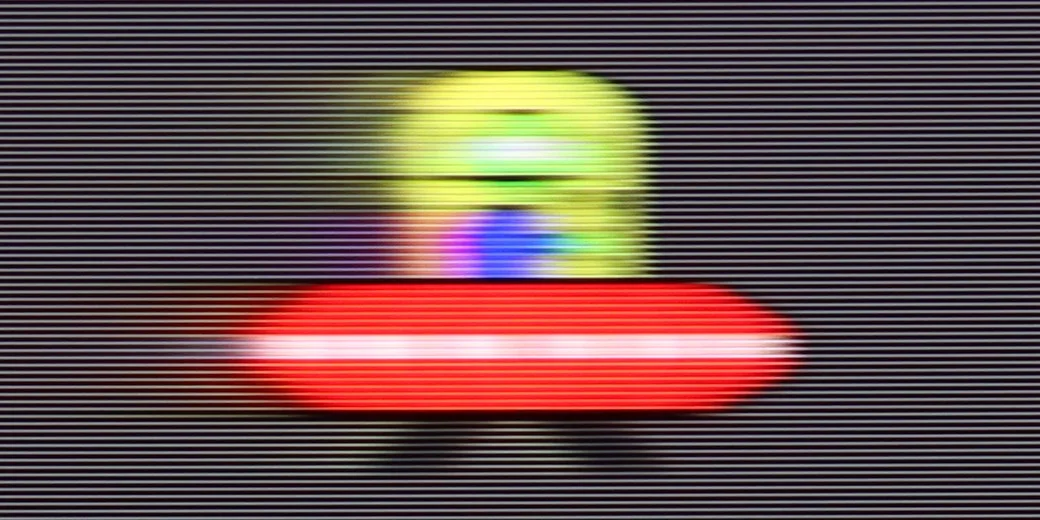
In contrast to budget constructions, which in dynamic sports scenes may resemble a slideshow, the iFFALCON U85X is a heavyweight contender equipped with a panel featuring a native refresh rate of 144Hz. However, it is worth remembering that in the world of movies, series, or sports, we will mostly operate at 120Hz due to the specifics of image enhancement systems. Such a fast panel is excellent news for gamers and sports fans, as it opens the door to advanced motion settings that simply don't exist in cheaper 60-Hz models.
We manage everything from the "Motion Clarity" menu, where instead of using pre-set, often too aggressive modes, we definitely recommend a custom configuration based on two sliders. The most important of them, reduction of flicker, is responsible for smoothness in films – here, it's best to aim for a value around 4, which will maintain a natural, cinematic character of motion without falling into the artificial "soap opera effect." On the other hand, the first slider, reduction of blur, is the key to success in sports broadcasts. In this case, it's worth going all out and setting it to maximum, ensuring that the image during fast actions on the field remains sharp, and annoying trailing is eliminated.
The RM7L uses a 144 Hz VA panel, so right out of the box it's a TV well suited for sports, gaming, and other fast-moving content. The high refresh rate also gives the motion interpolation engine more room to work, allowing it to generate extra frames. On the RM7L it works well, and with the right settings it can noticeably improve motion smoothness without causing an excessive soap opera effect.
Console compatibility and gaming features
9.8/10
9.8/10
- ALLM
- VRR
- VRR range48 - 240Hz48 - 288Hz
- Dolby Vision Game Mode
- Correct implementation of HGIG
- 1080p@120Hz
- 1440p@120Hz
- 4K@120Hz
- Game bar
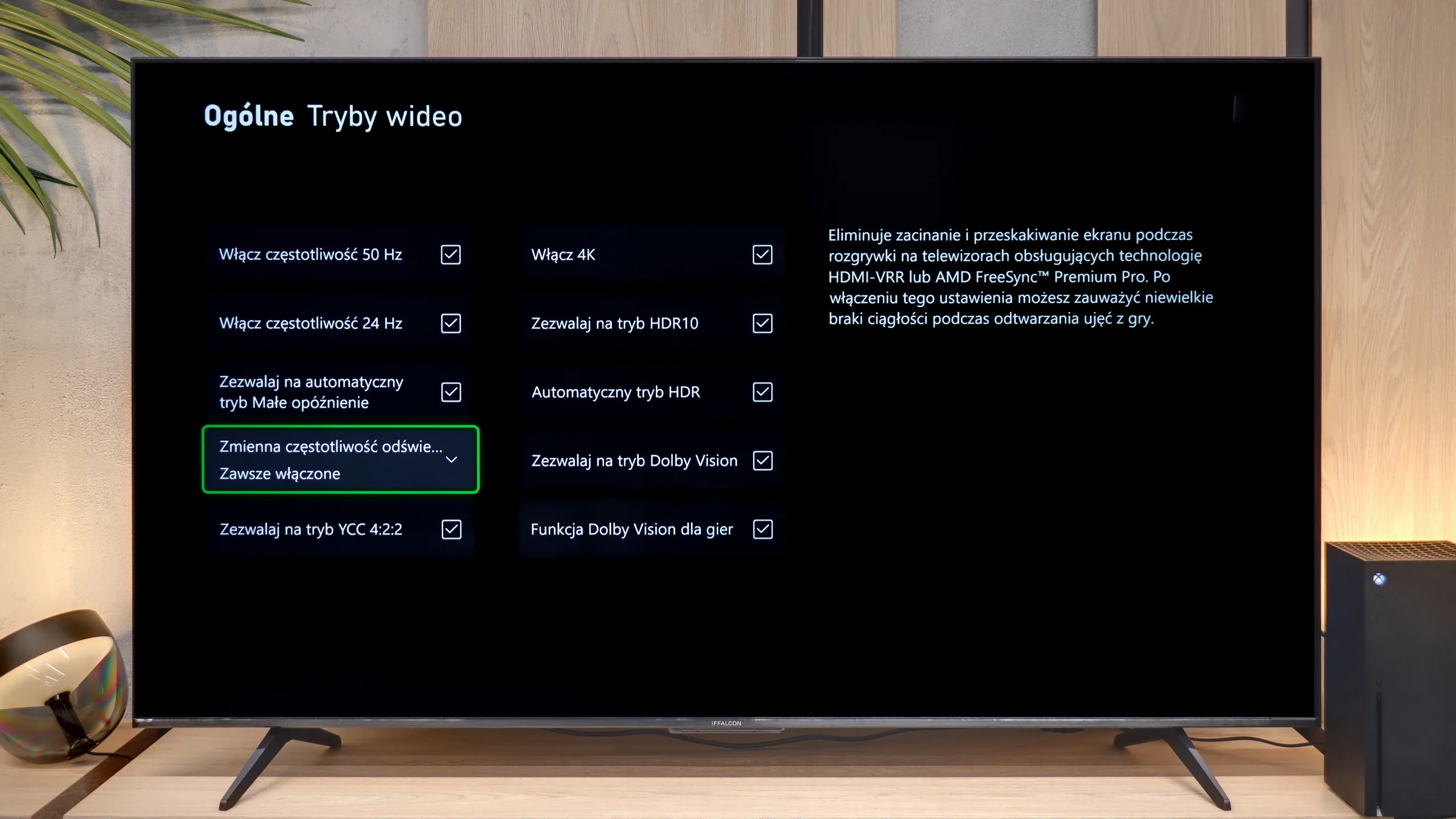
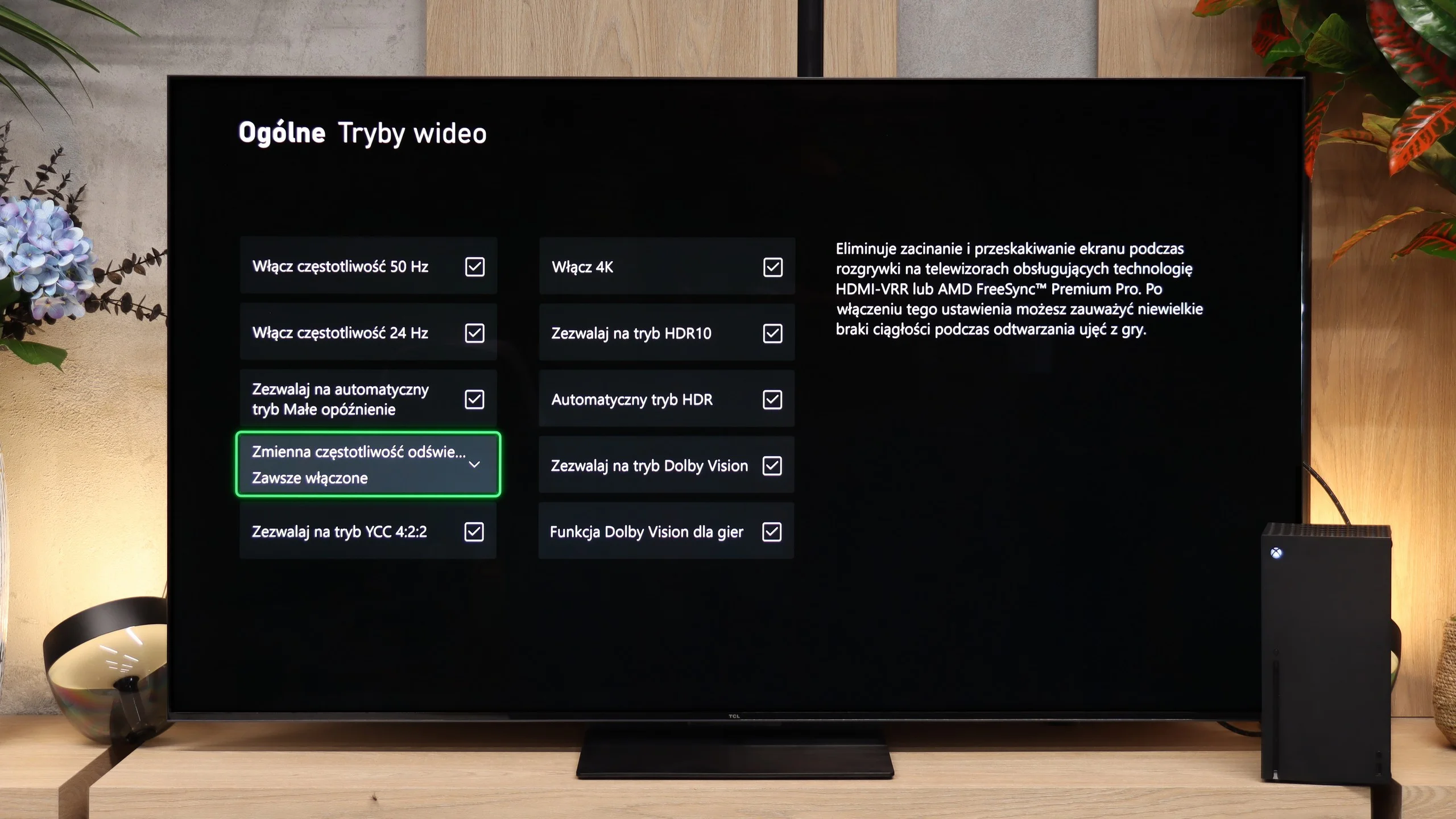
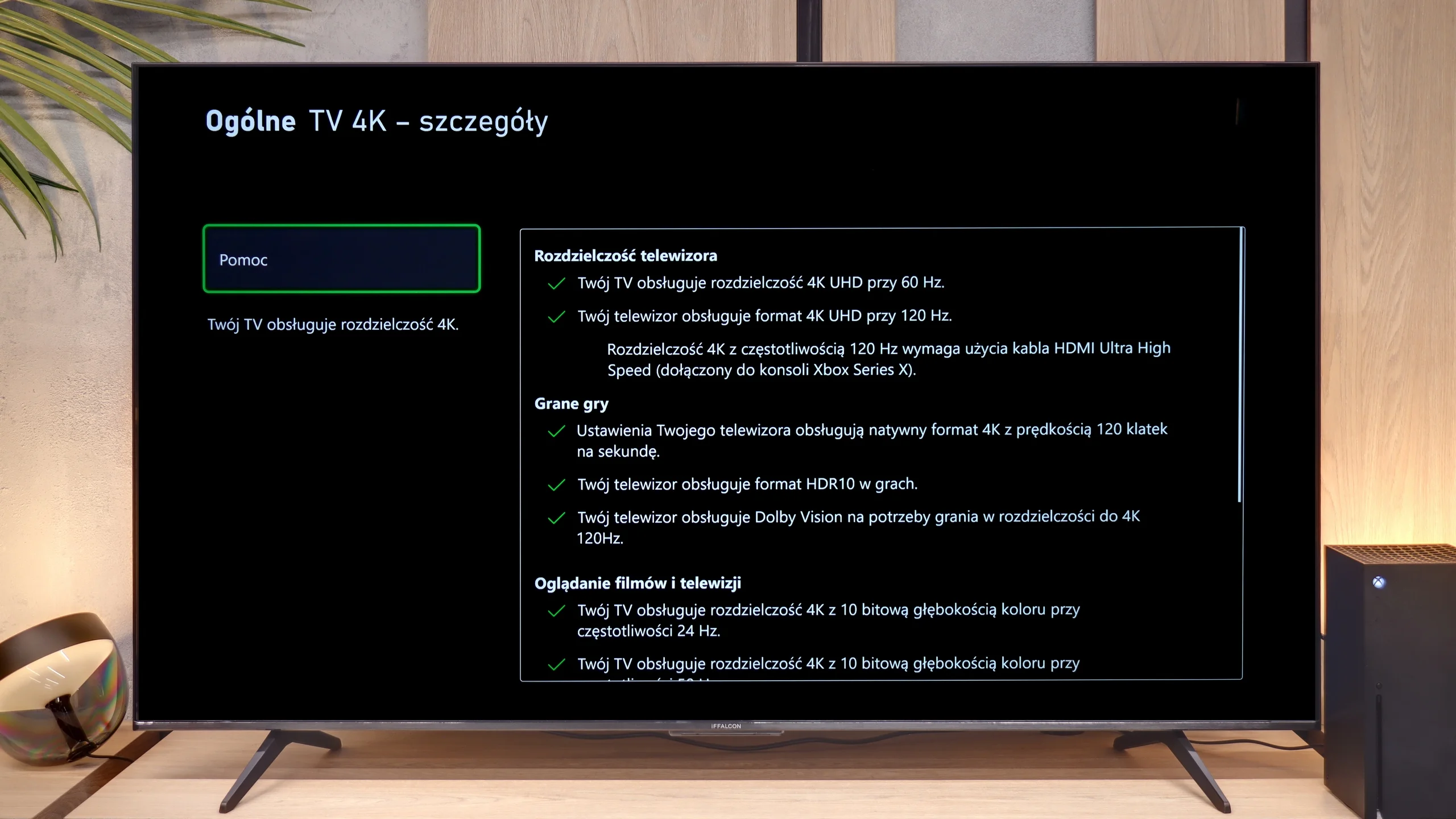
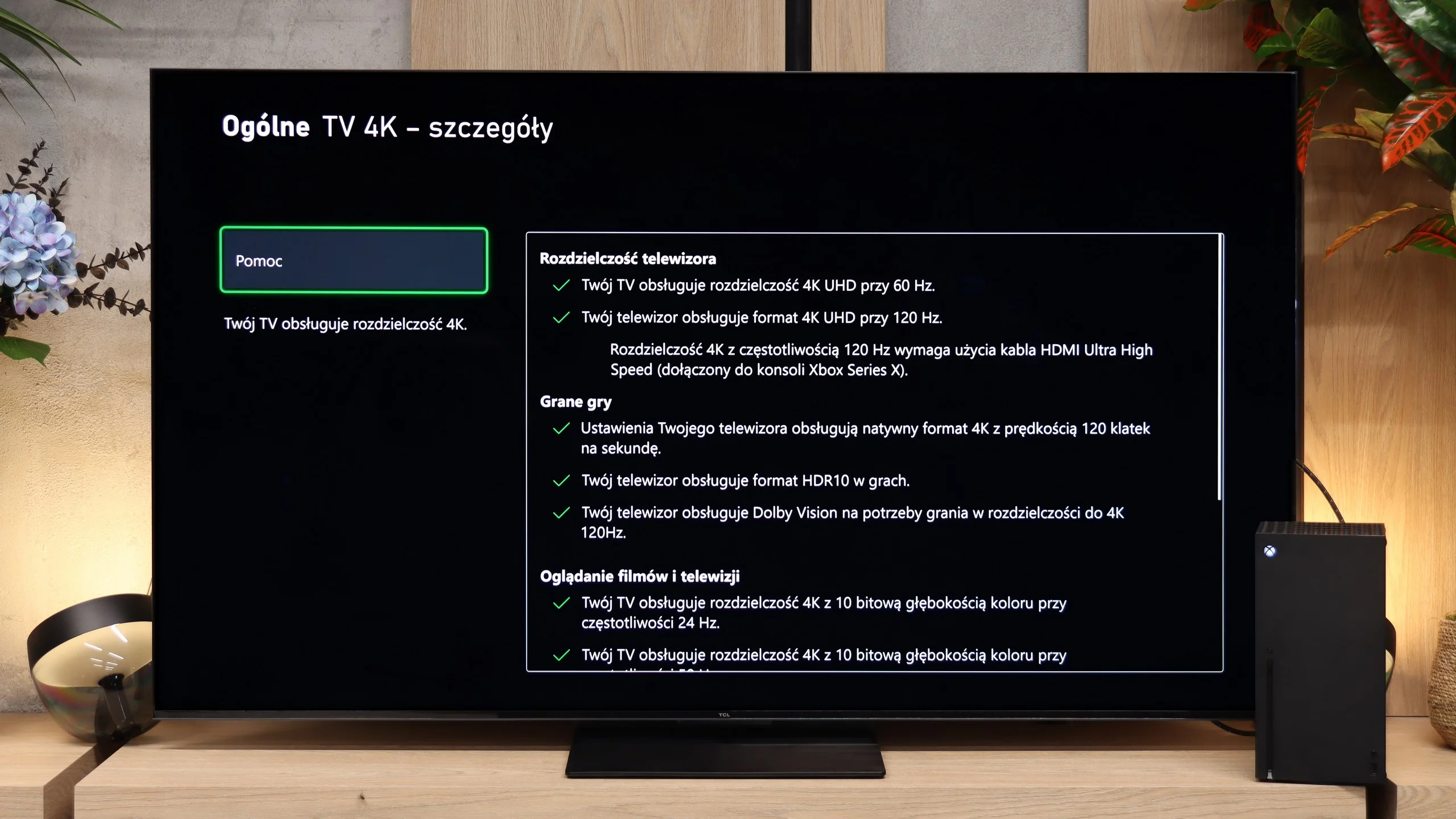
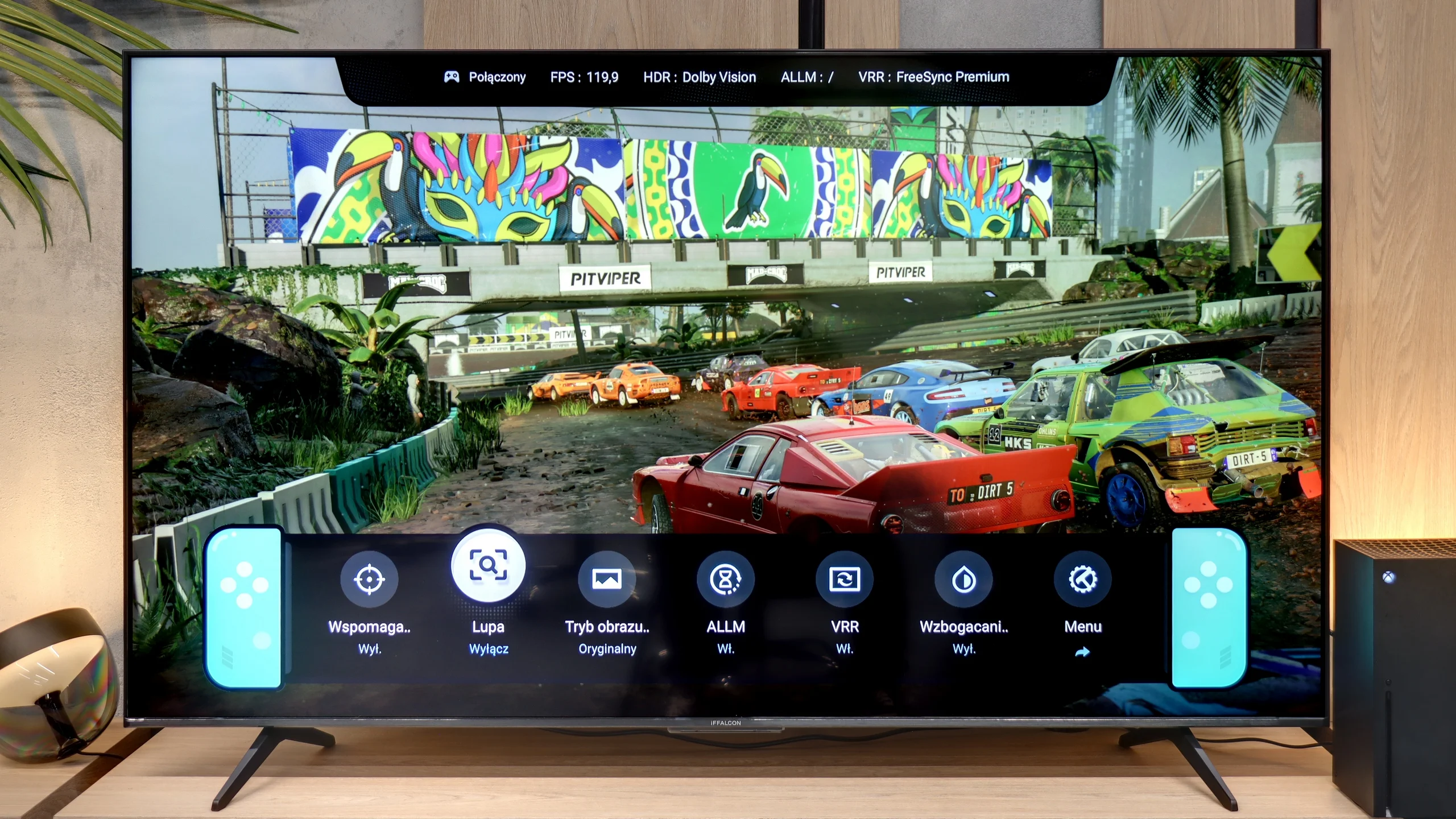
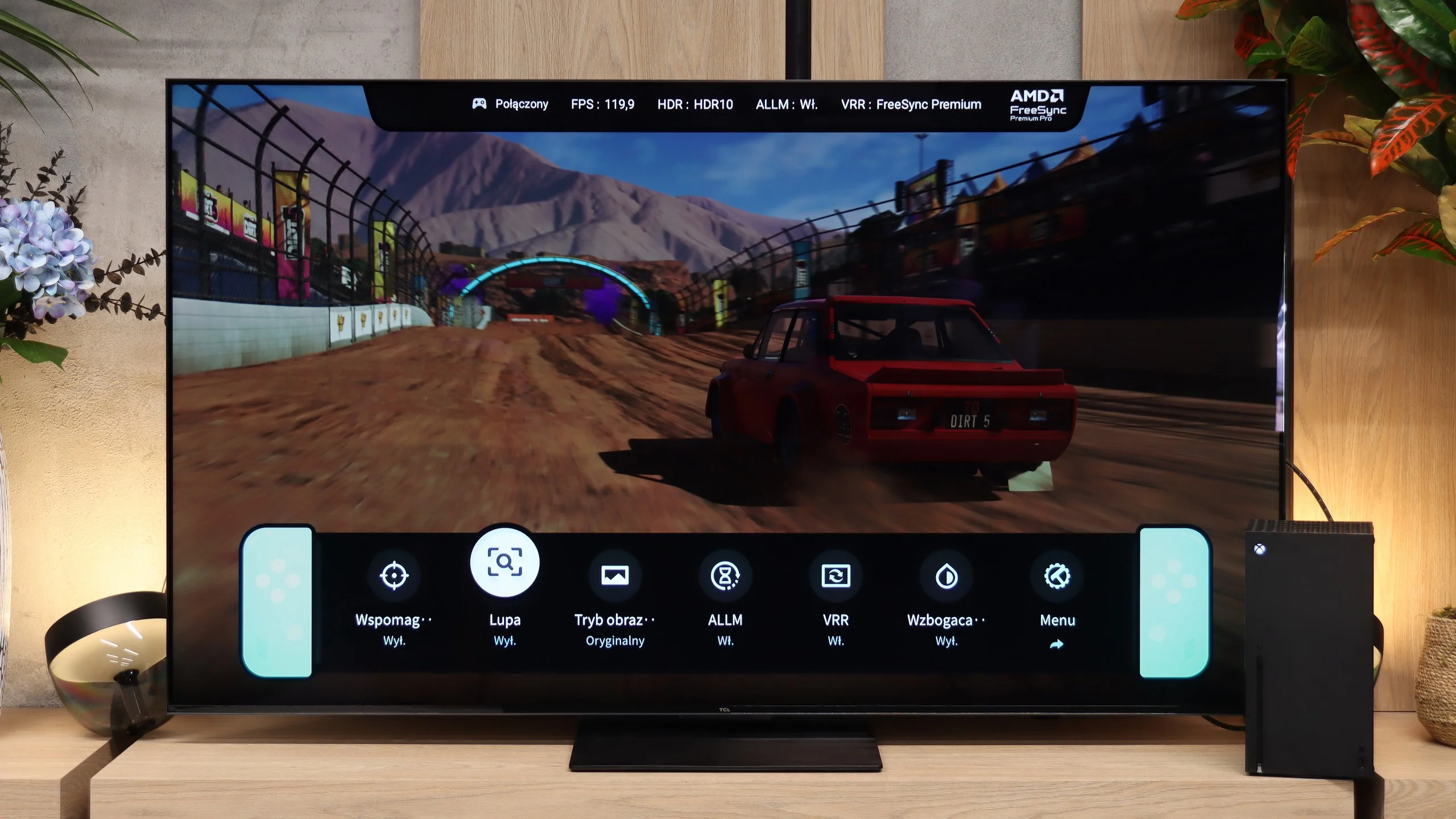
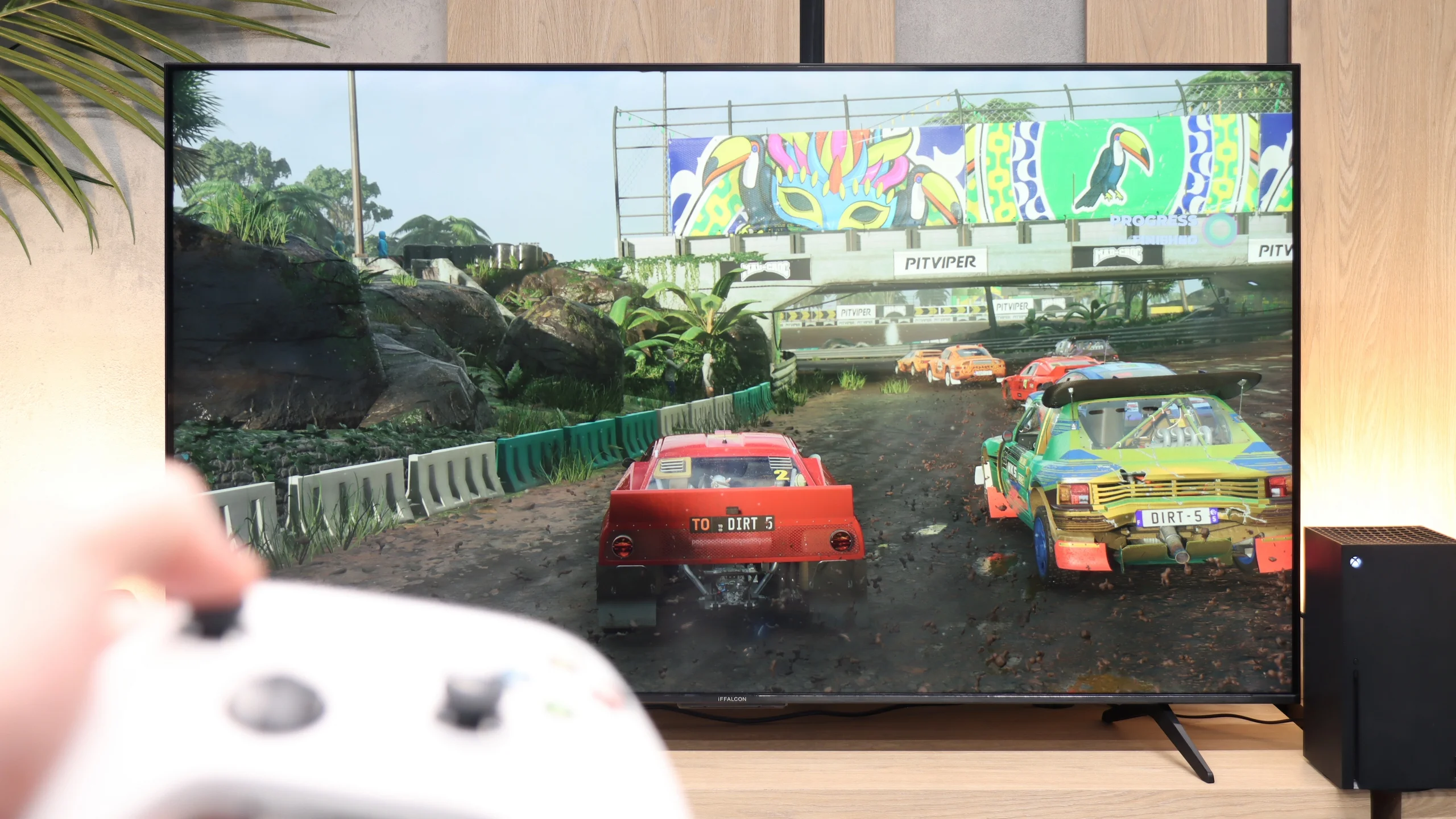
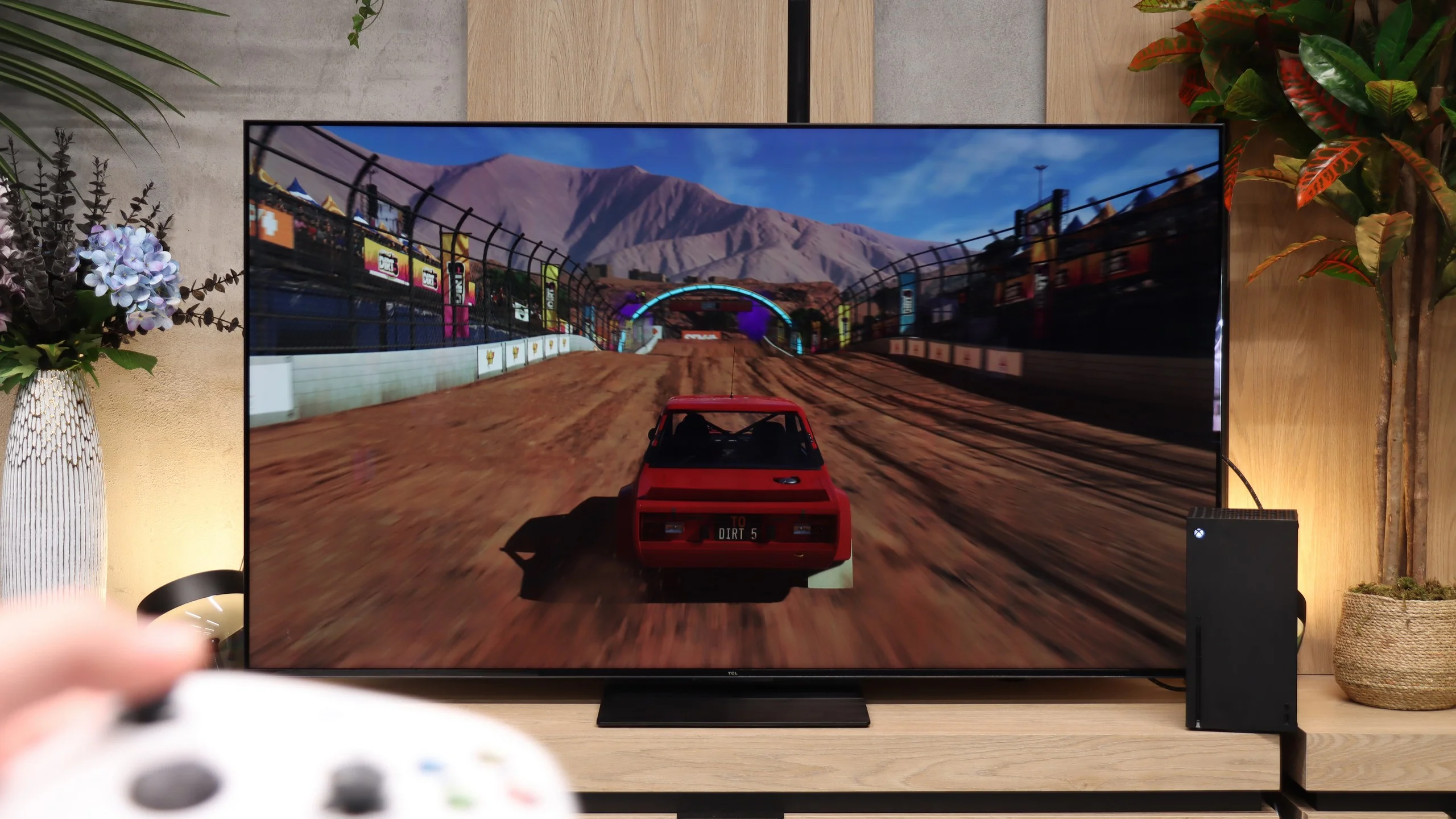
iFFALCON U85X is an exceptional device for gamers that has virtually everything you can expect from a modern screen for consoles or PCs. Here we find two fully-fledged HDMI 2.1 ports with full bandwidth of 48 Gbps, which opens the door to key technologies such as VRR and ALLM, ensuring smooth gameplay without tearing and with minimal latency. The TV handles high refresh rates at various resolutions without any problem, and a real curiosity is the mode that allows for up to 240Hz when dropping to Full HD quality. The entire system is managed by the Game Bar (a faithful copy from TCL), which allows for instant switching of picture modes, customization of the interface appearance, or even adding a virtual crosshair in the middle of the screen.
You can say almost nothing but good things about the RM7L when it comes to gamer features. The TV supports ALLM, VRR, Dolby Vision Gaming and works correctly with HGiG, so it’s hard to point out any major omissions in that area. In practice this means automatic switching to low-latency mode, a smoother picture with variable frame rates, and accurate brightness reproduction in HDR games. There’s also a handy Game Bar. From it you can quickly check the frame rate, VRR status, signal format, and aspect ratio, and change key settings without leaving the game. TCL also added a few extra options, like a crosshair and brightening of dark parts of the image, which can be useful in some titles. The biggest downside comes from the use of the Pentonic 700 processor. Only two of the four HDMI ports support the full HDMI 2.1 standard. With a single console this won’t matter much, but when connecting two consoles and a PC you may run out of space. Especially since one of those ports may also be needed for eARC and a soundbar.
Input lag
9.8/10
9.9/10
SDR
HDR
Dolby Vision
The completion of the gaming arsenal is the remarkable latency results that we measured in our tests. With a standard 60Hz signal, the input lag is only 17 ms, which is a completely safe value for comfortable gameplay, while switching to 120Hz reduces the latency to an impressive 9 ms. A nice fact is that these excellent parameters do not deteriorate even in Dolby Vision mode. In many televisions, activating this format still comes with additional processor overhead and increased lag, but here the engineers at TCL (or iFFALCON) did a great job.
Input lag in the RM7L is low. With a 120 Hz signal it falls below 10 ms, and at 60 Hz it’s just under 15 ms. In practice the response to inputs is instantaneous, and even the lower figures associated with OLEDs don’t give a clear advantage here. Dolby Vision Gaming also performs well. Input lag remains at the same level in this mode as in the other gaming modes, which still isn’t standard on every TV.
Compatibility with PC
8.6/10
8.4/10
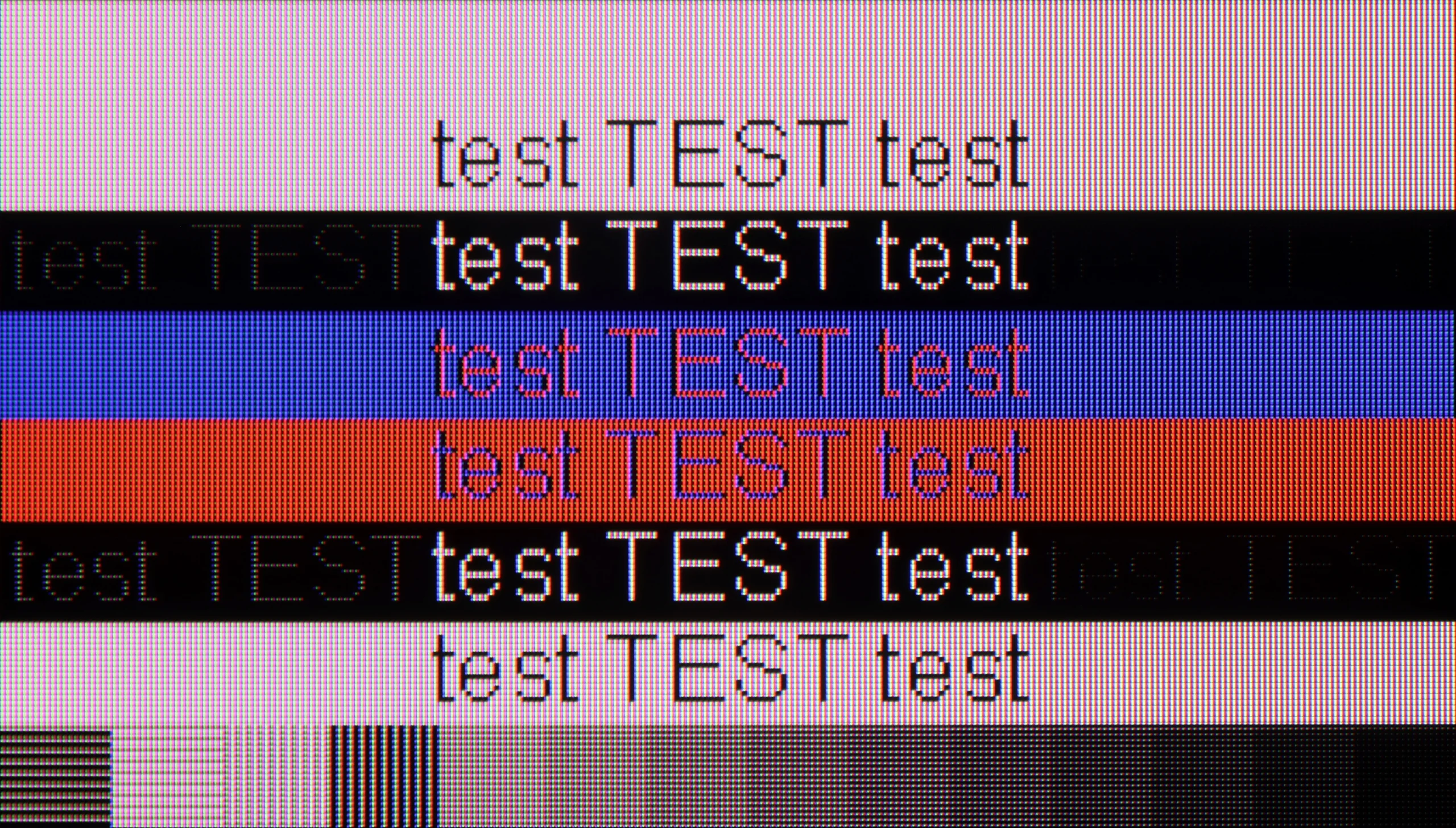
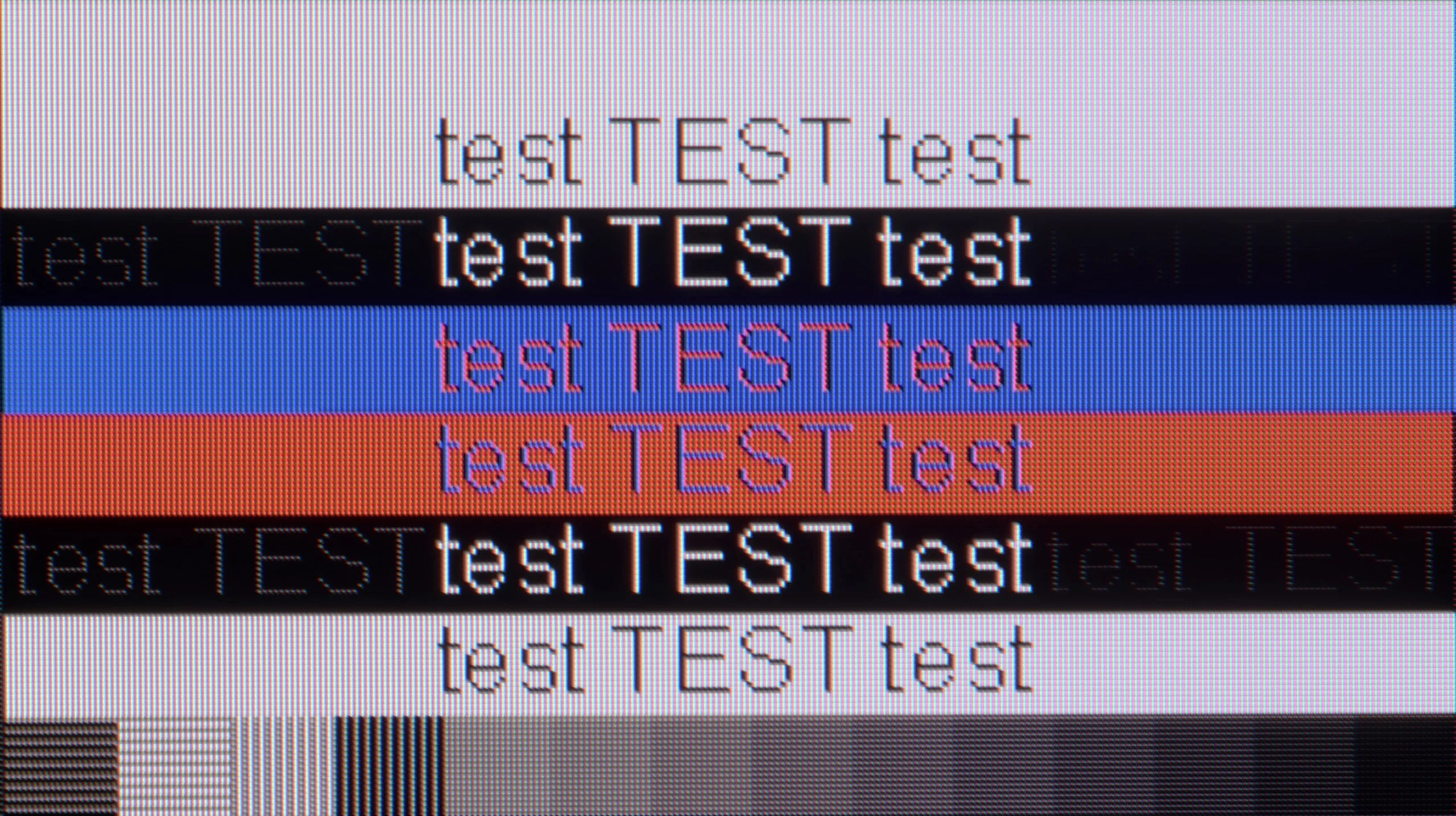
The photo shows the legibility of small fonts. Ideally, lines should be the same thickness on both light and dark text, with minimal pixel gaps.
iFFALCON U85X is also a great candidate for a powerful computer monitor, offering a work culture that is hard to find in typical televisions. The readability of the fonts is at almost an exemplary level – although due to the specifics of the VA panel, it is not as crystal clear as in IPS panels, the difference becomes practically undetectable to the human eye when maintaining a distance of over one meter. The device natively supports a resolution of 4K at 144Hz refresh rate, but the real ace up its sleeve is the 240Hz mode (available at lower resolutions), which makes this giant an excellent tool for fast-paced esports titles, where refresh rate takes priority over pixel count. What is almost most important for PC users, such high performance is fully supported by frame synchronization technologies such as NVIDIA G-Sync and AMD FreeSync, which effectively eliminates screen tearing and ensures perfect smoothness regardless of the graphic card in use.
The RM7L works very well with a PC, especially when you see it as a gaming display. The TV supports 4K at 144 Hz, and lowering the resolution to Full HD can increase the refresh rate to as much as 288 Hz. It also supports G-Sync and FreeSync, so there's little to complain about in terms of smoothness. Working with text is a bit less good. At the maximum refresh rate, letters viewed from very close aren't perfectly sharp and you can notice a faint shadow behind them. Switching to 120 Hz improves the situation, though they still aren't perfect. However, it's hard to call this a major flaw, since the RM7L's available sizes mean it likely won't sit on a desk as a monitor for document work.
Viewing angles
3.1/10
4.5/10
In terms of viewing angles, the iFFALCON U85X does not offer any surprises – it is simply poor, which is a typical characteristic of VA matrix screens. We must treat this as a natural and conscious compromise: when choosing a panel with high contrast and deep blacks, we almost always sacrifice wide viewing angles (only in top-end series do manufacturers use special coatings to improve this feature). The laws of physics in this price segment cannot be deceived, because while sitting directly in front of the television, the picture looks stunning, it only takes a slight lean to the side for the colors to start losing their saturation. If you plan on evening screenings with a larger group, it's a good idea to ensure that everyone sits as close to the central axis of the screen as possible.
Viewing angles on the RM7L are quite good and among the better ones you’ll find in TVs with VA panels. Even when viewing the screen from the side, colors don’t shift as much as in many classic designs of this type. In this respect the RM7L can be compared to the better WHVA panels used in higher TCL series, such as the C8L or X11L. There is, however, one clear drawback. As the viewing angle increases, brightness falls off very quickly. Colors and the overall character of the image remain relatively intact, but the screen itself becomes noticeably darker. At very large off-axis angles the difference is already large enough that the picture can simply look too dim. For that reason the RM7L is best watched as close to the center of the screen as possible.
Daytime performance
5.6/10
7.8/10
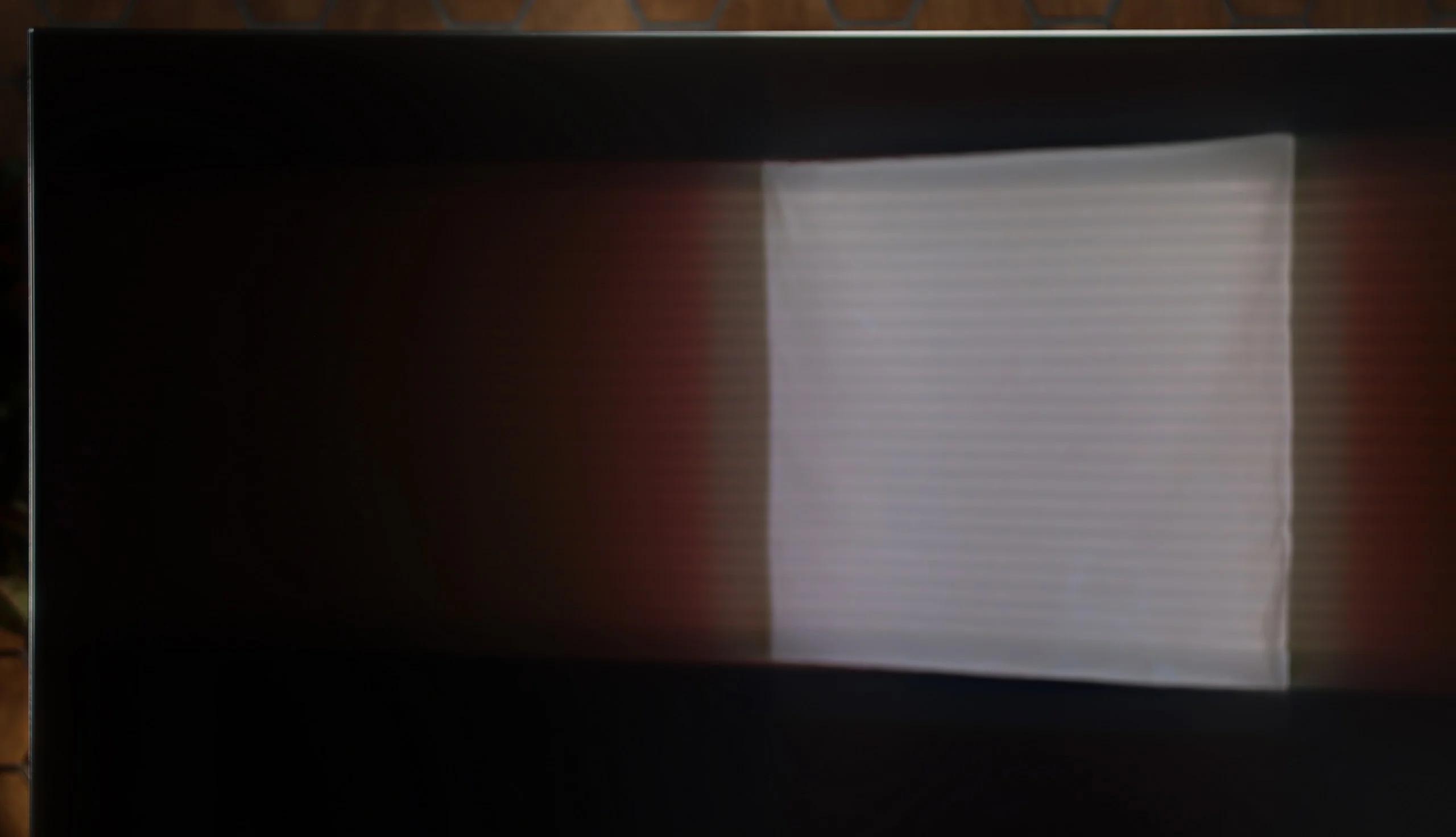
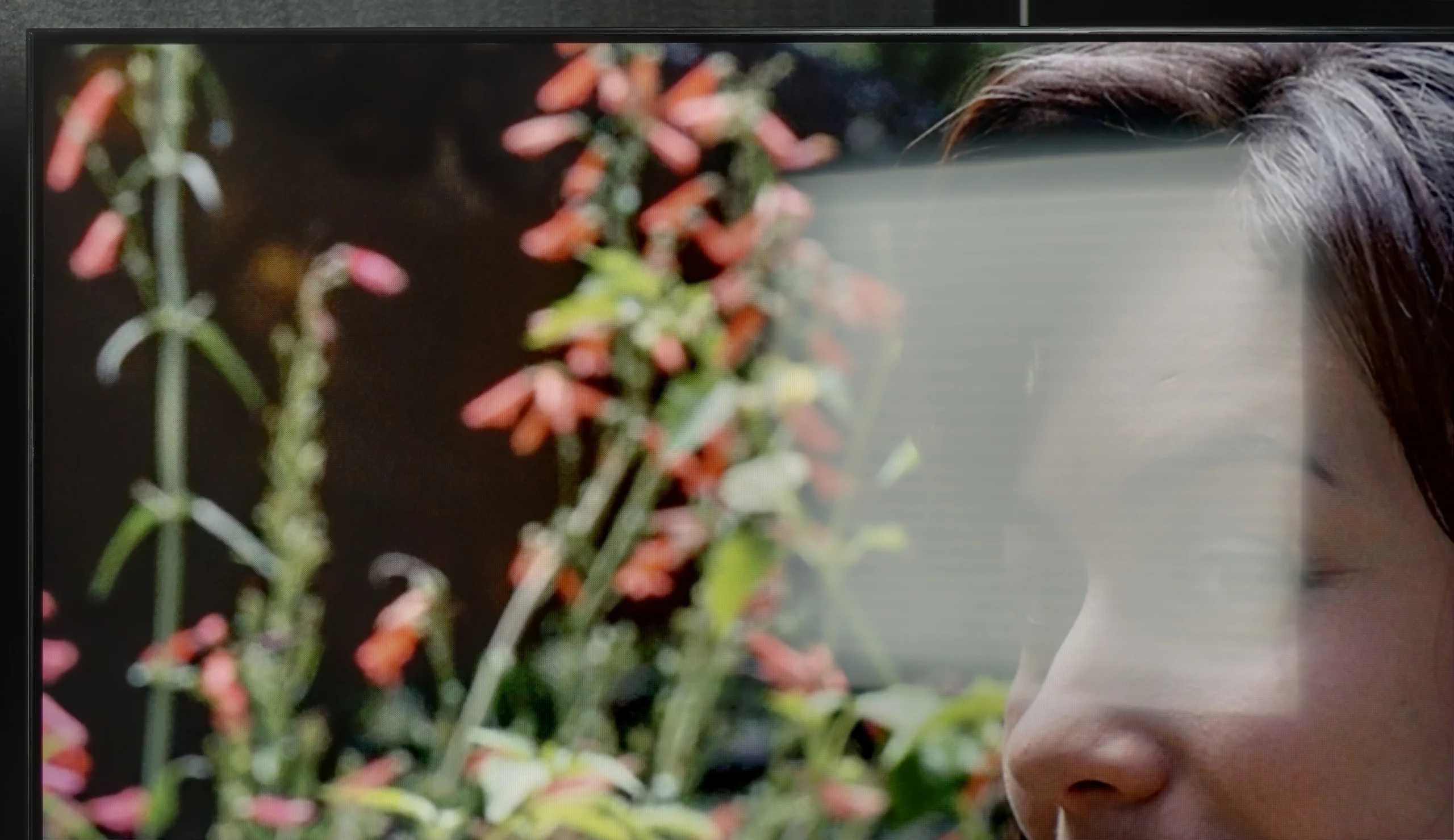
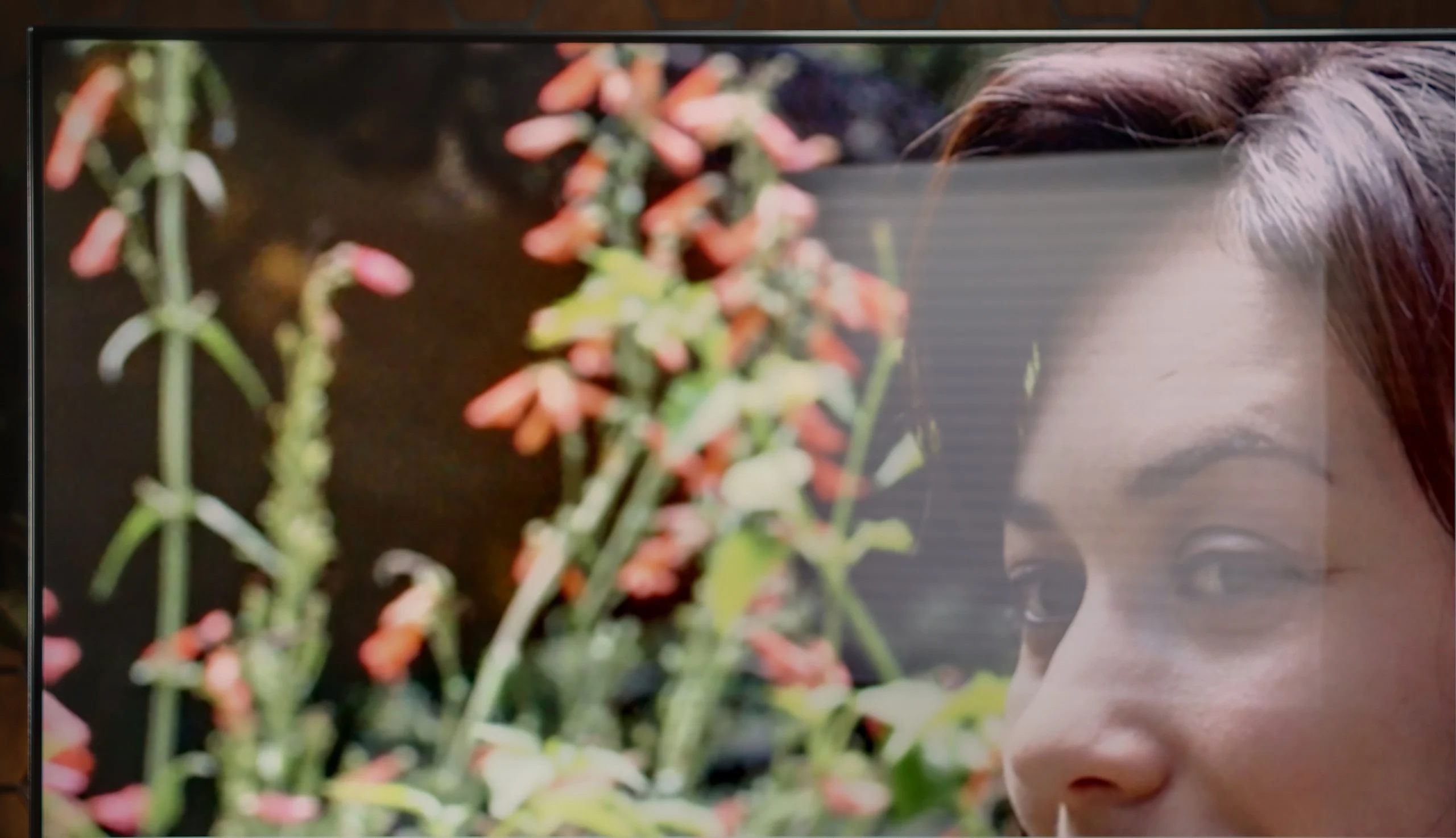
Panel brightness
TCL RM7L: 959 cd/m2
IFFALCON U85X: 419 cd/m2
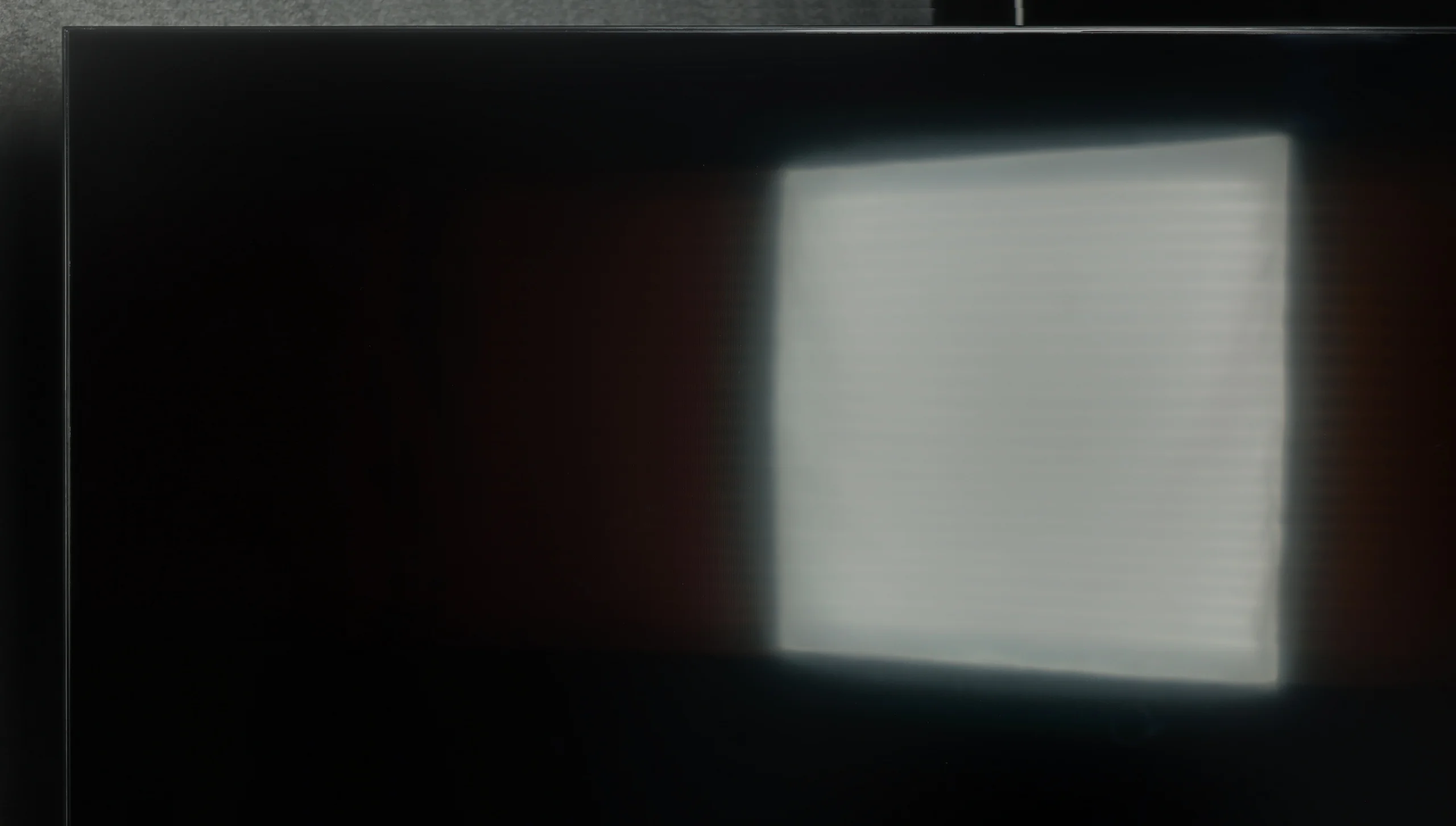
In a bright room, the iFFALCON U85X performs reasonably well, thanks to the satin coating used on the panel. It adequately dampens direct light reflections, allowing us to avoid the irritating mirror effect, although under stronger lighting, one can notice the characteristic warm "spills" of light around the reflecting objects. While it is not on par with top-tier panels featuring the most advanced filters, the absence of high gloss makes daytime use much less burdensome. In terms of pure brightness in SDR standard, that is for television, the TV achieves an average brightness level of around 420 nits. This is not an outstanding result that would allow it to compete with direct sunlight hitting the screen, but it is perfectly sufficient for comfortable viewing in a moderately sunny living room.
RM7L should perform well in a bright living room, mainly thanks to its high SDR brightness. With everyday content the TV averages around 1000 nits, so it easily cuts through ambient light entering the room and keeps a readable picture during the day. A weak point is the panel's glossy coating. Direct reflections are quite noticeable on it, and stronger light sources can also spread across the screen surface. For that reason it's best not to place the TV directly opposite a window or a lamp. With proper placement, however, the RM7L will still be a very good choice for a heavily sunlit room.
Panel details
Subpixel Structure:
Panel uniformity and thermal imaging:


IFFALCON U85X
TCL RM7L
TV features
7.6/10
7.8/10
- SystemGoogle TVGoogle TV
- System performanceDecentGood
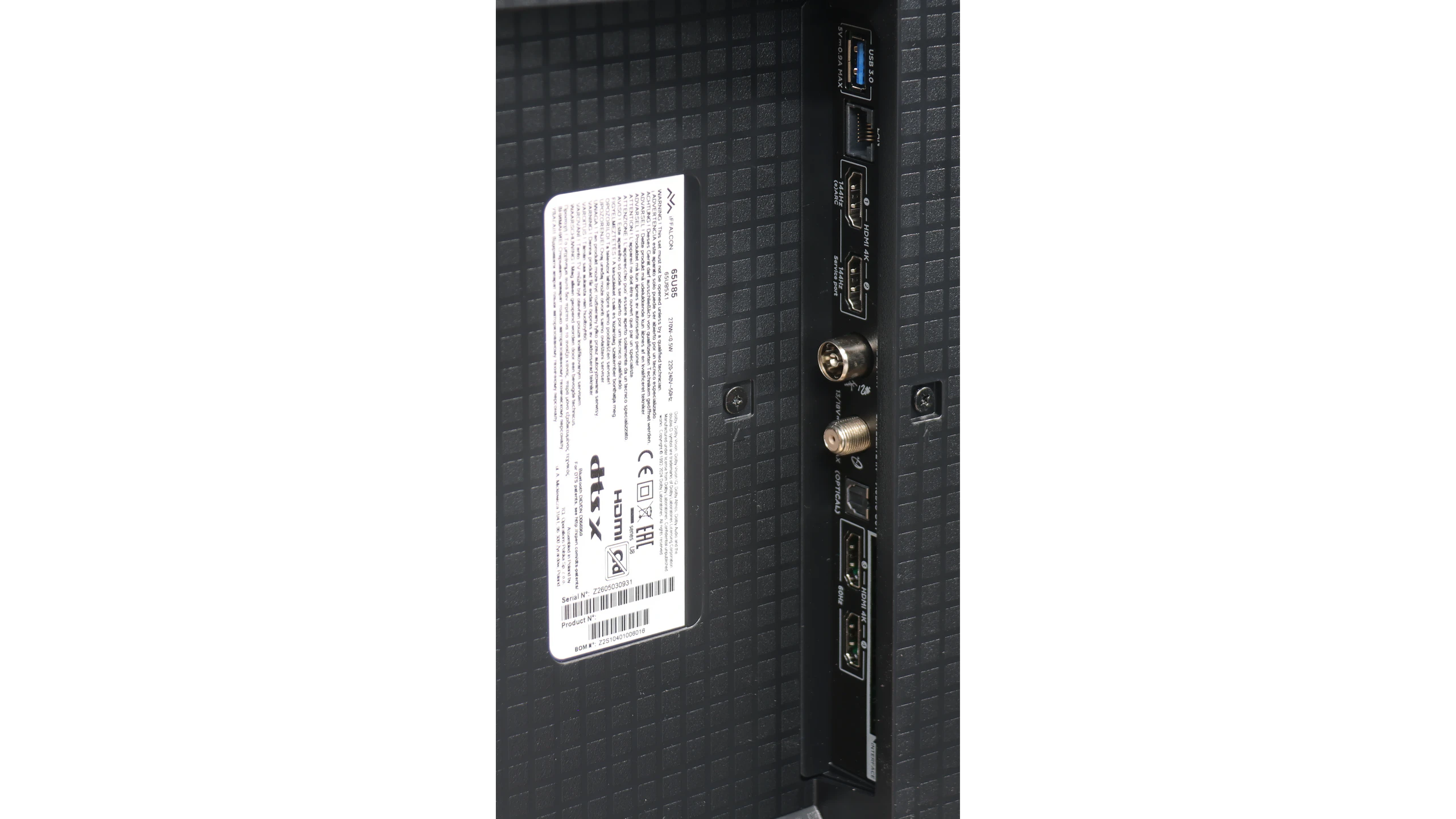
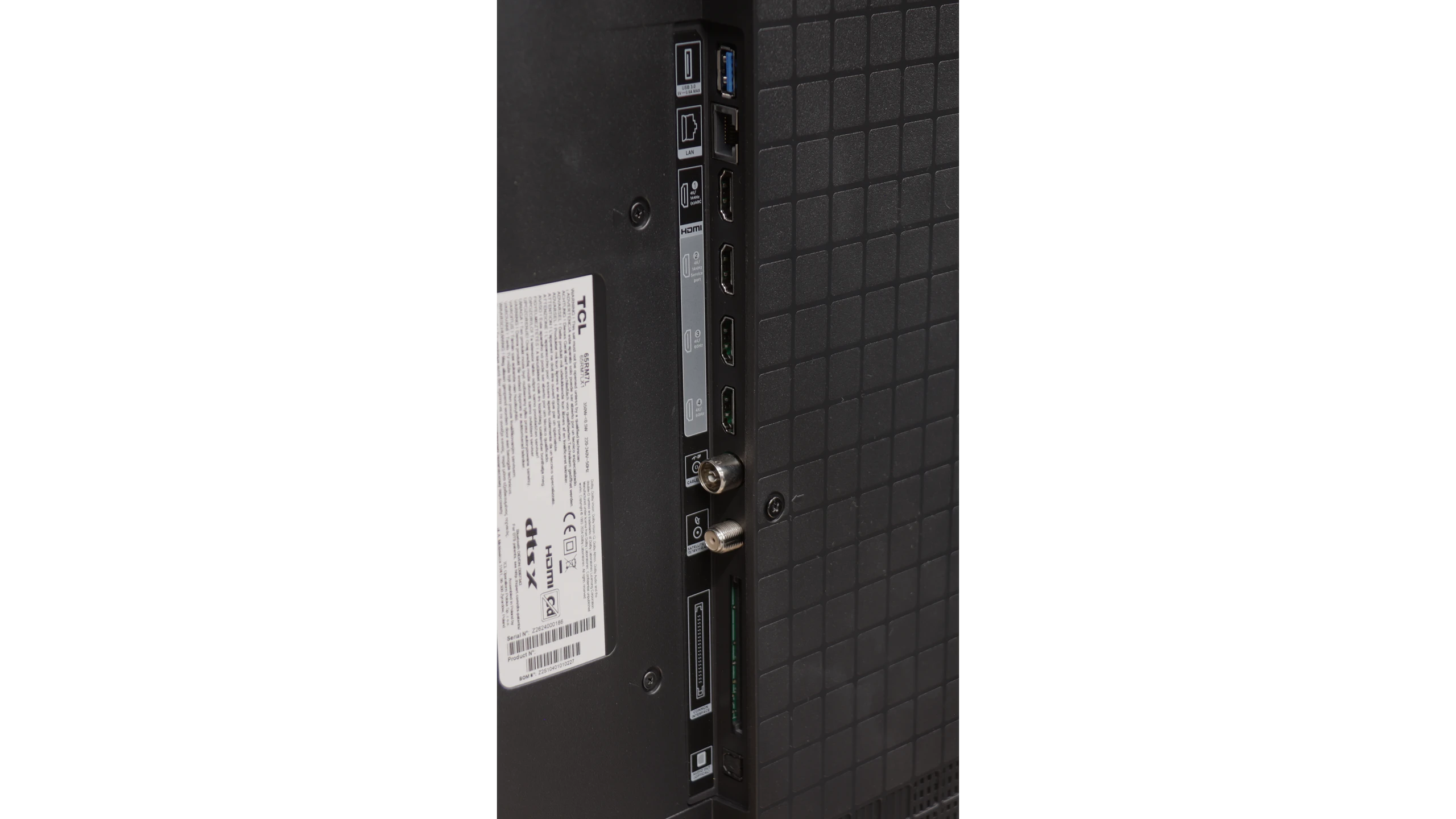
- HDMI inputs2 x HDMI 2.0, 2 x HDMI 2.1 48Gbps2 x HDMI 2.0, 2 x HDMI 2.1 48Gbps
- OutputsToslink (Optical audio), eARC (HDMI)Toslink (Optical audio), eARC (HDMI), ARC (HDMI)
- Network InterfacesWi-Fi 2.4GHz, Wi-Fi 5GHz, Ethernet (LAN) 100MbpsWi-Fi 2.4GHz, Wi-Fi 5GHz, Ethernet (LAN) 100Mbps
- TV receptionDVB-T, DVB-T2, DVB-S, DVB-S2, DVB-CDVB-T, DVB-T2, DVB-S, DVB-S2, DVB-C
Classic features:
- Recording to USB (terrestrial TV)

- Recording programming
- Picture in Picture (PiP)
- RF remote control (no need to aim)
- Backlit remote control
- Teletext
- Audio only mode
- Bluetooth headphones support
- Simultaneous Bluetooth headphones & TV audio
Smart features:
- AirPlay
- Screen mirroring (Windows Miracast)
- Voice search
- Voice search in native language
- Ability to connect a keyboard and mouse
Sound connection options
- HDMI audioeARC (HDMI)eARC (HDMI), ARC (HDMI)
- Other audio outputsToslink (Optical audio)Toslink (Optical audio)
- Wireless audioBluetoothBluetooth
Supported audio formats (external HDMI eARC audio):
- Dolby Digital Plus 7.1
- Dolby True HD 7.1
- Dolby Atmos in Dolby Digital Plus (JOC)
- Dolby Atmos in Dolby True HD
- DTS:X in DTS-HD MA
- DTS-HD Master Audio
Senior accessibility
- Numeric keyboard on TV
- Font size adjustment
- Audio description
Smart Features
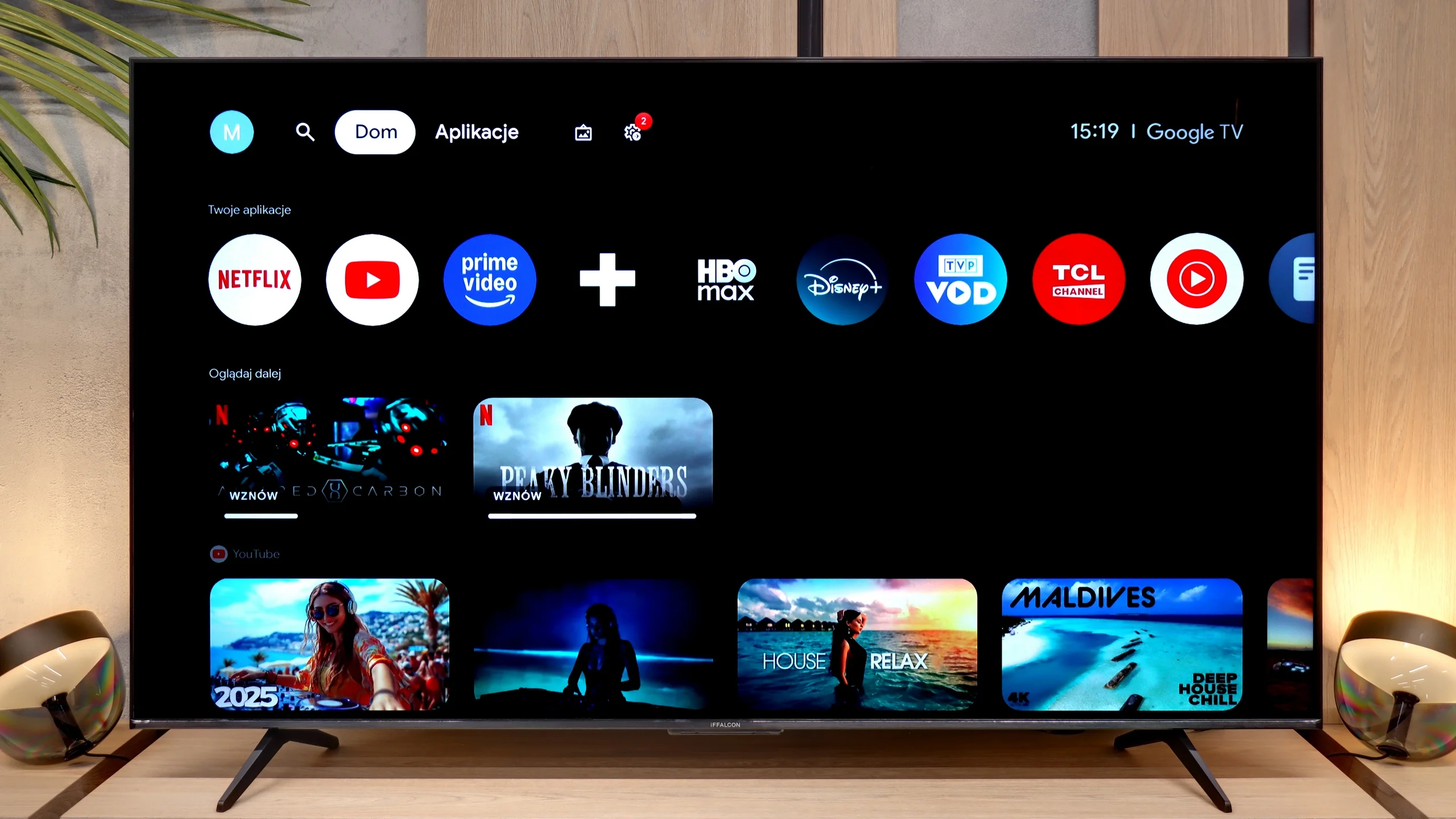
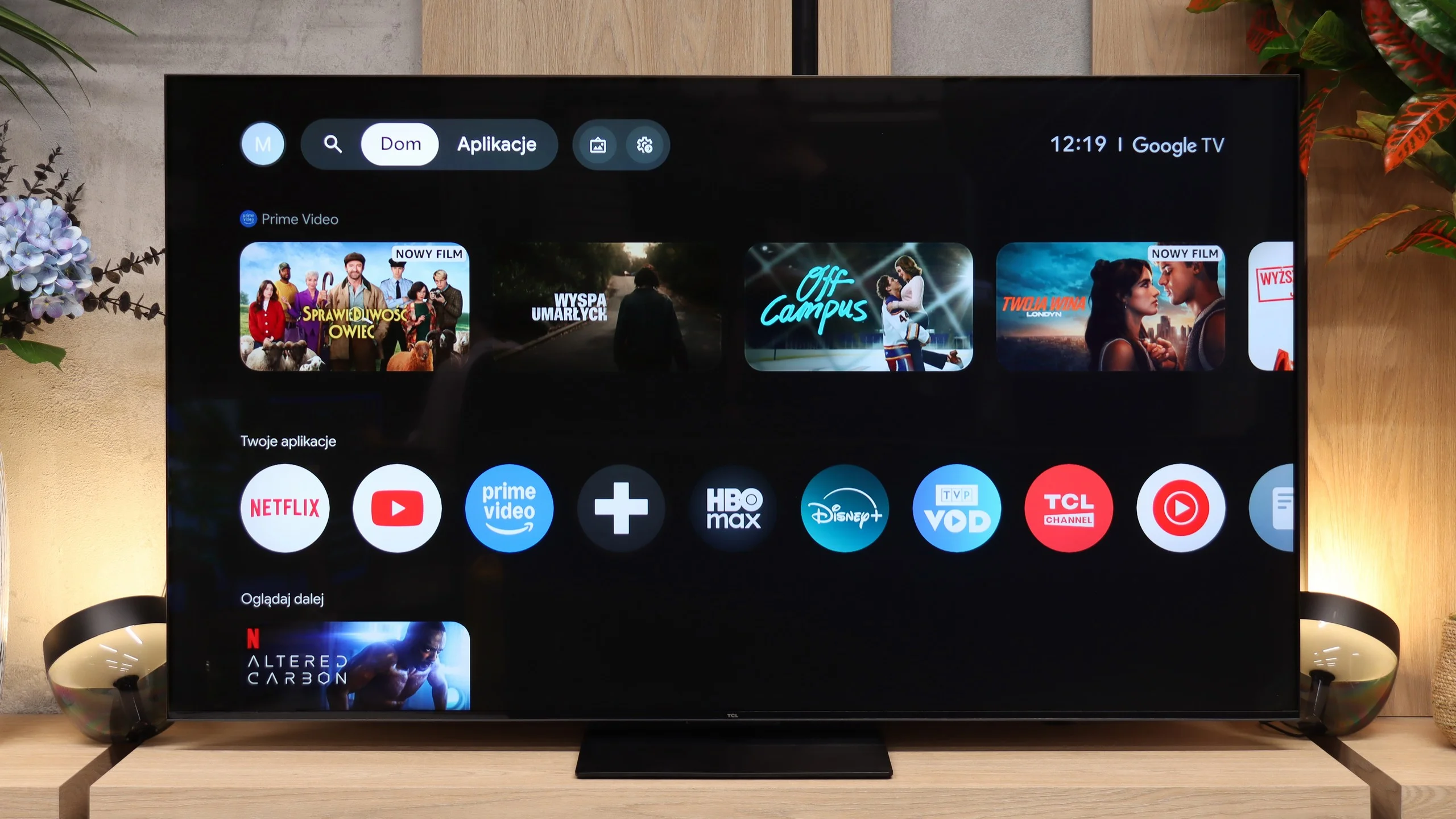
Like products from TCL, the iFFALCON U85X benefits from the Google TV system. This means access to an almost unlimited library of applications, from the most popular VOD services to niche tools, as well as full integration with Google and Gemini voice assistants. Apple ecosystem users are also not left out – the television easily works with their devices thanks to the built-in AirPlay feature. The system itself operates quite smoothly, although it's undeniable that it inherits some issues known from TCL models. The interface can sometimes "catch its breath" and needs a moment to think, and Polish translations in the deeper corners of the menu can be quite strange and occasionally illogical.
Classic Features
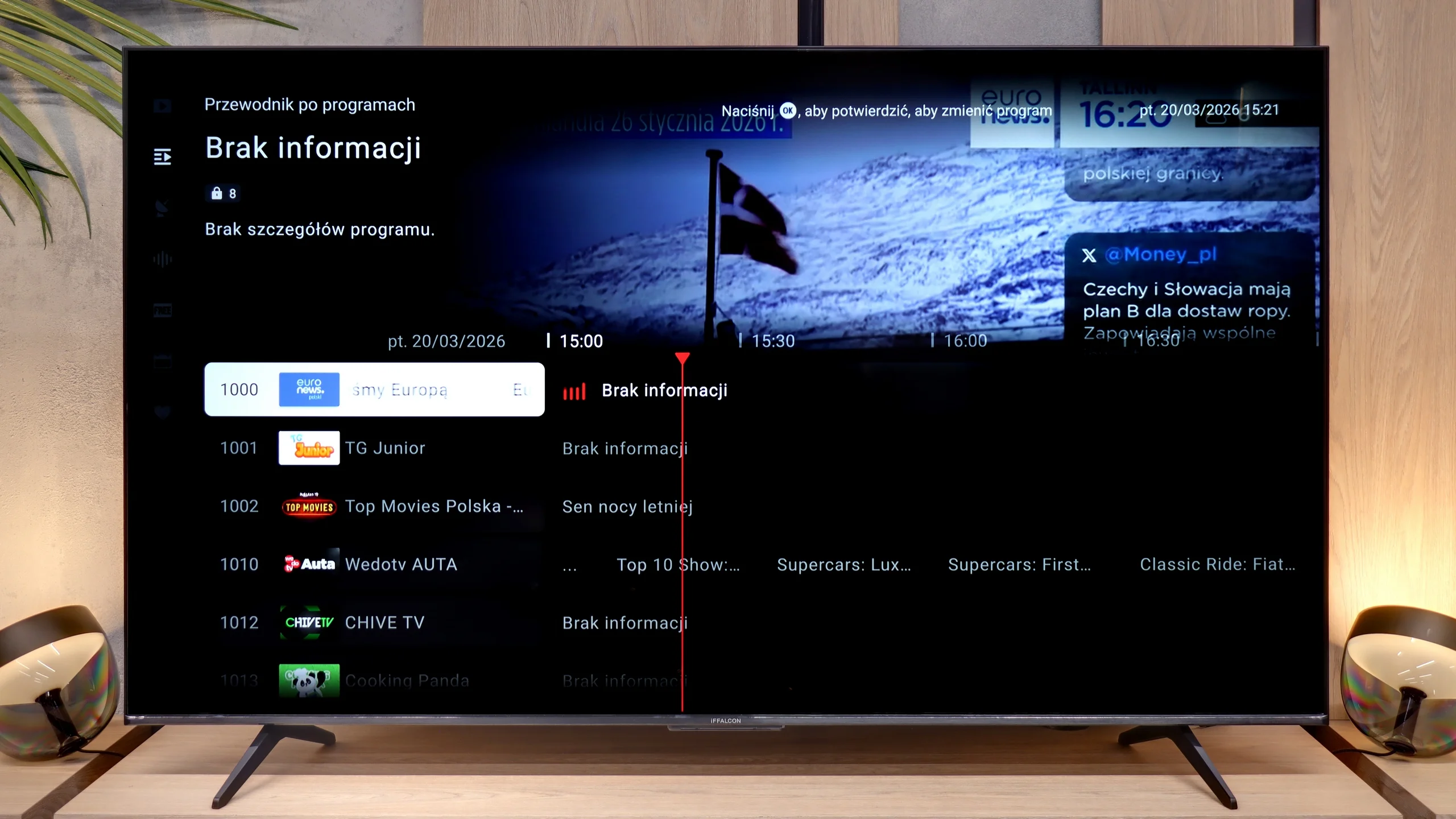
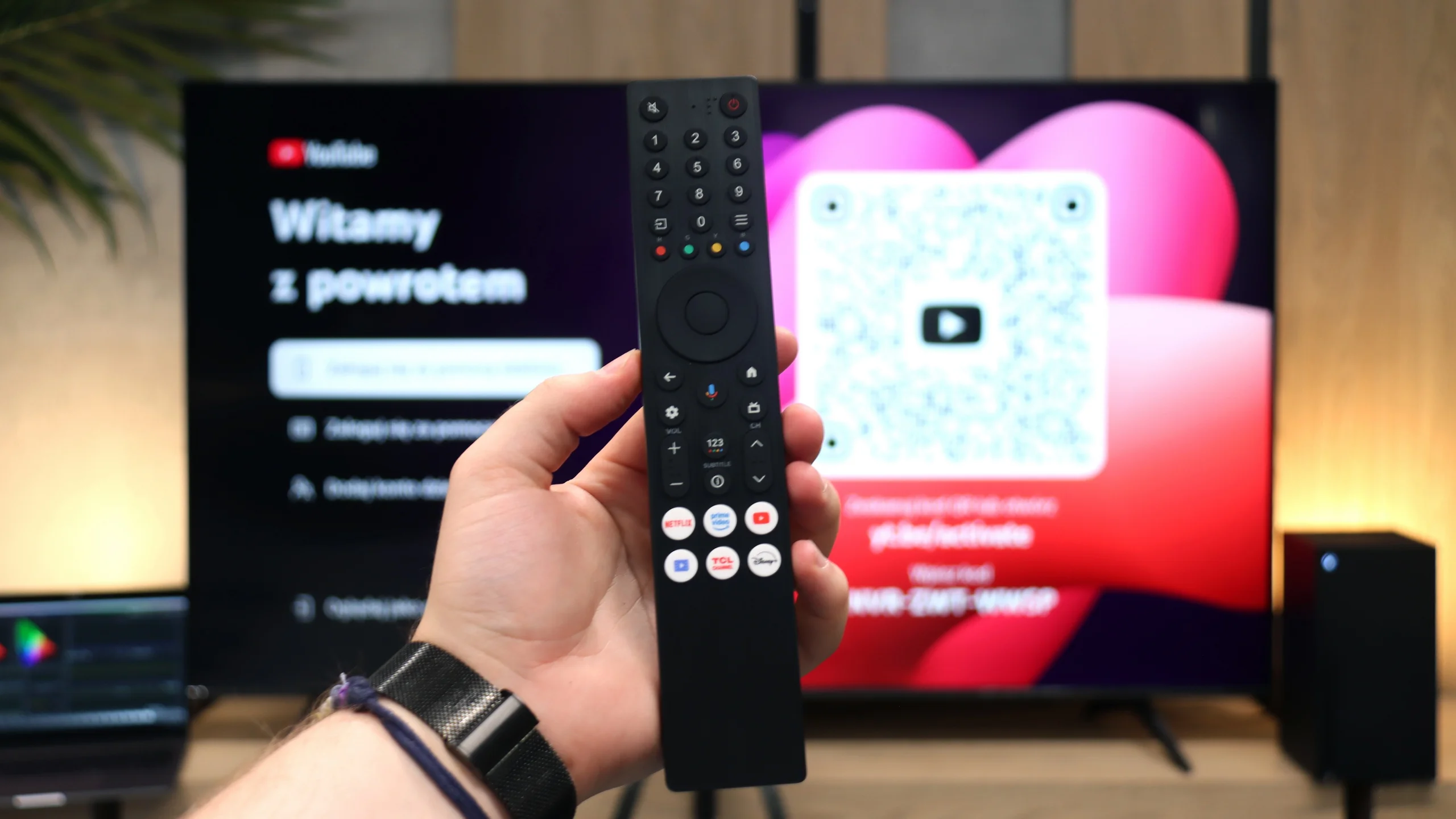
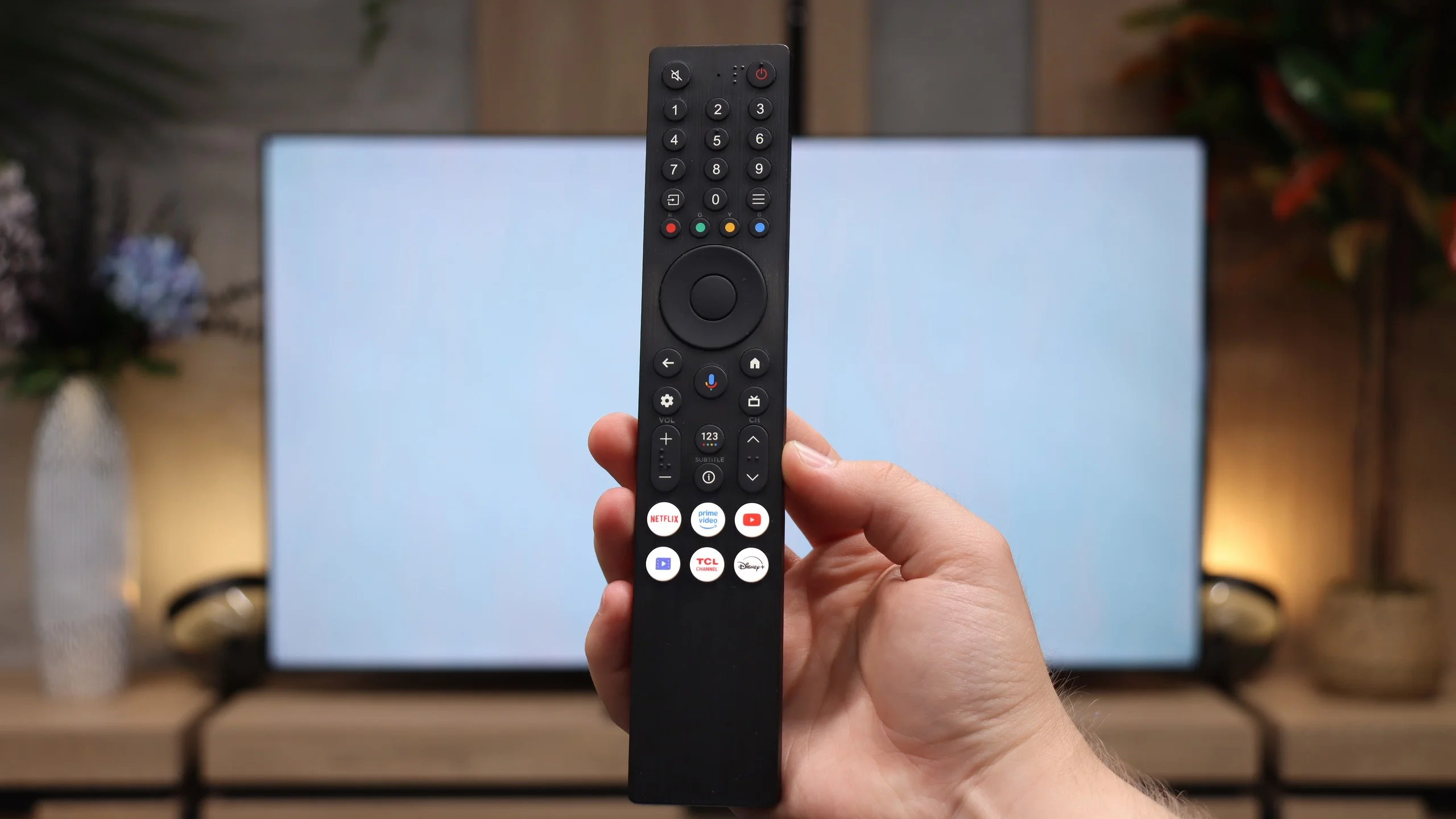
In terms of traditional television functions, the iFFALCON U85X does not strive for any extravagance and offers the absolute minimum, which may be somewhat disappointing for more demanding users of traditional cable or satellite. It’s futile to look for features like recording programs to external USB memory or picture-in-picture (PiP) mode, which would allow following two sources simultaneously. From the more "modern" classics, we only get the ability to wirelessly connect headphones via Bluetooth and teletext support. The remote control also does not pretend to be a modern gadget from the future; it’s a classic design with a full numeric keypad that makes it easier to jump quickly between channels, but visually it strongly diverges from minimalist trends.
Smart TV features
The RM7L runs on Google TV, and that's great news because it's one of the most polished systems on the market today. The store has pretty much everything: from major streaming platforms to lesser-known apps, so you really don't have to worry about a lack of content. On board we also have the classics, Chromecast and AirPlay, which let you easily cast your phone's screen to the big display. An interesting change is the replacement of the previous Google Assistant with Gemini. The new "artificial brain" better understands natural speech and can respond to questions much more sensibly. Everything runs smoothly and delivers exactly what we expect from a TV today.
Traditional TV
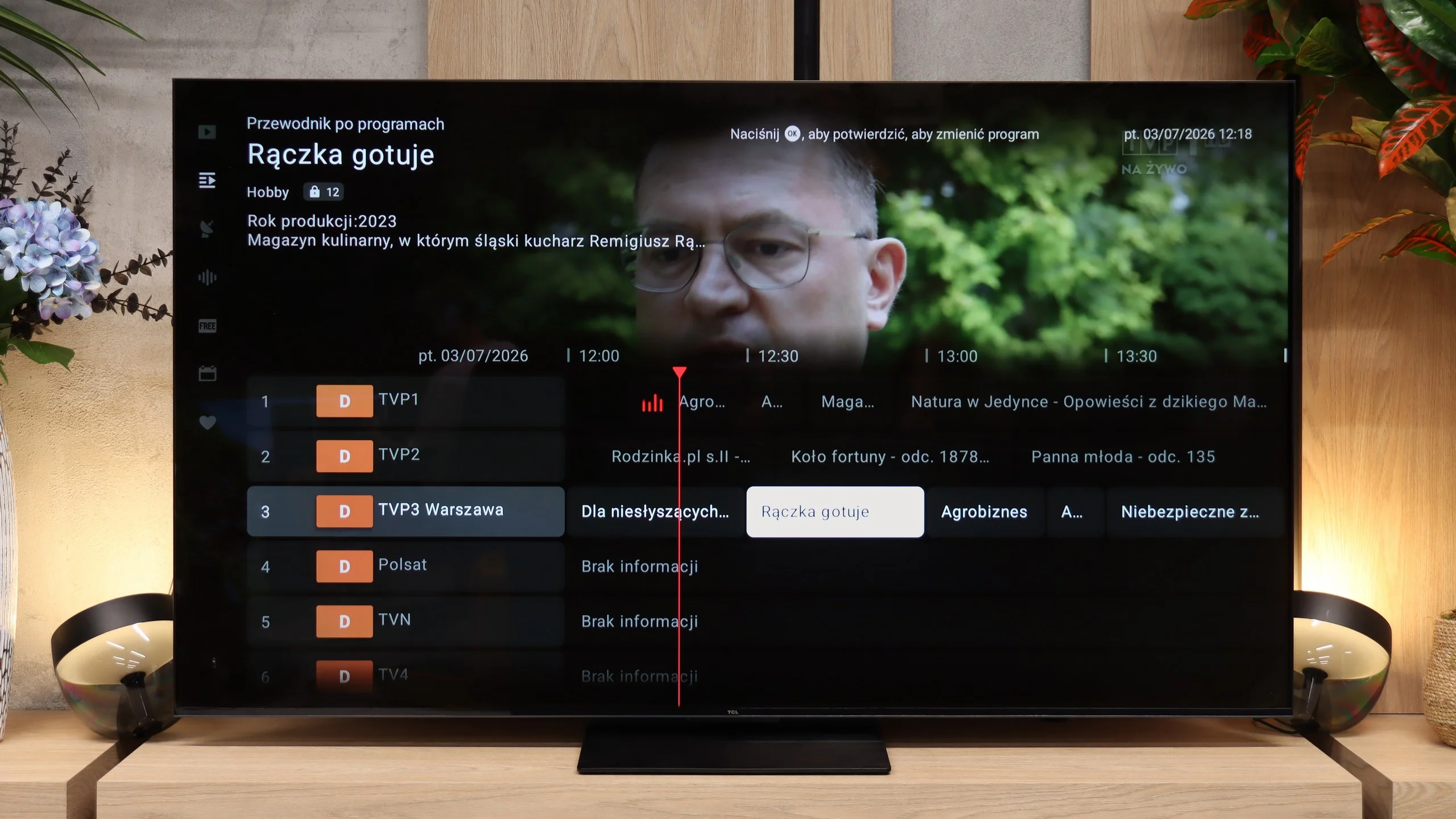
If someone prefers channel surfing to streaming, they'll be pleased by the inclusion of a traditional remote. It has a full numeric keypad and plenty of physical buttons, so operating the TV is quite straightforward without having to dig through on-screen menus. When it comes to the TV's features, it's simply solid. The program guide (EPG) and channel switching work flawlessly, although you won't find any extra features like PiP or PVR.
Apps
9.6/10
9.6/10






















Playing files from USB
9.2/10
9.4/10
Supported photo formats:
Maximum photo resolution:
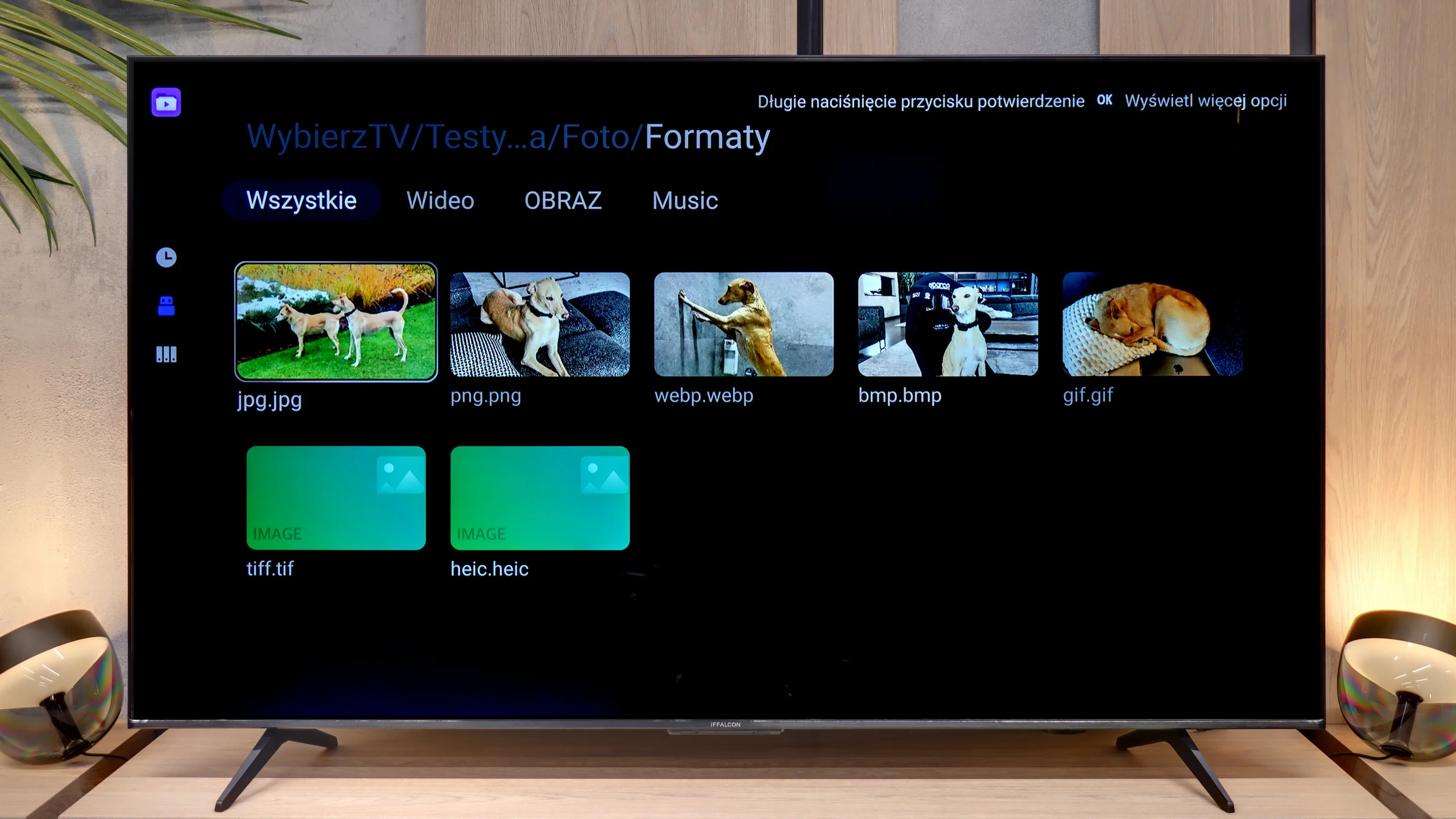
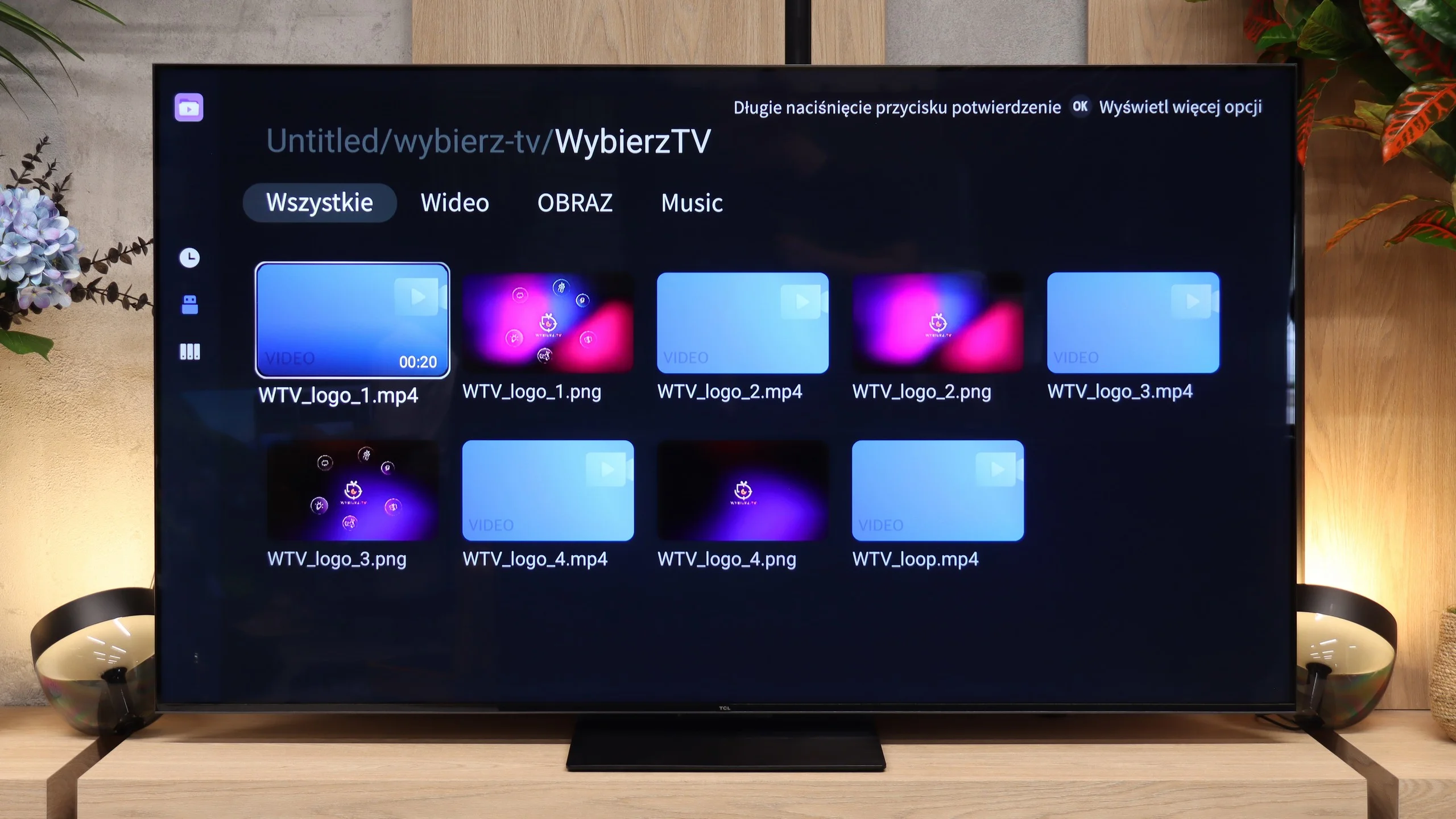
Playing files from a USB drive is no challenge for the iFFALCON U85X – the built-in player handles almost every audio and video format we threw at it during testing without a hitch. The only drawback we could point out is the support for external subtitles; while popular formats like .sub and .srt work flawlessly, the TV can be finicky with .txt files. Fortunately, with the presence of Google TV, this problem can be quickly resolved by installing an external VLC-type application. Still, for most users, the factory tool will probably be more than sufficient to enjoy their own multimedia library without unnecessary hassle.
The RM7L's built-in file player performs very well. The TV had no trouble with most of the test material, whether movies, photos, or music. Shortcomings do occur, of course, but they mostly involve less common formats. In practice, most people will be fine without installing an additional media player.
Sound
6.9/10
7.8/10
- Maximum volume83dB88dB
- Dolby Digital Plus 7.1
- Dolby True HD 7.1
- Dolby Atmos in Dolby Digital Plus (JOC)
- Dolby Atmos in Dolby True HD
- DTS:X in DTS-HD MA
- DTS-HD Master Audio
iFFALCON U85X proves that the absence of the Onkyo or Bang & Olufsen logo on the casing does not have to mean flat and shrill sound. The audio system in this model performs surprisingly well, largely due to the dedicated subwoofer located at the back of the device. Our acoustic measurements confirm that the lower frequencies begin to "respond." It is this discernible "bump" on the graph that accounts for the noticeable dose of bass, which typically provides weight and depth to films and music that are often lacking in televisions. The only criticism one might have is that such bass can overpower the high tones, making them seem a bit muted. Overall, it can deliver sound at a level of up to 83 dBC, which is more than sufficient for amplifying a larger living room.
Unlike the higher C7L, C8L, or X11L series, the RM7L does not include an audio system branded by Bang & Olufsen. TCL went with an Onkyo speaker package supported by "Ultra Bass" technology. The difference is also visible in the build. Instead of metal covers, simpler plastic grilles were used. Does that affect sound quality? In our view, not as much as you might expect. The RM7L simply sounds good, with a slightly different tonal character than the C7L. Dialogues are clean and clear, and the TV can easily fill even a larger living room. The amount of low end is also a plus. For a TV at this level there’s a fair amount of bass and it doesn’t come across as completely flat. Our measurements confirm this. Maximum volume reaches about 88 dB, which is a very good result, and the frequency response remains relatively even. Only above roughly 7–8 kHz is there a more noticeable drop in output, so the top end isn’t as well emphasized. That said, for a TV in this class the RM7L delivers a surprisingly pleasant sound and most users won’t have much to complain about.
Sound Quality Test
Acoustic Measurements
83dBC (Max)
75dBC
88dBC (Max)
75dBC
Reader comments
Comments are provided by the external service Disqus (Zeta Global). Once loaded, Disqus may set cookies and process data about your activity.
We will remember your choice on this device. Provider's privacy policy